
Fat-tire e-bikes are no longer a niche category. In the US market, models with 4.0-inch tires accounted for roughly 18% of e-bike unit sales in 2025, and the segment grows fastest in the Nordic countries, Canada, and the northern US states, markets where snow, sand, and gravel make narrow tires genuinely dangerous. For an OEM buyer, the fat-tire category offers a distinct advantage over commuter e-bikes: lower price competition from generic imports, because the frame, fork, wheels, and fenders all have to be engineered for the wider platform. This guide walks through every specification that matters when sourcing fat-tire e-bikes from a Chinese factory, with the numbers importers need before signing an order.
Why Fat-Tire E-Bikes Sell: Market Signals
The buying trigger for fat-tire models is rarely "I want a fat bike." It is usually one of three use cases: winter commuting (the tire floats on snow instead of sinking), trail and beach recreation, or utility riding on unpaved surfaces. The consequence for OEM product planning is that the same frame must handle dramatically different duty cycles, a 6-month winter in Helsinki versus year-round desert trails in Arizona. Before you choose components, decide which of these three buyers you are building for, because the motor and battery choices diverge significantly.
Price positioning matters too. A well-specced fat-tire e-bike at 750W with a 48V 20Ah battery retails between $1,400 and $2,200 in North America, while a comparable commuter e-bike sits $300 to $500 lower. The premium is justified by heavier components, wider rims, stronger spokes, a sturdier fork, but it also means the buyer expects more torque and range. Fat-tire bikes that feel underpowered get returned; the category's #1 complaint in dealer surveys is insufficient hill-climbing torque on 750W systems with heavy riders.
Tire & Wheel Specs: Sizing, Compound, and Tread
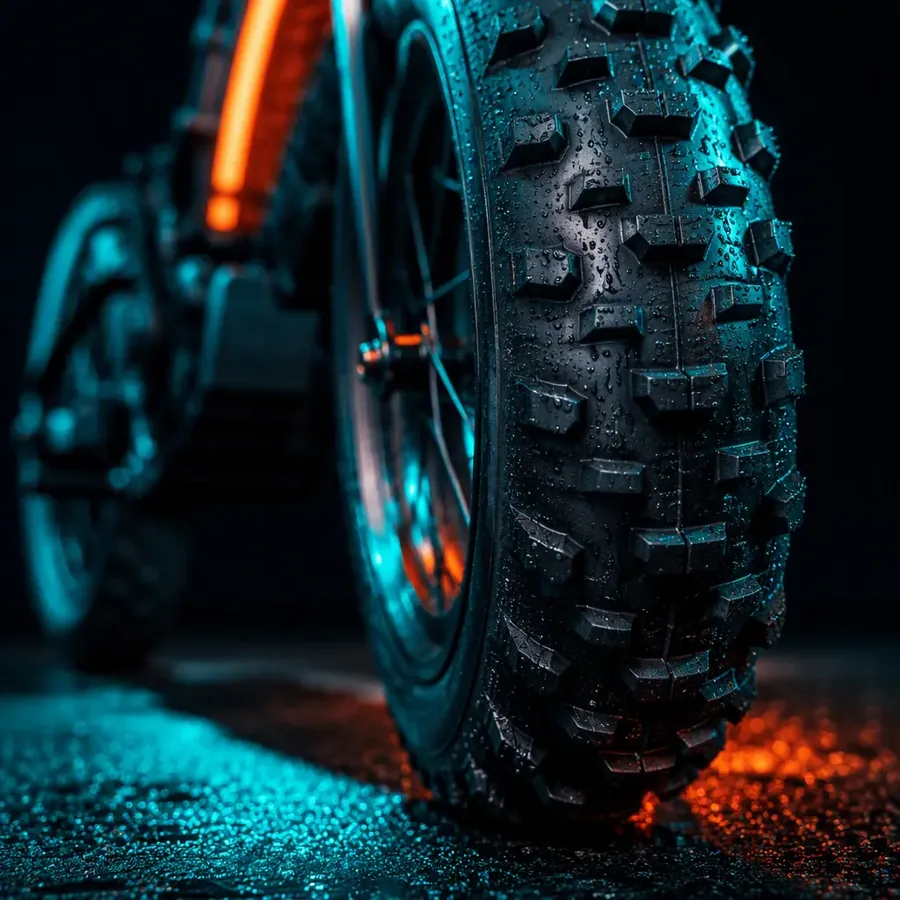
The tire is the defining component of the category, and the spec sheet must be precise. The standard sizes are:
| Size | Typical Use | Rim Width | Pressure Range |
|---|---|---|---|
| 26 x 4.0" | All-round trail, snow, beach | 80–100 mm | 6–15 PSI |
| 26 x 4.8" | Deep snow, soft sand | 100 mm | 4–10 PSI |
| 27.5 x 3.0" | Lighter trail bikes, "mid-fat" | 60–75 mm | 10–20 PSI |
| 20 x 4.0" | Folding fat bikes, compact storage | 80–100 mm | 6–15 PSI |
Three tire specs matter beyond size. Tread compound: winter-oriented models should use a softer compound with silica (better below 0°C grip), while all-season models use a harder compound that wears slower on pavement. Tread pattern: a continuous center ridge keeps rolling resistance low on hardpack and pavement; an aggressive chevron side lug digs into snow. Tubeless readiness: tubeless rims with sealant save 400–600 grams of rotating mass per wheel versus tubes, which matters because unsprung weight is the fat-tire category's biggest handling penalty. Specify tubeless-ready rims from the start, retrofitting later is a complete wheel rebuild.
Motor Selection: Torque Is the Spec That Matters
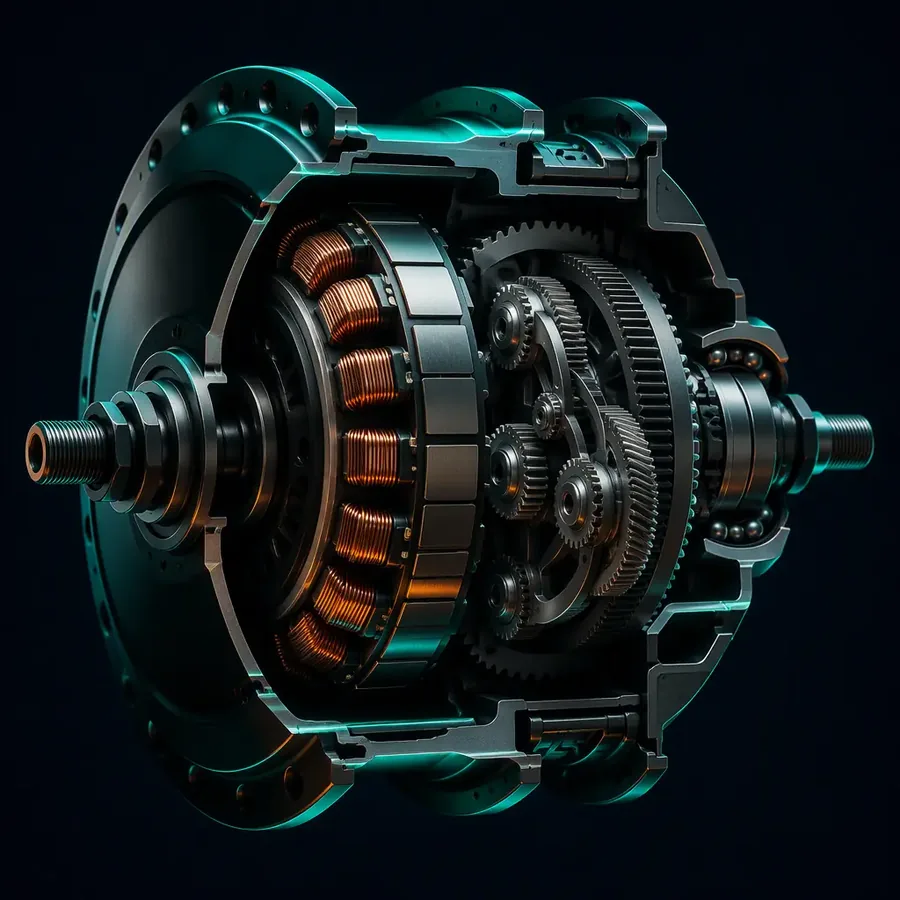
For fat-tire e-bikes, motor power ratings are less meaningful than peak torque. A 4.0-inch tire at 8 PSI has a larger contact patch and more rolling resistance than any standard tire, and riders on snow or sand need sustained torque at low speed rather than top-end speed. The practical specification ranges:
- 500W geared hub motor (55–65 Nm) . The minimum for a 26 x 4.0 fat bike carrying a rider up to 90 kg. Fine for flat terrain and light trail use. Not recommended for hilly winter cities.
- 750W geared hub motor (70–85 Nm) . The North American sweet spot. Handles 110 kg riders, 15% grades at 10–14 km/h, and heavy snow with reasonable efficiency. This is what EMS-EBIKE specifies for the majority of fat-tire OEM orders.
- 1000W+ hub motor (90+ Nm) . For cargo-capable fat bikes and extreme terrain. Note that 1000W+ systems disqualify the bike from EN 15194 in the EU and require class 3 / moped registration in many US states.
- Mid-drive (Bafang M620-class, 160 Nm) . The premium option for mountain-oriented fat bikes. Mid-drive exploits the drivetrain gearing, so torque at the wheel is multiplied 2–3x in low gear. Costs $200–350 more per unit than a hub system.
The motor decision interacts with the wheel build. Hub motors in the rear wheel mean the spoke count and rim strength must be specified for motor torque, 12-gauge spokes and 36H rims are the minimum for 750W fat hubs. If you plan a front-hub + rear-hub AWD configuration (common for extreme snow bikes), both wheels need motor-grade rims and the controller must be a dual-drive unit with synchronized throttle response. Our hub motor vs mid-drive comparison covers the efficiency and handling trade-offs in depth.
Battery & Range: Pack Size for 4.0-Inch Tires
Rolling resistance is the hidden tax on fat-tire range. A 26 x 4.0 tire at 8 PSI consumes roughly 30–40% more energy per kilometer than a 28-inch road tire at equivalent speed, which means a fat-tire e-bike needs a larger pack than a commuter for the same advertised range. The practical sizing matrix:
- 48V 15Ah (720 Wh) . Minimum viable for a 500W fat bike; 35–45 km of mixed riding.
- 48V 20Ah (960 Wh) . The standard for 750W models; 50–65 km mixed, 35–45 km in deep snow. This is the pack EMS-EBIKE defaults to for North American orders.
- 52V 20Ah (1040 Wh) . A performance upgrade for torque-hungry riders; the higher nominal voltage gives the controller more headroom before low-voltage cutoff.
- 48V 25Ah+ (1200 Wh+) . For cargo fat bikes and expedition builds; expect 80+ km range at the cost of 2–3 kg extra pack weight.
Cold weather is where fat-tire buyers actually ride, so battery chemistry selection is not academic. NMC packs lose 10–18% of capacity at -10°C and charge slowly below 0°C; LFP packs lose 15–25% but tolerate more charge cycles. For Nordic and Canadian markets, specify a pack with low-temperature charge cutoff in the BMS (charge disabled below 0°C) and consider a preheat feature in the enclosure. The full chemistry comparison: including cycle life and the 2027 EU Battery Passport requirements, is in our e-bike battery technology guide.
Frame Geometry & Braking: What Changes with Wide Tires
Fat-tire frames are not commuter frames with wider forks. The key engineering differences:
- Chainstay length . Must be 445–475 mm to clear a 4.0-inch tire with adequate mud clearance; too short and the tire rubs under load.
- Fork . A suspension fork for fat bikes must be specific to the wider crown and stiffer axle; using a standard fork with adapters is a warranty risk. Specify a fork rated for the tire width and rider weight.
- Dropouts . Rear dropout spacing is typically 197 mm on fat-bike frames (versus 135–148 mm on standard bikes). Verify this against your motor axle width before ordering. A mismatch is a common and expensive OEM mistake.
- Bottom bracket height . Raised 30–50 mm versus a commuter frame to keep the pedals clear of deep snow and ruts.
- Braking, 203 mm rotors minimum, 4-piston calipers recommended. Fat tires and heavy riders generate braking forces that overwhelm 160 mm rotors on long descents. Hydraulic disc brakes are mandatory for any fat bike above 500W.
Frame material is typically 6061 aluminum alloy for the mid-market, with steel (CrMo) for budget models and carbon for premium trail bikes above $2,500 retail. For OEM orders, aluminum with a hydroformed downtube that houses an integrated battery is the current sweet spot between cost, weight, and aesthetics. Frame and paint development timelines: including the MOQ implications of custom colors, are covered in our OEM e-bike buying guide.
Compliance: EN 15194, UL 2849, and Speed Limits
Fat-tire e-bikes sit at the edge of the regulatory envelope because their high torque and frequent 750W+ specifications collide with class limits. The three rules that most often catch importers:
- EU (EN 15194) . Pedelecs are limited to 250W continuous power and 25 km/h assisted speed. Fat-tire bikes above 250W must be registered as mopeds (L1e) in most EU states. The category is more popular in the EU than the regulation is friendly, plan for the moped variant or accept a 250W torque-tuned motor.
- US (UL 2849) . The electrical system standard that virtually every US retailer now requires. It covers the battery, BMS, motor, and controller as a system. UL 2849 certification adds roughly $15–30 per unit to the BOM and 4–8 weeks to the first-order timeline.
- Class 3 limits, 28 mph (45 km/h) assisted speed, throttle optional depending on state. A 750W fat bike configured as Class 2 (20 mph, throttle) avoids most state-level registration requirements.
Battery shipping is a separate compliance layer: UN 38.3 applies to every lithium pack crossing a border, and air freight of >100 Wh packs follows IATA DGR rules. A 48V 20Ah (960 Wh) pack ships by sea without special handling beyond Class 9 DG declaration; shipping it by air requires approval and is expensive. The full EU vs US certification comparison: including eMark for moped variants, is in our EN 15194 vs UL 2849 guide.
Sourcing Checklist: What to Specify in Your OEM Order
When you send the RFQ for a fat-tire e-bike, the factory should receive a specification that locks down every variable above. A complete order spec looks like this:
- Frame: 6061 aluminum, 197 mm rear dropout, integrated 48V battery, custom color per Pantone
- Motor: 750W geared hub, 80 Nm peak, 12-gauge spokes, 36H rear rim
- Battery: 48V 20Ah (960 Wh), NMC cells (Samsung 50E or equivalent), BMS with 0°C charge cutoff, IP65 enclosure
- Tires: 26 x 4.0", tubeless-ready rims, winter compound for Nordic markets
- Brakes: hydraulic disc, 203 mm rotors front and rear
- Display: LCD with PAS levels 0–5, throttle mode, walk assist
- Compliance: UL 2849 for US, EN 15194 (250W variant) for EU, UN 38.3 for all packs
- MOQ: 50 units catalog, 100 units custom color, 200+ units custom components
At EMS-EBIKE, fat-tire models roll off the same lines as our commuter and cargo lines, 4 parallel assembly lines under one quality chain. Standard lead time is 15–30 days after deposit for catalog models, 30–45 days for first OEM orders with custom paint and components. Every unit goes through a 7-point functional test and AQL 2.5 sampling before container loading, and third-party inspection (SGS or Bureau Veritas) can be scheduled into the timeline without friction. If you are also evaluating cargo and delivery configurations, our cargo e-bike fleet buyer's guide covers payload and fleet economics.
Get Fat-Tire Specs and Pricing for Your Market
Tell us your target market, rider weight assumptions, and terrain. We will recommend the motor, battery, and tire package, with UL 2849 or EN 15194 documentation for your region. First sample within 15 days for custom builds.
