
Most first-time importers lose their money in the gaps between the numbers a supplier quotes and the numbers a factory actually plans against. MOQ is quoted per model, but the tooling, the paint batch and the battery pack build are planned per platform. Lead time is quoted from deposit, but the clock that matters starts when your artwork and colour approvals are signed off. This guide walks through the four commercial levers that decide whether an OEM e-bike order comes in on budget, in the sequence you will actually negotiate them, using the production figures we run on the fat-tire and city-commuter platforms.
MOQ: What the Number Really Covers
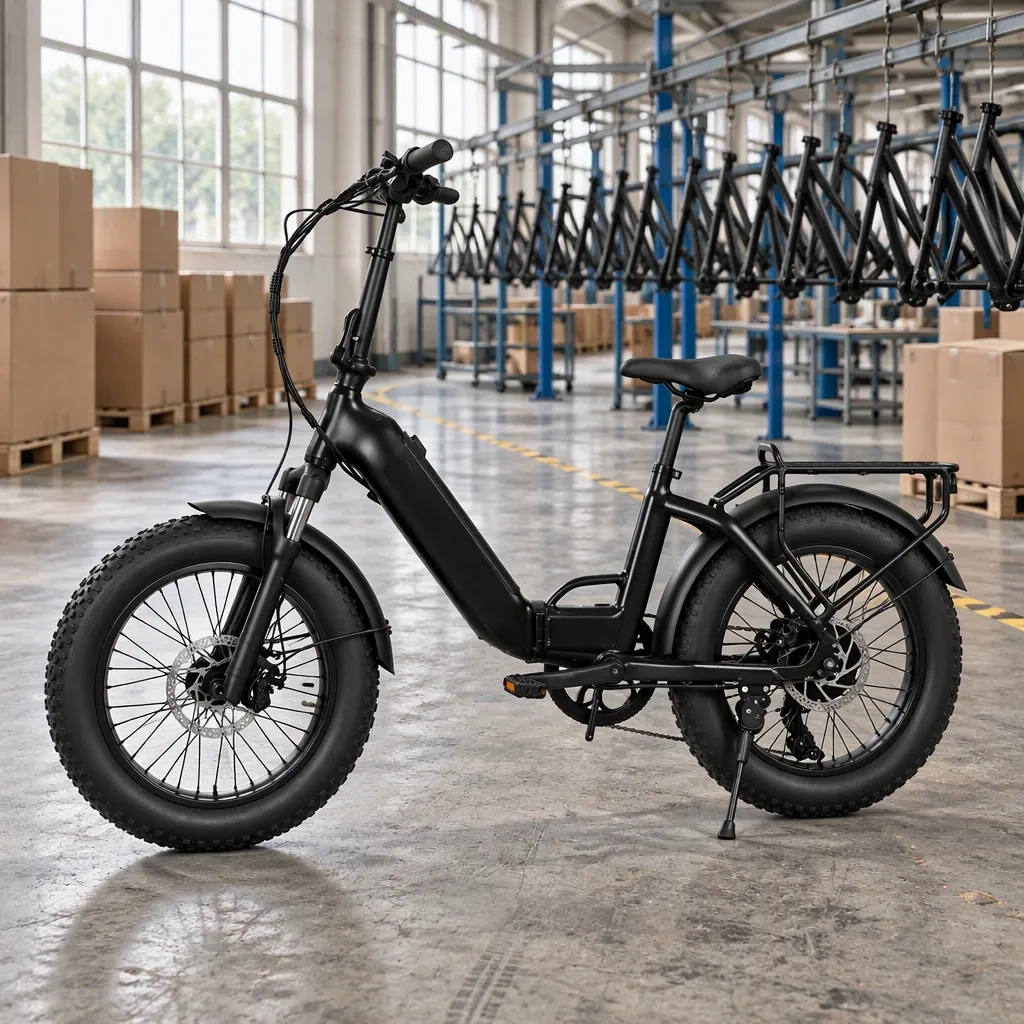
The fat-tire platform we build carries an MOQ of 50 units per model. That number is not arbitrary and it is not a sales tactic: it is the point at which a frame paint batch, a battery pack build and a motor winding run stop being loss-making for the factory. Below 50 units you are almost always buying either a stock specification or a shared production slot, and the customisation you can ask for shrinks accordingly.
Two things sit outside the 50-unit figure and are worth negotiating separately:
- Per-model, not per-order. A 50-unit MOQ means 50 of one colourway, one frame size and one component spec. If you want three colours across two sizes, that is six SKUs, and the factory has to batch them. Consolidating to two colourways and one size range is the single largest lever most importers have on landed cost.
- Component MOQs run higher. Batteries, chargers and motors bought as separate parts carry their own minimums, and a non-standard voltage or torque target on a motor requires a 200-unit minimum order plus roughly 7 to 10 days added to the standard lead time for winding setup, dynamometer validation and sample approval.
The practical approach is to treat the first order as a market test with a deliberately narrow spec, then widen the colour and size matrix on the second order once you know which SKU sells. Importers who try to launch a full matrix on the first container routinely end up paying for paint changes mid-run, which is where delivery dates slip.
Sample Strategy: What a Sample Actually Proves
A sample order is not a formality and it is not a free trial. On this platform a single sample unit is available at 1.2x the unit price, and sample orders or first-time trial orders under 10 units are payable 100% by T/T or through Alibaba Trade Assurance. Budget for the premium and plan to destroy the sample.
Here is the sequence that actually de-risks an order, in order of value for money:
- Ride it for a full week before you inspect it. Motor feel, assist ramp and brake lever travel are the things buyers complain about later, and none of them show up in a ten-minute car park test.
- Open the battery compartment and photograph the pack label and BMS connector. You are building a record of the cell batch you approved, so a later warranty claim has something to be measured against.
- Weigh it. The fat-tire platform runs 28 kg in 500W trim, 30 kg in 750W and 33 kg in the 1000W Pro build. A unit that arrives materially heavier than the spec sheet means a component substitution happened.
- Then strip it. Take the motor apart, check the weld quality at the dropouts, and look for sealant gaps around the battery compartment. This is the step importers skip and the step that finds problems.
Pre-production samples ship before mass production on every order, and that second sample is the one that matters commercially: it is built on the actual line, with your actual paint and your actual components, and signing it off is what starts the lead-time clock.
Lead Times and Production Milestones
Standard lead time on this platform is 15 to 30 days from deposit. A first custom-branded run extends to 30 to 45 days. Those numbers are honest but they are conditional, and the conditions are where schedules break.
| Stage | What happens | Who holds the clock |
|---|---|---|
| Proforma invoice | Itemised unit pricing, packaging spec, payment and delivery terms, estimated lead time. The PI is valid for 30 days. | Supplier |
| Deposit and artwork approval | 30% T/T deposit received, colour and decal artwork signed off, component spec frozen. | You |
| Winding and tooling setup | Only if the motor spec is non-standard, adds 7 to 10 days. | Supplier |
| Pre-production sample | Built on the line with your paint and components, shipped for sign-off before mass production. | Shared |
| Mass production | Parallel assembly lines, torque-controlled tools, per-unit quality passports. | Supplier |
| OQC and third-party inspection | AQL 2.5 Level II sampling with functional testing, report shared, non-conformities corrected before loading. | Shared |
| Loading | 70% balance against scanned B/L copy before shipment. | Shared |
The single most common cause of a late container is not factory capacity, it is an artwork approval that sat in an inbox for a week while the deposit had already started the clock. Approve artwork before you wire the deposit, not after, and the quoted 15 to 30 days is achievable. If you are planning a launch date, work backwards from loading rather than forwards from the purchase order.
Payment Terms and Trade Finance
The standard structure is T/T 30/70: 30% deposit with the purchase order, 70% against a scanned bill of lading copy before shipment. Three things are worth knowing about how that plays out.
- Above $60,000 we accept an irrevocable letter of credit at sight. If your order sits in that range, an L/C is usually cheaper than the working capital cost of paying 70% before you have seen the goods, but check your bank's issuing fees before assuming so.
- The 30-day PI validity is real. Cell prices and freight move. A PI you sit on for six weeks may come back revised, and that is not the supplier being difficult.
- Delivery terms are separate from payment terms. FOB, CIF and DDP are all available and each shifts a different chunk of risk. FOB leaves you owning the ocean leg; DDP hands the whole chain to the supplier and prices that risk in. For a first order into a market you do not yet know, CIF is usually the pragmatic middle.
Do not treat the 70% balance as your only remaining leverage. By the time the B/L copy exists, the container is loaded. The leverage that actually protects you is the inspection gate before loading, which is the next section.
Quality Control: The Three Gates
Every unit passes IQC, IPQC and OQC, and the specifics are what you should be asking a supplier to put in writing. Ours are documented, and they are a fair benchmark for judging any factory you shortlist.
IQC, incoming quality control
Every incoming batch is sampled to AQL 2.5 Level II before it reaches the line. Lithium cells undergo full internal-resistance and voltage sorting; cells outside 3 mΩ IR or 0.02V open-circuit voltage are rejected outright. Frame tubing is checked with ultrasonic thickness gauges and weld coupons from each steel batch are tensile tested. Motor stators are tested for winding resistance and insulation breakdown at 500V DC before lacing. A sub-supplier that fails IQC twice in a quarter triggers an on-site audit within 14 days.
IPQC, in-process quality control
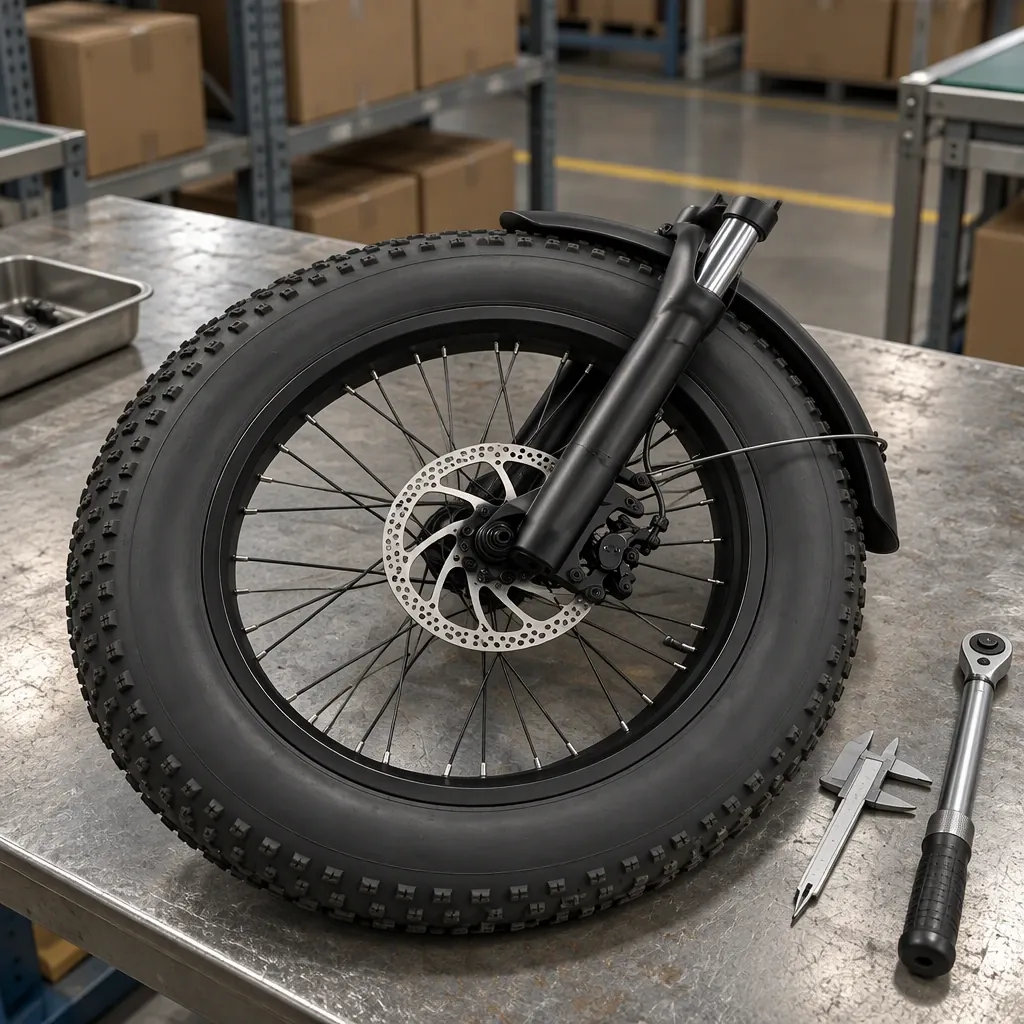
Inspectors sit at every assembly stage rather than in a separate lab. Every safety-critical fastener is torque-verified and logged to the unit's quality passport: handlebar clamp bolts at 25 N·m, axle nuts at 40 N·m, brake caliper mounts at 18 N·m. Battery BMS functional testing checks overcharge protection at 54.6V, over-discharge cutoff at 36V and short-circuit response under 200 µs. After the battery compartment seal is applied, every unit passes a pressure-decay leak test at 3 kPa for 15 seconds.
OQC and third-party inspection
Final release covers a 26-point check including cruise efficiency mapping at 15, 25 and 32 km/h, brake force distribution verification, and a full IP54 spray test at 10 L/min for three minutes from all angles with the electrical system powered. You can also nominate your own inspection agency to work at the facility before loading, sampled at AQL 2.5 Level II with functional testing, with the report shared and non-conformities corrected before the container is sealed.
Batch-level traceability is the part worth insisting on: the vehicle serial number links back to the arriving cell batch, its IR test values and the specific spot-welding station. Without that link, a warranty report eighteen months later cannot be investigated, only argued about.
Specification Levers That Move the FOB Price
The fat-tire platform spans a wide price band for what looks like one product. The differences are component-level, and knowing them keeps you from paying for margin you did not ask for.
| Specification | Standard 500W | Plus 750W | Pro 1000W |
|---|---|---|---|
| Motor | 500W hub, 48V | 750W hub, 48V | 1000W hub, 48V |
| Battery | 48V 15Ah | 48V 17.5Ah | 48V 20Ah |
| Range | 60–70 km | 65–75 km | 70–80 km |
| Top speed | 32 km/h | 32 / 45 km/h | 45 km/h |
| Charging time | 5–7 h | 5–7 h | 3.5–4 h (fast) |
| Weight | 28 kg | 30 kg | 33 kg |
| Suspension travel | 80 mm | 100 mm | 100 mm + lockout |
| FOB range | $550–650 | $680–800 | $850–980 |
| MOQ | 50 units | 50 units | 50 units |
Three observations from that table are worth carrying into a negotiation. First, the 500W and 750W builds share the same 48V architecture and the same frame, so moving between them is a battery and motor change rather than a re-tooling event. Second, the fast-charge capability in the Pro trim is a charger and BMS change, not a battery chemistry change, which is why it appears at the top of the band. Third, total load capacity is 150 kg across all three trims including rider and rear rack, so if your market carries heavier riders or cargo, the platform constraint is load, not power.
Beyond the three trims, the customisation levers that move cost are colour and finish, component spec (brakes, display, transmission, tyres), accessory packages such as racks, fenders and lights, and retail packaging. The display is a good example of a decision that looks cosmetic and is not: the platform ships with a colour LCD with USB charging and five assist levels, and swapping it changes both unit cost and the app or telematics integration your dealers will ask about.
Compliance Paperwork to Request Before You Order
The compliance package on this platform covers EN 15194, UL 2849, CE, RoHS and UN 38.3, and each order carries cell, BMS and test-report documents in the export file. Ask for them at quotation stage rather than at shipping stage, because two of them gate the booking itself.
- UN 38.3 test summary is required by every ocean carrier for Class 9 dangerous goods booking. Without it the container does not sail, regardless of how good the product is.
- UL 2849 or EN 15194 determines which market the electrical system is built for. These are not interchangeable and cannot be retrofitted after the fact, so the destination market has to be settled before the BMS firmware is flashed.
- Cell and BMS documentation per batch is what makes a warranty claim arguable rather than anecdotal. Ask for it as an export-file item in the PI, not as a favour afterwards.
If you are weighing platforms rather than suppliers, the same logic applies at a higher level: the compliance and market-fit comparison between categories is covered in EU versus US e-bike certification, and the drivetrain decision that drives most of the unit cost is set out in hub versus mid-drive. For a broader view of how a platform becomes a product line, motor power selection and battery technology are the two companion reads.
Packing and Loading: The Last Place Money Leaks
Packaging is quoted as a line item and treated as an afterthought, which is backwards. A container of e-bikes crosses multiple transfer points and customs inspections before it reaches your warehouse.
The standard export pack uses 7-layer BC-flute corrugated board with a minimum burst strength of 1,200 kPa, with foam protection inside the carton and steel-reinforced pallets rated to 1,200 kg where palletised loading is specified. The pack is designed to exceed ISTA 3A drop-test standards. Since the battery is Class 9 dangerous goods, the carton markings and the documentation have to agree exactly, and a mismatch between the two is a common cause of customs delay that looks like a supplier problem and is actually a paperwork problem.
Two practical asks before you sign the PI: specify whether you want palletised or floor-loaded containers, because the choice changes both freight cost and the carton specification, and ask for photographs of a packed container from a previous order for your market. A supplier who cannot produce them has not shipped there before, which is useful information.
Putting the Order Together
The sequence that works is unglamorous. Freeze the destination market first, because it fixes the electrical certification. Choose one platform and one trim, not a matrix. Sign off artwork before wiring the deposit so the lead-time clock starts on the same day the money moves. Budget for a sample at 1.2x and destroy it. Nominate an inspection agency for the pre-loading gate, or at minimum require the AQL 2.5 Level II OQC report. Then widen colour and size on the second order once you know which SKU sells.
Importers who follow that sequence get the quoted 15 to 30 days and the quoted FOB band. Importers who negotiate price first and spec second usually get a number that looks better on the PI and a container that arrives three weeks late with a component nobody approved. The cost of a first order is mostly the cost of the decisions made before the deposit, not the unit price printed on it.
If you are still at the platform-selection stage rather than the supplier stage, the comparison between buying a finished OEM product and building a fleet specification is covered in cargo e-tricycle OEM sourcing, and the dealer-side view of the same transaction is in dealer and distributor onboarding. For importers moving containers rather than samples, importing from China covers the customs and landed-cost mechanics that sit downstream of everything above.
Ready to Price Your OEM E-Bike Order?
Tell us your target market, quantity, and budget. We will propose the right model, certification path, and production timeline, with transparent pricing and no hidden costs. First sample available within 15 days for custom builds.
