
Most first-time buyers plan the vehicle and leave the container to the last week. The container is where a well-specified tricycle order stops being profitable: a loading plan that wastes cubic metres, paperwork that holds the booking, or a packing method that survives the factory floor but not forty days at sea. This checklist covers the four decisions that decide whether your first shipment lands in sellable condition. For the tariff, HS code and certification side of the same purchase, start with our China import guide for electric tricycles; this article picks up where that one stops, at the loading dock.
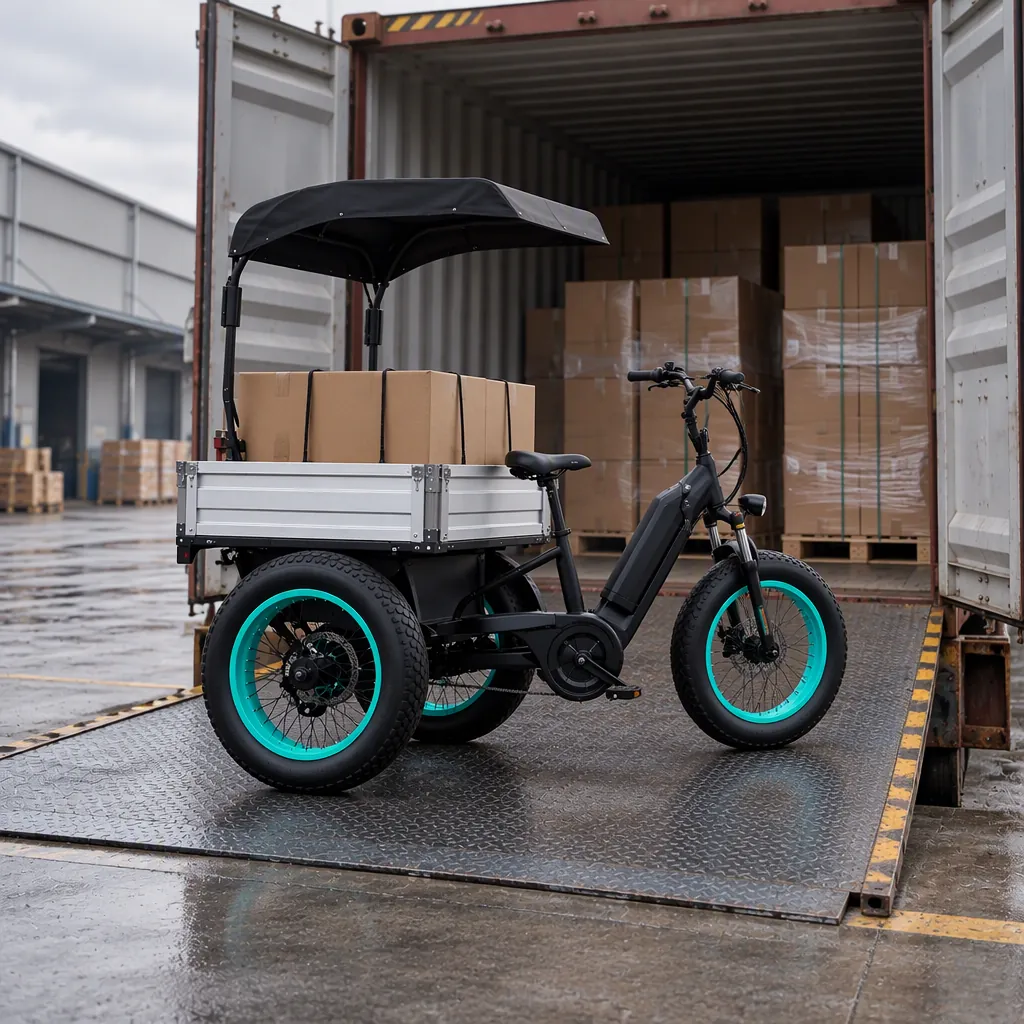
Why the First Container Is Decided Before Loading Day
A first order is usually small: one 20GP, occasionally a 40HQ shared between two models. That size is exactly what makes the logistics fragile. One model at one specification gives you no spread across the container, no room to re-pack a damaged unit, and no second chance if a certificate is missing from the document set. Experienced importers treat the first container as a measured trial rather than a shopping trip, and they choose the loading configuration to protect unit condition rather than to squeeze in the last three vehicles.
The reason is arithmetic. On a partially disassembled tricycle the freight share of the landed cost is small enough that a badly packed container can still lose money on damage, while a slightly lighter container rarely does. Loading density is a cost lever; condition on arrival is a margin lever. This checklist sequences the two so that the second order is easier than the first.
Containers by Model: What Actually Fits
Loading figures only mean something when they are tied to a vehicle and a packing state. Our own published export figures cover three references, and buyers should ask for the equivalent numbers for the exact model they are ordering rather than assuming they scale linearly.
| Vehicle reference | Packing state | 20GP | 40HQ |
|---|---|---|---|
| City e-bike (two-wheel reference) | Partially disassembled: handlebar off, pedals unthreaded, front wheel off | ~42 units | ~90 units |
| Cargo / passenger e-tricycle | Assembled, upright, single layer | 18–25 units | 50–60 units |
| Cargo / passenger e-tricycle | Knocked down, flat-packed | 35–45 units | 70–90 units |
Two observations matter more than the numbers. First, the 40HQ is not simply double the 20GP: the published rate relationship for a full high-cube is roughly 1.6 times the 20GP rate, which is why the larger box wins on freight per unit once you can fill it. Second, the knocked-down gain on a tricycle is real but conditional. Flat-packing a trike means removing wheels, the cargo box and in most cases the canopy, and it only pays if you have somewhere to reassemble the units at destination with the right torque values on axle nuts and caliper mounts. A first container of assembled units is slower to unpack but reaches the end user without a workshop.
Ask the factory for the loading figure for your configuration in writing, together with the container loading plan: carton numbers, pallet configuration and the sequence inside the box. That plan is also the document you check the container against on arrival.
The Packing Specification to Demand in Writing
Packing is where a factory's export experience becomes visible. A tricycle is a heavy steel chassis with a large flat panel body, which is exactly the shape that transfers shock into welds and box panels when a container is handled. Our standard export packing is specified layer by layer, and each layer answers a specific failure mode.
- Master carton: seven-layer BC-flute corrugated board with a minimum burst strength of 1,200 kPa, printed with handling symbols, your SKU barcode and the unit serial number, and stacking tested to five cartons high, equivalent to a 2.4 m container stack.
- Foam cushioning: 30 mm custom-moulded closed-cell PE foam at 28 kg/m³ covering about 85% of the frame surface, giving progressive absorption with a 45G peak deceleration at a 1.2 m drop. Handlebar, pedals and display are wrapped separately in 2 mm EPE film.
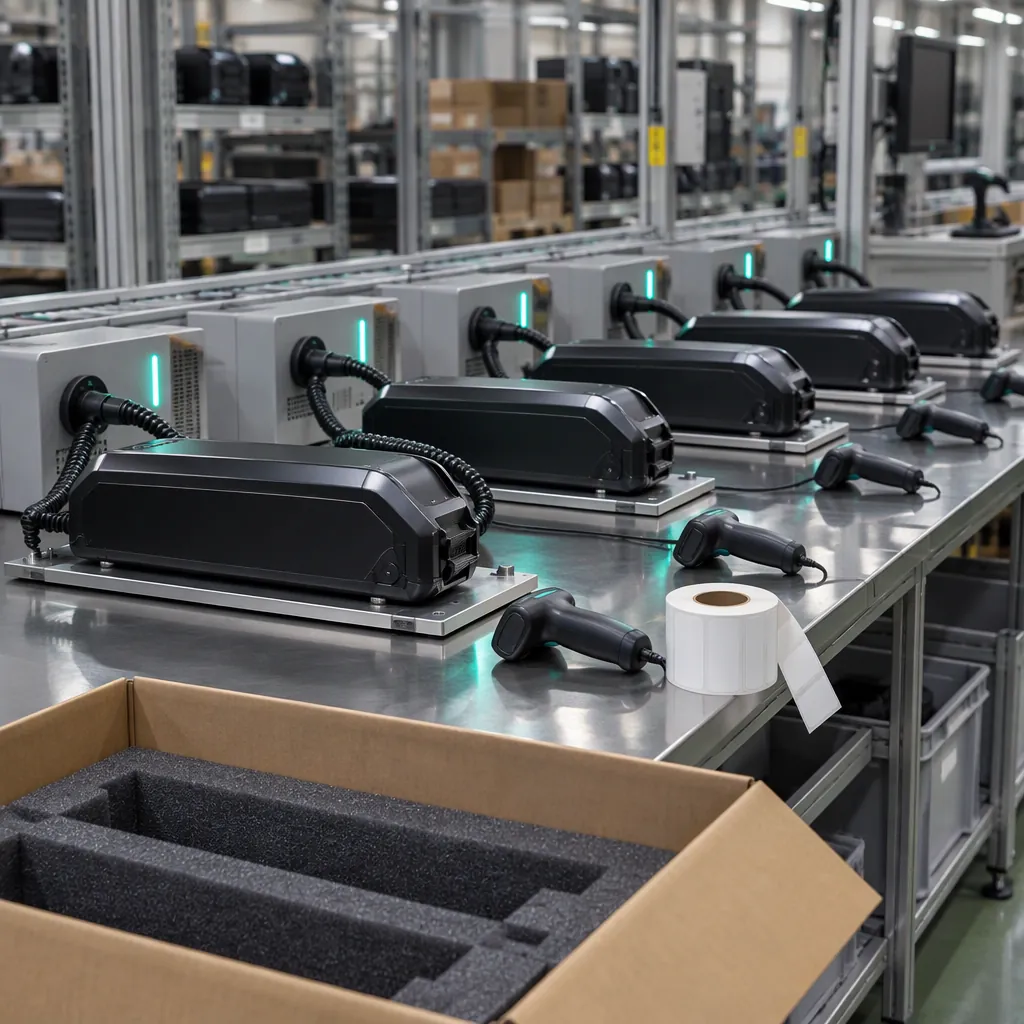
- Moisture barrier: a 150 µm PE and aluminium laminate bag, heat-sealed, with a 50 g silica gel desiccant pack holding internal humidity below 40% for the sea transit. Battery terminals are capped before bagging so a short circuit is physically impossible in handling.
- Pallet and strapping: a 1,100 x 1,100 mm four-way entry pallet with steel corner reinforcement rated to 1,200 kg static load, stretch-wrapped in 80 µm LLDPE film at 250% pre-stretch and secured with PET strapping at 450 kg break strength.
The packaging standard is designed to exceed ISTA 3A, and every carton is drop-tested from 1.2 m on three edges before it is sealed. For a first order the useful request is not the specification document but the evidence: packing photographs, carton numbers, and the pallet configuration, sent before the container arrives for loading.
The Battery Paperwork That Stops a Booking
Lithium packs travel as Class 9 dangerous goods under UN 3480, and this is the single most common reason a first container slips a sailing. The paperwork is not optional and it is not interchangeable between modes:
- UN 38.3 test summary per UN Manual of Tests and Criteria Part III subsection 38.3, required by every ocean carrier before a dangerous goods booking is accepted.
- MSDS and the dangerous goods declaration, prepared by a competent shipper rather than improvised by the buyer.
- Air freight is stricter: packs must ship at below 30% state of charge under IATA Dangerous Goods Regulations Section II of PI 965 to 967, with airline approval handled by the shipper. This is why sample units often move by express courier instead.
- Ocean surcharge: expect roughly USD 250 to 400 per container for the Class 9 declaration and handling, and confirm whether it is inside or outside the quoted freight.
A mis-declared pack is not a documentation nuisance. It is a detention, a fine, and in some ports a refusal to discharge. If a supplier cannot produce the UN 38.3 summary for the exact cell it is using, the vehicle is not ready for export regardless of how well it rides.
Payment: What the Deposit Actually Buys You
The standard structure for an export order is 30% deposit with the order and 70% before shipment release, paid against a copy of the bill of lading or documented evidence that the goods are complete, packed and photographed in the warehouse. The deposit covers material and the start of production; the balance is your last real lever, so it should be released against evidence rather than a promise. Our OEM buying guide sets out the wider negotiation framework and the alternatives, including letters of credit for larger values and platform escrow for small first orders.
Two terms are worth pinning down before you sign, because both are routinely left vague. The price validity window on the proforma invoice is typically 15 to 30 days, so a container planned for next quarter needs a stated mechanism for raw-material or exchange-rate movement rather than a verbal assurance. And the delivery term should be explicit about what happens at the port: under FOB China the supplier clears export and delivers to the terminal, you nominate the forwarder and pay ocean freight and destination charges, while CIF bundles the freight into the unit price and removes visibility you may want back once you are shipping regularly.
Pre-Shipment Inspection: What to Watch Being Checked
The inspection that protects a first container is a third-party one, held at the factory before the container is loaded, not a set of photographs emailed afterwards. Book it against AQL 2.5 Level II sampling and require functional testing on the sampled units: throttle and brake cutoff response, display readout, lighting, and a short loaded run.
Ask for the production evidence that sits behind any warranty discussion later. Our quality system records three gates on every unit, and the three numbers to look for in the report are these:
| Gate | What is checked | The number that matters |
|---|---|---|
| IQC (incoming) | Cell sorting, frame tube thickness, motor stator insulation | Cells rejected beyond 3 mΩ internal resistance or 0.02 V open-circuit spread |
| IPQC (in process) | Torque verification on every safety-critical fastener, logged to the unit quality passport | Handlebar clamp 25 N·m, axle nuts 40 N·m, caliper mounts 18 N·m |
| OQC (outgoing) | Dynamometer cycle, IP54 spray, road simulation, carton drop test | IP54 spray at 10 L/min for 3 minutes; carton dropped 1.2 m on three edges |
Non-conformities found at this stage are corrected before loading, which is the whole point. An inspection that happens after the container is sealed is a claims exercise, not a quality gate. If the order includes spares, keep them in the same container: a kit rides along at almost no incremental freight, and the parts pipeline is what decides fleet uptime later, as our after-sales and spare parts guide explains.
Loading Day: The Ten-Minute Check
Container loading is usually recorded on CCTV at the factory. Watch for the four things that are cheap to fix at the dock and expensive to fix at destination: pallets blocked against the container walls so the stretch wrap cannot chafe through, no void fill between pallets and the door end, batteries and cartons separated so a leaking pack cannot contaminate cardboard, and the seal number photographed before the truck leaves for the terminal. The seal photograph is the only proof you will have if goods are short-landed.
Within 48 hours of departure you should hold the full document package: commercial invoice, packing list, bill of lading, certificate of origin, and the market certificates for your destination, whether that is EN 15194, UL 2849 or a CE declaration of conformity. Compare the certificate of origin form against your destination: the wrong form is a tariff problem that cannot be corrected after the vessel sails.
Arrival: Checking Condition Before You Sign
Inspect before you clear the container, not after it reaches your warehouse. Photograph the seal and the doors, then the pallet configuration before unloading, then every carton with crushed corners or strapping damage. Damage that is noted on the delivery receipt with photographs is a claim; damage discovered a week later is a discussion. Two checks specific to electric vehicles belong in the same hour: a visual check of the moisture barrier bags for condensation, and a pack voltage reading on a sample of units before any charging attempt.
Keep the container loading plan the factory sent and check it against what you unload. A missing unit is then a documented short shipment rather than an argument, and a carton that arrives in a different position than planned tells you where handling went wrong.
What the Second Container Should Change
A first container that arrives intact gives you three levers for the second. You can move to a knocked- down configuration once local reassembly is proven, trading assembly labour for a 30 to 40% freight saving per unit. You can raise the mix to two or three models now that the packing plan is known, and you can size the spare-parts kit against real failure data rather than a rule of thumb. None of those changes require a new supplier relationship, which is the argument for choosing a supplier whose loading figures, packing evidence and dangerous goods paperwork are already documented.
If you are still comparing platforms, the container math also depends on the vehicle: a payload and capacity guide explains how the 300 kg EU and 500 kg non-EU ratings change what a full container can carry, and our cost breakdown of the cargo platform shows where the landed cost of a unit actually sits. Buyers moving into passenger work should read the passenger tricycle platform guide before fixing a container mix, because seating layout changes the packed footprint far more than motor choice does. For the sequence from enquiry to a signed order, the dealer and distributor launch guide covers the margin and inventory decisions that sit around the first shipment.
The container is the first place where a purchase order becomes a physical fact. Get the loading plan, the packing evidence and the dangerous goods file in writing before loading day, keep the balance payment tied to evidence, and check condition before you sign at the port. That sequence is what makes the second container a routine purchase instead of another experiment, and it is the difference between a shipment that arrives and a shipment that sells.
Plan Your First Container With a Real Loading Sheet
Send us your target market, the model or models you are considering, and the container size you have in mind. Our export engineers will return a container loading figure for your configuration, the packing and UN 38.3 document list, the AQL 2.5 inspection plan, and FOB pricing, usually within one business day.
