
The mountain e-bike is the category that changed how the premium e-bike market thinks about margin. A trail-ready eMTB carries a chassis cost that is 40–60% higher than a commuter bike of the same nominal motor class, and the buyers, trail rental operators, DTC trail brands, and independent bike dealers, pay for it without flinching, because the product is judged on terrain, not on spec-sheet price. But that premium only survives if the engineering is real: a mountain e-bike that fails on the trail fails loudly, in front of a customer who will never buy again. This guide covers the suspension architecture, frame geometry, motor and drivetrain specs, and the sourcing checkpoints that separate a credible trail line from a commuter bike with knobby tires.
Where Mountain E-Bikes Actually Sell
Mountain e-bikes move through four channels, each with a different spec emphasis:
- Trail rental fleets and bike parks . The volume anchor. Parks buy 50–200 units at a time, run them 300+ days a year, and spec for durability above all: reinforced frame welds, serviceable suspension, and batteries that survive daily fast-charging. Rental fleets are also the cheapest marketing channel in the category: every rented eMTB is a test ride.
- DTC trail brands . Direct-to-consumer brands that launch one or two models per season. They need a factory that can deliver first-article samples in 4–6 weeks and hold tolerances across 500–2000-unit production runs.
- Independent bike dealers . The trust channel. Dealers stock eMTBs from established lines and demand dealer support: spare parts catalogs, service training, and warranty stock. A brand without dealer support does not get shelf space.
- Tour and guide operators . Small fleets (5–20 units) for guided trail tours, spec'd for reliability and mid-range battery capacity rather than peak performance.
The common thread: mountain e-bike buyers are the most component-literate customers in the category. They will read the suspension travel, the motor torque curve, and the frame geometry numbers before they look at the price. Every spec below is something a rental fleet manager or a dealer will verify on the sample.
Suspension Architecture: The First Spec You Lock
Suspension travel is the single most defining number on a mountain e-bike, and it maps directly to the riding category:
| Category | Fork Travel | Rear Travel | Typical Use |
|---|---|---|---|
| XC (cross-country) | 100–120 mm | 100–120 mm | Uphill-heavy trails, racing |
| Trail | 130–150 mm | 130–150 mm | All-round trail riding, the volume segment |
| Enduro | 160–180 mm | 150–170 mm | Descend-focused, park laps |
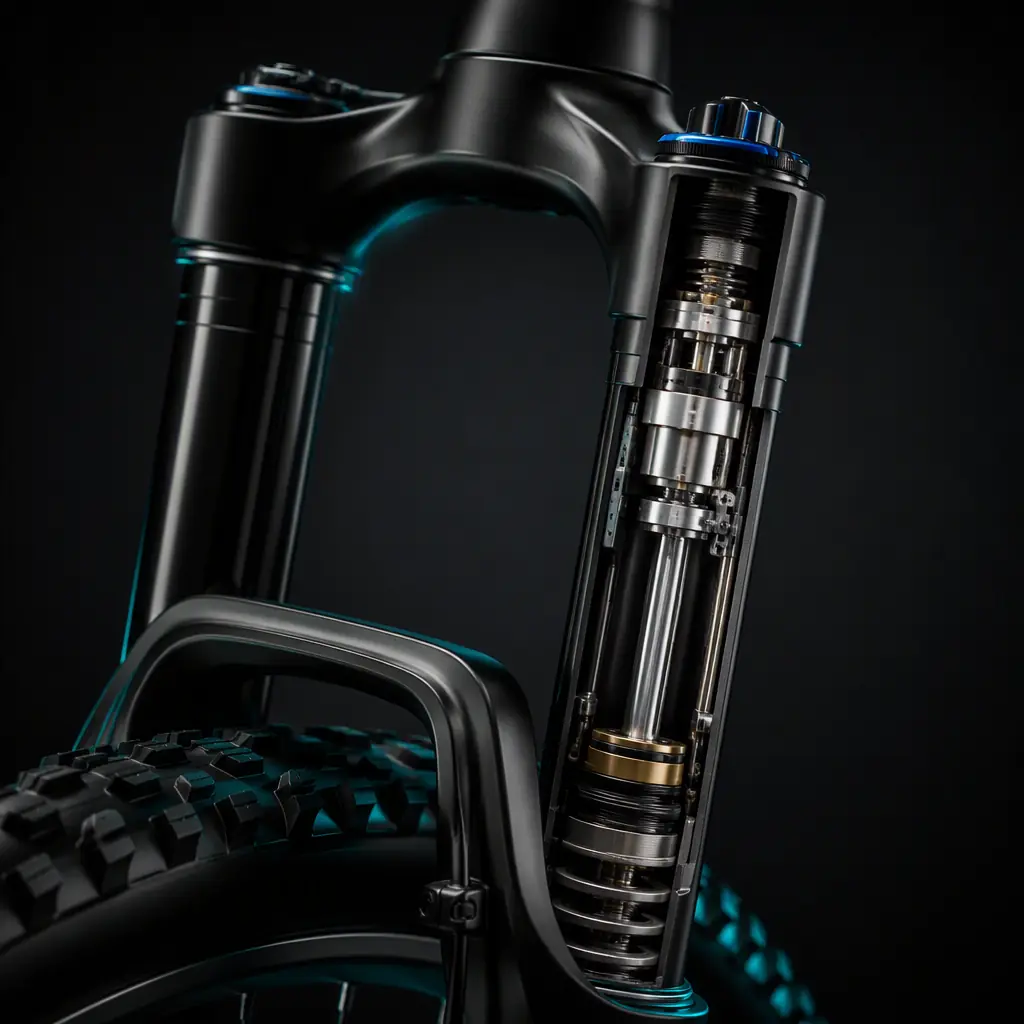
Three suspension decisions matter more than travel numbers:
- Air vs coil . Air springs are lighter and tunable with a pump, which is why 90% of OEM eMTB lines ship air. Coil springs suit enduro/park rental fleets where rider weight is constant and durability is paramount; coils have fewer seals to service.
- Stanchion diameter, 34 mm forks belong on XC bikes; trail and enduro need 35–38 mm stanchions. A thin fork on a 24 kg eMTB flexes under braking and reads as "cheap" to any dealer who picks the bike up.
- Rear shock tune . The shock must be tuned for the motor-added weight (22–26 kg vs 13–15 kg for a pedal mountain bike). A factory that cannot supply shock tune data per frame size is a factory that has not tested the bike.
Suspension is where rental fleets measure cost-per-ride: a serviceable fork with sealed cartridge internals and 200-hour service intervals will outlast a cheaper fork by years in park duty.
Frame Geometry: Trail-Ready Numbers
Frame geometry is what makes a mountain e-bike feel planted on the trail. The numbers to lock in the OEM spec:
- Head angle 65–67° . The slack head angle is the defining trail-geometry number. 67° suits trail/XC duty; 65–66° for enduro stability at speed. A 69°+ head angle (typical of commuter geometry) makes the front end feel twitchy and nervous on descents.
- Reach per frame size . Reach grows with size (e.g. 450–500 mm across S–XL) so that taller riders get proportional cockpit length. A one-size-fits-all frame is a commuter compromise that trail riders reject.
- Chainstay length 430–450 mm . Short enough to lift the front wheel over obstacles, long enough to stay stable at speed.
- Dropper post routing . Internal dropper-post routing is now table stakes for trail eMTBs; external routing reads as a 2019 design.
- Battery integration . The battery should sit in the down tube with a captive mount that cannot rattle loose on descents. The torque spec for the battery mount bolts belongs in the assembly documentation, not in the field.
Frame material for eMTB is dominated by 6061 and 7075 aluminum with reinforced welds at the head tube and motor mount. The motor mount area carries roughly double the stress of a pedal bike's bottom bracket. The fatigue certification for the frame and the motor mount must be documented; the frame fatigue standards are the same discipline as EN 15194, which we cover in our EU vs US certification guide.
Motor and Drivetrain: Mid-Drive Dominance
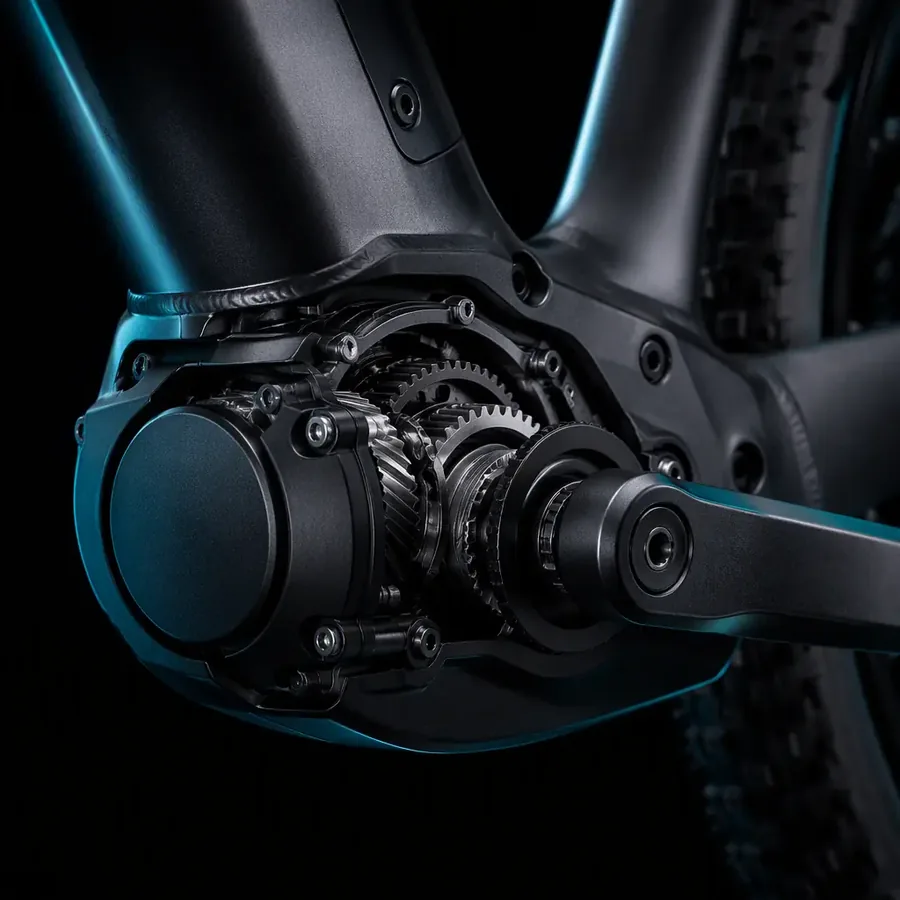
Mountain e-bikes are the one category where mid-drive motors dominate, and the reason is torque at the wheel:
- Mid-drive torque 80–160 Nm . The Bafang M510-class (80–95 Nm) covers trail duty; the M620-class (160 Nm) is the standard for enduro and heavy riders. Mid-drive exploits the drivetrain gearing, so the motor spins fast while the wheel crawls, exactly what technical climbing needs. The full architectural comparison of hub vs mid-drive, including the cost impact on your BOM, is in our hub motor vs mid-drive guide.
- Hub motors belong on flat-terrain products . A hub motor on a trail bike overheats on sustained climbs because it cannot use gear multiplication. If a supplier proposes a hub motor for an eMTB line, treat it as a red flag.
- Battery: 48V 14–21Ah (672–1008Wh) . Real trail range is 60–120 km depending on assist level and terrain. Rental fleets will ask for a battery that survives daily fast-charging; the BMS and cell-grade decisions are the same discipline as our battery technology guide.
- Torque-sensing assist . Cadence-only assist feels like an on/off switch on the trail. A torque sensor with a smooth power ramp is what dealers test first on a demo ride.
One motor number buyers misread: rated vs peak power. A "1000W" motor is usually 250W rated with a peak burst. For trail duty the number that matters is sustained torque delivery, not the peak sticker. The power-class logic is in our motor power class guide.
Wheels, Tires, and Braking for Descents
Wheel and brake specs decide whether the bike survives a season of park duty:
- 27.5 vs 29 vs mullet. 29-inch wheels roll over obstacles and hold speed (the XC/trail default); 27.5 is more maneuverable (enduro and smaller riders); a mullet setup (29 front, 27.5 rear) balances both and is increasingly common on trail and enduro lines.
- Tire width 2.4–2.6 inches with tubeless-ready rims. Tubeless is standard on trail eMTBs; a spec that ships tubes-only will be upgraded by the dealer and the cost will come out of your margin.
- Four-piston hydraulic disc brakes . This is non-negotiable for eMTB. A 24 kg bike at trail speed needs 4-piston calipers with 203 mm rotors front and rear (180 mm is the absolute minimum). Brake fade on long descents is the #1 safety complaint in eMTB rental fleets.
- Wheel strength . EMTB wheels need reinforced rims and spokes built for motor torque; standard commuter wheelset spec will taco under a 160 Nm mid-drive on the first season.
The braking spec is also a compliance issue: the stopping-distance requirements that apply to pedal-assist bikes in the EU and US are covered in our certification guide, and the torque-side of the drivetrain decision is in our hub vs mid-drive comparison.
Compliance: EN 15194, UL 2849, and the eMTB Speed Question
Mountain e-bikes sit at the edge of e-bike regulation because riders want speed, and regulators draw lines:
- EU: 250W continuous / 25 km/h assist (EPAC) . The EN 15194 path covers trail eMTBs as pedal-assist cycles. Above 25 km/h assist, the product crosses into L1e territory (45 km/h S-pedelec) with type approval, plates, and insurance, a different product line entirely, covered in our e-moped OEM guide.
- US: Class 1–3, 750W, 28 mph . Most US eMTBs ship as Class 1 (pedal-assist, 20 mph) for trail access, because many trail systems restrict Class 2/3 e-bikes. The UL 2849 electrical-system certification applies to all classes.
- Trail access is the hidden spec . In the US and parts of Europe, trail access rules (not vehicle laws) decide what you can sell: a Class 1 eMTB is allowed on many trails where Class 3 is not. This is a marketing spec as much as a legal one.
The certification cost and scope comparison between EN 15194 and UL 2849, including what the factory must document, is in our EU vs US certification guide.
OEM Checklist for a Trail-Ready Line
When evaluating factories for a mountain e-bike program, verify these six items on the sample and in the factory:
- Suspension tune data . Shock and fork tune charts per frame size, with sag settings for a 75–95 kg rider range. A factory that cannot produce this has not tested the bike.
- Frame fatigue certification . Documented fatigue tests for the frame, motor mount, and swingarm; eMTB frames carry double the stress of pedal mountain bikes.
- Battery mount torque spec . The down-tube battery mount must have a defined torque spec and a captive locking mechanism; rattling battery mounts are the top warranty complaint in the category.
- IP rating for the motor and display . Trail bikes face water and mud; the motor and connectors should carry IP65+ sealing, and the spec should be written into the BOM, not assumed.
- Brake test at full payload . Documented stopping distance at 25 km/h with a 120 kg combined mass, per unit type.
- Warranty and spare-parts stock . Confirm the factory stocks suspension seals, brake pads, and motor spares, and can supply service documentation in English. Rental fleets will not buy a bike they cannot keep running.
On MOQ and lead time: a trail eMTB line typically starts at 100 units for a custom frame color and decal package, with first-article samples at 4–6 weeks and production at 30–45 days after approval, the same negotiation structure as any OEM program, detailed in our OEM buying guide. If you are also building a fat-tire or winter line for the same channels, the tire and wheel engineering overlaps with our fat-tire OEM guide.
Spec a Mountain E-Bike Line for Your Channel
Tell us your target category (XC, trail, or enduro), fleet size, and distribution channel. We will spec the suspension, frame geometry, mid-drive motor, and battery, with shock tune data and brake test results included in the sample phase.
