
Importers rarely lose money on the first trike order. They lose it in the second year, when a controller fails and nobody can name the part number, or a battery underperforms and the contract never said who pays for the replacement. After-sales is what separates a trike brand that builds a dealer network from one that gets a reputation for orphaned vehicles. This guide covers the four pillars of a workable after-sales program for exported electric tricycles, warranty structure, wear-item supply, RMA handling, and service documentation, with the actual QC and export process a factory has to show you before you sign.
Why After-Sales Decides the Second Order
A cargo trike fleet's availability is a function of parts lead time, not failure rate. A 20-trike delivery fleet with roughly one repair event per trike per quarter faces about 80 events a year. At a 4-6 week sea-freight wait per part, that fleet loses 15-20% of its theoretical uptime; with a stocked kit and a 5-8 day air lane, the same fleet stays above 95%.
This is why the after-sales conversation belongs in the negotiation. Our OEM buying guide covers the general negotiation framework; this article adds the parts-and-warranty specifics trike buyers most often forget to contract.
Warranty Terms That Matter on a Trike
A trike warranty is not one number. A realistic export structure separates the vehicle into components with different risk profiles:
| Component | Typical export warranty | What to verify |
|---|---|---|
| Frame and chassis | 2-3 years | Weld fatigue; rust-through on the cargo box panels |
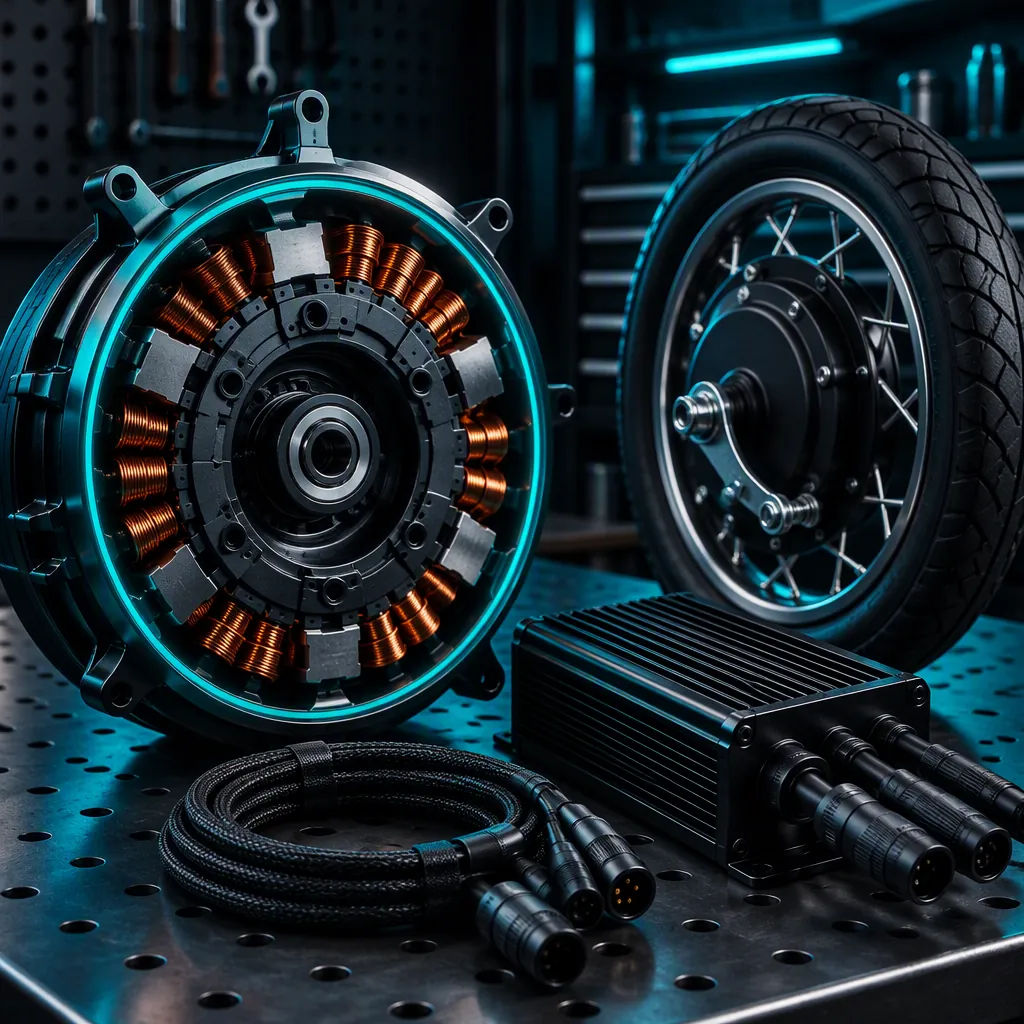
| Motor and controller | 1-2 years | Water-ingress claims; connector corrosion |
| Battery | 1-2 years or 500 cycles | Which comes first; capacity retention % at end of term |
| Wear items (pads, shoes, tires, cables) | 30-90 days | Explicitly excluded from the main warranty |
The battery clause deserves special attention: "500 cycles" means nothing without a defined discharge depth and test temperature. A 60V 32Ah pack cycled to 80% depth at 25 degrees C should retain 80% capacity at 500 cycles. Put that sentence in the contract. The chemistry and BMS context behind it is in our battery technology guide.
The Wear-Item Pipeline: What Must Be Stocked
Every trike model needs a defined wear-item list with factory-stocked availability and quoted lead times. The minimum set for a cargo trike:
- Brake pads and drum shoes. The highest-frequency wear item. The platform runs a hydraulic disc front with dual drum rear and a parking brake, so both service kits must be stocked separately. Pad life runs roughly 3,000-5,000 km, shoes 8,000-12,000 km. Spec details are in our cargo trike brake guide.
- Tires and inner tubes. The 3.00-12 front and 3.75-12 dual-rear sizes are common across Chinese trike brands, which helps. Confirm the load rating matches your model, a loaded 500 kg non-EU unit puts real stress on the rear pair. See our tire guide.
- Controller and throttle assembly. The most common electronic failure. Demand the factory hold minimum stock of the exact controller revision your fleet runs, since firmware and connector pinouts change between revisions.
- Charger and charge port. Chargers fail from heat and cable strain. A fleet should hold one spare 5A charger per 5-8 trikes, matching the 60V or 72V pack voltage your units ship with.
- LCD display, lights, and switches. Low-cost items that cause the most downtime per dollar, because a dead display grounds an otherwise healthy vehicle.
For each item, get three numbers in writing: price, MOQ, and lead time by sea versus air. A factory that cannot quote these numbers has no parts pipeline.
Parts Kits: Stocking for a Fleet, Not for a Single Trike
Rather than ordering parts one at a time, contract a spare parts kit sized to fleet count. A workable rule of thumb for a 10-trike fleet over 12 months:
- 10 sets of front brake pads and 10 sets of rear drum shoes (one set per trike per year)
- 6 tires and 8 inner tubes in 3.00-12 and 3.75-12 (the dual-rear layout wears the rear pair fastest)
- 2 controllers, 2 throttles, 3 chargers, 2 LCD displays
- 1 full wiring harness plus a box of connectors, fuses, and cable ties
A kit priced at roughly 3-5% of the fleet's vehicle value keeps availability above 95% without emergency air freight. For used-trike buyers the same logic applies in reverse: verify parts availability before purchase, one of the checks in our used trike buying guide.
RMA and Defect Handling: What the Contract Should Say
Defects will happen; the contract decides whether they become a crisis. Four clauses to include in every import agreement:
- Defect definition and evidence. What counts as a warranty defect (photos, video, diagnostic logs) and who decides. Define the response window: acknowledgement within 48 hours, and a replacement or repair decision within 10 working days.
- Replacement versus repair. Specify that non-repairable components (controllers, displays, battery packs) are replaced outright rather than returned, because shipping a lithium pack back is uneconomic and restricted under dangerous-goods rules.
- Dead on arrival threshold. An agreed DOA rate, typically under 1% of units, above which the factory covers replacement shipping costs.
- Consignment stock option. For larger fleets, negotiate consignment stock of high-failure items at the importer's warehouse, billed only when consumed. This is the single most effective clause for fleet uptime.
Negotiation leverage for these clauses comes from the same factory audit discipline used on the first order. Our cargo trike OEM guide covers what to verify in the factory itself.
The QC Evidence a Factory Should Give You With the Order
After-sales claims are won or lost on the records the factory kept at production time. Ask for the three-gate QC evidence applied to your build:
| Stage | What is checked | Number that matters |
|---|---|---|
| IQC, incoming | AQL 2.5 Level II sampling; cell IR and voltage sorting; frame tube ultrasonic thickness | Cells rejected beyond 3 mΩ IR or 0.02V open-circuit spread |
| IPQC, in-process | Torque verification on every safety-critical fastener, logged to the unit quality passport | Handlebar clamp 25 N·m; axle nuts 40 N·m; caliper mounts 18 N·m |
| OQC, outgoing | Full dynamometer cycle, IP54 spray chamber, 2 km road simulation, 1.2 m carton drop test | 0-25 km/h in under 6.8 s at 75 kg; insulation over 1 MΩ at 500V after spray |
The quality passport is the part that matters for warranty disputes: a serial number that traces back to the cell batch, the torque log, and the test bench results for that specific vehicle. Without it, a defect claim becomes an argument about what happened after delivery. More on the test benches themselves is on our quality and compliance page.
Service Documentation and Technician Training
Parts are useless without the knowledge to install them. The documentation package to demand from the factory:
- Service manual in the target market's language. With torque values, wiring diagrams, and the battery removal procedure. A Chinese-only manual is a red flag for export readiness.
- Controller diagnostic procedure. Error-code table and a fault-diagnosis flowchart. Most electronic repairs are connector and code diagnosis, not component replacement.
- Video-based training. Factory-recorded disassembly and reassembly for the brake system, drivetrain, and battery. Our maintenance guide covers the day-to-day checks that reduce service load.
- Spare parts catalog with stable part numbers. An exploded-view catalog so technicians order by number rather than by description, which is what makes a dealer network possible.
Liability and recall obligations differ by market, which changes what your documentation must contain. The classification side is in our US and EU legal classification guide.
Shipping Spares Without Killing the Margin
The parts kit arrives by a different route than the vehicles. Three real constraints:
- Sea freight for the kit, air for the emergency. A full 20GP holds about 42 partially disassembled units; kits ride along in the same container at near-zero incremental cost. Air freight runs 4-6x sea on a per-kg basis and tops out around 12 units per air pallet, so reserve it for the failure that actually grounds a vehicle.
- Batteries move under dangerous-goods rules. Lithium packs ship as UN 3480 Class 9 with MSDS and UN 38.3 test summary in the document package. By air, packs must be under 30% state of charge per IATA PI 965/966/967 Section II. This is exactly why the RMA clause should specify outright replacement rather than return.
- Packaging is part of warranty survival. Cartons use 7-layer BC-flute board; the outgoing test includes a 1.2 m drop on three edges. The pallet is a 1,100 x 1,100 mm four-way entry unit with steel corner reinforcement rated to 1,200 kg static load.
Transit reality sets your safety stock: 28-35 days to Europe, 18-22 to the US West Coast, 32-38 to the US East Coast, 7-12 to Southeast Asia. A fleet stocking three months of wear items is not being conservative, it is matching the sea schedule. Our fleet charging guide covers the other infrastructure question that decides whether a fleet stays on the road.
How EMS-EBIKE Structures After-Sales for Export Markets
For OEM programs, EMS-EBIKE commits the after-sales package in writing before production: a 12-month vehicle and 24-month battery warranty with defined cycle terms, a stocked wear-item list with quoted MOQ and lead times, spare parts kits sized to fleet count, RMA acknowledgement within 48 hours, and service documentation in the target market's language including a parts catalog with stable part numbers. Accessories and spares are supplied from the same program as the vehicles, battery packs, chargers and motors and controllers with their own certification documentation, so a spare is not a different product with a different supplier behind it. The structure exists because a trike is only as good as its parts pipeline. Start with your fleet size and target market and we will put the after-sales terms on the order before the first unit ships.
Build an After-Sales Program Around Your Trike Fleet
Tell us your fleet size and target market. We will structure the warranty terms, spare parts kit, and service documentation package: including lead times for every wear item.
