
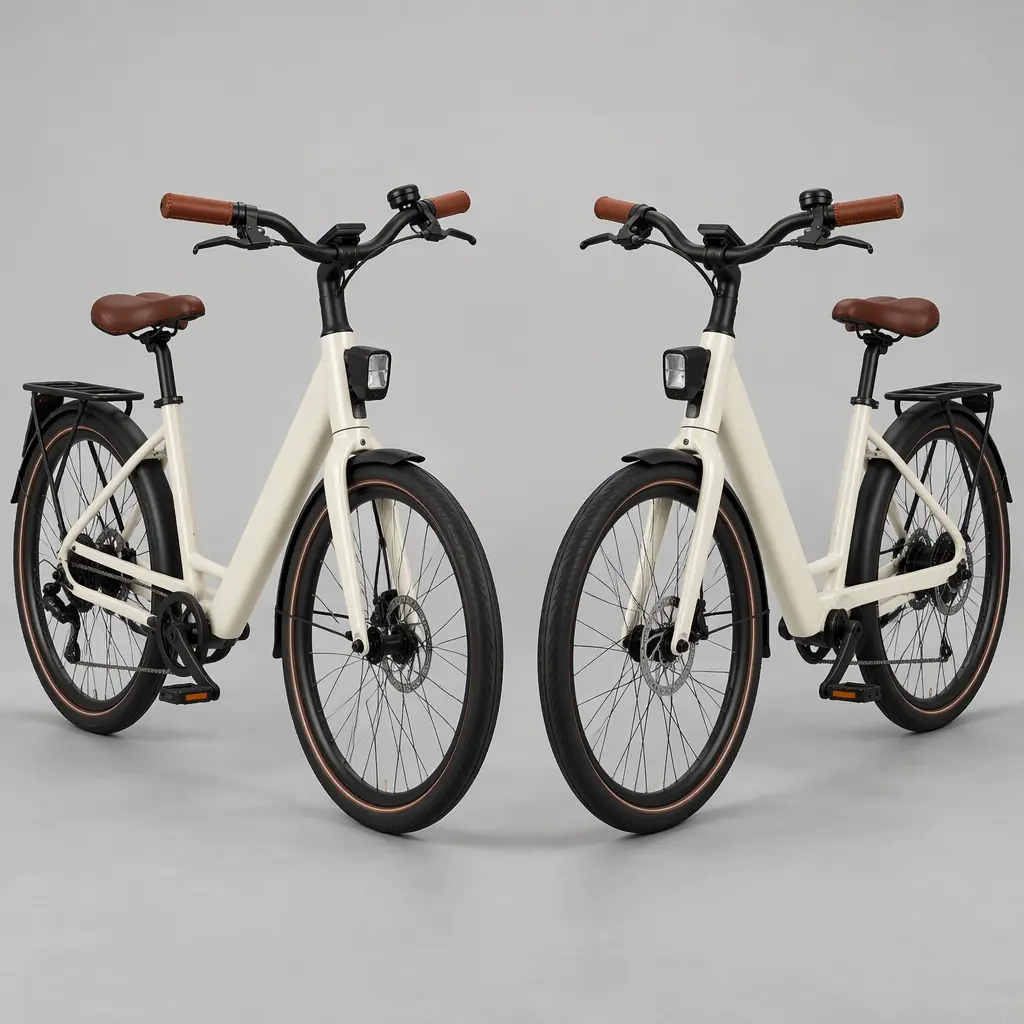
Two identical e-bikes leave the same assembly line on the same day. One is sold in Rotterdam and one in Denver. Under the two regulatory frameworks that govern them, they are not the same product at all — and if you built a single batch expecting to ship both without modification, one of those containers is going to sit at the port of entry while your compliance engineer re-opens the electrical design.
EN 15194 and UL 2849 are both called "e-bike certification," and that shared phrase is where most first-time importers lose money. They are written by different bodies, tested against different hazards, scoped differently across the vehicle, and validated through different paperwork chains. A test report from a Chinese lab can satisfy one and mean nothing to the other. This guide walks through what each standard actually requires, where the two diverge in ways that force a hardware change, and how a platform can be engineered from the start so that both paths remain open.
What EN 15194 Actually Covers
EN 15194 is the European standard for electrically power assisted cycles — EPACs. Its scope is narrow by design. It applies to cycles with pedal assistance, a motor with a rated continuous output of no more than 250 W, and assistance that cuts off at 25 km/h and progressively reduces before that point. Ride a bike outside any one of those three numbers and it stops being an EPAC: it becomes an L1e-B moped, which pulls in type approval, a different helmet regime, licensing and insurance. That tripwire sits at the specification stage, not at the test house.
The standard then addresses four further groups of requirements. Electrical safety covers the battery, the motor, the controller, the charger and the wiring — insulation, short-circuit behaviour, overcharge and over-discharge protection. Mechanical integrity covers frame and fork fatigue, which is why a frame designed for a 250 W pedal-assist motor is not automatically acceptable once a 750 W unit is bolted into the same dropouts. Electromagnetic compatibility has its own requirements for both emissions and immunity, and the functional safety section covers failure modes such as a runaway throttle or a motor that keeps driving after the rider stops pedalling.
Two practical points follow. First, EN 15194 is a standard, not a certificate: compliance is demonstrated through testing plus a technical file, and the CE marking on the frame is the manufacturer's declaration that the file exists and the design conforms. Second, the standard does not test the complete vehicle as one indivisible object — it tests the electrical power assist system in the context of the cycle, which is why a platform with a documented test lineage is far easier to keep compliant across model variants than a frame-up new design each season.
What UL 2849 Actually Covers
UL 2849 takes a different approach: it certifies the electrical system as a whole. The standard, formally titled "Electrical Systems for eBikes," was developed with a strong fire-safety emphasis, and its scope is explicitly the combination of battery, motor, controller, wiring harness, charger and the interaction between them. That "system" framing matters commercially, because it means component-level approvals do not add up to a vehicle-level pass. A UL-recognised battery and a UL-recognised motor, correctly assembled into an unrecognised system, is still an unrecognised system.
The test programme revolves around the failure modes that produce fires: overcharge, over-discharge, short circuit, abnormal operation, and thermal propagation behaviour of the pack. It also addresses the mechanical and environmental abuse a pack can see in normal use — vibration, drop, crush, and water exposure — plus the charger as part of the system rather than as an accessory. Documentation is audited as much as the product: the bill of materials, the cell specification, the BMS firmware behaviour and the factory's process controls all form part of what a certification body reviews.
For an importer, the consequence is that UL 2849 is closer to a product-family certification than to a one-off test. Once a platform's electrical system is certified and the factory's process is under follow-up inspection, adding a colourway is cheap and adding a differently-rated battery is not. Retail and insurance requirements in North America tend to name UL 2849 specifically, so the standard is frequently a market-entry gate rather than a nice-to-have.
Where the Two Frameworks Diverge in Ways That Cost Money
The table below summarises the differences that most often force a redesign or a second production run. It is written from the perspective of a buyer who wants one platform serving both markets.
| Aspect | EN 15194 (EU) | UL 2849 (North America) |
|---|---|---|
| Assist limit | 250 W rated continuous, cutoff at 25 km/h | No 250 W ceiling; class-based speed limits apply instead |
| Unit of certification | Electrical power assist system in the context of the cycle | The complete electrical system as one certified assembly |
| Driver of the test plan | Functional safety plus EMC | Fire and thermal-event prevention, plus abuse testing |
| Battery treatment | Electrical safety requirements, UN 38.3 for transport | Pack-level abuse and thermal propagation within the system scope |
| Charger | Covered as part of the EPAC electrical system | Explicitly inside the certified system boundary |
| Factory involvement | Technical file held by the manufacturer | Follow-up inspection of the production process |
| Market gatekeeper | CE marking plus a technical file that survives audit | Certification mark commonly required by retail and insurers |
Read the first row and the third row together and the commercial problem becomes obvious. A platform engineered to be excellent in Europe — 250 W, 25 km/h, tuned for a light assist feel — is under-specified for the North American market, where riders expect meaningfully more torque on hills and where the class system permits higher assist speeds. Push the same frame and drivetrain up to satisfy that expectation and the EU file needs re-visiting, because the fatigue and functional-safety assumptions have moved.
The charger row is the one that catches buyers who treat it as a commodity. In the EU framework the charger is part of the electrical system and is addressed within that scope. In the UL 2849 framework it is inside the certified boundary, which means swapping a charger supplier after certification is a change to a certified assembly, not a purchasing decision. Importers who plan to source chargers locally to save freight should know that before the certification is filed, not after.
The Specification Decisions That Keep Both Paths Open
A dual-market platform is not a compromise product; it is a product designed with the divergence known in advance. Five decisions do most of the work.
1. Put the speed and power ceiling in firmware, not in hardware
If the controller's assist curve, cutoff speed and current limit are parameters rather than fixed by the motor winding and the shunt, one hardware build can serve an EU configuration at 250 W / 25 km/h and a North American configuration at a higher assist level. Our e-bike platforms are specified with configurable controller tuning precisely for this reason, and the city commuter platform ships at 25 km/h EU-compliant with an unlockable 32 km/h setting for markets that permit it. The engineering discipline this requires is that the locked configuration must be genuinely locked — a dealer-accessible menu that reverts the vehicle to an uncertified state undermines the file.
2. Choose the battery pack for the stricter framework, then verify the lighter one
It is far cheaper to certify a pack built to the abuse-testing expectations of the North American framework and then document it against the European requirements than to run two pack designs. On the city commuter platform the pack is a removable downtube unit in 36 V 10 Ah / 48 V 15 Ah, with 10 Ah, 13 Ah and 15 Ah options and a choice of Samsung, LG or Panasonic cells. Cell provenance is not a marketing detail here: a change of cell supplier is a change of the pack's thermal behaviour, and both frameworks care.
3. Treat the charger as a certified component from day one
Because UL 2849 places the charger inside the system boundary, the charger supplier should be selected before the certification programme begins and should not change without a documented review. The practical answer is to keep the charger inside the OEM package rather than sourcing it separately — the standard 2 A charger on the city commuter brings a 36 V 10 Ah pack to full in four to six hours, and its inclusion in the order file keeps the system boundary intact.
4. Match the mechanical spec to the higher-performance variant
Brakes and tyres are where a light EU build and a heavier North American build stop sharing parts. The city commuter runs Tektro mechanical discs with 160 mm rotors as standard, with a hydraulic upgrade available; the fat tyre platform, which is engineered around 500 W / 750 W and 48 V 15 Ah or 20 Ah packs with 60–80 km of range, uses hydraulic discs with 180 mm rotors front and rear. If you intend to sell one frame into both power tiers, specify the brake and tyre package for the higher tier and accept the small cost premium on the EU variant rather than maintaining two builds.
5. Fix the labelling and marking plan early
Marking is a surprisingly common source of delay. The EU path expects the CE marking and the associated technical documentation to be in place and consistent with the declaration. The North American path ties the product to a certification mark and to a listing that names the manufacturer and the model. Both require the name on the label to match the party that holds the file — which is why a branded order needs the dossier assembled in the buyer's name, with the buyer as the responsible party, and cannot simply inherit the factory's existing paperwork without amendment.
What the Test Evidence Looks Like in Practice
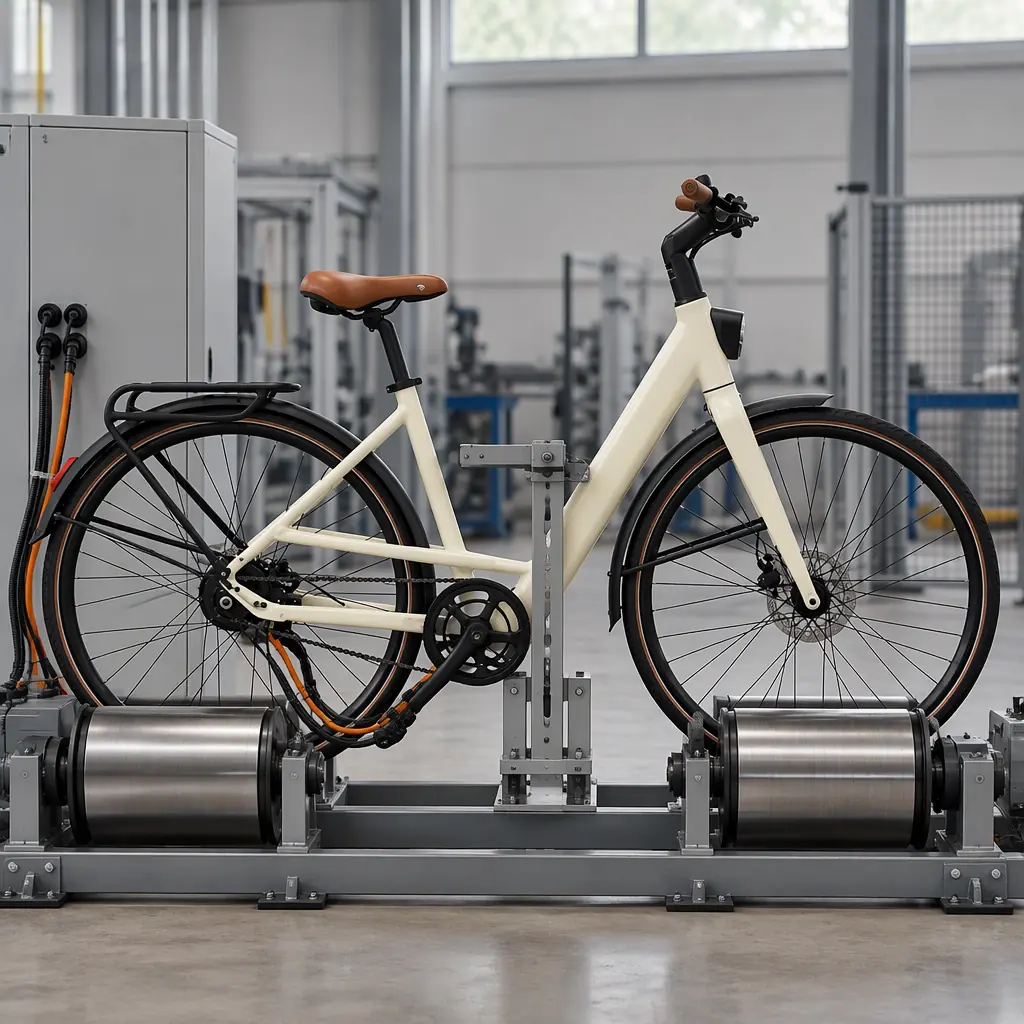
Both frameworks are satisfied by evidence, and the evidence is generated before the vehicle reaches a certification body. On our side that evidence starts in the test laboratory rather than in a filing cabinet. Motor batches are run on a dynamometer with a 0–3000 W measurement range, mapping efficiency from 30% to 100% throttle across an equivalent 0–45 km/h, with an acceptance threshold of 82% peak efficiency for hub motors and 78% for mid-drive units. Torque curves and efficiency plots are produced for every new motor batch, not just the first.
Battery packs are cycled in a programmable thermal chamber from −20 °C to 60 °C at 0.5C and 1C, and a new cell supplier must demonstrate 200 cycles at 45 °C with less than 15% capacity fade before approval, with production packs sampled at one in 200 units for full thermal profile validation. Water exposure is a chamber test rather than a hose test: a 360-degree spray array delivers 10 L/min from twelve nozzles for three continuous minutes with the electrical system powered, and post-spray insulation resistance must exceed 1 MΩ at 500 V DC between the battery terminals and frame ground. Braking is measured as stopping distance from 50 km/h on a simulated 0.7 µ surface, with an acceptance threshold of 4.2 m for 160 mm rotors and 3.8 m for 180 mm rotors at 75 kg total system mass.
What arrives with the container is the part importers most often find missing when they change supplier: per-order test reports, cell and BMS documentation, UN 38.3 transport summaries for the battery, and the market-specific technical file — compiled with the order so that a customs broker or a regulatory consultant can act on it immediately. UN 38.3 deserves its own line here, because it is a transport requirement that applies regardless of which market the bike is destined for, and a pack that cannot travel legally never reaches a test house at all.
Certification Is Not the Same Question as Vehicle Classification
A compliance file tells you the product meets a standard. It does not tell you how the vehicle is classified on the road, which varies by jurisdiction and can determine whether the rider needs a licence, registration or insurance. Some markets treat a 250 W pedelec as a bicycle for all practical purposes; others regulate by class and speed; still others have local rules that a national standard does not resolve. This is a separate analysis from certification and should be run in parallel, not afterwards. Our guide to electric tricycle laws in the US and EU covers how classification works for three-wheeled platforms, and much of the reasoning transfers directly to two-wheelers sold into the same states and member states.
The distinction has a commercial edge: importers occasionally discover after certification that a model is legal to sell but awkward to register, or that the local class assigned to it restricts where it can be ridden. Resolving that in the specification phase is cheap; resolving it after the first container lands is not.
Beyond the Two Big Markets
Very few distributors sell into exactly two jurisdictions. The United Kingdom maintains its own marking framework, and while the technical content sits close to EN 15194, the documentation route is separate and cannot be assumed to follow automatically from an EU file. Australia, New Zealand, Canada and the Gulf markets each layer their own requirements on top of, or instead of, the European and North American standards.
The efficient way to handle this is to treat the two major frameworks as the design envelope and then map each additional market onto that envelope, asking a single question per market: does this jurisdiction require a different electrical design, or only different paperwork? Most answers are the latter. Where the answer is the former — for example a market that mandates a lower assist cutoff or a specific battery chemistry — that becomes a firmware configuration or an option code rather than a new platform.
Where Importers Most Often Get the Sequence Wrong
Three sequencing errors account for most of the avoidable cost. The first is certifying before the specification is frozen: a change of cell supplier, motor rating or charger model after the file is issued means revisiting the certification, and the second round is rarely cheaper than the first. Freeze the bill of materials, then test.
The second is treating the sample as representative. A pre-production sample that passes is not the same claim as a production run that conforms, and both frameworks ultimately rest on the factory continuing to build what was certified. That is why process quality matters to a compliance conversation — torque verification on safety-critical fasteners, battery BMS functional checks, pressure-decay leak testing on the battery compartment and an outgoing inspection at AQL 1.0 are not a separate quality story, they are the mechanism by which the certificate stays true. Buyers who want to understand how that process is inspected can read our breakdown of the electric tricycle manufacturing process, which describes the same station-by-station logic that applies to two-wheelers.
The third is under-documenting the shipment. The certification is one document among many that a customs broker and a distributor's insurer will ask for. A dossier that arrives incomplete at the destination — missing a test report, missing the transport summary, missing the declaration — tends to surface as a delay measured in weeks.
A Practical Checklist Before You Place the Order
- Confirm the assist ceiling and cutoff your target markets require, and verify they are set in controller firmware rather than fixed in hardware.
- Fix the battery pack specification, including cell supplier and capacity, and confirm it against the stricter of the two abuse-testing expectations.
- Nominate the charger inside the OEM package and treat any change as a certification event.
- Specify brakes, tyres and frame reinforcement for the highest-performance variant you intend to sell from that platform.
- Decide who is the responsible party on the label, and have the dossier assembled in that name.
- Ask for the per-order documentation set in writing before the deposit, including the UN 38.3 transport summary.
- Run the vehicle-classification question for each jurisdiction in parallel with certification, not after it.
How a Single Platform Can Serve Both Markets
Our e-bike range is organised as five platforms — city commuter, fat tyre, folding, cargo and mountain — each specified so that the electrical system, the mechanical package and the documentation can be configured per destination market. The compliance package on every order covers EN 15194, UL 2849 and UN 38.3, with the market-specific technical file compiled alongside the order rather than reconstructed later. Orders start at 50 units per model with a 15–30 day standard lead time, extending to 30–45 days for a first custom-branded run, and custom cell selection or controller retuning typically adds five to seven days. Geometry changes or proprietary components move the minimum to 200 units with first-article samples at roughly 45 days.
If the platform choice itself is still open, the comparison between hub and mid-drive motors is worth settling before the certification scope is fixed, since the drivetrain choice changes the efficiency evidence a test house will want to see. For battery-specific questions, the battery technology guide covers cell chemistry and pack architecture in more depth than this article can. Distributors building an opening container often pair one commuter SKU with one fat tyre SKU, and the fat tyre OEM guide explains why that second SKU behaves so differently under certification: higher power, larger rotors and a heavier all-up mass all move the test plan.
Where the target market includes commercial or institutional buyers, the certification question usually arrives alongside a tender or a fleet requirement, and the government fleet e-bike guide sets out what those buyers tend to ask for in the documentation pack. Buyers comparing a two-wheeler against a three-wheeled platform for the same duty should start with electric tricycle versus e-bike, because the certification and classification paths diverge sharply at that fork.
None of this is exotic engineering. It is a matter of deciding, before the bill of materials is frozen, which framework sets the ceiling on each subsystem and which one only sets the paperwork. Get that mapping right at the specification stage and one platform serves both markets with a firmware configuration and a documentation set. Get it wrong and the cost surfaces later, at the port, in the form of a container that cannot be sold into half the markets it was built for.
Enquiries that arrive with a target country list and a draft specification can be answered with a compliance mapping rather than a price alone. Send the destinations, the assist speed you intend to sell, and the battery capacity you are planning, and the reply can identify which framework will govern each market, which subsystems are likely to need a second variant, and where the documentation burden actually falls before any deposit is committed.
Need Help with E-Bike Certification for Your Target Market?
Our compliance engineers can map out the exact certification path, EN 15194, UL 2849, UKCA, AS 15194, or multi-standard, for your specific product specification and target countries. Test reports included in your OEM/ODM order package.
