
A cargo tricycle carries its payload on three tires, and the arithmetic is unforgiving. A 500 kg-class trike with a full load runs a gross weight near 700 kg spread across three contact patches, and the rear pair takes the larger share of it on two 3.75-12 tires. Each rear tire does work that a passenger-car tire spreads across four wheels and a much larger footprint. Tires are the most abused component on a working cargo trike and the last line on most buyers' spec sheets. This guide covers what to put in the RFQ: load ratings, the dual-rear-wheel layout, tread selection by duty cycle, pressure discipline, and the wear limits that decide replacement. It is written for OEM buyers and fleet operators.
Why Tires Are a Spec, Not an Accessory
A cargo trike tire set has three jobs, and each one is a load-bearing engineering decision:
- Carrying the payload. The EMS-EBIKE cargo platform is rated 300 kg payload for EU configurations and 500 kg for non-EU configurations, on a chassis that weighs 150–220 kg without the cargo box. That is continuous load on tires built to utility-vehicle duty, not bicycle duty. A bicycle-casing tire at this load fails quickly; a load-rated 12-inch utility tire does not.
- Absorbing road shock. The tire sidewall is the first stage of suspension on a three-wheeler. Because the third wheel transmits shock straight into the frame (that trade-off is covered in our cargo tricycle suspension guide), the tire's air volume and sidewall stiffness define much of the ride quality a driver actually feels at the end of a shift.
- Delivering drive and brake torque. The rear tires transmit torque from an 800W–1200W hub motor and hold braking force from the hydraulic disc front and dual drum rear brakes. A tire with insufficient grip or an over-inflated footprint turns braking performance into a liability.
That is why the tire spec is a durability decision rather than a comfort one. The consequences of undersizing show up as sidewall failures and pinch flats inside the first 1,000 km, exactly the warranty-return pattern fleet operators want to avoid.
The Dual-Rear-Wheel Layout: Sizing and Load Distribution
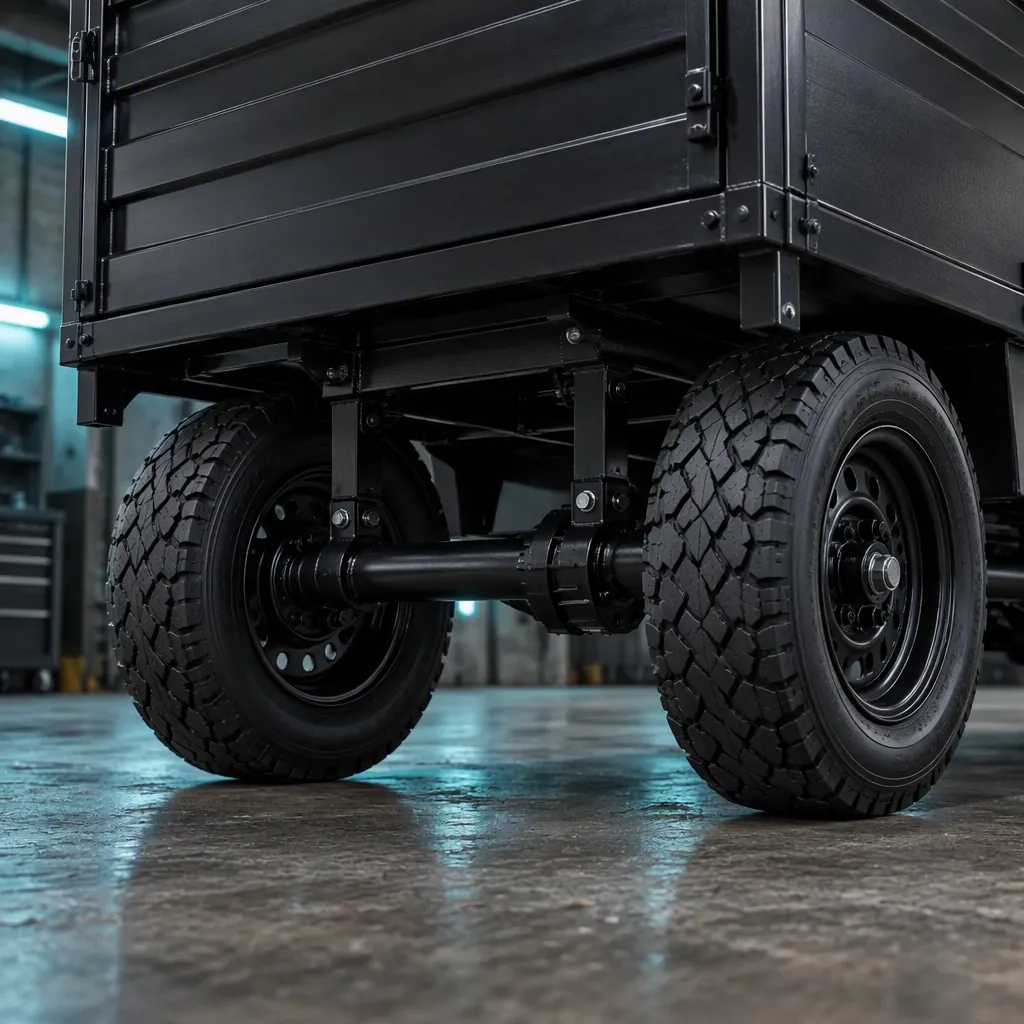
The standard EMS-EBIKE cargo build runs 3.00-12 front and 3.75-12 rear, dual, reinforced load-rated. The split follows load, not looks:
- 3.00-12 front. The front tire carries roughly 35–40% of gross weight and does all the steering. A 3.00 section balances contact patch against steering effort; fitting a wider tire adds scrub radius and heavy steering without adding payload capability.
- 3.75-12 rear, dual. Each rear tire carries the larger share of gross weight on a fully loaded 500 kg trike. The 3.75 section on a 12-inch rim provides the sidewall height and air volume needed to survive potholes and curbs at rated load. Two rear tires also mean a flat on one side does not leave the vehicle stranded on a live road, a genuine fleet-safety argument.
- Differential or freewheel. The rear axle has to let the inside wheel rotate slower than the outside wheel in a corner. A solid axle scrubs the inside tire on every turn, wears it out in months, and makes low-speed cornering feel unstable. The drivetrain side of that decision is covered in our cargo tricycle motor power guide.
When you specify tires for an OEM program, the size is a system decision: rim width, load rating, and tire outer diameter all have to stay inside the envelope the frame, brake, and fender designs assume. Changing tire OD by even 20 mm changes speedometer calibration, brake leverage, and ground clearance.
Load Ratings: What the Sidewall Numbers Actually Mean
Utility tires in this class carry a load index and a speed symbol stamped on the sidewall, and the load index is only valid at the rated inflation pressure. On a cargo trike, pressure loss is not a comfort issue:
| Specification | What it covers | Cargo trike requirement |
|---|---|---|
| Front: 3.00-12 | Steering axle, roughly 35–40% of gross weight | Load-rated utility casing; semi-slick or hybrid tread by route |
| Rear: 3.75-12 dual | Drive axle, the larger share of gross weight | Reinforced load-rated casing; the higher-capacity ply option for the 500 kg class |
| Load index | Maximum load per tire at rated pressure | Sized so the dual rear pair covers the loaded axle with margin |
| Speed symbol | Rated maximum speed of the casing | Platform top speed is 25–35 km/h, so any utility symbol clears it |
| Construction | Tubeless vs tube-type | Both run on 12-inch utility rims; tube-type is easier to service in the field |
| Inflation pressure | The pressure at which the load index is valid | Set to the sidewall rating for the loaded axle, not to a generic number |
The pressure point is where most fleets lose tire life. Run a rated tire well below its spec pressure and its real load capacity drops with the pressure: under-inflated rear tires on a loaded trike overheat, the sidewall flexes further on every revolution, and the casing eventually delaminates. That failure mode, not tread wear, is what ends most cargo trike tires early.
Tread Patterns: Street, Off-Road, and Hybrid
Tread selection follows the duty cycle, and the same chassis can ship with three different tire fits:
- Street / semi-slick. The default for urban delivery and vending routes. Lower rolling resistance means more range per charge and a quieter ride. Street fit is the right call for mobile vending and food delivery trikes that live on pavement.
- Off-road / knobby. Deep lugs for gravel, farm tracks, and mud. The trade-off is real: knobby tread costs range through rolling resistance and wears faster on asphalt. Farm and ranch operators should read the terrain guidance in our electric tricycle farm and ranch guide before choosing.
- Hybrid / all-terrain. A center rib with shoulder lugs. The pragmatic middle for mixed routes, such as a rural delivery loop that touches 60% pavement and 40% gravel, or courier work that occasionally leaves the curb.
The rule: spec the tire for the worst surface the route touches regularly, not the average. A trike on knobbies wastes range on pavement; a trike on street tires fails in mud season.
Air Pressure: The Maintenance Number That Matters Most
On a cargo trike, tire pressure is not a check-every-few-weeks item. It is the difference between a long tire life and a short one. The discipline:
- Check cold, weekly. Pressure rises with heat, so check before the first run of the day. A 10 psi swing between cold and hot is normal; the cold number is the spec.
- Pressure follows load. A lightly loaded trike runs lower rear pressure than one at full payload. At full rated load, set the rear pair to the sidewall rating for the tire fitted, and set the front to its own rating rather than copying the rear number.
- Front pressure matters for steering. The front tire carries less weight, but its pressure defines steering response and brake stability. A soft front tire makes the trike feel vague at speed and stretches hydraulic disc braking distance.
For fleets, a gauge in every vehicle plus a weekly inspection slot in the maintenance schedule (the full schedule is in our electric tricycle maintenance guide) removes most tire-related downtime. The same schedule is where you catch the slow leak that would otherwise become a roadside flat.
When to Replace: Wear Limits and Age
Cargo trike tires fail in four ways, and each has a hard limit:
| Wear mode | Inspection | Replace at |
|---|---|---|
| Tread depth | Wear bar across the tread groove | At the wear bar (roughly 1.6 mm remaining) |
| Sidewall cracking | Visual check for weather checks and dry rot | Any crack reaching the casing |
| Age | Date code on the sidewall | Roughly 5–6 years regardless of remaining tread |
| Dual-rear mismatch | Compare diameter and tread of both rears | Replace both sides together; a mismatched pair overloads the larger tire |
| Impact damage | Bubble or bulge in the sidewall after a curb strike | Immediately, before the next loaded run |
Two fleet notes. First, replace dual rears in pairs; a new tire paired with a worn one makes the new tire carry more load and wear fast. Second, rotate the rear pair at every service interval, because the differential-driven inside tire wears differently from the outside one on routes with many turns.
Tubed vs Tubeless, and Flat Prevention
Both constructions work on 12-inch utility rims, and the choice is a service-strategy decision:
- Tube-type. The field-service favorite. A spare tube is small and cheap, and any mechanic can fit one. The downside is pinch flats when a loaded trike hits a curb or pothole at speed.
- Tubeless. Fewer flats from small punctures, lower rolling resistance, and no tube to pinch. The downside is that sealing a damaged tubeless tire in the field is harder, and the rim has to be tubeless-compatible from the factory.
- Puncture-resistant liners. A belt between tire and tube, or a sealant inside a tubeless tire, stops the small debris that dominates delivery-route flat rates. On glass-strewn urban routes, liners are the cheapest insurance per kilometre.
Whichever you choose, carry one spare per vehicle in a fleet. A flat at the far end of a rural route can otherwise cost an entire delivery shift, the same logistics argument that drives the trailer decision in our electric tricycle trailer guide.
Ordering Tires for an OEM Program
When tires go into an RFQ for a cargo trike program, specify the set rather than the size:
- Front: 3.00-12, load-rated, street or hybrid tread matched to your route mix.
- Rear: 3.75-12 dual, reinforced load-rated, matching tread, same production batch where possible.
- Construction: tube-type or tubeless, with liners or sealant if the route is urban.
- Spares: one spare tire and tube per vehicle written into the fleet contract.
- Validation: ask the factory for the loaded-vehicle tire test at rated pressure, with temperature and wear data rather than a marketing photo. The wider factory evaluation process is in our cargo e-tricycle OEM guide.
Seasonal Planning Before the Order Ships
Plan for winter before it arrives: cold air contracts, snow changes grip, and the dual-rear layout has specific cold-weather handling that differs from a two-wheeler. The operating protocol is in our electric tricycle winter guide. Getting the tire set and the seasonal pressure schedule into the same RFQ is the cheapest way to avoid a first-winter warranty conversation.
Spec the Tire Set With Your Cargo Trike Order
Tell us your payload class, route surfaces, and climate. We will spec the 3.00-12 front and 3.75-12 dual rear tire fit, the pressure schedule, and the spare parts package with your cargo trike order, backed by loaded-vehicle test data from the sample phase.
