
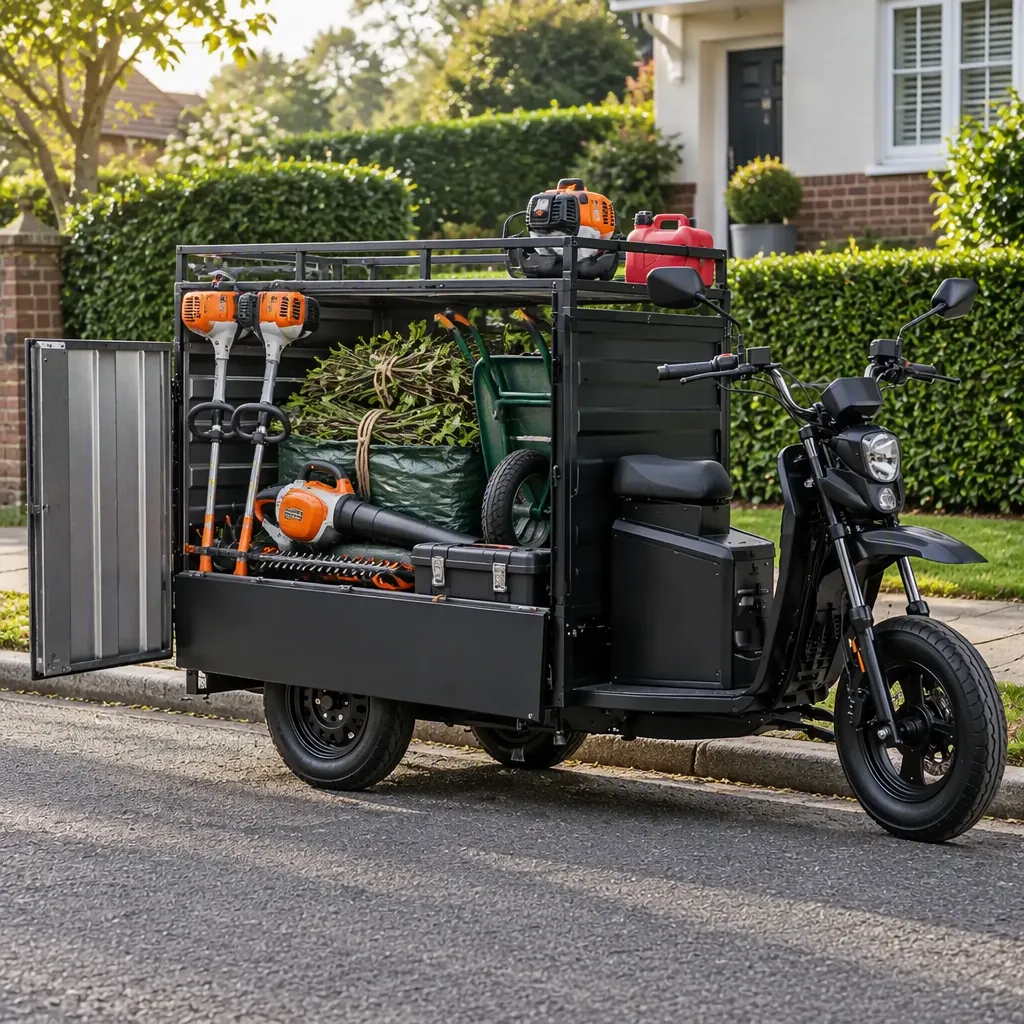
The maths on a grounds maintenance contract is not decided by cutting speed. It is decided by how many times a day the crew has to stop work and drive back. A two-person crew running a suburban mowing and hedge round will lose 1.5 to 2 hours a shift to green-waste runs, fuel stops and the second vehicle trip — and every one of those hours is an hour nobody is invoicing. Swapping the crew truck for a one-tool-carrier-plus-one-waste-trike pair is the version of the electric tricycle that actually pays for itself, because it removes the trips rather than the fuel.
That said, most of what gets published about "an e-tricycle for landscaping" stops at the payload rating, and the payload rating is not the constraint. Four other numbers decide whether the fleet works: the towing limit above a 25 km/h platform, the loaded reach to the furthest stop, the tipping stability of a raised load on a sloped yard, and how your municipality treats the material leaving the site. This guide works through all four, then gives the replacement-cycle table that tells you when the truck goes back.
Why One Trike Per Crew Is the Wrong Fleet
Almost every contractor who tries a single cargo trike on a grounds contract makes the same discovery inside a month. One vehicle attached to one crew does not remove a trip, it just moves it: the trike fills with green waste, and someone still drives it back to dump. The truck never leaves the fleet.
The configuration that removes the trip is two vehicles sharing one platform, one dedicated to each half of the job. The route economics of a single-trike landscape operation are covered in our landscaping and grounds maintenance guide:
| Vehicle | Carries | Built as | Removes |
|---|---|---|---|
| Carrier | Tools, second operator, daily consumables | Cargo build, 300–500 L open box, tie-down rails, long-handled tool rack | Fitting the whole crew and tool set into the waste crate |
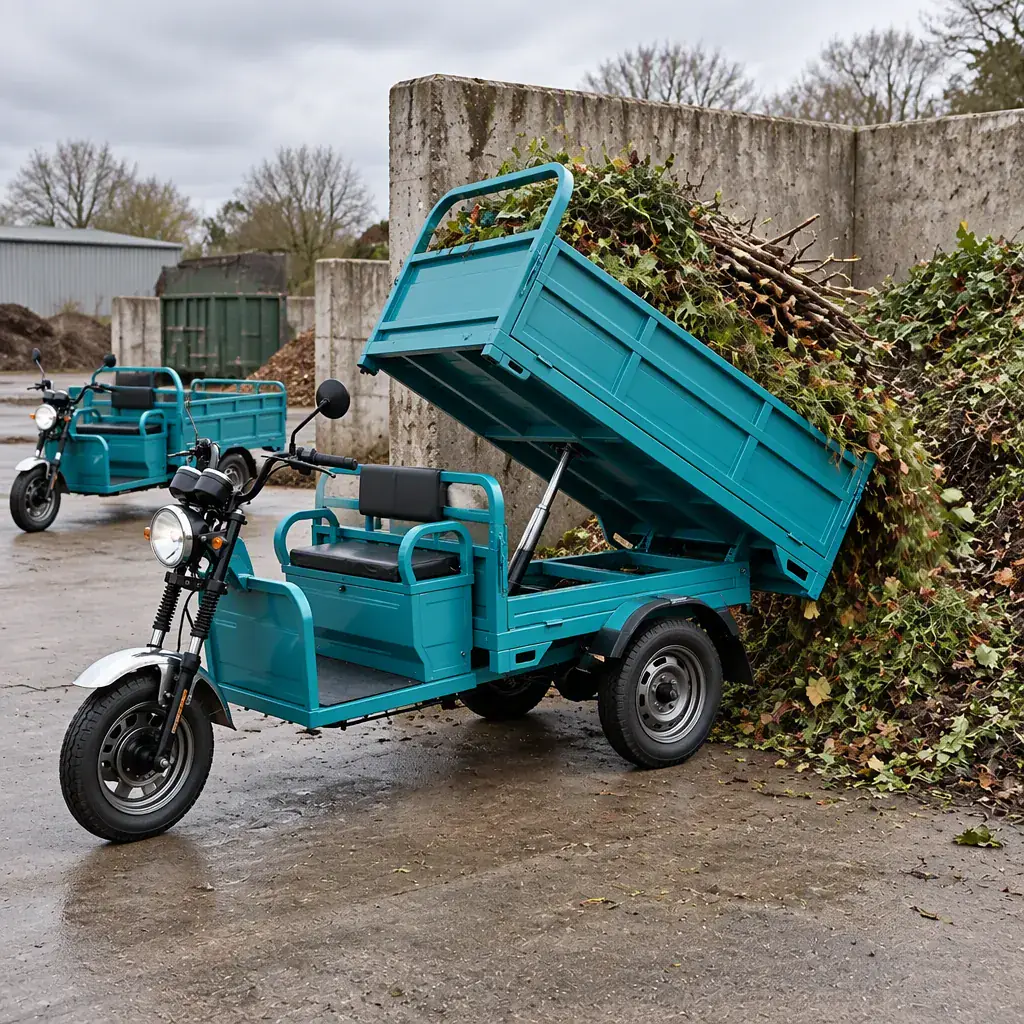
| Waste hauler | Cut branches, clippings, turf, leaf litter | Drop-side build; trailer hitch 200 kg on the frame; 1200W/72V for towed and grade duty | The mid-shift dump run, and the second truck trip for the growing pile |
Both are the same motor, battery, brake and controller platform. That is the whole point: the spare-parts bin stays small, one spare battery fits either vehicle, and either trike can tow when the other is down. A contractor running four crews has eight trikes but one parts shelf.
The two-trike configuration is also the point at which a contractor should stop reading capex per vehicle: the same argument at fleet scale, including the fuel, insurance and maintenance lines, is worked through in our commercial cargo fleet guide. The reason this reads as a two-vehicle solution rather than a downsizing story is in the cost comparison itself — the trike pair costs less than a used pickup purchase outright, and the operating spread is what funds the second trike.
The Real Constraint Is Not Payload — It Is Towing
Payload is the number printed on every spec sheet and the number that almost never limits a grounds crew. A 300 kg (EU class) or 500 kg (non-EU class) rating in a 150–500 L drop-side box covers a full day of tools and trimmings with margin. What actually breaks the configuration is the trailer.
Green-waste routes generate volume, not mass. The trailer types worth considering, the coupling and lighting specification, and the towing-capacity maths in full are in our electric tricycle trailer guide. Two hundred litres of hedge clippings weighs less than 60 kg. That means crews reach for a trailer long before they reach the payload ceiling — and a trailer is where the platform stops being an electric bicycle and starts being a vehicle under a different set of rules.
| Load case | Typical mass | In the box? | Towed? |
|---|---|---|---|
| Daily tool set, top-handle blower, fuel-free battery boxes | 60–100 kg | Yes, with room left | No need |
| One shift of hedge and grass cuttings (compacted) | 100–140 kg | Yes, drop-side dump to a yard bin | Optional |
| Cut branches, bundled, light bulky | 60–120 kg | No — length exceeds box geometry | Flatbed 1.0–1.5 m², 35–60 kg unladen |
| Turf rolls and soil bags from a planting job | 150–250 kg | Marginal | Flatbed with sides, 700 L+ |
| Full-shift waste consolidation at a second site | 200–300 kg | No — needs the tipping bed | Yes, and this is the case that drives the 1200W spec |
Three numbers govern that trailer column, and all three belong in the RFQ rather than in a phone call after delivery:
- Hitch rating, welded to the main frame. A bolt-on or clamped hitch that is fine for a child trailer is not fine for a 300 kg towed load crossing a kerb at 20 km/h every ninety seconds. Specify the hitch welded to the main frame with a stated vertical load limit, and specify it at order time — retro-fitting means removing the bed.
- Lighting made part of the harness. The trailer must mirror the trike's brake lights and indicators through a pre-wired 4-pin connection. Trailer lighting is enforced at the state level in the US even where the trailer itself is below the registration threshold (the state-by-state classification and registration position is in our insurance and registration guide), and a failed tail light is an insurance problem on a public road, not a cosmetic one.
- Braking sized for the combination, not the vehicle. The platform's hydraulic front disc with dual rear drums and a parking lock is sized for the trike at its rated payload. Adding a trailer changes the stopping distance of the whole combination; that is an axle, brake and brake-balance conversation to have with the factory rather than a decision to discover on a downhill approach.
Towing duty also pushes the specification up the range. The 800W class is honest for flat, untowed box work. A trike that tows a flatbed over undulating ground at full payload belongs on the 1200W tier with the 72V 40Ah pack. The torque, winding and power-band logic behind that choice is in our motor power guide and our 60V vs 72V comparison, because the towed load sits outside the rated payload envelope and the motor is now pulling both.
Loaded Reach: What a 25 km/h Platform Actually Covers
The second number is reach, and it is where a grounds operation differs from a delivery fleet. Residential grounds work clusters tightly: most jobs sit inside a 5–8 km radius of the yard, and a crew route runs 20–40 km per day at low speed between properties, which is exactly the profile where the platform wins on cost and access. But the green-waste run is not part of that cluster. It goes to the municipal yard, the composting facility or the transfer station, and in a rural franchise territory that run can be 20–30 km each way.
So two calculations matter, and they are different calculations:
- Route distance per day. Count every stop-to-stop leg twice, because the tool carrier and the waste hauler both travel it. A 30 km route is 60 km of loaded vehicle travel per day across the pair, shared over two packs.
- Loaded reach. The published rating of 50–80 km assumes 200 kg on a level road. Add a towed trailer, add grade, add winter cold and the usable figure drops to the conservative end and below. If the waste run is 25 km each way, one trike on one pack does not complete it with margin in February (the full cold-weather routine is in our winter operating guide), and the honest answer is a swap — not a bigger battery, which cannot be charged any faster on a 5A lead.
This is the single most useful piece of arithmetic in the whole configuration, so it is worth stating plainly: on these platforms a spare battery is a cheaper and more reliable answer than a longer-range battery, because the constraint is charging time, not stored energy. A 60V 32Ah pack needs 6–10 hours on the standard charger. Overnight that is free; mid-shift it is fatal. A second pack in a cradle turns a 6-hour wait into a 30-second swap, and it costs a fraction of a second trike. The cell chemistry and BMS trade-offs behind that recommendation, including why LFP holds up better in an outdoor fleet, are in our battery technology guide and our battery pack selection guide.
Charging itself stays a non-project on this scale. Both trikes plug into a standard commercial wall circuit overnight at 5A each; two on one 15A circuit need staggered start times rather than an electrical upgrade. That is the detail that lets a contractor scale without a facilities conversation. Where a depot does need to add capacity or share a circuit across several units, the arithmetic is in our fleet charging guide.
Green Waste Is Regulated Waste
The third constraint is the one that gets contractors fined, and it is not a vehicle question at all. What leaves a grounds site is frequently not plain vegetation, and the distinction is an environmental compliance matter rather than a transport matter.
The practical separation, from the point of view of what you can put in a load:
| Material | Accepted as clean green waste? | Practical handling |
|---|---|---|
| Grass cuttings, hedge trimmings, leaves, branches | Normally yes | Standard drop-side load, tipper out at the yard |
| Treated timber, fence panels, pallets | No | Separate load, separate destination, or leave for a waste carrier |
| Turf containing soil and stones | Depends on the receiving site | Confirm before the first load, not after |
| Root balls and soil | Usually a soils stream, not a green-waste stream | May need its own skip |
| Bags and packaging from plant deliveries | No | Segregate on site; never in the same crate |
Because sites accept different streams, the crate needs to be dividable rather than simply large. That argues for a drop-side box with a mid-length divider as a factory option, and it argues against the enclosed box: an enclosed box trailer is the right choice for weather-sensitive cargo and the wrong choice for material that has to be tipped out by hand at the end of the shift.
Compaction is the other half of the problem, and it is a vehicle safety question rather than a volume question. A load that spills over the crate rails changes the centre of gravity, and a drop-side dumping cycle on soft or sloped ground is a genuine rollover risk rather than a theoretical one. Two rules prevent it: load to the rail line and no higher, and dump on firm, level ground with the crew clear of the tipping side. The visibility and lighting configuration that goes with kerbside work is covered in our safety features guide. The stability geometry that makes this manageable is the same low centre of gravity that the delta three-wheel layout — one wheel at the front, two at the rear — provides, and it is the reason a trike tolerates a dumped load that a two-wheel cargo bike cannot.
The Replacement Cycle: When the Crew Truck Actually Goes
Contractors rarely replace a truck with trikes on day one, and the ones who succeed do not plan to. They plan a cycle. Three stages, each with a measurable trigger:
- Stage 1 — Prove it on one contract. One carrier and one waste hauler, running the two hardest routes you have for a full season. The metric is not fuel saved: it is trips removed per shift. If a pair does not remove a return journey a day, the configuration is wrong for that contract and you have learned it for the price of two units.
- Stage 2 — Retire the second vehicle. Two-person crews often run a truck and a van. Once the trike pair covers the route, the second vehicle's utilisation has to justify itself against insurance, servicing and depreciation — and this is the point where the trike becomes a $/km argument in a fleet review rather than a fuel-saving argument.
- Stage 3 — Keep the truck for what it is actually good at. Long tows, spoil and turf disposal, winter snow work, and anything with a plated weight above the platforms’ envelope. A grounds operation that genuinely needs a truck for 20% of its duty cycle is a better business than one running a truck for 100% of it.
Where a fleet order needs to be spread rather than funded outright, the structures available to importers and operators are set out in our fleet financing guide. The financial frame for stage 2 comes from the energy and maintenance lines rather than the purchase price. A full-size pickup runs $0.15–0.25 per km in fuel alone before insurance, plates and depreciation, most of it burned idling between jobs, while a trike route of 3–4 kWh a day at commercial rates lands under $0.02 per km in energy. Replacing the second vehicle is therefore funded by the first vehicle's idle time, not by cutting anyone's wage. The full five-year model including the routes where the truck still wins is in our cargo trike vs pickup cost comparison.
Specifying the Pair: What to Put in the RFQ
The two builds share a platform and diverge in six line items. Both need the same motor, pack, brake set and electronics so that the parts bin, the spare battery and the service procedure are identical.
| Spec | Tool carrier | Waste hauler |
|---|---|---|
| Motor | 800W hub with differential — adequate once untowed | 1200W hub with differential — towing duty and grades |
| Battery | 60V 32Ah, swappable | 72V 40Ah LFP, swappable — better cold behaviour and longer cycle life in a vehicle that lives outside |
| Box | 300–500 L open, tie-down rails, long-handled tool rack, boxed insert for power tools | 150–500 L drop-side with mid-length divider; hydraulic tipper bed option |
| Towing | Hitch fitted as a fleet standard so either trike can take the trailer | Hitch welded to the main frame, 200 kg rating with stated vertical limit, pre-wired 4-pin harness |
| Running gear | All-terrain tyres; 3.00-12 front / 3.75-12 rear dual-wheel spec | Same, plus hydraulic front disc, dual rear drums, parking lock confirmed for towed duty |
| Controls | Reverse gear, LCD readout, full LED lighting | Same, plus a high-visibility beacon for kerbside and road-shoulder work |
Five commercial terms decide whether the fleet is maintainable, and they belong in the first email rather than in a warranty claim:
- MOQ 50 units with a sample first. A pair means two, which sits far below the minimum order quantity; the practical route is to order a demonstration pair, run them for a season, and place the fleet order against the proven configuration rather than against a brochure.
- Lead time 15–30 days on a standard configuration, and 30–45 days for a first order with factory-applied branding.
- Consumables must be re-orderable by specification. Tyres at the 3.00-12 front and 3.75-12 rear sizes (load-index and tread selection for these sizes is in our tricycle tyre guide), brake pads for the hydraulic front disc and dual rear drums, and BMS spares. A fleet that cannot re-order a tyre size locally is a fleet with a parked vehicle — the spares and service-channel structure to look for is described in our after-sales and spare parts guide.
- A service schedule with numbers. Brake inspection interval, bearing play check, battery capacity test procedure. Ask for it in writing at order time; a maintenance schedule that arrives after the first failure is not a maintenance schedule — the intervals worth writing into the contract are set out in our tricycle maintenance guide.
- A documentation pack per unit. Battery transport documentation, the applicable certification file for your market, and the parts list with prices — the same documentation that supports a fleet operator's own insurance and warranty position later.
Dealers and distributors building a grounds-maintenance channel rather than a single-crew sale should also read our China import and landed-cost guide and the cargo e-tricycle OEM program guide — the two documents that decide whether a contractor fleet order is repeatable business or a one-off.
Get the pair right and the second truck stops being a fixed cost. Get it wrong, and you have bought two vehicles that each need someone to drive them back to the yard — which is the trip you were trying to remove in the first place.
Spec a Two-Trike Crew Fleet
Tell us your crew size, your daily stop count, your longest single run, the steepest sustained gradient on your routes, and how your municipality handles green waste and trailer registration. We will spec both trikes off one platform — tool carrier, waste hauler and tow spec included — with the certification file for your market. FOB China, MOQ 50 units, 15–30 day lead time.
