
Safety is the hidden line item in every trike fleet order. A cargo or passenger tricycle that saves $200 at purchase can cost thousands in a single incident: a tipped load, a low-light collision, or a battery failure that grounds the whole batch. Fleet buyers spec safety differently from consumers: every feature must be testable, documented, and repeatable across a production run, because the operator, not the rider, carries the liability. This checklist walks through the four pillars of trike safety, visibility, braking, speed governance, and electrical safety, and ends with the factory test data you should demand before signing an order.
Why Safety Specs Decide Fleet ROI
A trike fleet's cost per kilometer is dominated by three things: energy, maintenance, and incidents. Incidents are the only one that can spike without warning. One collision with a pedestrian at low speed, one cargo spill into traffic, or one battery fire in a warehouse can erase the energy savings of a full year. That is why the safety spec is not a compliance checkbox. It is a financial decision made at the ordering stage, when you still control the hardware.
Three structural facts should shape the spec:
- Most trike incidents are low-speed and daylight . The risk profile is not motorcycle risk. The failures that matter are cargo shifts, brake fade on long grades, and riders being unseen at junctions and driveways.
- The third wheel changes the accident geometry . A two-wheeler falls over; a trike does not, but it can tip on camber and it cannot filter between cars. Stability and visibility specs matter more than top speed.
- Certification is the floor, not the ceiling. EN 15194 and UL 2849 set minimum electrical safety; the lighting, braking, and stability specs below are what separate a safe fleet from a compliant one.
Lighting and Visibility: The Spec That Prevents Most Crashes
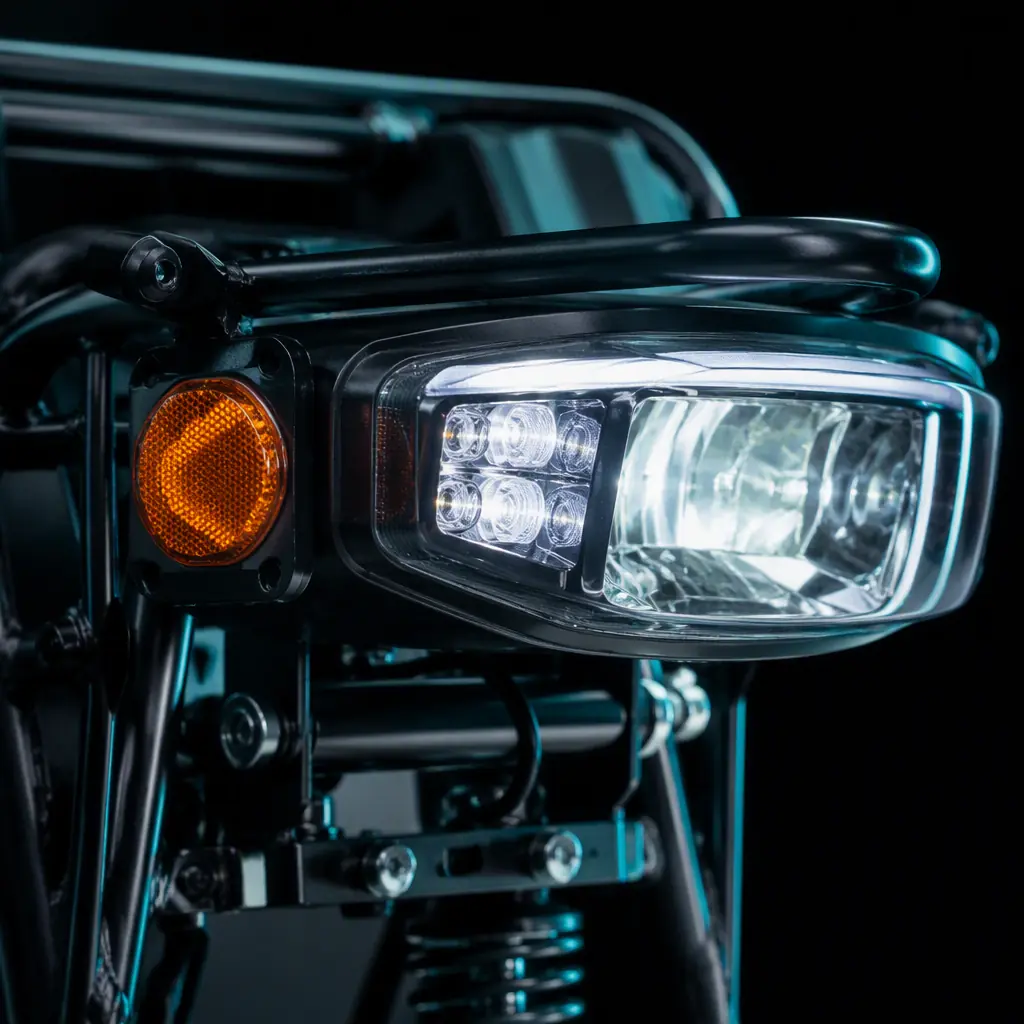
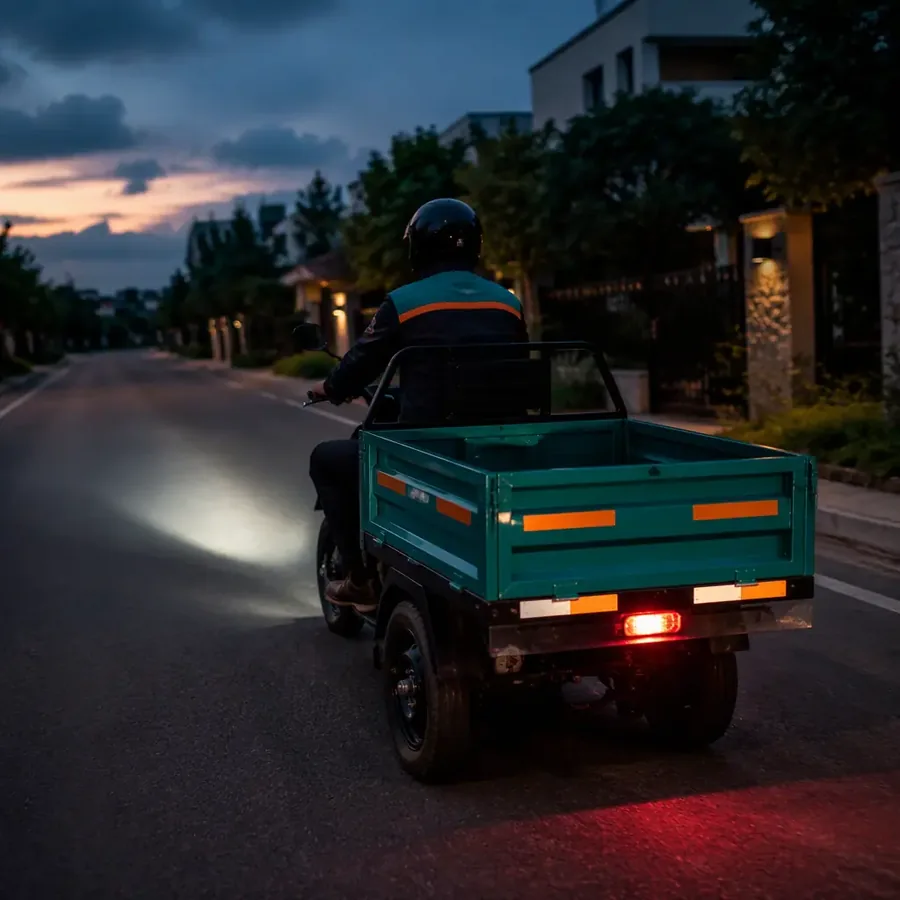
A trike is narrow, sits low, and is easy to miss in a car's blind spot, especially at dusk and on rainy days. The lighting spec is the single highest-leverage safety decision in the order:
- Always-on LED headlight . The headlight should have no off switch. A running light that activates automatically with the ignition is the cheapest crash-prevention feature on the vehicle. Spec a unit of at least 400 lumens with a focused beam for 25–35 km/h riding.
- Wide-angle tail light with brake activation . A 180-degree rear light visible from the sides, wired to brighten when the brake lever is pulled. Drivers approaching from behind need the early brake signal more than a constant glow.
- Reflectors and side markers . Front, rear, and pedal reflectors are the legal minimum; add side reflectors or reflective striping on the cargo bin. A 500 L bin is a large dark surface, treat it as a billboard for reflectivity.
- Turn signals and hazard lights . Standard on our 60V and 72V builds; if your supplier offers them as an option, take the option. Hand signals are not visible on a vehicle with a 300 kg payload behind the rider.
If you ship into the EU, lighting must meet the eMark R50 (headlamp) and R87 (daytime running lamp) requirements for the vehicle class; US buyers should confirm state reflector and lamp requirements, which vary. The regulatory map for both regions is in our EU vs US certification guide.
Braking: Hydraulic Discs, Dual Rear Drums, and the Parking Lock
A trike carries up to 500 kg of combined mass, and all of it must stop on two rear wheels and one front. The braking architecture that works on our cargo and passenger builds is a hydraulic front disc plus dual rear drum brakes with a separate parking brake. Why that combination:
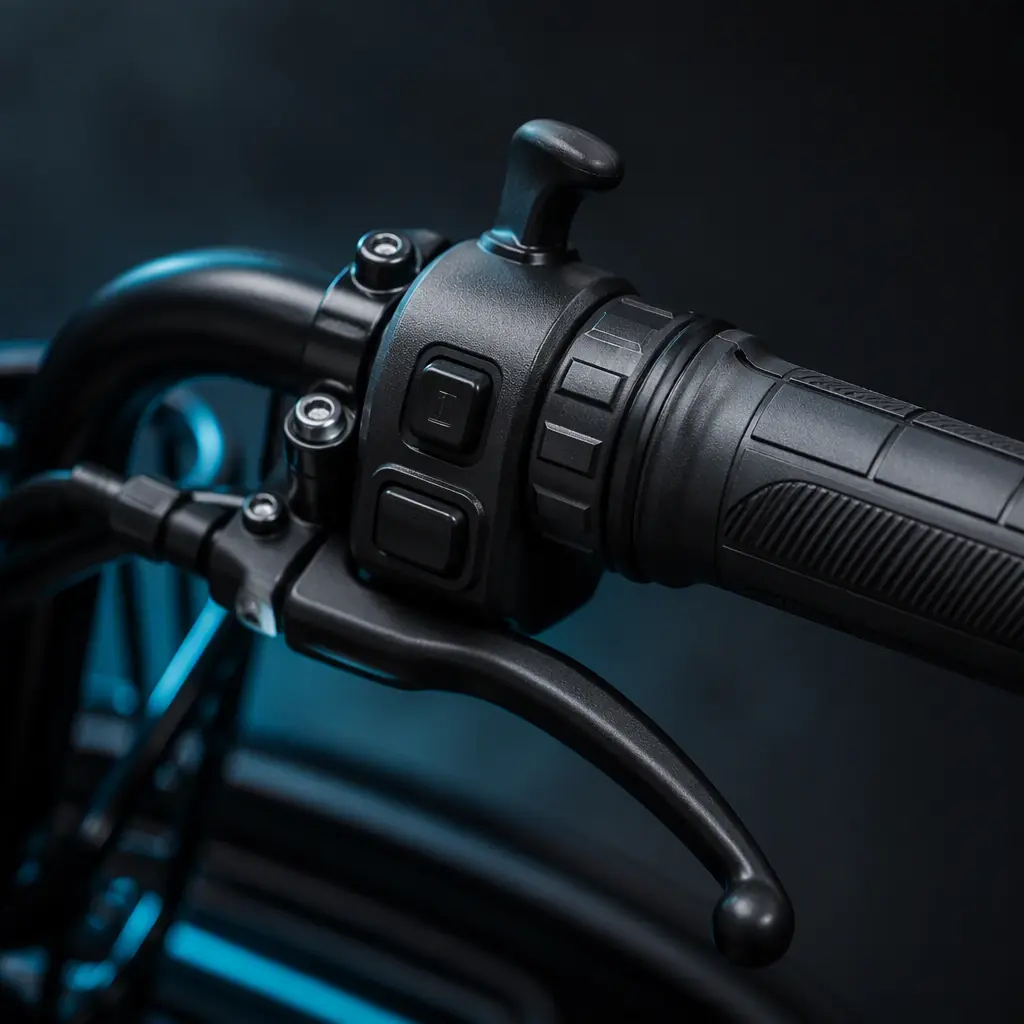
- Hydraulic front disc . The front brake does 60–70% of the stopping work. Hydraulic actuation delivers consistent clamping force with two fingers, which matters on long delivery grades where cable brakes fade.
- Dual rear drums . Drums are sealed against dust and water, last 20,000+ km on trike duty, and provide the even, synchronized rear braking that keeps a loaded trike straight under hard stops.
- Parking brake as standard . A lever-lock on the rear brake holds the trike on slopes while the rider loads or unloads the bin. On a cargo trike, this is a safety feature, not a convenience: a 500 kg vehicle rolling on a driveway is a liability.
The full brake-system engineering, disc sizing, drum lining, wet-weather performance, and the stopping-distance tests to demand, is covered in our cargo tricycle brake systems guide. The number to verify on the sample: stopping distance from 25 km/h at full payload, which should be under 7 meters on dry asphalt and documented per unit type.
Speed Governance: Class Limits and Limiters
Speed is a legal variable as much as a performance one. The controller and motor should be matched to the class you are selling into, and the limiter should be a firmware setting, not a promise:
| Market class | Motor | Assisted speed | Licensing |
|---|---|---|---|
| EU EPAC | 250W continuous | 25 km/h | None (EN 15194) |
| US Class 2 | 750W | 20 mph (32 km/h) | None (most states) |
| Heavy trike (export) | 1000–1200W | 35 km/h governed | Varies by country |
The important procurement detail: the limiter must be enforceable. Verify that the LCD shows live speed, that the controller's speed cap is set at the factory, and that the cap cannot be defeated by a button sequence. Our 1000W and 1200W builds ship speed-governed with the 60V/72V controllers, and the LCD reports speed, battery, and load status. The power-class logic behind these numbers is in our motor power guide, and the state-by-state legal map is in our US and EU tricycle law guide.
Stability: Track Width, Differential, and Center of Gravity
Stability is engineered, not claimed. The specs that define a stable trike are measurable on the drawing before the first sample ships:
- Rear track width . The distance between the two rear wheels. Cargo and passenger trikes should spec 650–750 mm; below 600 mm the trike feels tippy in corners and on camber.
- Rear differential or freewheel . Without it, the inside rear wheel drags in corners, wearing the tire and making low-speed turns feel unstable. A differential is standard on our heavy builds.
- Low center of gravity . The battery should sit low in the frame (under the seat or in the floor), keeping the combined center of gravity under the rider. This is the single most important stability spec for a loaded vehicle.
- Suspension tuning . The third wheel transmits road shock directly into the chassis; front and rear suspension tuned for the loaded weight band prevents load shifts. The suspension spec is covered in our cargo tricycle suspension guide.
For the passenger trike variant, where the stability spec doubles as a market-access spec for mobility buyers, the full architecture discussion is in our passenger e-tricycle OEM guide.
Electrical Safety: UL 2849, UN 38.3, and the BMS
The battery is where trike safety failures become expensive. The three protections every fleet spec must name explicitly:
- UL 2849 certification . The US standard covering the complete electrical system (battery, charger, controller, wiring) of e-bikes and trikes. It is the difference between a battery that is tested as a system and a pile of components.
- UN 38.3 transport testing . The battery cells and pack must pass the UN 38.3 series (altitude, thermal, vibration, shock, short-circuit) so the pack is legal to ship by air and sea. Your freight forwarder will ask for this report; your insurer will too.
- BMS protection set . Overcurrent, overcharge, deep-discharge cutoff, and low-temperature charge cutoff. On trike fleets, the BMS also guards the real-world failure modes: daily full discharges, hot warehouse storage, and winter charging. The chemistry and BMS decisions are detailed in our battery technology guide, including the EU Battery Passport requirements arriving in 2027.
The Factory Test Data to Demand
Before you commit to a factory, ask for these five documents. A supplier that can produce them can produce a safe fleet; one that cannot is selling you a liability:
- Brake test report . Stopping distance from 25 km/h at full payload, dry and wet, per unit type.
- Static stability test . The documented tip-over angle (lateral and longitudinal) with and without load. EU type-approval requires stability testing for L-category trikes; it is best practice for every other class.
- Light output data . Measured lumens of the headlight and visibility of the tail light at 150 m, not marketing figures.
- BMS protection trigger log . Evidence that the protection thresholds (overcurrent, low-temp cutoff) have been tested and logged, not just configured.
- Spare-parts and service commitment . The factory stocks the wear items and can supply service documentation in your market's language. A fleet you cannot service is a fleet that fails. The after-sales structure is covered in our after-sales and spare parts guide.
The Safety Spec Sheet for Your Order
| Category | Spec to write into the order |
|---|---|
| Headlight | LED, always-on, 400+ lumens, automatic activation |
| Rear lighting | 180° tail light with brake brightening, side reflectors |
| Brakes | Hydraulic front disc + dual rear drums + parking lock |
| Stopping distance | < 7 m from 25 km/h at full payload, documented |
| Speed governance | Class-matched limiter, live speed on LCD, factory-locked |
| Stability | 650–750 mm rear track, differential, low battery placement |
| Electrical | UL 2849 (US) / EN 15194 (EU), UN 38.3 pack, BMS protection set |
| Documentation | Brake, stability, light, and BMS test reports per unit type |
Spec the safety package once, and it compounds across every trike in the fleet. That is the ROI of the checklist above: the same five test documents and four spec pillars apply to a 10-trike pilot and a 500-trike program.
Spec a Safe Trike Fleet for Your Routes
Tell us your routes, payloads, and target markets. We will spec lighting, braking, speed governance, and battery safety around your duty cycle, with brake-distance and stability test data included in the sample phase.
