
Every week, a rural business owner or small-town fleet manager asks the same question: why would anyone buy an electric tricycle when a used pickup does the job? The honest answer is that a pickup does some jobs better, and the numbers show exactly which jobs. This comparison uses a USD 1,250–1,550 FOB Chinese electric cargo tricycle (800–1200W, 300–500 kg payload) against a mainstream full-size pickup at USD 38,000–58,000, with operating costs calculated at 12,000 miles (19,300 km) per year. The result is not a knockout for either vehicle; it is a split decision, and the split is entirely predictable.
Why the Comparison Is Happening Now
The cargo tricycle has moved from novelty to mainstream in the United States and Europe over the past three years. The triggers are concrete: gasoline at USD 3.20–4.50 per gallon, the spread of 20 mph electric-bicycle laws that let a tricycle operate with no license or registration, and the simple math that most trips are short. The US Department of Transportation consistently finds that over 50% of all personal vehicle trips are under 10 km. Feed-store runs, hardware pickups, mail routes, tool deliveries, market stalls, none of these need a 2-ton vehicle. The cultural wave behind this shift is documented in our analysis of why the Chinese three-wheeler went viral in America; this article adds the spreadsheet.
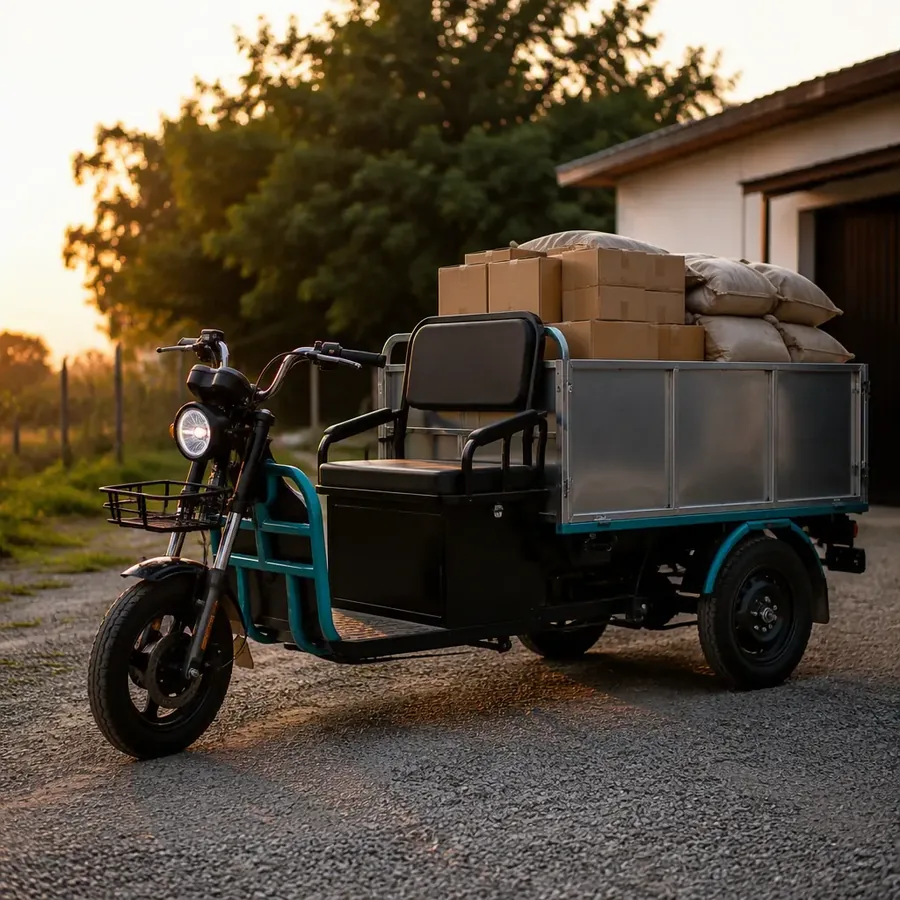
Upfront Cost: USD 1,450 FOB vs USD 38,000+
The purchase price gap is the headline number, and it is not close:
| Line item | Cargo e-tricycle | Full-size pickup |
|---|---|---|
| Base purchase | USD 1,250–1,550 FOB China | USD 38,000–58,000 MSRP |
| Shipping per unit | USD 150–250 (container, 20–28 units per 40 ft HC) | n/a (local purchase) |
| Registration | None (Class 2 e-bike path) | USD 200–500 / year |
| License required | No (most states) | Yes (driver's license) |
| Insurance | USD 0–100 / year (homeowner or commercial rider) | USD 1,200–2,000 / year |
One container of 24 cargo trikes costs about the same as one base-model pickup. That is why the first wave of trike buyers was not consumers, it was distributors importing by the container. The landed-cost mechanics, HS codes and container loads are covered in our China import guide for electric tricycles.
Fuel vs Electricity: The 12,000-Mile Math
This is where the trike compounds its advantage. A full-size pickup at 18–22 mpg burns 545–667 gallons per 12,000 miles; at USD 3.50 per gallon that is USD 1,900–2,330 per year in fuel alone. A cargo tricycle with a 60V 32Ah pack (1.92 kWh usable) charges in 6–10 hours and covers 50–80 km per charge. To cover 19,300 km a year, the trike needs roughly 240–390 full charges. At USD 0.15/kWh, that is USD 70–115 per year in electricity . About 96% less than the pickup's fuel bill.
| Annual operating cost (12,000 mi) | Cargo e-tricycle | Pickup truck |
|---|---|---|
| Fuel / electricity | USD 70–115 | USD 1,900–2,330 |
| Insurance | USD 0–100 | USD 1,200–2,000 |
| Maintenance | USD 150–250 | USD 1,000–1,500 |
| Registration / taxes | USD 0 | USD 200–500 |
| Annual total | USD 220–465 | USD 4,300–6,330 |
The battery pack's real-world endurance and cold-weather behavior determine whether those numbers hold; the chemistry and BMS choices that keep a pack alive through 500+ cycles are explained in our battery technology guide.
Maintenance: What Actually Breaks
A cargo trike is mechanically simple: one hub motor (or mid-drive), one controller, three wheels, hydraulic discs up front, dual drum brakes at the rear, and a parking brake. The annual service list is brake pads, tires (3.00-12 front, 3.75-12 rear), and periodic chain/controller checks, budget USD 150–250 per year including a tire replacement. A pickup requires oil changes, transmission service, brake rotors, and a set of highway tires every 40,000–60,000 miles; USD 1,000–1,500 per year is a realistic average, and repair bills above that are common in years 4–8. The torque and power-class decisions that determine whether a 800W or 1200W motor suits a specific payload profile are covered in our motor power guide.
Five-Year Total Cost of Ownership
Combining purchase and operation over five years at 12,000 miles per year, assuming one replacement battery pack in year four (USD 350–500):
| 5-year TCO | Cargo e-tricycle | Pickup truck |
|---|---|---|
| Purchase | USD 1,450 | USD 45,000 (avg) |
| Operating (5 yr) | USD 1,100–2,300 | USD 21,500–31,650 |
| Battery replacement | USD 350–500 | n/a |
| Resale value | –USD 300 (used trikes hold modest value) | –USD 22,000 (trucks depreciate ~10%/yr) |
| Net 5-year cost | USD 2,600–3,950 | USD 44,500–54,650 |
Over five years the trike costs roughly 6–7% of what the pickup costs . And that is before counting the fact that the trike covers most trips while the pickup sits parked.
Where Each Vehicle Wins
- Trike wins: trips under 15 km, payloads under 300 kg, stop-and-go routes, narrow farm lanes, markets and fairs, indoor/covered storage, zero-emission zones, any route where parking is scarce. A 300–500 kg payload with a 150–500 L box handles the daily load of a small farm or delivery route; see the cargo-specific engineering in our cargo fleet guide.
- Pickup wins: highway work, towing, loads over 500 kg, multi-county runs, bad winter roads at speed, and any task requiring a passenger cabin with heat.
- The fleet answer: most rural fleets discover they need both. One pickup for the heavy days and two or three trikes for the 80% of trips that are light. Fleet-level procurement, including how to spec and certify a mixed fleet, is covered in our delivery fleet buyer's guide.
The Charging Reality
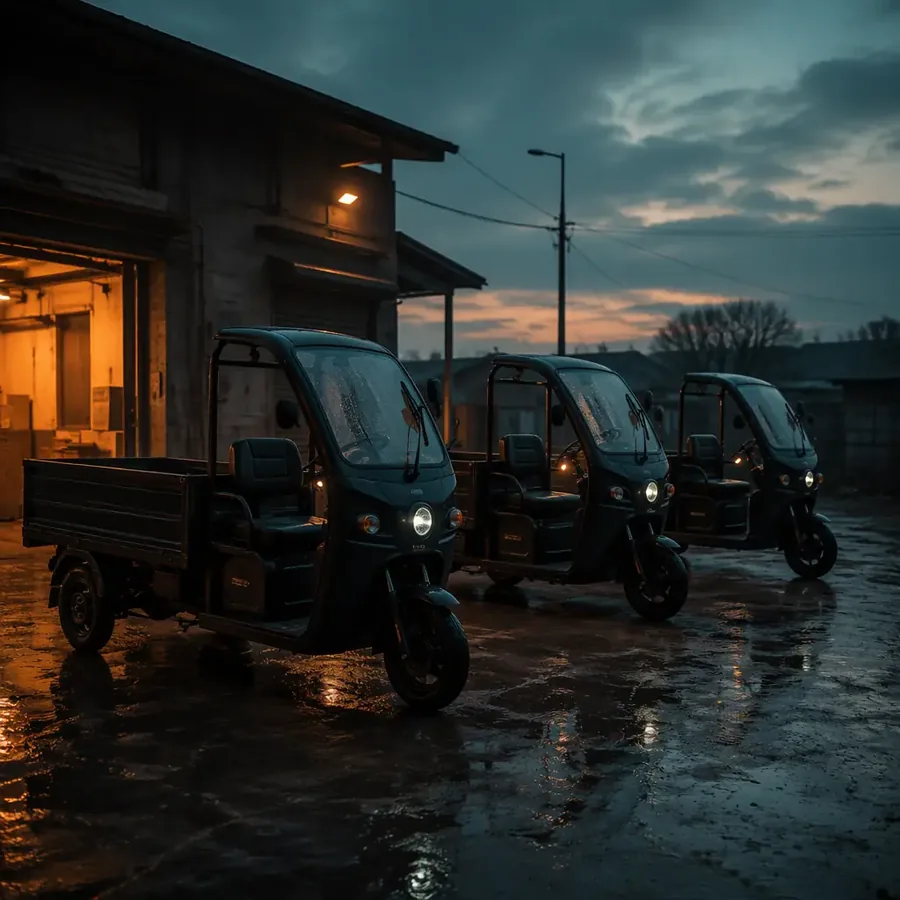
Charging a trike is a wall outlet, not infrastructure. A 60V 32Ah pack at 5A charging current refills in 6–10 hours overnight; a 72V 40Ah LFP pack takes the same window with the standard charger. For a three-trike micro-fleet, one 15A circuit with a rotation schedule is enough, no charging station, no electrical contractor. The same socket logic applies to cold climates: the pack charges indoors, and the BMS low-temperature cutoff protects the cells, a detail covered in our battery guide.
Specs to Order for a Cargo Trike Program
If the math above points to a trike program, order these specifications on the sample unit:
| Component | Recommended spec |
|---|---|
| Motor | 800W / 1000W / 1200W brushless hub + differential |
| Battery | 60V 32Ah NMC or 72V 40Ah LFP, swappable, heavy-duty BMS |
| Payload / box | 300 kg (EU) / 500 kg (non-EU); 150–500 L drop-side box |
| Brakes | Hydraulic disc front + dual drum rear + parking brake |
| Drive modes | Forward / neutral / reverse, LCD with speed & load display, full LED |
| Certification | UL 2849 / EN 15194 path per target market |
Certification scope for the US vs EU market is the difference between a product that sells and one that gets stopped at the border; the full comparison is in our EU vs US certification guide. For custom branding, colors and spec changes, the OEM negotiation structure, MOQ 50 units, samples at 4–6 weeks, is documented in our OEM buying guide.
Run the TCO on Your Own Routes
Send us your route list (distance, load weight, terrain) and we will spec the right cargo tricycle configuration, motor, battery, box size, and certification path, with a landed-cost estimate per unit for your market.
