
A cargo e-tricycle with a 150–500 L drop-side box is a capable workhorse, but the moment a farm or fleet needs to move long, bulky or loose loads . Lumber, fencing rolls, hay bales, bulk feed, the box runs out of geometry. The answer buyers are increasingly searching for is the electric tricycle trailer: a $300–$800 accessory that turns a $1,450 FOB cargo trike into a two-axle hauling rig. This guide covers trailer types, towing capacity math, hitches, braking and the legal notes that decide whether a trailer program is a good idea for your market. Plus the OEM specs to order so the trike is built to tow from day one.
What a Trailer Adds That the Cargo Box Can't
The cargo box is optimized for dense, contained payload: 300 kg (EU class) or 500 kg (non-EU class) of boxes, bags and produce. A trailer changes the payload geometry instead of just the volume:
- Length . A 1.8–2.4 m flatbed carries lumber, pipe, fencing and ladders that physically cannot fit inside a 1.5 m box.
- Bulk density . A trailer bed adds 600–1,000 L of open volume on top of the box, so hay bales, mulch and compost stop competing with daily cargo for space.
- Dedicated duty . A box trailer can stay loaded as a mobile storage unit while the trike's own box handles the regular route; the trailer is dropped at the job site instead of unloaded.
- Second trip elimination . On a farm loop that runs 10–15 km between buildings, one round trip with a trailer replaces two or three with the box alone.
This is the same logic that made the three-wheeler a farm favorite in the first place, the economics are detailed in our three-wheeler boom guide, and the farm duty cycle (feed, fencing, harvest) in our farm & ranch guide. The trailer simply extends the same $0.03/km operating cost envelope.
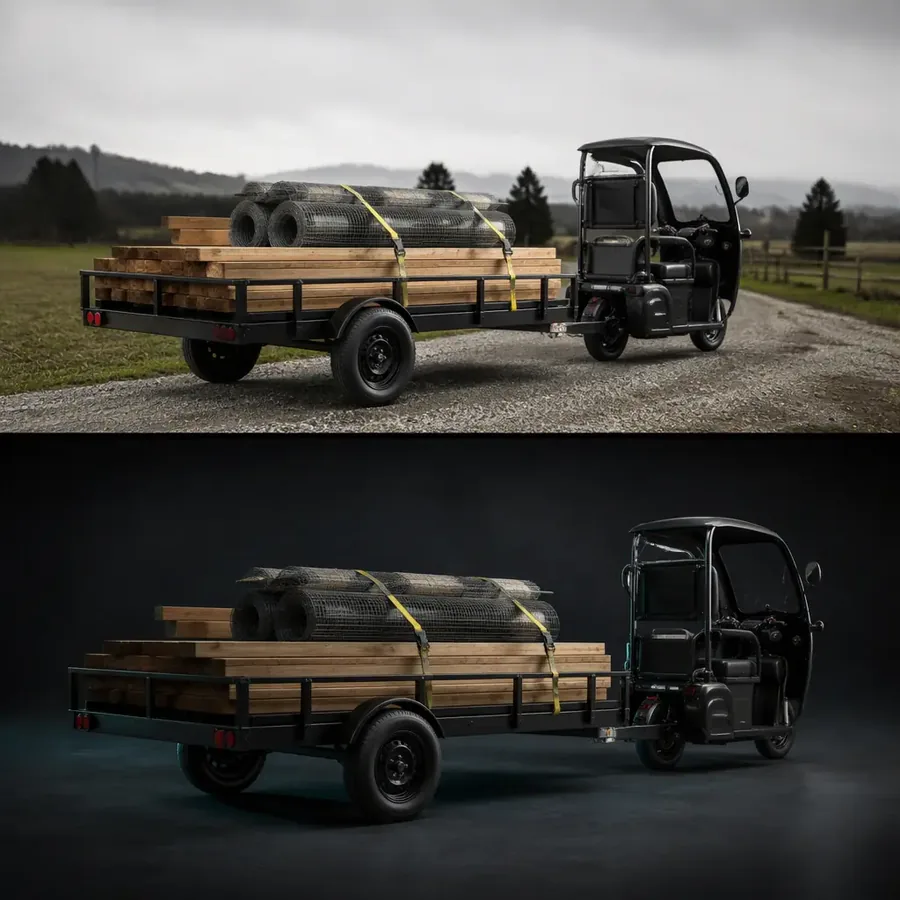
Trailer Types for Electric Tricycles
Not all trailers suit a 25–35 km/h platform. Lightweight construction matters more than capacity. A 200 kg trailer with 400 kg of load is manageable; a 400 kg steel trailer eats the payload before you load it:
| Type | Typical bed volume | Unladen weight | Best for |
|---|---|---|---|
| Flatbed | 1.0–1.5 m² | 35–60 kg | Lumber, fencing, appliances, long cargo |
| Dump / tipper | 400–800 L | 50–80 kg | Mulch, compost, gravel, harvest loads |
| Box / enclosed | 600–1,000 L | 60–100 kg | Weatherproofing cargo, mobile vending, deliveries |
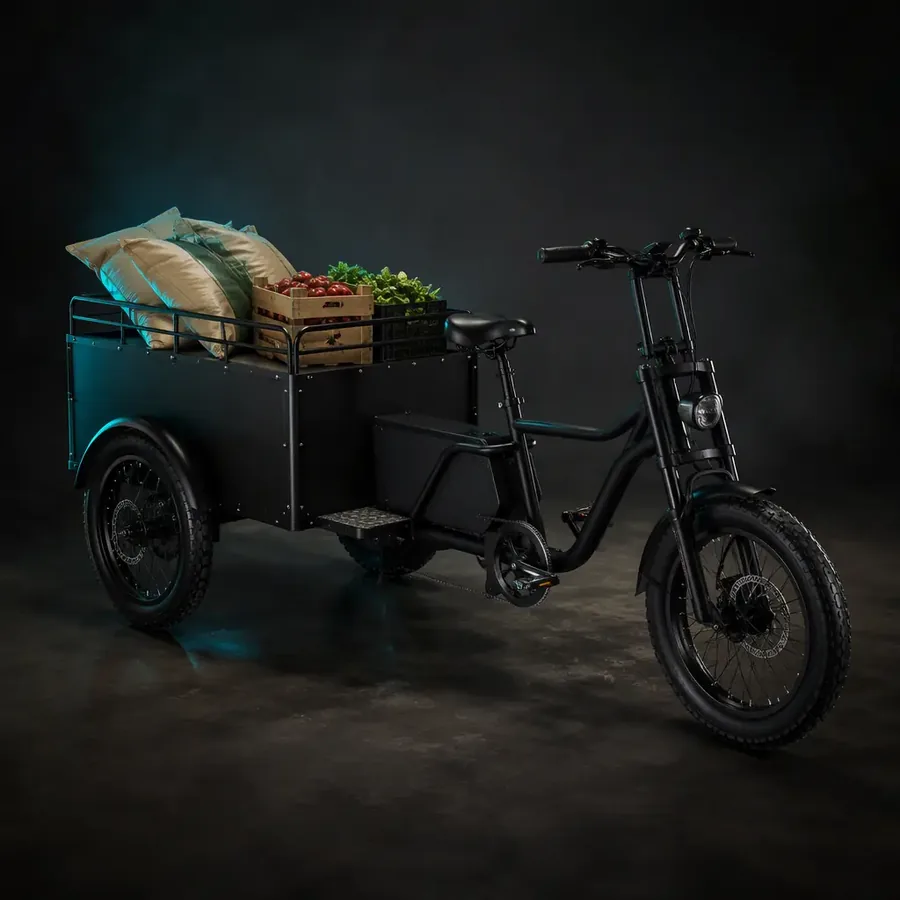
| Flatbed with sides | 700–1,000 L | 45–70 kg | Feed bags, produce crates, general farm hauling |
For vending and food operators, an enclosed trailer doubles as a sealed build-out space, the same approach documented in our mobile vending guide, where a lightweight canopy and insulated inserts turn the platform into a stall. Trailer weights and axle ratings should always be matched to the trike's 500 kg total towing envelope discussed next.
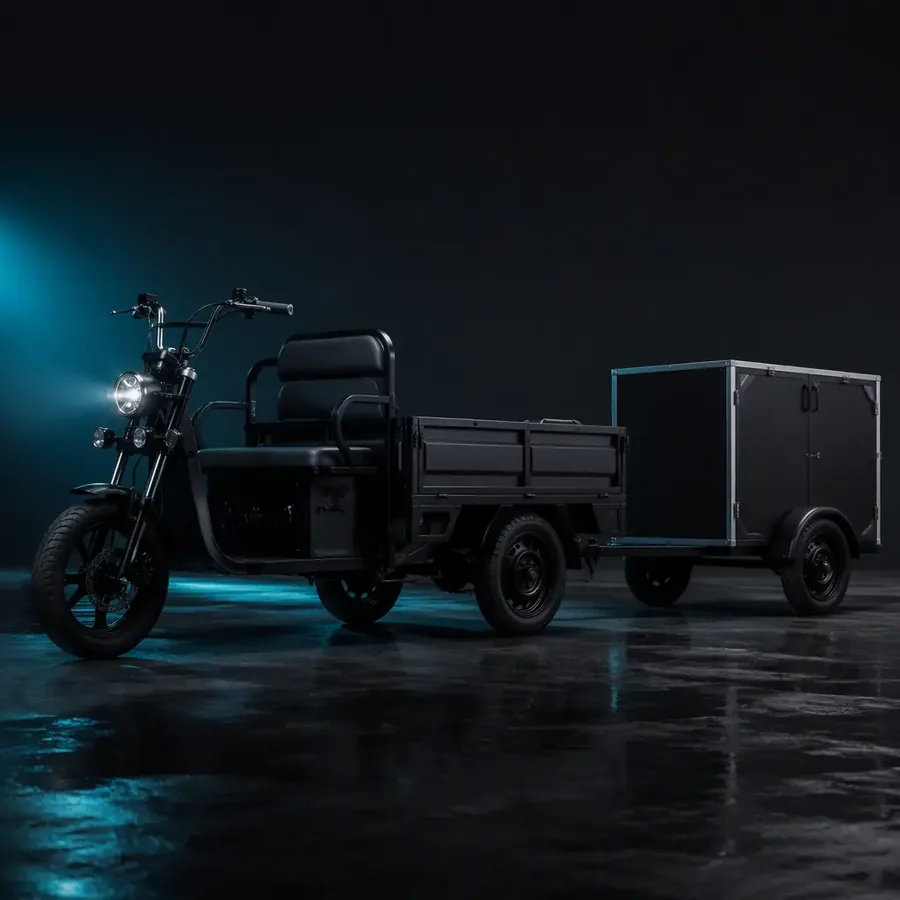
Towing Capacity: The Physics of 300–500 kg
Towing capacity on an e-tricycle is set by three components: motor torque, drivetrain (differential) and brakes. Our cargo trikes use an 800W / 1000W / 1200W brushless hub motor with differential . The differential is the critical piece, because it lets the two rear wheels turn at different speeds while both drive, which keeps a loaded trailer from fighting the rear axle in turns. Practical towing guidance:
- 300 kg trike (EU class) . Tow up to ~200 kg of trailer-plus-load on flat terrain. Fine for box trailers and light flatbeds.
- 500 kg trike (non-EU class) . Tow up to ~400 kg on flat-to-moderate terrain. This is the farm configuration: 100 kg trailer + 300 kg of hay, feed or harvest.
- Grades . Every 5° of sustained grade reduces practical towing capacity by roughly a third. A 400 kg tow works on flat farm roads; keep it under 250 kg where 8°+ ramps are common.
- Speed . Towing is a 20–25 km/h activity. Stability and braking margins drop above 25 km/h with a loaded trailer; the 25–35 km/h top speed of the platform is already the right envelope.
Motor power classes and what 800W vs 1200W delivers under load are covered in our motor power guide; the voltage choice that affects torque under tow (60V vs 72V) is covered in our 60V vs 72V battery guide . The 72V pack's extra energy and hill margin matter noticeably when a trailer is attached.
Braking With a Trailer: The Non-Negotiable
A trailer doubles the kinetic energy the trike must arrest. The stock brake set, hydraulic disc front + dual drum rear + parking brake . Is sized for the trike's own 300–500 kg load. With a trailer, three rules apply:
- Keep total towed weight within the brake envelope . The combination (trike + load + trailer + trailer load) should stay under ~900 kg for the 500 kg class. Beyond that, add trailer brakes.
- Trailer brakes . A 100–150 kg trailer can run without brakes at 25 km/h on flat ground; anything heavier or hillier should use a mechanical overrun (inertia) brake or an electric brake wired to the trike's brake light circuit.
- Descending . Use the 3-speed selector to hold a lower gear (motor regen) on descents instead of riding the discs; the brake service schedule in our maintenance guide covers disc pad and drum adjustment intervals that shorten under towing duty.
The stability comparison that explains why three wheels + a trailer behave differently from a two-wheeler + trailer is in our tricycle vs e-bike guide: the rear dual-wheel track is exactly what keeps a loaded trailer from tipping the platform in turns.
Hitches and Coupling: What to Specify
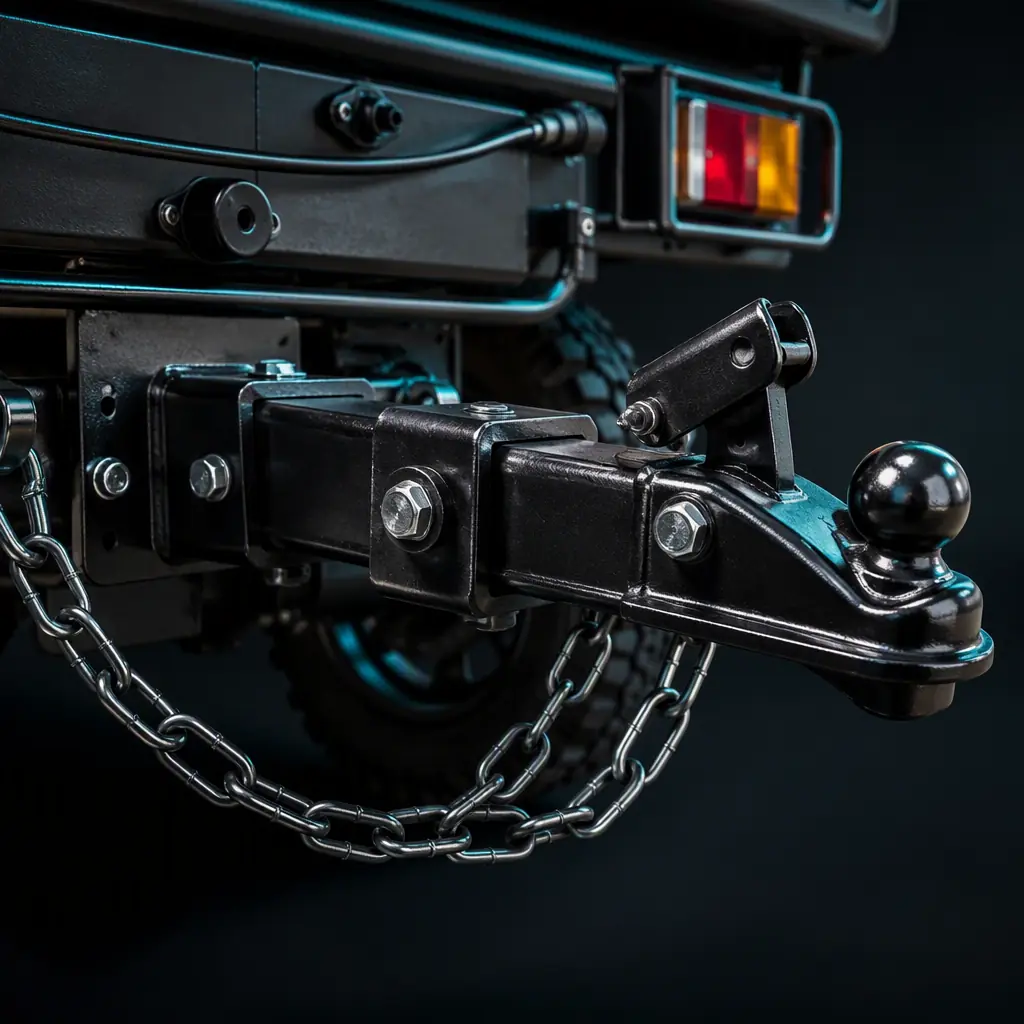
The hitch point is a frame modification, not an accessory bolt-on. A trailer tongue puts a cantilevered load on the rear frame; a hitch bolted to the cargo box instead of the chassis will fatigue the box mounts. Spec the following:
- Reinforced tow hitch . Welded or high-tensile bolted to the main frame rails, rated for 150–200 kg tongue-plus-trailer weight, with a vertical load limit stated in the OEM spec.
- Coupler . A 50 mm (2-inch) ball coupler or a pin-and-clamp coupler; ball couplers are the de facto standard for farm trailers and allow borrowing a neighbor's trailer.
- Safety chains . Crossed chains rated to the towed weight, required in most US states for any towed load.
- Lighting wiring . A 4-pin flat or 7-pin round harness piggybacked on the trike's full-LED lighting system, so the trailer's tail lights, turn signals and brake lights mirror the trike.
When you order the trike with the hitch from the factory, the frame is reinforced and the wiring is included in the harness, which is why OEM specification beats aftermarket welding. The full list of OEM options (motor, pack, box, electronics) is in our cargo tricycle OEM guide.
Legal Notes: Trailers Change the Vehicle Class
A trailer can push an otherwise exempt vehicle into territory the local code cares about:
- US . Most states classify a 3-wheel e-tricycle as a low-speed electric vehicle or moped-class machine where no license is required (the classification breakdown is in our US & EU law guide). Trailers under ~1,500 lb gross are typically exempt from registration, but lighting, safety chains and a visible license plate mount on the trailer are enforced at the state level, check the state DOT trailer page before buying.
- EU. L2e (light quadricycle-class) trikes towing trailers generally require the trailer to be registered and plated; EPAC-class (250W) machines are not designed to tow at all. If your market is EU, confirm the trailer legality with the importer before ordering.
- Speed limits . Towed operation often drops the legal ceiling (e.g., 25 km/h in many jurisdictions even where the bare trike can do 35 km/h).
For importers, the trailer is usually sourced separately from the trike, the container economics and landed-cost model in our China import guide help you decide whether to ship trikes, trailers, or trikes with flat-packed trailers in the same container.
Farm Duty Cases: Where the Trailer Earns Its Keep
Three farm patterns show up repeatedly in buyer feedback:
- Feed and hay runs . A 300 kg trike with a 100 kg flatbed-side trailer carries ~20 feed bags or 8–10 small bales per trip, replacing a pickup run on a 5–10 km loop. The cost comparison vs a pickup makes the math stark: the whole rig (trike + trailer) costs less than one month of pickup payments.
- Harvest and orchard work . A dump trailer handles fruit, vegetable and nut collection where the box would need hand-unloading; the tipper bed drops the load at the barn in seconds.
- Property maintenance . Fencing rolls, tools and water containers move between buildings on a flatbed while the box stays free for daily chores.
The same trailer logic applies to rural delivery routes, our rural last-mile guide covers the route economics, and the fleet-level view (maintenance, charging, rider shifts) is in our cargo fleet guide.
Spec Sheet: Ordering a Tow-Ready Cargo Trike
When you place the OEM order, add these line items so the trailer program works from day one:
- Reinforced tow hitch welded to the main frame, rated 200 kg, with stated vertical load limit
- 4-pin lighting harness pre-wired to the tail-light circuit
- 1200W motor + 72V 40Ah LFP pack if the duty includes grades or regular 300 kg+ tows
- Heavy-duty BMS and UN 38.3 transport certification (standard on both packs)
- Hydraulic disc front + dual drum rear brake set with the parking brake confirmed for trailer duty
Trailer itself: aluminum or steel light construction, 35–100 kg unladen, 50 mm ball coupler, safety chains, full LED lighting kit, and tires rated for 25 km/h continuous. The 2026 three-wheeler market guide has the demand-side context for why tow-capable tricycles are the configuration buyers are asking for this year.
Spec a Cargo Trike Built to Tow
Send us your payload list, grades and trailer plans. We will quote the reinforced hitch, wiring harness, motor and pack combination, with a tow-capacity sheet for your exact configuration.
