
Landscaping is a local business. Crews move between nearby properties, carry tools and trimmings, and spend their mornings in residential neighborhoods where noise rules apply. The default tool is a pickup truck. But a growing number of grounds-maintenance contractors are running a three-wheeled electric cargo tricycle on their short routes: $1,450–1,550 FOB against a $38,000+ pickup, a 300–500 kg bin that tips to unload, and a quiet electric drivetrain that lets crews start before noise ordinances do. This guide covers what a cargo trike actually carries on a landscape route, where it beats a truck, and the exact spec to order.
The Route Math: When a Pickup Is Overkill
Most landscape work happens within a 5–8 km radius of the yard: mowing contracts, hedge trimming, bed maintenance, and cleanup visits. A typical crew route is 20–40 km per day, mostly at low speed between jobs. That profile is the worst case for a pickup and the best case for an electric trike:
- Truck cost per km . A full-size pickup at current fuel prices costs $0.15–0.25 per km in fuel alone, before insurance, plates, and depreciation, most of it burned idling between jobs.
- Trike cost per km, 3–4 kWh per day at $0.15–0.30/kWh commercial rates works out to under $0.02 per km in energy. The fuel math is laid out in full in our cargo trike vs pickup truck comparison, including the five-year total cost of ownership.
- Parking and access . A trike fits in a residential driveway, a service gate, or a loading dock where a truck cannot go. That access is billable time.
What a Cargo Trike Carries on a Landscape Route
The payload question is the first thing every contractor asks, and the honest answer is: it carries the daily route, not the seasonal project. The spec that matters:
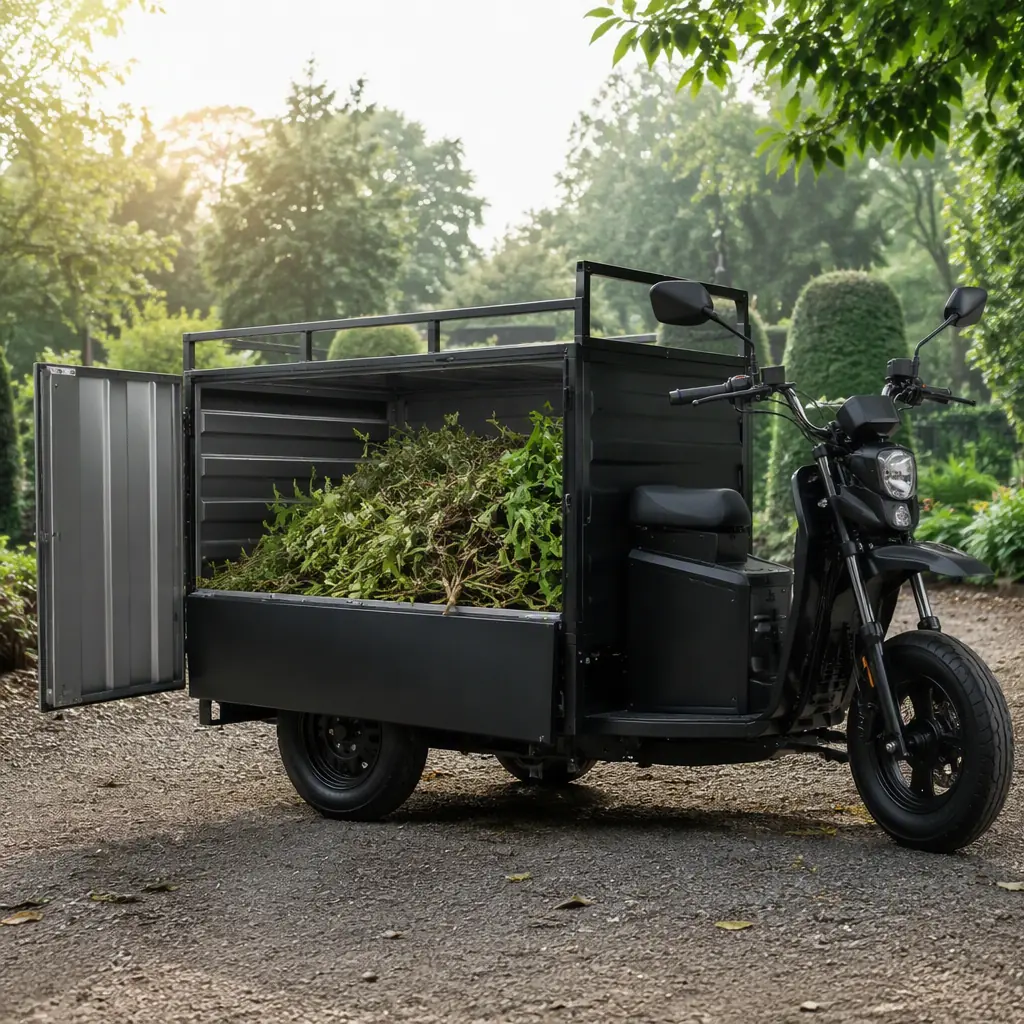
- Payload: 300 kg (EU) / 500 kg (export) . Enough for a full day's tools plus trimmings: string trimmers, blowers, edgers, hand tools, and a growing pile of green waste. The 500 kg build uses the 1200W motor and 72V pack to keep moving at full load.
- Bin: 150–500 L with drop-sides . Side-opening bins dump trimmings straight into a trailer or yard-waste bin without shoveling. The drop-side option turns the trike into a mini tipper and is the single most-used feature on landscape builds.
- Tool organization . A flat floor and tie-down rails carry toolboxes and a rack for long-handled tools; the bin liner can be swapped for a boxed insert when hauling blowers and trimmers.
The full OEM build options, bin types, motor tiers, and customization, are covered in our cargo e-tricycle OEM guide.
Quiet Starts: The Early-Morning Advantage
Residential landscape work starts early because heat and daylight demand it, and early starts collide with noise ordinances. Gas equipment at 90+ dB(A) generates complaints; an electric trike at 60–65 dB(A) is below conversation level. Three practical effects:
- More billable hours . Crews that can start at 6:30 AM without triggering noise complaints schedule more jobs per day in summer.
- HOA and gated communities . Many property managers now write quiet-equipment clauses into maintenance contracts; electric equipment is becoming a bid requirement, not a preference.
- Neighborhood relations . The contractor who does not wake the street keeps the contract. The regulatory context for trike operation in residential areas is covered in our US and EU tricycle law guide.
Terrain and Access: Beds, Gravel, and Gateways
Landscape sites are where trucks scrape and cars cannot go: gravel paths, soft beds, narrow gateways, and curbs. The trike's advantage is threefold:
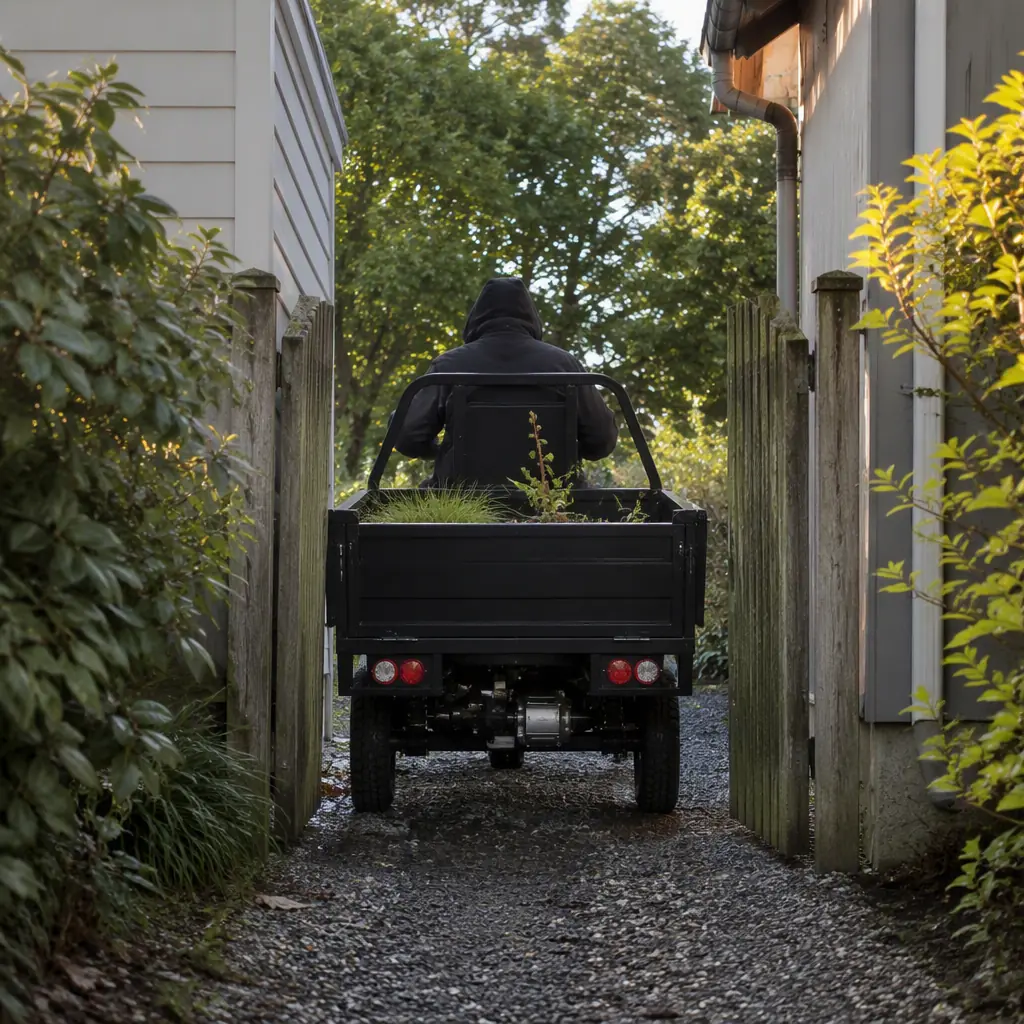
- Narrow track . A cargo trike threads a 1.2 m garden gate that a truck cannot enter, cutting hand-carry distance from 100 m to zero.
- Tire choice. 3.00-12 front and 3.75-12 dual rear tires with a tread pattern chosen for turf and gravel; the tire spec (load rating, tread, and dual-rear behavior) is detailed in our tricycle tires guide.
- Suspension and differential . The rear differential stops the inside wheel dragging on tight turns through gates, and suspension tuned for the loaded weight keeps the load stable on gravel. The suspension engineering is in our suspension guide.
Crew Transport vs Tool Transport: Two Builds
Contractors typically discover they need two different trikes. A crew carrier with a passenger bench moves a second worker between sites, the same platform our passenger e-tricycle guide specs for mobility and shuttle duty. A cargo build carries tools and trimmings. For a two-person crew, the practical fleet is one of each: the carrier towing the route, the cargo trike hauling the load. Both share the same motor, battery, and brake platform, which keeps the spare-parts bin small.
The 3-Year Cost Math
Compare a 500 kg cargo trike against a used pickup over three years of daily landscape duty:
| Cost item | Cargo trike | Used pickup |
|---|---|---|
| Purchase | $1,550 FOB | $18,000–25,000 |
| Energy / year | $150–250 | $2,500–4,000 |
| Insurance / year | $150–300 | $1,200–2,000 |
| Maintenance / year | $150–300 | $800–1,500 |
| 3-year total | ~$3,000 | $26,000–38,000 |
Even adding a second trike for redundancy, three trikes cost less than one pickup over the same period. And they keep working when the truck is in the shop. The full five-year model, including depreciation and the routes where a truck still wins, is in our TCO comparison.
Charging and Winter Operation for Contractor Fleets
Contractor fleets charge overnight at the yard, and winter changes the battery math:
- Overnight charging . A 60V 32Ah pack charges in 6–10 hours on a 5A charger; two trikes share one 220V circuit with staggered start times. A 72V 40Ah LFP pack extends range for long summer days. The voltage and chemistry trade-off is covered in our 60V vs 72V guide and our battery technology guide.
- Winter range and storage . Cold cuts lithium range 20–30%; store packs indoors overnight and charge before the morning run. The full cold-weather operating routine is in our winter guide, and the service schedule in our maintenance guide.
Spec Sheet for a Landscaping Trike
| Spec | Landscaping build |
|---|---|
| Motor | 1000–1200W hub with differential |
| Battery | 60V 32Ah NMC or 72V 40Ah LFP |
| Payload | 300 kg (EU) / 500 kg (export) |
| Bin | 150–500 L, drop-side option, tie-down rails |
| Range | 50–80 km per charge (loaded) |
| Brakes | Hydraulic front disc + dual rear drums + parking lock |
| Extras | Reverse gear, LED lighting, optional warning beacon |
Spec a Landscaping Trike for Your Crew
Tell us your route profile (residential, commercial grounds, or municipal), your crew size, and your typical loads. We will spec the payload, bin type, motor, and battery around your daily route, with sample units available for field testing.
