
A plumbing contractor's day is not a delivery route. A delivery route moves one box from A to B and finishes. A service day moves a workshop to twelve different addresses, works out of it for forty minutes at each, and then has to put everything back. That difference decides which vehicle belongs on the drive, and it is the reason a panel van often runs at a fraction of its rated payload while a cargo tricycle covers the same round in a fraction of the fuel and parking cost.
This guide is written for the contractor or fleet buyer specifying a field-plumbing platform: what the kit actually weighs, why copper and cast iron break single-number payload assumptions, where tank and pump placement decides vehicle stability, how the electrical budget works out on a 60V traction pack, and what to put in the enquiry so the first unit arrives configured for trade work rather than for parcel work.
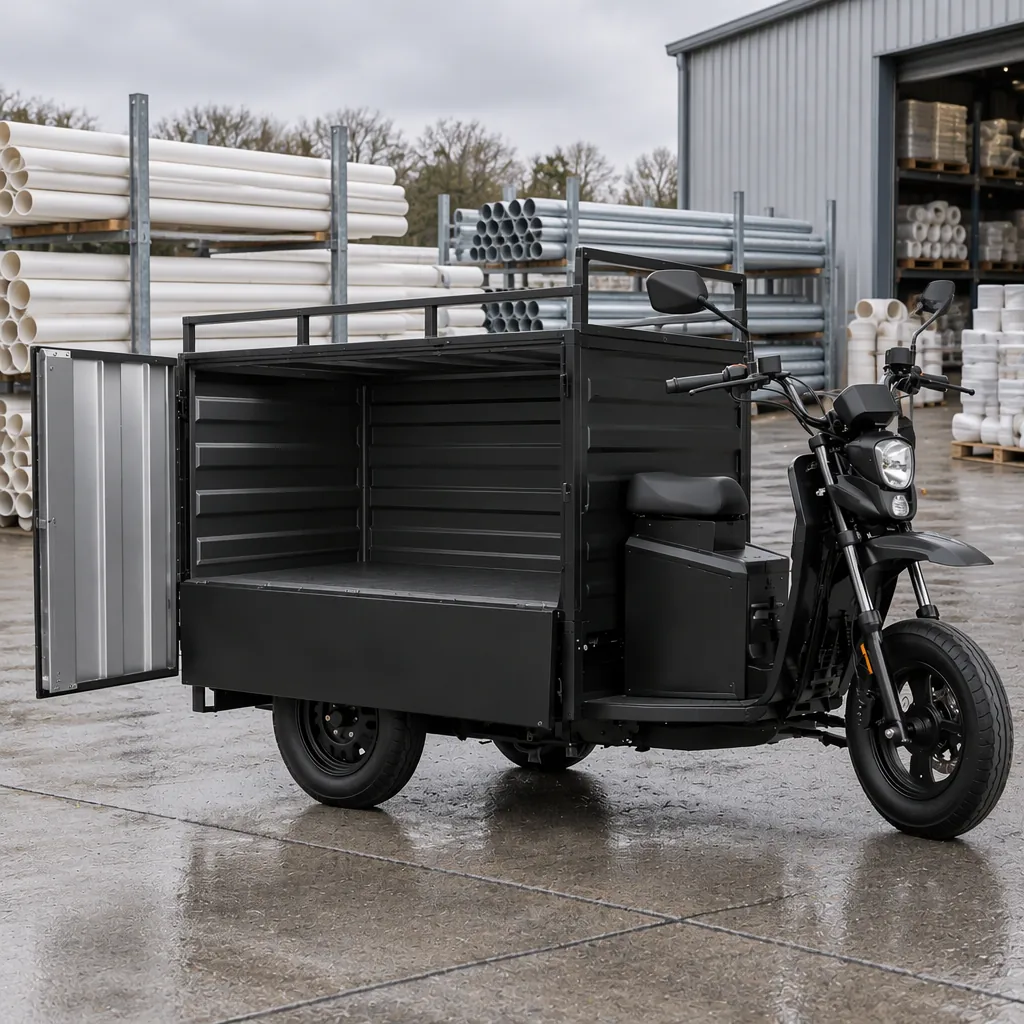
Why a Plumbing Service Round Is Not a Delivery Round
The two duties look similar on paper and behave completely differently in the field. A parcel round optimises for volume per stop and a short dwell time. A plumbing round optimises for tool access at every stop, a long dwell time, and the ability to leave the vehicle parked at the kerb for an hour without the load shifting.
| Duty property | Parcel / delivery round | Plumbing service round |
|---|---|---|
| Stops per day | 60–120 | 5–12 |
| Dwell time per stop | 2–5 minutes | 30–90 minutes |
| What the load is | Cartons, sealed, light | Tools, fittings, pipe, gas, sometimes water |
| Load density | Low (0.1–0.2 kg/L) | High (0.5–1.2 kg/L) |
| Access frequency | Rear door only | Side gate, multiple times per stop |
| Daily distance | 60–150 km | 40–90 km |
| Failure cost | One late parcel | A booked job abandoned, customer at home |
The load-density row is the one that eliminates most platforms before the conversation reaches motor ratings. A plumber's box is small and heavy. A 200-litre compartment filled with copper fittings, brass valves and a wet vacuum will out-weigh a 600-litre parcel box filled with cartons, and the vehicle is chosen against the weight, not the volume.
The Workshop You Carry, in Kilograms
Before choosing a platform, weigh the kit. Not estimate it — weigh it, on a bathroom scale with each case loaded, because the numbers that surprise contractors are always the second-order items: the drain machine, the wet vacuum and the gas set.
| Item | Typical weight | Notes that change the spec |
|---|---|---|
| Hand tool bag / tote | 15–25 kg | Access at every stop, so it must sit at the gate, not at the bottom |
| Cordless tool cases (drill, SDS, grinder) | 12–20 kg | Batteries need a charging plan, not just storage |
| Drain cleaning machine + cable | 25–45 kg | Concentrated point load, often 40–60 cm long |
| Wet/dry vacuum | 10–18 kg | Tall, unstable in transit unless strapped |
| Propane torch set + 2 spare cylinders | 8–15 kg | Ventilation and securing rules apply; see the LPG section below |
| Copper tube, 15 mm and 22 mm, 3 m lengths | 4–6 kg per bundle | 3 m length is the constraint, not the weight |
| Press tool with jaws and battery | 6–9 kg | High-value item; needs lockable storage |
| Fittings stock (brass, copper, push-fit) | 15–30 kg | Highest density in the vehicle; area per kg is tiny |
| Waste pump / transfer pump | 8–15 kg | Wet after use; drainage matters |
| Consumables, sealants, PPE | 10–15 kg | Bulk volume, low weight |
| Water, if carried for testing | 1 kg per litre | The single most under-estimated item on the list |
Add those up honestly and a light service round lands around 110–150 kg of kit, and a heavy one with a drain machine, a full fittings stock and 60 litres of test water lands at 220–280 kg. That second number is where the platform decision is actually made, because it sits against the rated payload rather than against the box volume.
Two reference points from the current platform range, both with the same chassis family and the same rear axle: a payload engineering guide covers how the 300 kg (EU) and 500 kg (non-EU) ratings are derived, and the utility work tricycle OEM guide explains why a bed rating and a vehicle rating are two different numbers. For plumbing work, plan against the lower of the two regulatory figures for your market and keep 15–20% of that figure unused for the water and the unexpected.
Four Measurements That Eliminate a Platform Before You Discuss Motor Rating
Vehicle selection for trade work is a geometry problem first. Four measurements, taken at the properties on the actual round, will decide the platform more reliably than any specification conversation.
1. The gate or side-passage width
Most domestic plumbing work sits behind a house, up a side passage. Measure the narrowest point on your three tightest jobs. A cargo tricycle with a 300–500 litre box is commonly 1.1–1.3 m across the body; a 0.9 m side gate with a downpipe on one side and a fence post on the other is a real constraint, and it does not appear on any datasheet. If two of your regular properties cannot pass the vehicle, that is not an inconvenience, it is a route redesign.
2. Door sill and threshold height
Where the vehicle stops and the tools go next is usually a step. Loading a 40 kg drain machine over a 20 cm sill, forty times a day, is a lifting injury waiting to be documented. The relevant number is the height of the vehicle floor from the ground, not the height of the box. Ask for it in writing.
3. Gradient on the approach
A loaded tricycle on a driveway ramp is a different vehicle from the same tricycle on a flat street. Steep driveways and loading ramps above roughly 8% will change the motor tier you need far more than daily distance will. The motor power guide covers the 800W/1000W/1200W selection against gradient and load rather than against top speed, and it is the right way to choose for trade work.
4. Where the vehicle parks overnight
Charging is a fixed constraint, not a daily decision. A standard 5A charger needs six to ten hours to bring a 60V 32Ah pack from empty to full. If the vehicle parks on a drive with an outdoor socket, single-shift operation is straightforward. If it parks on a street with no socket, the charging plan — not the vehicle — becomes the limiting factor, and the honest answer is either a swappable pack or a different parking arrangement. The fleet charging dock guide sets out how to size a charging position for a service fleet.
Run those four measurements before looking at a single specification sheet. In practice, two of the four eliminate a platform, and the remaining work is choosing within a much smaller field.
The Payload Envelope: What the Platform Actually Carries
Payload on this platform is a system figure, not a bed figure. It is bounded by four separate limits, and the vehicle is only as capable as the lowest one on the day.
| Limit | What it means for plumbing work | Where it bites |
|---|---|---|
| Axle and frame rating | 300 kg (EU) / 500 kg (non-EU) on the current cargo platform | Legal exposure in the EU; plan to the lower figure |
| Tyre load rating | 3.00-12 front / 3.75-12 rear dual, load-rated reinforced | Under-inflation plus a full fittings stock is the common failure |
| Brake capacity | Hydraulic disc front, dual drum rear, parking brake | Loaded stopping distance on a wet driveway |
| Motor and controller thermal limit | 800W / 1000W / 1200W hub with differential | Sustained climbing with a heavy load, not top speed |
The concentration problem is specific to this trade. 30 kg of brass fittings occupy less than half a cubic metre and put a dense, low point-load on one corner of the bed. Load distribution matters more than the total, both for the axle and for the way the vehicle tracks when one rear wheel takes the crown of the road. Keep dense stock over the rear axle area, never in the tail corner, and strap tall items such as the wet vacuum and the drain machine so they cannot walk across the bed during a turn.
Box configuration follows from the same logic. A three-way drop-side body converts to a flatbed in seconds and gives side access at every stop, which matches how plumbing work is actually loaded and unloaded. A fixed box with a single rear gate forces the technician to reach over the tail every time. The trade-off is weather protection, and the canopy and weather protection guide covers the options for keeping a tool load dry without converting to a fully enclosed cabin.
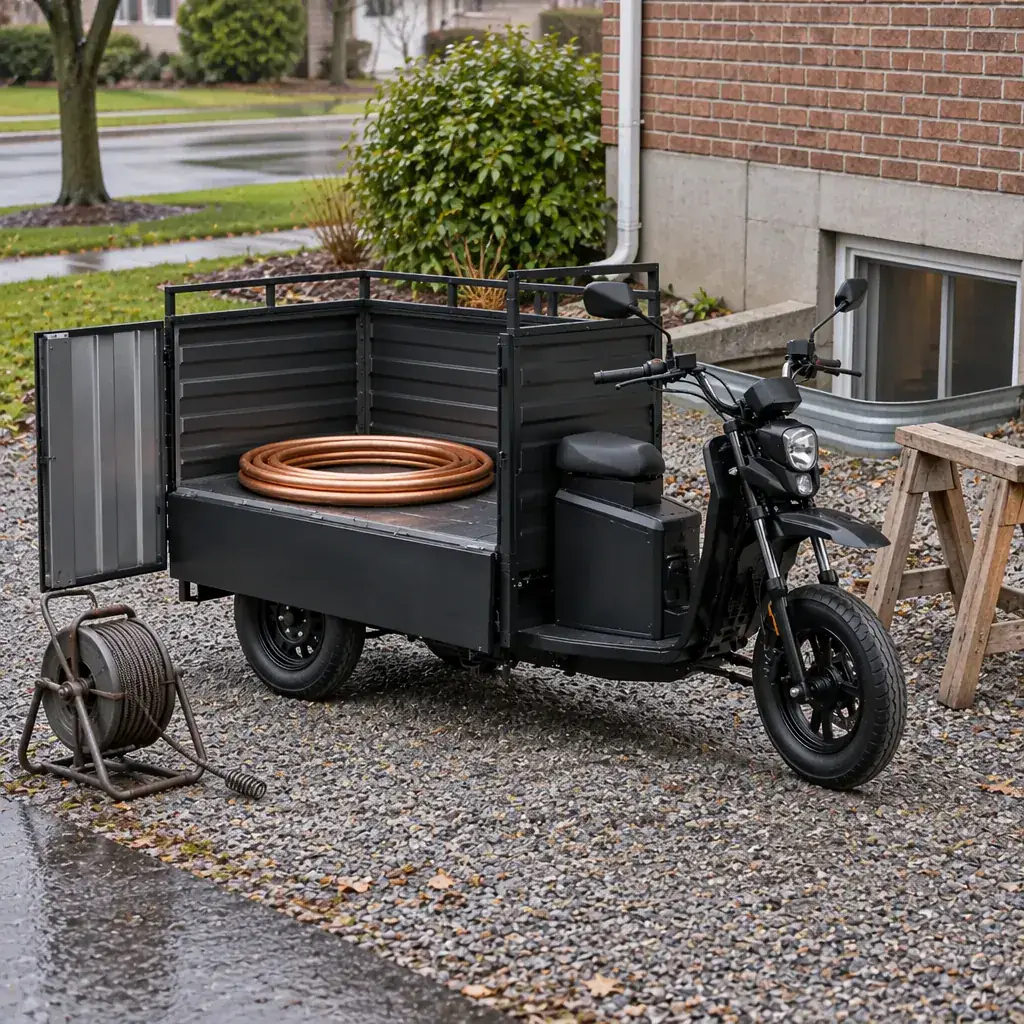
Propane, Copper and the Items That Change the Specification
Two items in a plumber's kit are not ordinary cargo, and both need to be settled on the order rather than discovered on site.
LPG cylinders
A torch set with spare cylinders is a normal part of the trade and a normal part of transport compliance. The practical requirements repeat across markets: cylinders upright and restrained so they cannot fall or roll, stored away from the traction battery and from any heat source, and the vehicle ventilated rather than sealed. On a tricycle this argues for an open or half-open bed rather than a closed box, with a dedicated rack or cradle that holds each cylinder individually. If your round involves daily gas work, specify the cradle as a line item on the order — a generic box cannot be retrofitted cleanly afterwards without drilling through whatever panel the factory used.
Copper and press-fit stock
Three-metre tube lengths are the length constraint that decides bed layout. A 1.6 m bed will not take them flat, so they either go diagonally — wasting the corners of the bed — or in a purpose-built length rack above the sides. The rack is a 20–40 cm addition to the vehicle height, which matters for the side passage measurement from earlier. Sort this out on paper, not on delivery day.
Water and wet equipment
Whether the vehicle carries test water is a specification decision, not a preference. A 60-litre tank adds 60 kg directly over the rear axle and moves the vehicle's centre of gravity upward. If test water is part of the round, the tank should be baffled, mounted low and forward, and the payload budget should be recalculated with the tank full rather than empty. Wet equipment, meanwhile, needs a drain path — a bed with a low point and a drain plug, not a sealed tray that holds water against the steel.
The Charging Arithmetic That Decides One Vehicle or Two
The most common planning error in a one-vehicle trade fleet is assuming the vehicle is available for the whole working day. It is not: it is available for the working day minus the charging window, and the charging window is fixed by the charger, not by the pack.
With the standard 5A charger, a 60V 32Ah pack needs six to ten hours from empty. That fits an overnight charge comfortably and fits nothing else. The consequence for a single-vehicle plumbing business is straightforward: if the round can be completed within the loaded range — the platform is rated 50–80 km with 200 kg on flat ground, and a plumbing round is typically 40–90 km with more climbing — one vehicle works. If it cannot, the options are a second pack, a swappable pack configuration, or a second vehicle, and those three have very different costs.
| Round profile | Daily distance | Charging fit | Practical answer |
|---|---|---|---|
| Dense urban, single technician | 40–60 km | Overnight full charge is sufficient | One vehicle, standard pack |
| Suburban, mixed travel | 60–80 km | Overnight charge plus a lunchtime top-up | One vehicle, LFP pack for partial-charge tolerance |
| Rural, long legs between jobs | 80–120 km | Does not fit a single overnight cycle | Second pack or second vehicle |
| Two technicians, one vehicle | Shared | Vehicle is booked out for the day | Second vehicle, not a bigger battery |
The LFP option is worth calling out for trade work specifically, because the pattern of a plumbing day is partial charging rather than deep cycling: the vehicle returns with 40% remaining, sits for an hour, and goes out again. LFP tolerates that pattern without the cycle-life penalty that a higher-density chemistry would take. The battery chemistry guide covers the cycle-life comparison at fleet scale, and the battery pack specification guide covers what to ask for on the order. Where the vehicle parks matters just as much as the chemistry — see the fleet charging guide for the socket, cable and access questions that decide whether a charging position actually works.
Auxiliary Power: Running Trade Equipment Without Draining the Traction Pack
Trade work needs 12V or 230V/110V power at the kerb: a charger for tool batteries, a work light, sometimes a transfer pump. The safe architecture is a separate auxiliary battery charged from the traction pack through a DC-DC converter, with the tools running from the auxiliary side. This keeps the traction pack out of the tool circuit entirely, so a flat tool battery cannot strand the vehicle.
Size the auxiliary side from the tools, not from the vehicle. A typical day might be two 5Ah tool batteries charged at 4A, a 20W LED work light for three hours, and a phone and tablet on charge — roughly 0.6–0.9 kWh, which a 12V 60–100Ah auxiliary battery covers comfortably with margin. If a 230V inverter is fitted, it should be sized for the largest single load plus 30%, not for the sum of everything that could be plugged in at once.
Ask specifically whether the auxiliary circuit is isolated, whether the DC-DC converter is rated for continuous output or only peak, and whether the inverter has a low-voltage cut-out that protects the traction pack. A factory that cannot answer the third question is fitting an inverter, not designing an electrical system. The motor controller guide covers how the controller and the auxiliary circuit interact on the same low-voltage harness.
Route-Time Arithmetic: Where a Trike Wins and Where It Does Not
The honest comparison is not trike versus van in the abstract, it is trike versus van on your specific round. Three variables decide it.
| Variable | Favours a tricycle | Favours a van |
|---|---|---|
| Parking per stop | Permit-free kerbside, footway-adjacent | Loading bays, timed restrictions, multi-storey height limits |
| Cost per km | Electricity at a fraction of diesel or petrol | Long motorway legs where the trike's speed limits the day |
| Kit capacity | Up to roughly 250–300 kg of trade kit | Full workshop, ladders, heavy plant, 3+ technicians |
| Weather exposure | Mitigated with canopy; technician still exposed on the move | Fully enclosed |
| Restricted zones | Access to low-emission and pedestrian zones | Increasingly restricted |
In dense urban work the trike usually wins on parking alone, because a plumbing job outside a terraced house has no loading bay and the van parks two streets away. The equipment then gets carried by hand, which adds ten to fifteen minutes per stop and is the single largest hidden cost in the van comparison. On rural rounds with forty-minute legs between jobs, the van wins on speed and the trike wins on nothing that matters.
For most plumbing businesses the realistic answer is a mixed fleet: a trike for the dense core of the round and a van for the long legs and the heavy jobs. That is also the configuration that makes a pilot easy to run, because the trike can be trialled on the round it suits without abandoning the rest. The tricycle versus golf cart comparison and the tricycle versus pickup comparison both cover adjacent versions of the same cost argument.
Specification Checklist for a Field-Plumbing Platform
Bring this list to the quotation stage. Every line has a direct effect on whether the vehicle works on a real round.
- Payload against the weighed kit, not the estimated kit. Plan to the lower of the EU and non-EU figures for your market, leaving 15–20% headroom for water and unexpected weight.
- Bed configuration that gives side access. A three-way drop-side body is the default for trade work; a rear-gate-only box is a delivery configuration.
- Floor height and bed dimensions in writing. Including the internal length, so 3 m tube stock can be planned rather than discovered.
- Length rack as a factory line item. Above-bed racks change overall height and must be considered in the side-passage measurement.
- LPG cradle, if gas work is daily. Individual cylinder restraints, isolated from the traction battery, in a ventilated position.
- Auxiliary battery plus DC-DC converter with a stated continuous rating. Isolated from the traction pack, with a low-voltage cut-out.
- Battery chemistry matched to the charging pattern. LFP where partial charging is the norm; NMC where full cycles are and weight matters.
- Differential rear axle. On tight driveways and site entrances, a differential prevents the tyre scrub that wears out rear tyres and marks surfaces.
- Brakes specified for the loaded case. Hydraulic disc front and dual drum rear with a parking brake is the current platform standard; confirm it is rated for your payload.
- Lockable storage for high-value tools. The press tool and the cordless kit need a lockable compartment, not a strap.
- Tyre specification and spare. 3.00-12 front and 3.75-12 rear dual are the platform sizes; confirm a spare and a service kit ship with the first order.
- Warranty terms per subsystem. Chassis, motor and differential, controller, and battery are usually different periods and should be read separately.
Order Terms for a Trade Fleet Rollout
The commercial framework on this platform is built for a fleet order rather than a single retail purchase, and the numbers are worth knowing before the enquiry is sent.
- MOQ: 50 units per model for an OEM order. Single-unit evaluation happens through the sample programme, not through the MOQ.
- Lead time: 15–30 days for standard configurations. Box customisation adds roughly 10 days, and a first custom-branded run can extend to 30–45 days.
- Sample: pre-production samples ship before mass production, and a sample can normally be arranged at cost against a later production order.
- FOB tiers: the current platform pricing runs in three bands depending on motor and battery specification, from the light 800W / 60V 32Ah NMC build through to the 1200W / 72V 40Ah LFP build. Quantity breaks typically apply at the 100, 200 and 500 unit levels.
- Documentation: UN 38.3 battery test reports, CE and RoHS declarations, and ECE R10 EMC planning ship with the order file. These are the documents a trade buyer's insurer and a customs broker will ask for.
- Spares: the platform ships with a spare parts allowance covering brake pads, inner tubes, bulbs, fuses and controllers on a per-unit ratio, which matters more for a trade fleet than for a consumer purchase.
The OEM buying guide covers how to structure the enquiry itself, and the dealer and distributor guide is the right reference if you are buying to resell into the trade rather than to operate the vehicle yourself. For a first order, the first container shipment guide covers the packing, battery paperwork and inspection steps that decide whether the vehicles arrive ready to work.
Running the Pilot Before Committing the Round
Put one vehicle on your densest round for a full month, and measure four things: stops completed per day, minutes lost to parking, kit actually carried against kit expected, and charging time against plan. The first two tell you whether the trike is faster on your round. The third tells you whether the specification was right. The fourth tells you whether one vehicle is enough.
Track the charge state at the end of each day as well. A vehicle that returns at 20% on a cold wet Tuesday is a vehicle that will strand you in February, and the honest fix is either a second pack or a shorter round — not a bigger battery fitted after the fact. The winter operation guide covers the cold-weather derating that makes that difference, and the maintenance guide sets out the weekly checks that keep a working vehicle working.
Only scale to a second vehicle when the first one has proved the round. A trade fleet of two is a different operating problem from a fleet of one: it needs a charging position that serves both, a shared spares kit, and a rule about who owns the vehicle on a Friday afternoon.
The Short Version
Weigh the kit before you specify the vehicle, because a plumbing load is dense rather than bulky and the number that matters is 220–280 kg on a heavy round rather than a box volume. Take four measurements on your real round — passage width, sill height, ramp gradient and where the vehicle parks — before discussing motor ratings, because geometry eliminates platforms faster than specifications do. Plan to the lower payload figure for your market and keep 15–20% in reserve. Choose a drop-side bed with side access, a factory-fitted LPG cradle if you do daily gas work, and an isolated auxiliary circuit sized from the tools rather than from the vehicle. Match the battery chemistry to the charging pattern: LFP where partial charging is normal, and a second pack or vehicle where the round cannot fit one overnight cycle. Then run one vehicle on your densest round for a month before you buy the second one.
Spec a Plumbing Service Trike Against Your Real Round
Send us your weighed kit list, your three tightest access points and where the vehicle parks overnight. We will come back with a bed configuration, payload budget and charging plan that fits the round.
