
A canopy is the single option that decides whether a cargo tricycle earns money in month four of your operating year or sits idle through it. Buyers order it as an accessory, then discover it changes the vehicle's weight, its drag, its range, its charging rhythm and the way the rider feels at the end of an eight-hour shift. This guide treats the canopy as a platform decision, not a bolt-on: which roof type fits which route, what each one costs you in range, and how to specify the whole package so the trike survives a wet winter without going back to the workshop.
Canopy types: how much weather protection you actually need
Canopies are usually quoted as one line item, but there are three genuinely different products, and they solve different problems. Ordering the wrong one is the most common first-purchase mistake, because buyers compare on price per unit rather than on what the route requires.
| Type | What it protects | Weight added | Best route profile |
|---|---|---|---|
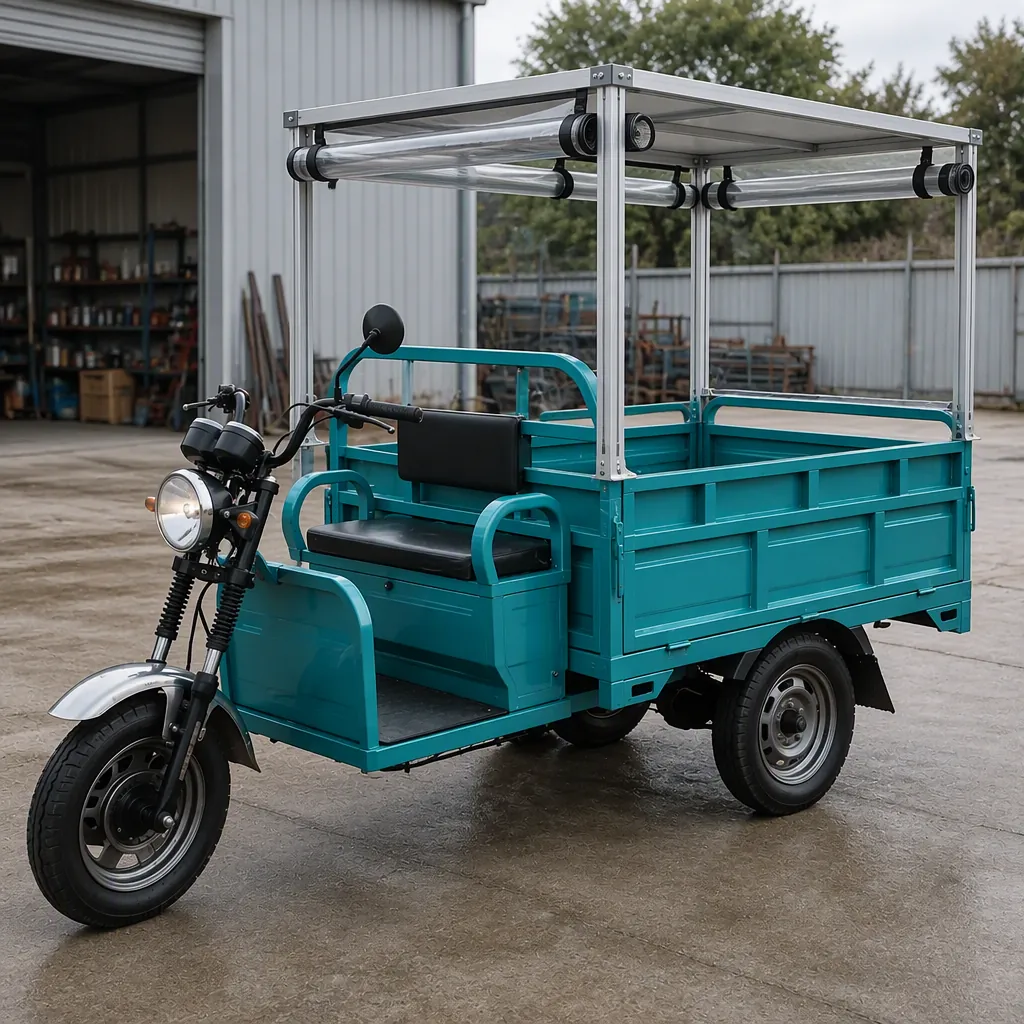
| Sun shade / fixed roof | Rider and box top; UV and light rain | Lightest (composite roof on tubular posts) | Hot, dry, high-UV markets; markets and vending |
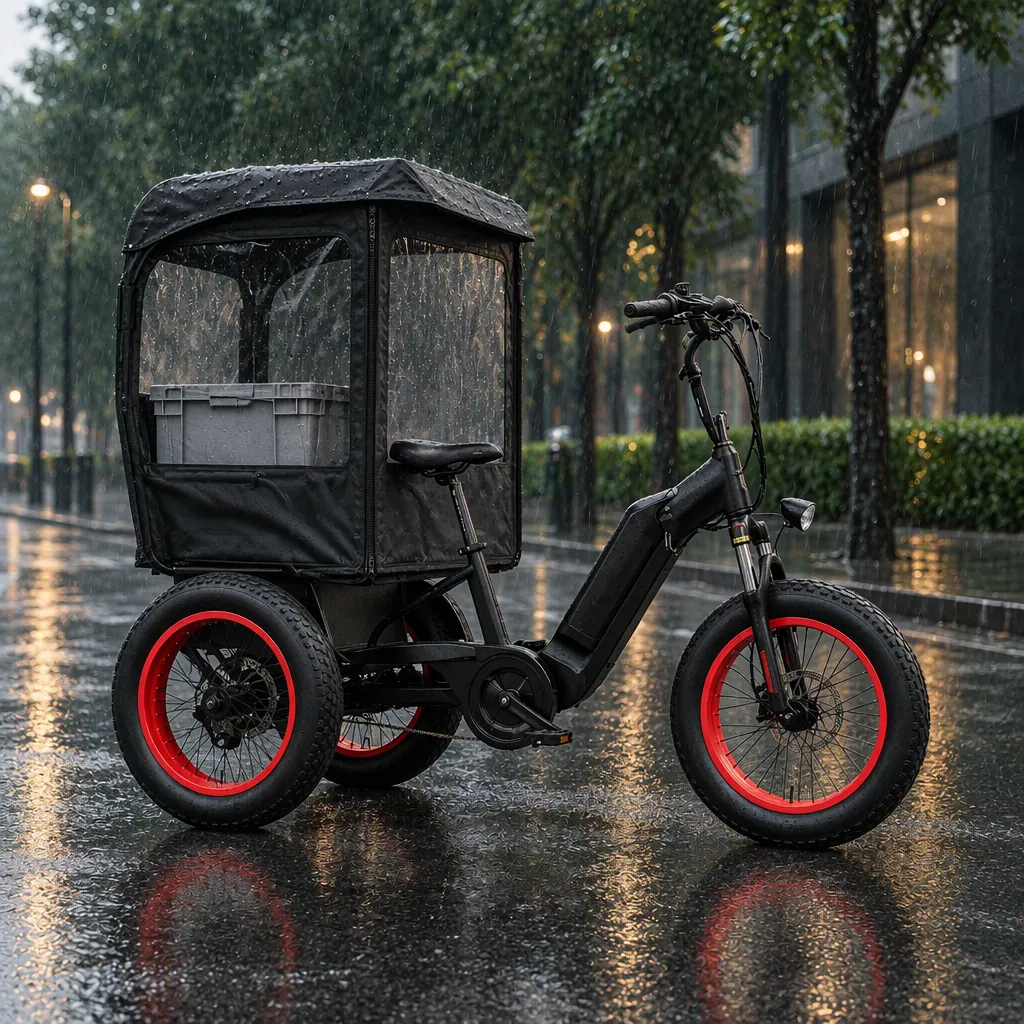
| Full enclosure with side curtains | Rider, box, and electronics; full rain and wind | Heaviest (panels, zips, extra frame bracing) | Year-round urban delivery in temperate and wet climates |
| Market / serving canopy | Counter area and goods on display | Moderate (flat panel, lift-assist struts) | Mobile vending, food stalls, market trading |
A fixed roof is the default in desert and tropical markets where the problem is radiant heat rather than rain: a simple composite or fabric panel on four tubular posts shades the rider and keeps the box lid from cooking in direct sun. The solar panel roof option belongs in this family — it trickle-charges the auxiliary battery and adds 8–12 km of daily range, which is meaningful on low-mileage urban circuits and close to irrelevant on long rural runs.
A full enclosure is what most European and North American fleet buyers actually need. Side curtains turn the canopy from a sunshade into a working space, and for anything carrying electronics, parcels or food, that is the difference between the trike being usable in February and being parked. The trade is weight and the practical friction of getting in and out several hundred times a day.
A serving canopy is a different animal: it opens out to present goods, so it is specified around counter height, lift-assist struts and a flat working surface rather than around weather sealing. If your fleet does vending, that is covered in more depth in our mobile vending tricycle guide.
Weight, drag and range: the real cost of a canopy
Two penalties come with any roof, and buyers routinely budget for only the first.
The weight penalty is modest. A light fixed roof adds a fraction of the platform's capacity. Set it against the base numbers: the cargo platform carries 300 kg in EU configuration and 500 kg outside the EU, with a box volume of 150–500 L, and returns 50–80 km on a 200 kg load on flat terrain. A canopy does not meaningfully reduce payload, because the vehicle's limit is the frame, axle group, brakes and tyres rather than a few kilos of roof panel.
The drag penalty is the one that shows up in your route plan. A large flat frontage converts headwind into a continuous power draw, and the effect scales with speed, not with distance. That matters because the platform's governed top speed is adjustable across 25 / 35 / 40 km/h, and a fleet that runs at the top of that range through an exposed corridor pays for the canopy twice: once at purchase, and again in amp-hours on every shift. The practical answers are to govern down where the route allows, or to plan the range budget from measured consumption rather than from the flat-terrain 50–80 km figure.
Range budgeting rule: quote the flat-terrain figure as your ceiling, never your plan. A closed enclosure on an exposed route at governed top speed is the worst case; a fixed roof at town speed is close to the best. If you are specifying a canopy for the first time, ask your supplier for the consumption assumption behind the range number and check whether it was measured with a canopy fitted.
Keeping cargo dry: box, inserts and enclosure
The canopy keeps rain off the top. It does not, by itself, keep cargo dry. Water reaches goods through three routes, and each one has a different fix.
- Road spray from below. The most underrated route. Wet roads throw a fine mist upwards, and a slatted or unsealed bed floor will pass it straight through. An insulated sandwich-panel box or a sealed liner is the answer, not a bigger roof.
- Driving rain through the gap between canopy and box. Where a canopy is a separate structure sitting above a drop-side box, wind-driven rain gets in at the interface. Specify the canopy as part of the box assembly rather than as an accessory bolted above it.
- Condensation inside an enclosure. A fully sealed enclosure with a warm load and a cold night will sweat. Goods that are hygroscopic or packaging that is moisture-sensitive need either internal airflow or a desiccant strategy.
On box configuration, the drop-side box in the 150–500 L range is the default because it lets the same vehicle do canopy-covered parcel work in the morning and open-sided bulk work in the afternoon. If your load is insulated or refrigerated, the canopy must be specified together with the box material, and that combination is treated properly in our cold chain guide.
Cold weather: battery behaviour and the charging protocol
Cold does not damage a battery pack by being cold. It narrows the window in which the pack can accept charge, and it raises internal resistance so the same load pulls more energy. Both effects are manageable with a protocol rather than with hardware.
Charge warm, ride cold. The pack chemistry on this platform is 60V 32Ah NMC or 72V 40Ah, with LFP available, and heavy-duty BMS. A 5A charge takes 6–10 hours. Charging in a cold yard is what turns that into a nine-hour job that never finishes; charging indoors at normal ambient keeps it near the six-hour end. If your depot has no heated space, the answer is to bring packs in, not to buy a bigger charger.
Expect a real range reduction in winter, and plan for it honestly. Cold-weather capacity loss is a property of the cell chemistry, not a defect. Fleet operators who plan winter routes on summer figures are the ones who run out of charge in the worst possible place.
- Top up between shifts, not during them. The standard 6–10 hour window fits an overnight cycle well and does not fit a two-shift operation. A two-shift fleet on one vehicle needs either a second pack, a swap rail, or a second vehicle. Full arithmetic on that decision is in our fleet charging guide.
- Watch the storage chemistry choice. For fleets in genuinely hot or genuinely cold markets, chemistry selection matters more than brand. The trade-offs are set out in our battery technology guide.
Rain and electronics: IP ratings and the drying protocol
Electrical failures in wet weather almost never come from submersion. They come from water sitting on a connector, or from a partially sealed enclosure breathing moist air in as it cools overnight.
| Component | Protection level to specify | Failure mode to watch |
|---|---|---|
| Motor and controller | Motor IP65; controller potted and IP-rated | Water ingress at the connector, not the housing |
| Display and switchgear | Sealed LCD, IP-rated handlebar controls | Condensation behind the lens; intermittent F/N/R switching |
| Battery pack and BMS | Heavy-duty BMS, sealed pack enclosure | Charge refused after a cold wet night |
| Harness connectors | Waterproof connectors, dielectric grease on service joints | Corrosion at exposed pins |
The controller is the part buyers underestimate. It is the most exposed electronic component, and on this platform it carries an 18-month warranty covering MOSFET failure and water ingress — which tells you the manufacturer treats ingress as a real failure mode, not an abuse case. Motor and drivetrain components are similarly covered against bearing seizure and gear tooth breakage.
Build a drying routine into the shift close rather than treating it as repair work: park under cover where possible, let the vehicle come up to ambient before charging, and check connector boots at the service interval. Most "it stopped working after the rain" reports are the second wet day, not the first.
Rider comfort and retention: the shift-length argument
Forget the vehicle for a moment. The canopy is the cheapest rider-retention tool in the fleet.
An open trike in a wet, cold or sun-exposed operating environment produces a rider who is willing to work a shorter season, or a shorter shift, or who leaves for a competitor with enclosed vans. A fully enclosed cab with a canopy-covered box gives that rider a reason to stay through the winter. Against a driver turnover cost that lands in recruiting, training and vehicle handover, the price of side curtains is small.
This is why fleets that run year-round tend to standardise on the enclosure across the whole vehicle set rather than on a mixed fleet. Standardising also simplifies parts, service training and the charging protocol. More on how the whole fleet decision hangs together is in our cargo delivery fleet guide.
Spec sheet: ordering an all-weather cargo trike
When you write the RFQ, put the canopy line into the specification rather than leaving it as an accessory quote. These are the fields that change the price:
| Parameter | Range on this platform |
|---|---|
| Motor | 800 W / 1000 W / 1200 W brushless hub with differential, 60 V / 72 V |
| Battery | 60 V 32 Ah / 72 V 40 Ah lithium, LFP available; heavy-duty BMS |
| Range / speed | 50–80 km loaded at 200 kg on flat terrain; 25–35 km/h, governor adjustable 25 / 35 / 40 |
| Payload / box | 300 kg (EU) / 500 kg (non-EU); 150–500 L drop-side box |
| Brakes | Hydraulic disc front, dual drum rear, parking brake |
| Tyres | 3.00-12 front, 3.75-12 rear dual |
| Charging | 6–10 hours at 5 A |
| Canopy options | Fixed roof, full enclosure with side curtains, market serving canopy, solar panel roof (+8–12 km) |
| Fleet options | GPS tracker integration, reverse alarm, lockable toolbox, flatbed or enclosed body |
| Compliance | CE, RoHS, UN 38.3, ECE R10 (EMC) |
| Commercial terms | MOQ 50 units per model; 15–30 days standard, 30–45 days first custom order |
Two specification habits separate a fleet order that works from one that disappoints. First, specify the canopy and the box as one assembly, with the mounting interface defined, so water cannot enter between them. Second, state the winter operating temperature range you actually run in, because it determines both the cell chemistry recommendation and whether you need heated storage or a swap strategy.
Spec an enclosed trike for year-round routes
A canopy is not a cosmetic option. It sets the number of days per year your fleet can earn, it shapes the charging schedule, and it decides whether your rider is still with you after the first winter. Get it right at the specification stage and the trike becomes an all-year vehicle; get it wrong and you own a seasonal one.
Send us your route profile — climate, daily distance, payload, whether the rider is exposed all shift — and the engineering desk will return a canopy and enclosure configuration with the box assembly, range assumptions and compliance documentation for your target market. For the wider vehicle decision, start from the cargo vs passenger platform comparison.
Spec an Enclosed Trike for Year-Round Routes
Send us your climate, route length and payload. We will match the canopy, enclosure, pack voltage and box insulation, with cold-weather range data and a charging protocol for your depot.
