
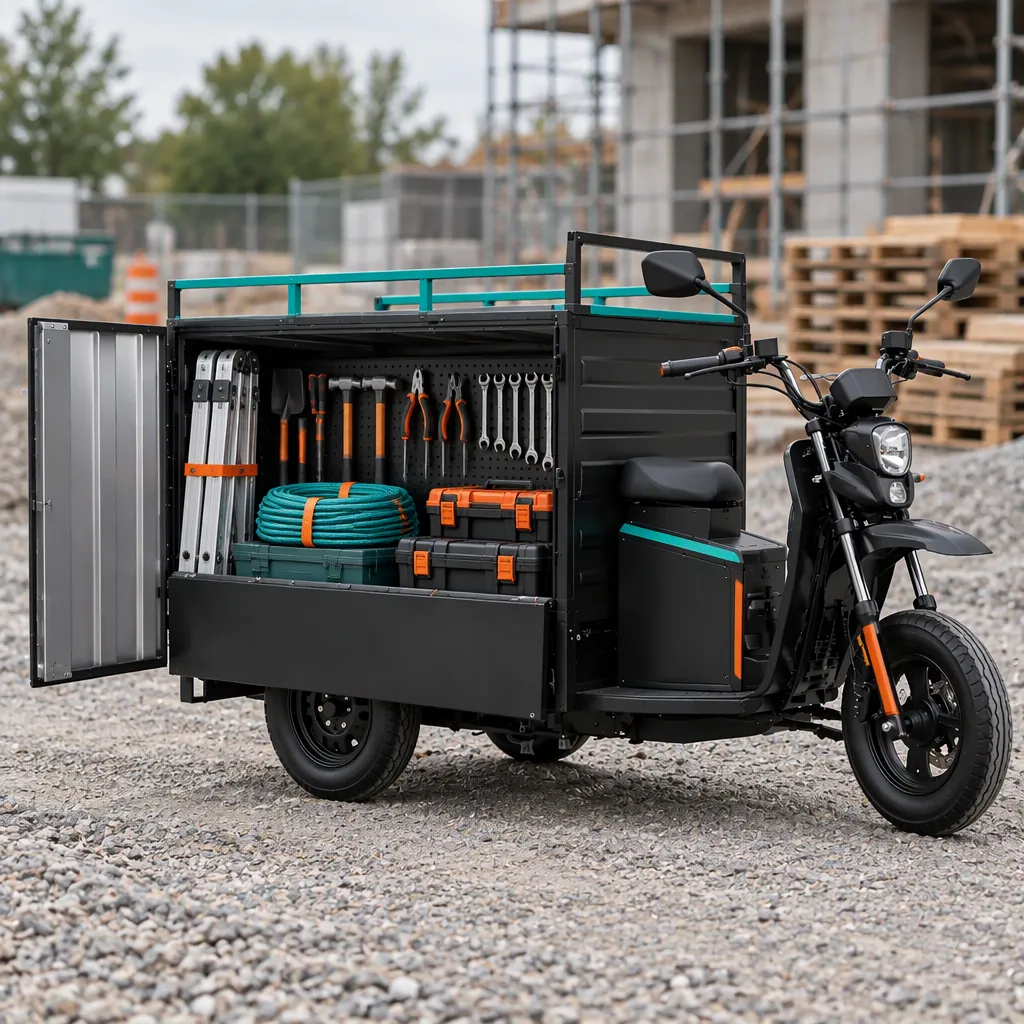
A utility work tricycle is bought for the job, not for the journey. The buyer is a grounds contractor, a plant maintenance team, a municipal support crew or a trade that needs to carry tools, material and waste to a work point and back again without parking a van in a place it cannot turn around. That difference shows up in the specification: the bed type, the electrical load for powered attachments, the axle loading, and the accessory set all matter more than top speed or motor badge. This guide is written from the factory side of that order — what we ask buyers before quoting, and which platform data should drive the decision.
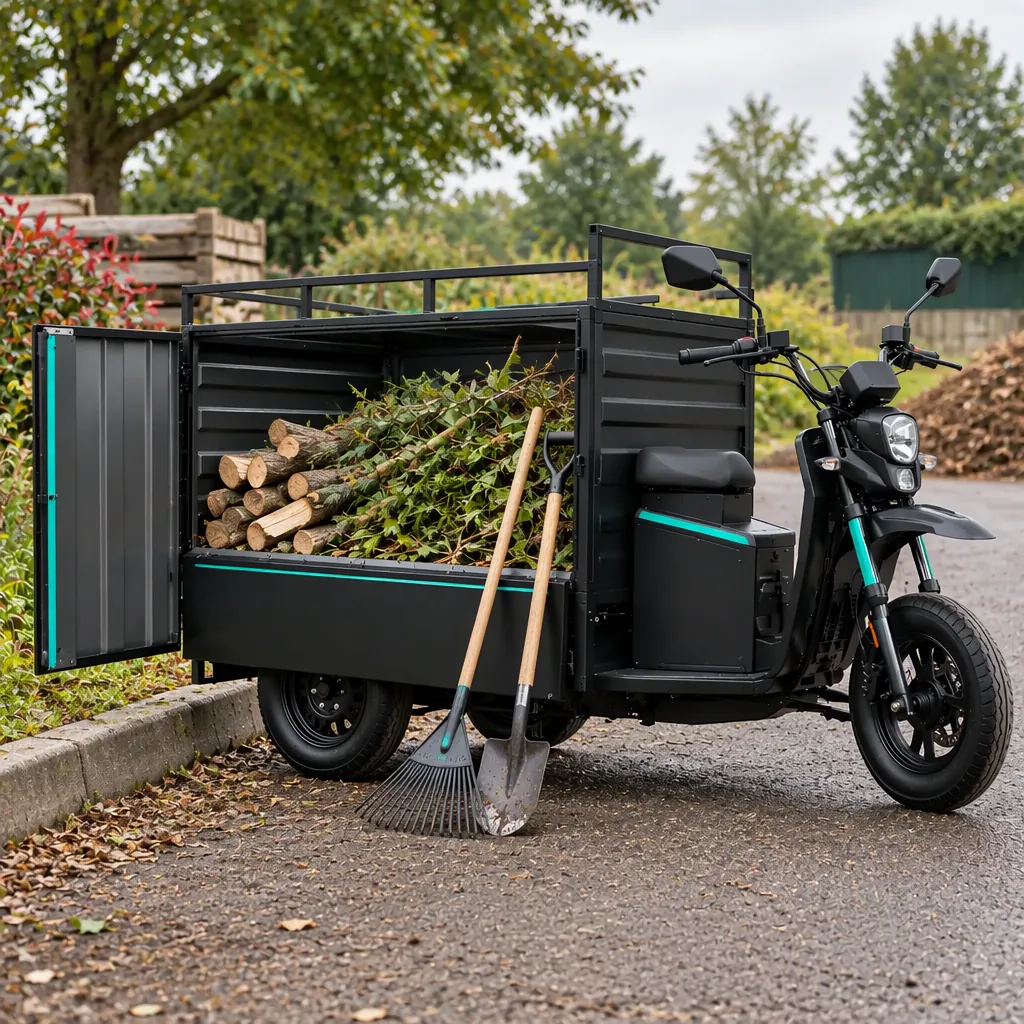
What Separates a Work-Rated Trike From a Delivery Trike
The delivery trike is a route vehicle: it runs a defined loop, stops frequently, and the load is mostly parcels in a fixed box. A work trike is a task vehicle. It goes to one work point, sits there while the crew works, gets loaded with offcuts, spoil or green waste, and comes back. The duty-profile differences are practical:
- Loading events, not deliveries. A work trike is loaded and unloaded once or twice per site visit, often with loose or irregular material, so side access and drop-sides matter more than a sealed box.
- Idle-heavy duty. The vehicle spends most of the visit parked. Electrical load is dominated by auxiliary circuits — work lights, a beacon, a powered tool or a pump — rather than traction.
- Rough access. Sites have ramps, kerbs, compacted gravel and muddy approaches. Wheel and brake specification carries more weight than on a sealed urban route.
- Tool geometry. Rakes, ladders, a strimmer or a long-handled implement do not fit a parcel box. The body has to accept lengths and awkward shapes.
Start With the Bed, Not the Motor
Across the platform we build, the cargo body is treated as a blank-slate engineering item per order, so the bed decision is genuinely open. There are four common bodies and each suits a different work pattern:
| Body type | Best for | Practical note |
|---|---|---|
| Fixed flatbed with stake sides | Long, rigid loads — pipes, planks, ladders, scaffolding tube | Stake sides are removable; load restraint is the operator's responsibility, so tie-down points matter |
| Three-way drop-side body | Loose or palletised material, green waste, spoil, offcuts | Converts to a flatbed in seconds from three sides — the most flexible single body for mixed work |
| Enclosed box with lockable lid | Tool security, high-value equipment, night parking on site | Higher tare weight; check it still leaves usable payload against your axle limit |
| Hydraulic tipper body | Bulk spoil, gravel, mulch, waste that must be discharged without manual effort | Adds hydraulics and a power take-off path — specify the electrical supply for the pump up front |
For most trade and grounds work the three-way drop-side body is the default, because it is the only single body that handles both a rigid load one day and a loose load the next. The enclosed box is specified when tools are left on an unsecured site; the tipper is specified when manual discharge is the bottleneck — our hydraulic tipper trike guide covers the tipper build in detail.
Payload Is a Systems Number, Not a Bed Number
Buyers routinely read the payload figure as a property of the box. The full engineering breakdown of how chassis, axle group, tyres, brakes and motor each cap the number is set out in our cargo tricycle payload capacity guide. It is not. On the platform data sheet, the load capacity is stated as 300 kg (EU) / 500 kg (non-EU) with a box volume of 150–500 L, and that figure is the engineering limit of the whole assembly — chassis, axle group, tyres, brakes and motor. Change one and the real limit moves. The three configurations are specified as follows:
| Specification | Motor | Battery | Range (loaded) | Box volume | FOB band |
|---|---|---|---|---|---|
| Light | 800W hub, 60V | 60V 32Ah NMC | 50–60 km | 150–300 L | $1,250–1,550 |
| Standard | 1000W hub, 60V | 60V 32Ah NMC | 60–70 km | 200–400 L | $1,580–1,880 |
| Heavy-Duty | 1200W hub, 72V | 72V 40Ah LFP | 70–80 km | 300–500 L | $1,880–2,250 |
Range figures are quoted at a 200 kg load on flat terrain at a 25 km/h average, so a work trike carrying 400 kg on a stop-start site route will not return the nameplate number and should not be specified as if it will. The spec that carries the load is the rest of the vehicle: steel tube chassis with e-coat and powder coat, 3.00-12 front / 3.75-12 rear reinforced load-rated tyres, and hydraulic disc front with dual drum rear plus a parking brake. Tyre and suspension selection for rough site access is covered in the cargo tricycle tires guide and the suspension guide. The parking brake is not a detail on a work vehicle — it is what stops the trike rolling on a slope while the crew loads.
Electrical Load for Work Attachments
This is where work trikes diverge most from delivery trikes, and where buyers most often under-specify. Traction is not the demand; auxiliary circuits are. Before quoting we ask for four numbers:
- Continuous auxiliary draw in watts. Work lights, a beacon, a cab or hand-held fan, a powered pump or a small compressor. Add them up; the stock DC-DC converter may not cover the total.
- Peak draw and duration. A tipper pump or a pump start-up draws a short spike well above steady-state. The electrical path has to be sized for the peak, not the average.
- Duty cycle of the vehicle itself. A trike that spends 80% of its day parked with lights on needs a different balance between traction and auxiliary energy than one that runs continuously.
- Whether the site has mains power. If not, an auxiliary or roof-mounted solar panel that trickle-charges the auxiliary battery and can extend daily range by 8–12 km changes the charging arithmetic materially.
Get those four numbers onto the order and the factory can size the converter, the auxiliary battery and the fuse/protection layout before the body is built. Leave them out and the accessory set arrives as an afterthought that overloads a circuit designed for lights only.
Drivetrain and Terrain: Where the 800W / 1000W / 1200W Choice Actually Lands
The motor is a brushless hub motor with differential in 800W, 1000W or 1200W at 60V or 72V. The differential is the item buyers overlook. On a three-wheel work vehicle turning tightly around site obstacles, a rear axle without a differential scrubs the inside wheel through every tight manoeuvre, wearing tyres and working the axle group. For a vehicle that turns in yards, on access roads and between parked plant all day, the differential is not a performance feature — it is a durability feature.
The power step should follow terrain, not marketing. Flat urban and yard work sits comfortably on 800W. Mixed routes with ramp access or sustained grades belong on 1000W. Sites built on genuinely steep ground, or units that run loaded all day, justify 1200W at 72V. Speccing 1200W for flat work buys nothing but weight and cost; speccing 800W for a hilly site is the single most common specification mistake we see.
Battery Chemistry and the Climate You Work In
Battery options are 60V 32Ah NMC or 72V 40Ah LFP, both with a heavy-duty BMS, and the choice is climate-driven as much as capacity-driven. NMC gives more energy density for a given pack weight. LFP gives materially longer pack life under thermal stress, and for operators in tropical, desert or heat-soaked yard environments the longevity argument outweighs the weight argument. Charging is 6–10 hours on the supplied 5A charger, which maps cleanly to an overnight park for a single-shift work vehicle. If a trike has to work two shifts, the answer is not a bigger pack — it is a second pack on a swap rail or a second vehicle. Fleets working out of a rented yard rather than a depot should read the field service fleet trike guide for the charging-without-a-depot arithmetic.
Accessories and Attachments: Specify Them on the Order
Work vehicles live or die on the accessory set, and almost all of it can be factory-fitted rather than retro-fitted. The options that matter most to trade and grounds buyers:
- Lockable tool and equipment storage — a lockable box or enclosed rear body so tools can stay on the vehicle between sites.
- LED work lights and a beacon — the vehicle is quiet and low-speed, so visibility to pedestrians and other plant is the main safety exposure. High-visibility colour plus full LED lighting and a beacon is the standard package.
- Reverse gear and a parking brake — the F/N/R selector with a three-speed setup makes yard manoeuvring practical, and the parking brake holds a loaded vehicle on a grade.
- Fleet telemetry — GPS tracker integration with geofencing for operators running several units who need utilisation reporting, not just theft recovery.
- Solar roof panel — for remote or off-grid sites, extending daily range by 8–12 km.
The single most useful thing a buyer can do is send the intended accessory list with the enquiry, because the body, the electrical path and the mounting points are all decided at build. An accessory purchased later is a drilling and wiring job on a finished vehicle; the same accessory on the order is a design input.
Compliance and Documentation for the Order
A work trike is used in a commercial setting, so the document pack matters at customs and at the site gate. Every unit is planned against CE marking for the full electrical system including motor controller and BMS cell-balancing logic, RoHS material declarations, UN 38.3 battery transport testing — with specific attention to the crush and impact tests on the larger 72V 40Ah packs — and ECE R10 electromagnetic compatibility, the EMC standard applied to four-wheeled commercial vehicles that customs authorities in the EU, GCC and ASEAN regions increasingly enforce on electric cargo carriers. Each vehicle then passes a per-vehicle inspection covering weld integrity on the cargo subframe, torque verification on all chassis fasteners, and a loaded road test with ballast to confirm brake balance and motor thermal behaviour under real duty cycles.
The last point matters for work vehicles specifically: a trike loaded with irregular material on a sloped site is a different vehicle from one tested empty on flat ground, and the ballast road test is where brake balance is actually confirmed.
Order Terms That Fit a Work Fleet Rollout
The commercial terms are straightforward and worth knowing before you plan the budget. MOQ is 50 units per model, with a 15–30 day standard lead time and 30–45 days for the first custom-branded run, and pre-production samples ship before mass production so the body and accessory layout can be verified first. Box customisation typically adds around ten days. Quantity discounts apply at 100, 200 and 500 units, which is where a multi-year fleet or a dealer programme starts to show real per-unit movement.
For a first order, the sensible sequence is: define the workload, choose the body, confirm the electrical load, order a sample unit, run it on your hardest route for a month, then commit the fleet. A work trike is specified once and lived with for years, and the cost of the specification conversation up front is a fraction of the cost of discovering the body was wrong after fifty units land.
For adjacent specifications, see our guides on municipal public works trikes, in-plant and warehouse material flow, charger selection, canopy and weather protection and heavy-duty cargo trike OEM specification.
If you are weighing a work trike against a second van or a small utility vehicle, the honest framing is that the trike wins on access, running cost and quiet operation, and the van wins on weather protection and highway speed. For site, yard, grounds and facility work that never leaves a 25 km/h envelope, the trike is usually the cheaper vehicle over its life — provided the bed, the payload and the electrical load are specified around the real job rather than a generic cargo platform.
Send Us the Work, We Will Spec the Platform
Tell us the material you carry, the accessory set you need and the terrain you work on, and we will come back with a body recommendation, the electrical sizing for your attachments, and an FOB quotation with the certification pack for your market.
