
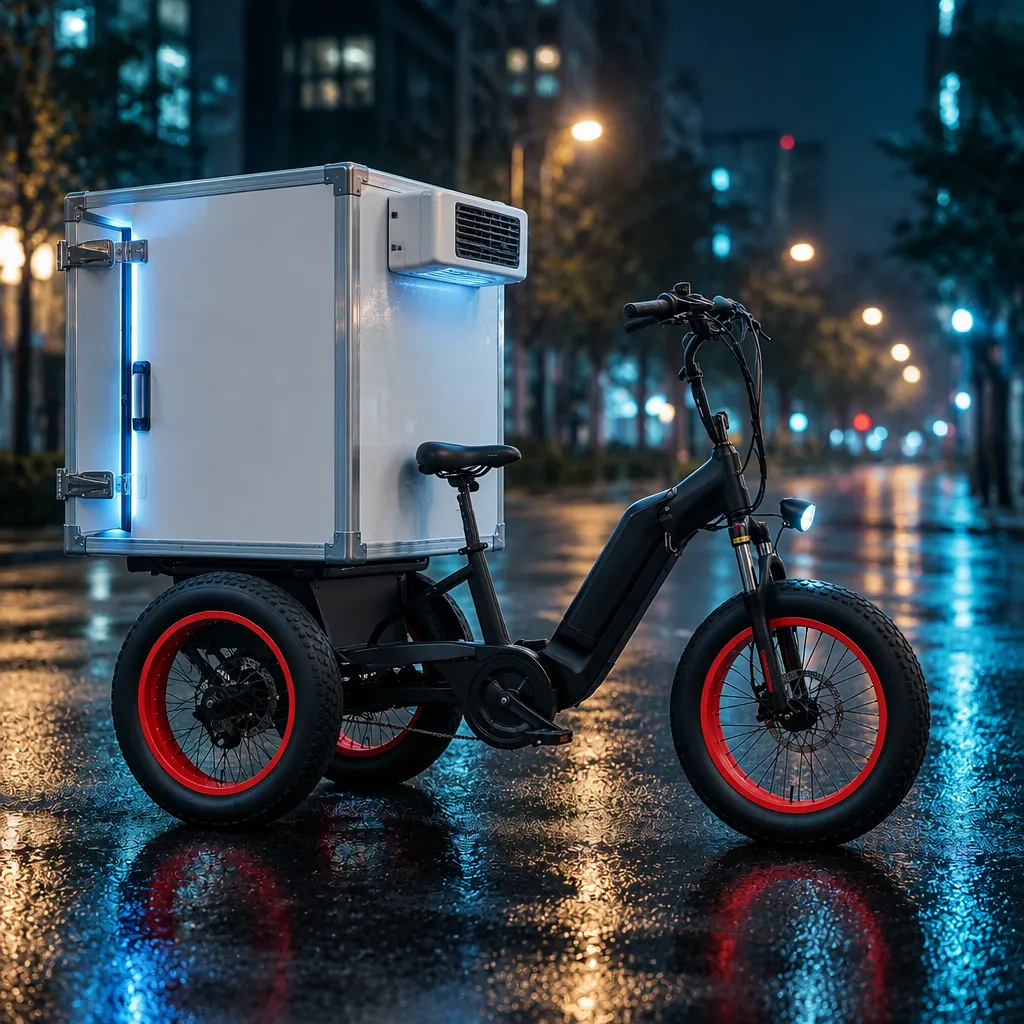
The cold chain does not break in the warehouse. It breaks on the last five kilometres, at the point where a full-size refrigerated van is too expensive, too wide, and too fuel-hungry to serve the route it was bought for. A refrigerated cargo tricycle takes the other approach: a three-wheeled platform carrying an insulated box and a compact refrigeration unit, running on the same 60V or 72V drivetrain as a standard cargo trike, through streets, alleys, pedestrian zones and campus lanes that a van cannot enter. This guide covers the two cooling builds the platform supports, the compressor power budget against each pack option, the monitoring stack auditors actually ask for, and the spec that holds frozen goods for a working shift.
The Last-Mile Cold Chain Problem
Cold-chain economics get worse the closer the load gets to the door, because the vehicle is sized for the whole route but paid for per stop. A refrigerated van serving dense urban stops spends most of its shift parked and idling, holding temperature at 2–4 kW of engine load. Grocery, meal-kit and pharmaceutical routes all meet the same wall: the final kilometres are served by a vehicle that is too big, too costly and too loud for the job. The trike answers the dense-urban case directly — narrow enough for service alleys and pedestrian streets, near-silent, and cheap enough to run a dedicated temperature-controlled route instead of mixing chilled and ambient goods in one compartment. The general fleet economics are in our cargo delivery fleet guide, and the hot-hold version of the same problem — insulated boxes with no active cooling — in our food-delivery trike guide.
Passive vs Active Cooling on a Trike
Cold-chain trikes come in two cooling tiers, and choosing wrong either melts the cargo or drains the pack. The decision is not a preference; it follows from the temperature the load must hold and how often the box opens.
- Passive: sealed insulated box + phase-change panels. A double-wall sandwich-panel box with pre-frozen gel or eutectic panels holds 2–8°C for a four-hour working window with zero ongoing power draw. This is the build our cold-chain box module is specified around — 2–8°C with a four-hour hold on a quick-release mounting — and it suits chilled grocery restocking and meal-kit runs where the box is loaded cold and emptied before the hold expires. The enclosure and insulation logic borrows directly from our cargo trike canopy guide.
- Active: 12V DC compressor unit. A small DC refrigeration unit holds a set temperature against external heat and door openings, reaching frozen temperatures where the load demands it, and drawing power continuously while it runs. Active cooling is the only honest option for frozen goods and for multi-drop routes where the box is opened dozens of times in a shift.
| Cooling build | Compartment spec | Hold time | Ongoing power | Best for |
|---|---|---|---|---|
| Passive insulated module | 2–8°C | 4 h on the module hold spec | 0 W (panels pre-frozen) | Chilled grocery, meal kits |
| Active 12V DC compressor | Set point, frozen capable | Full shift | Continuous while cycling | Frozen runs, multi-drop |
| Hybrid box + circulation fan | 0–8°C | Extended chilled window | Low continuous draw | Long chilled routes |
Most first fleets start with the insulated module and move to an active unit when frozen SKUs enter the route. Both mount to the same chassis: the cold-chain compartment is one of three box modules in the programme, alongside a lockable parcel box and an open flatbed, all on the same quick-release mounting. The swap procedure, plus the electrical connector mating that a refrigerated box needs, is taught to depot staff in the handover. Box construction and options are covered in our cargo trike OEM guide.
Power Budget: Battery, Compressor and Range
Active cooling turns the trike into a rolling appliance, and the pack has to feed both the motor and the refrigeration unit. On this platform the cold-chain grade build is the 1500W mid-drive with a 60V 32Ah pack, rated at a 70 km range on the refrigerated specification, with the 72V 40Ah LFP option available where longer frozen routes justify it. Three practical points decide the sizing:
- Cooling is a duty-cycle cost, not a nameplate cost. A compressor cycles; it does not run flat out for a whole shift. Size the pack against the measured run-time of the unit on your route, not against its peak label.
- The insulated box does the first half of the work. Insulation quality sets how often the compressor cycles. A four-hour passive hold on the same box volume means the active unit only has to carry the route beyond that window.
- A second pack beats a bigger pack for double shifts. For frozen routes running beyond one shift, a slide-out spare pack is faster and cheaper than oversizing the primary pack, and it keeps the box cold while the first pack recharges. Charging windows and depot power for a mixed fleet are covered in our fleet charging guide, and the cold-weather derating that hits both pack and compressor in winter in our winter operation guide. The pack chemistry comparison is in our battery technology guide and the voltage trade-off in our 60V vs 72V guide.
Temperature Control, Monitoring and Provenance
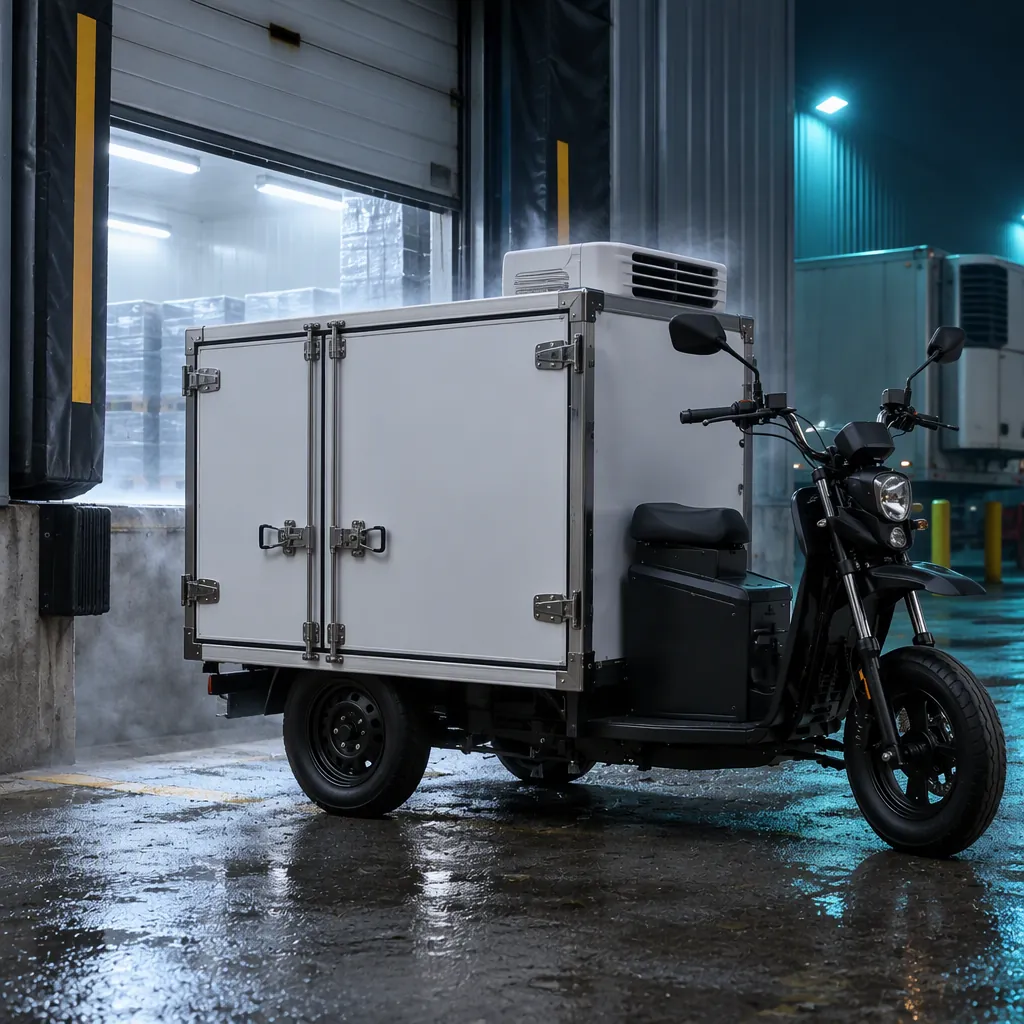
Cold chain is an audit business. The question is never whether the load stayed cold; it is whether you can prove it after the fact. The monitoring layer on a refrigerated trike is small, and it is the part that decides whether a route survives a customer audit:
- Compartment temperature sensing. A probe inside the cargo space feeding the display or a standalone logger, so the driver sees drift while it is still correctable.
- Temperature data logger with export. Time-stamped history at a fixed interval, downloadable for food-safety and good-distribution-practice records. This ships with our cold-chain box module rather than being an afterthought.
- Door-open discipline. The box is a thermal battery. Every open door spends hold time, and on multi-drop routes the door is the single largest source of temperature drift.
- Pre-cool before loading. Bring the compartment to set point on shore power or at the depot, then load fast. Pre-cooling on the pack is the most expensive way to cool a box.
Because every unit carries a per-VIN production record, the electrical and drivetrain history behind the refrigerated build is traceable to the torque and test logs of the specific vehicle. That traceability is part of the export documentation file. The operating routine around these controls, including what fails when they are skipped, is in our maintenance guide.
Routes and Duty Cycles That Fit
The cold-chain build earns its place on the routes that punish vans. Four duty cycles map cleanly onto the platform:
- Urban grocery and convenience restocking (2–8°C). High stop count, short legs, one shift. The insulated module with a four-hour hold covers the route; the 60V 32Ah pack carries the traction load with margin.
- Meal-kit and prepared-food runs. Chilled compartments with frequent openings, which is exactly the profile that erodes a passive hold. Hybrid box with circulation, or an active unit.
- Frozen routes. Active cooling on the 72V LFP grade, with a spare pack for confidence. On these routes the limit is usually hold time, not battery range.
- Pharmaceutical and clinical last mile. Small, high-value, temperature-critical loads where the logger matters more than the vehicle. Monitoring first, box second. The import and certification path for a qualified build is in our China import guide.
Platform limits on these routes follow the standard cargo envelope — 300 kg (EU) / 500 kg (non-EU), 150–500 L box volume, 50–80 km loaded on flat terrain, 25–35 km/h with a governed top speed. The load-rating arithmetic behind those numbers is in our motor power guide and payload capacity guide.
Regulatory Notes: Vehicle Law, Food Safety and Pharma
A refrigerated trike sits at the intersection of vehicle law and food or drug law, and the two seldom arrive in the same document. Three separate threads need to be closed before the first route runs:
- Vehicle class. A 20 mph governed build needs no licence in most US states; in the EU a 250W EPAC build stays inside EN 15194, while faster builds move into L-category rules with eMark implications. The full map is in our US and EU regulation guide. The platform ships to CE, RoHS, UN 38.3 and ECE R10 (EMC), with compliance documentation per order.
- Food safety and hygiene. The box must hold temperature and prove it; a washable interior liner and a sealed door gasket are as much a hygiene requirement as a thermal one. Temperature records are the vehicle-side evidence.
- Pharmaceutical distribution. Validated temperature control plus calibrated monitoring and retained records. Treat the trike as a component of the cold chain, not a transport afterthought.
Buyers running regulated routes should put the monitoring requirement into the specification from day one. Retrofitting logging after a failed audit costs more than the logger. The spares and service pipeline that keeps a qualified build running is in our after-sales and spare parts guide.
How to Spec a Refrigerated Trike for a Route
A working specification follows the route, not the catalogue. Work through five decisions in order:
- Temperature band and hold time. Chilled only, or frozen capable. This single answer selects passive versus active cooling before anything else is discussed.
- Box volume and door count. Volume per stop, multiplied by stop count, sizes the compartment. High door counts push toward active or hybrid.
- Pack and range. 60V 32Ah as the cold-chain grade standard, 72V 40Ah LFP where frozen routes run long, plus a spare pack decision for double shifts.
- Mounting and swap requirement. If one chassis must also run parcel or flatbed duty, specify the quick-release mounting and the electrical connector for the refrigerated module at order time.
- Monitoring and records. Logger, interval, export format and retention — written into the purchase specification, not added later.
Typical builds start at 50 units per model, with a 15–30 day standard lead time and 30–45 days for a first custom-branded run; pre-production samples ship before mass production. Tell us the temperature band, the route length and the box volume, and we will write the insulation, cooling, pack and monitoring specification around it. The purchase and running-cost comparison against a refrigerated van is in our trike vs pickup cost guide.
Spec a Refrigerated Trike Route
Send us the temperature band, route length and box volume. We will return an insulated box, cooling, pack and monitoring specification built for your cold-chain routes.
