
Food delivery is a margin business, and the vehicle is where margins go to die. The average order pays $3–7 in the US and €2.5–5 in Europe, and a car-based courier burns that margin on fuel, insurance, parking tickets and repairs before the first delivery of the day. Electric tricycles are entering this math because they attack the three biggest cost lines at once: energy, maintenance and parking enforcement. A 300–500 kg cargo trike carries two insulated boxes, needs no motorcycle license in most US states, and costs less than a single month of car payments. This guide works through the per-trip economics, the box integration, the battery strategy for double shifts, and the city rules that decide whether trikes can actually operate in your market.
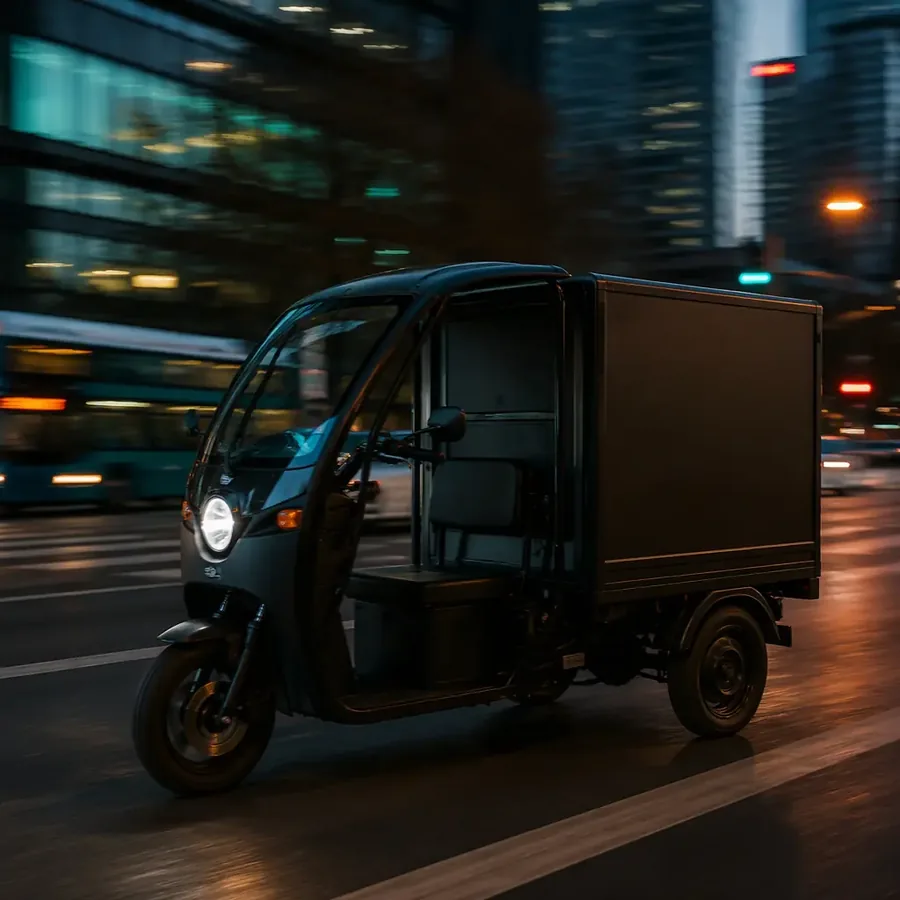
Why Trikes Are Winning Delivery Routes
Delivery operators are switching from mopeds and cars to trikes for four concrete reasons:
- Standstill stability . A courier on a two-wheeler cannot load and unload without balancing; a trike is a workstation. At 80–120 orders per day across multi-stop routes, the loading and unloading time adds up to real hours.
- Payload headroom . Two 60–90 L insulated boxes plus a drinks rack fit on the 150–500 L platform, which lets one rider batch three or four orders per run instead of one.
- No license friction . In most US states the 750W-equivalent Class 2 configuration needs no license, registration or insurance; the classification details are in our electric tricycle laws guide.
- Parking economics . A trike parks on the sidewalk or in a bike rack, not a metered spot. In Manhattan-style markets that is $2,000–4,000 a year per vehicle in avoided tickets and meters.
The comparison against cargo e-bikes, where two wheels still beat three on pure agility, is worth reading in our tricycle vs e-bike comparison before you commit to a platform.
Cost per Trip: Trike vs Moped vs Car
Here is the vehicle economics for a 12,000-order-per-year courier, using delivered prices and realistic operating costs:
| Cost line | E-tricycle | Gas moped | Used car |
|---|---|---|---|
| Vehicle (delivered) | $1,400 | $3,800 | $18,000 |
| Energy / fuel per year | $60 | $1,100 | $2,400 |
| Insurance per year | $150 | $700 | $2,100 |
| Parking / tickets per year | $50 | $400 | $3,200 |
| Maintenance per year | $180 | $900 | $1,800 |
| Cost per order | $0.14 | $0.55 | $1.42 |
Charging the 60V 32Ah pack costs about $0.25 per full charge at US residential rates, roughly 4–5 days of delivery. The full total-cost-of-ownership model, extended to pickup trucks for heavier cargo, is in our cargo trike vs pickup comparison.
The Insulated Box Integration
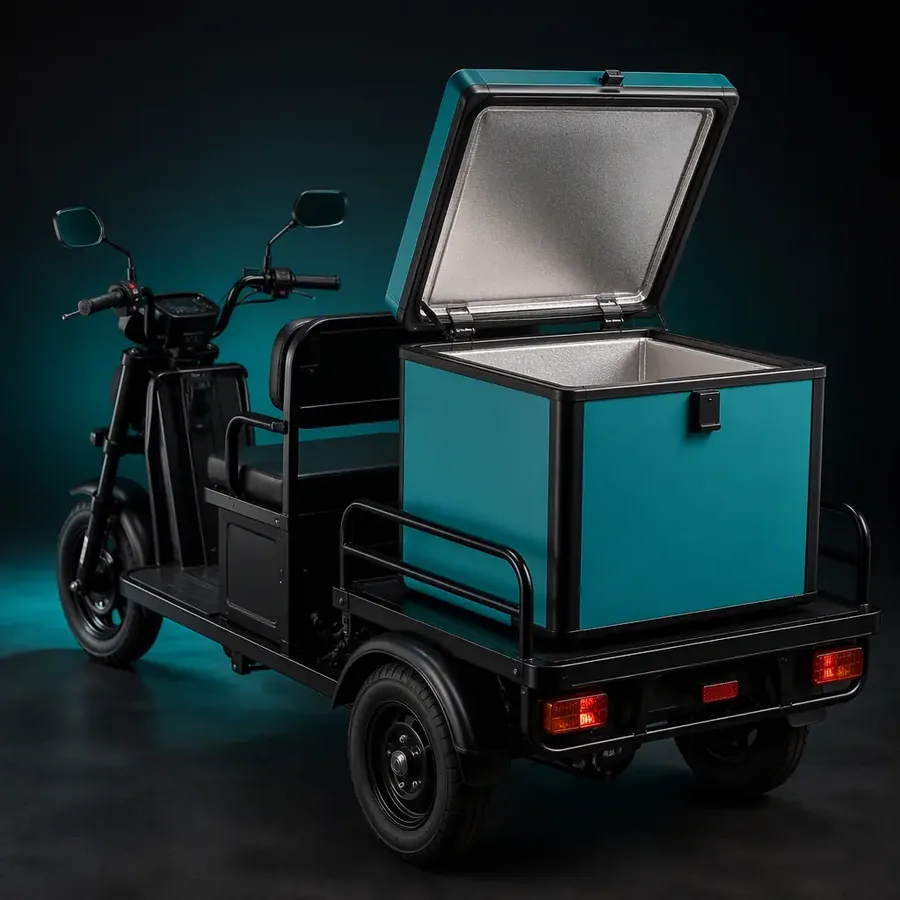
Food safety is the unglamorous spec that keeps delivery fleets alive. The platform’s box families, fixed 250–300 L or drop-side 300–500 L, accept a standard insulated insert kit: 40 mm food-grade EPS walls, a 60–90 L hot zone and a 60–90 L cold zone, with a vented divider between them. The inserts are removable for cleaning, which matters when health inspectors start asking questions. The same box platform is used by the mobile-vending operators we profile in our vending guide . The difference is the insert kit and the lid locking system, both of which are OEM options at the factory.
Battery Strategy for Double Shifts
Lunch and dinner peaks are six hours apart, and that gap is the whole battery problem. Two workable strategies:
- Swappable packs . The 60V 32Ah and 72V 40Ah packs both slide out in under a minute. A courier carries a spare or swaps at a central charger between peaks; one trike becomes a 2-shift vehicle.
- Fast mid-day top-up . The standard 5A charger adds roughly 30% in 2 hours, which covers the lull between peaks if the courier’s home base has a socket.
Range on the 60V pack is 50–65 km at 200 kg payload, enough for a 40–50 km delivery shift in a dense city. For 500-order-per-week fleets in hot climates, the 72V 40Ah LFP pack’s 2,000+ cycle life and heat tolerance make it the cheaper long-run choice; the chemistry reasoning is in our battery technology guide.
Rider Experience and Retention
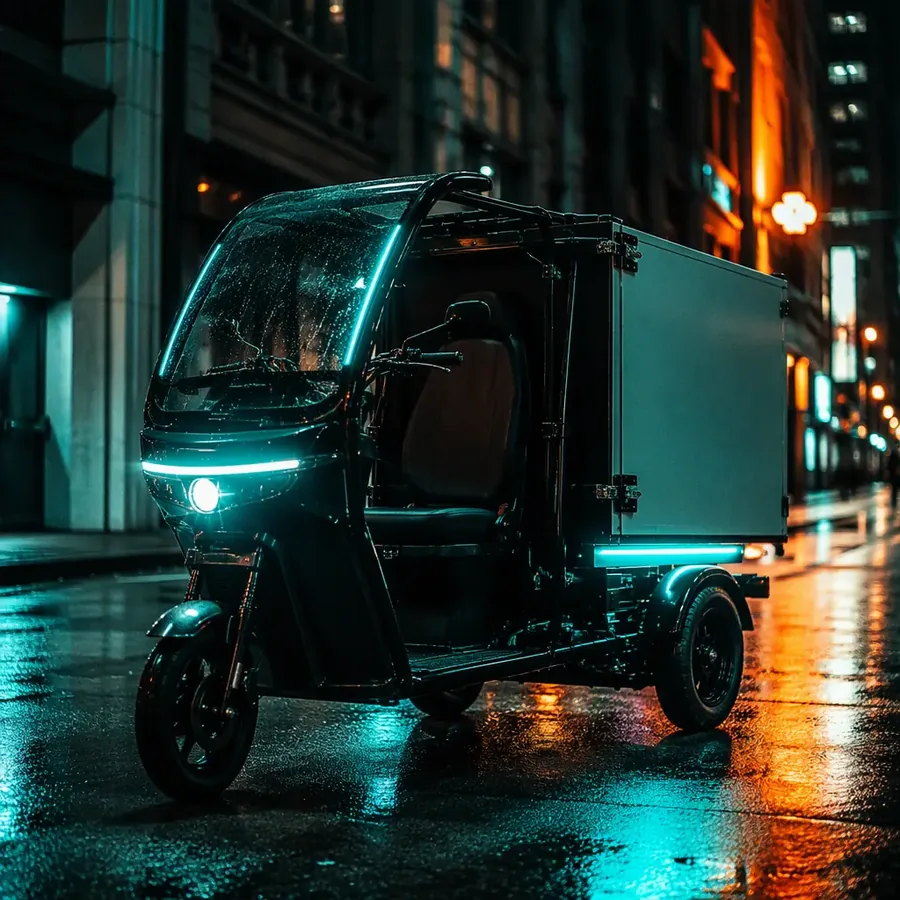
The courier shortage is the quiet killer of delivery fleets, and trikes help on the retention side in ways operators underrate. A rider who does not have to balance a 40 kg loaded two-wheeler, who can park on the sidewalk instead of hunting for a spot, and who works in the weather instead of fighting it, lasts measurably longer in the job. The 1200W/72V configuration with a cushioned seat and full suspension forks is the one to spec if your market is hilly or your riders are new to delivery work: the ride quality difference at 60 km of daily stops is the difference between a 3-month and a 12-month rider. The stability physics that make this possible, why three wheels beat two at low speed with a load, are laid out in our tricycle vs e-bike comparison.
City Rules That Decide Whether Trikes Operate
Three regulatory questions determine where food-delivery trikes can run:
- Vehicle class . Does the 750W/20 mph configuration count as an e-bike (bike lanes, no license) or a moped (roadway, helmet, registration) in your state or province? The US and EU classification maps are in our laws guide and the certification costs in our EU vs US certification guide.
- Food handling permits . Insulated-box fleets usually operate under the restaurant’s permit rather than their own, but some cities require courier registration. Check before ordering 50 units.
- Commercial parking . Some downtown zones restrict commercial vehicles in pedestrian areas; trikes are increasingly exempted as micro-mobility, but the exemption must be written down.
Specifying the Fleet: What to Order
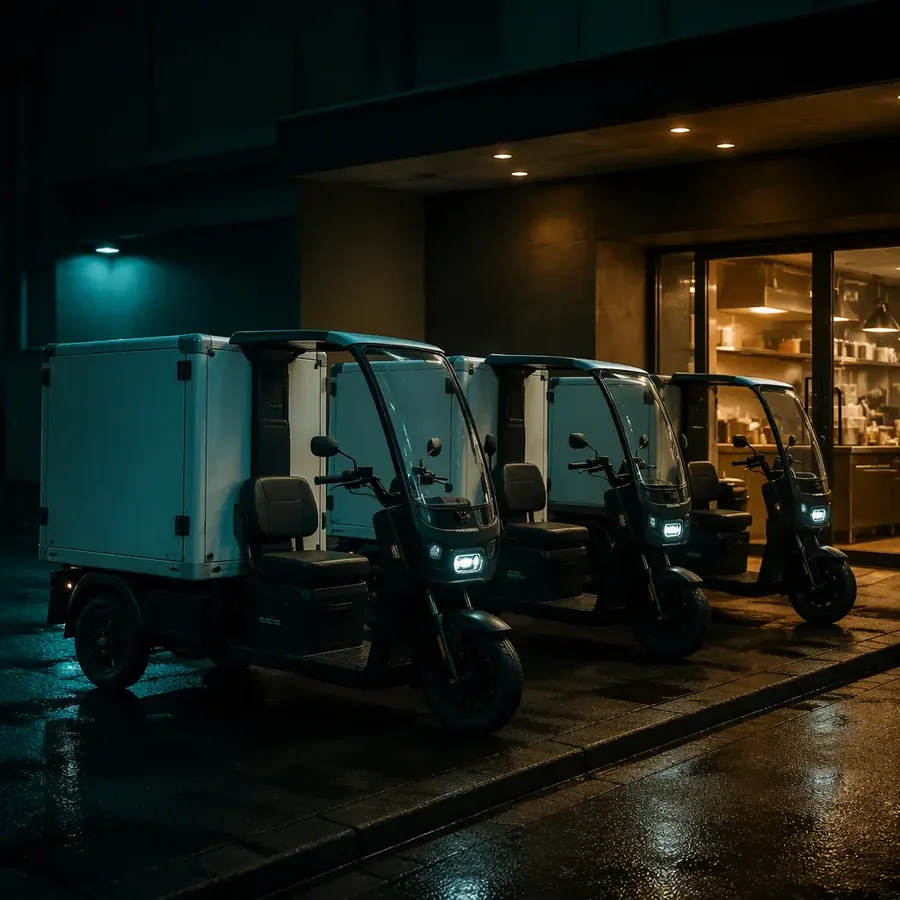
For a food-delivery fleet program, the EMS-EBIKE default specification is:
- 1000W hub motor with differential, 60V . Enough torque for hilly cities at 300 kg gross, staying clear of vehicle-class thresholds in most markets.
- Hydraulic disc front + dual drum rear + parking brake . The parking brake is what stops a loaded trike rolling on a delivery stop.
- Drop-side 300 L box with insulated insert kit . Loading from three sides at restaurant counters.
- LCD dashboard, full LED lighting, optional GPS telematics . The same fleet-management package we spec for delivery fleets.
- Reverse gear . Alleyway maneuvering with a loaded box.
MOQ is 50 units at $1,250–1,550 FOB with 15–30 day production. The fleet maintenance plan, which wear items fail at what mileage under delivery duty, is in our maintenance guide, and the sourcing process is identical to any OEM program in our OEM buying guide.
Spec a Food-Delivery Trike Fleet
Tell us your city, order volume and delivery radius, and we will size the fleet, motor, battery, insulated box integration and charging plan, with per-trip cost modeling included in the proposal.
