
A cargo e-tricycle spends its life between two demands that pull in opposite directions. It must carry 300–500 kg without squatting, and it must keep a rider comfortable across 6–10 hour shifts on roads that were never designed for delivery vehicles. Suspension is the component group that decides how well the platform does both. Buyers searching for a cargo e-tricycle with suspension system are really asking one question: does the comfort upgrade cost payload? This guide answers it with the trade-offs, fork travel, sprung seatposts, rear-axle options, and the platform specifications that balance ride quality against the rated load.
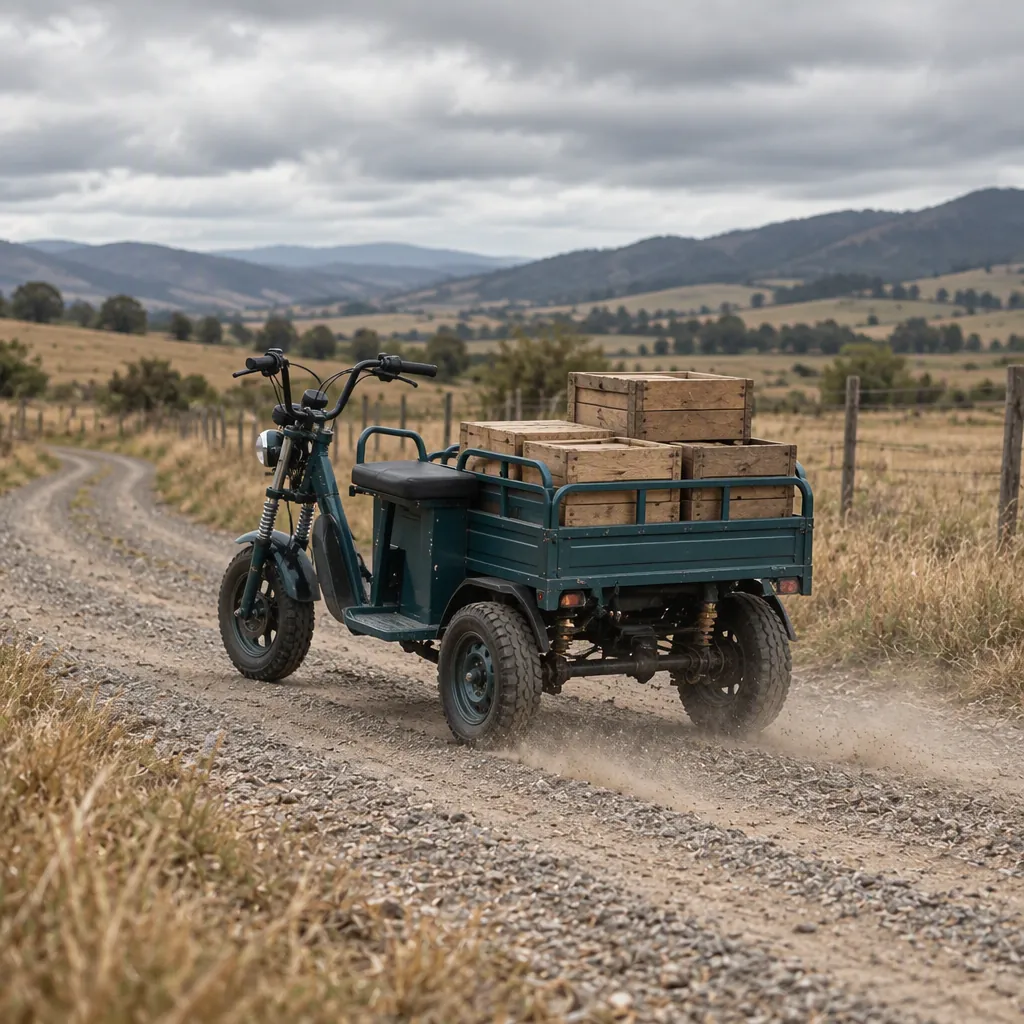
What Suspension Actually Does on a Three-Wheeler
A tricycle's three-wheel layout is inherently more stable than a two-wheeler, but it also removes the one thing a bicycle rider unconsciously uses as suspension: body lean. On two wheels the rider's hips and knees absorb a large share of road input. On a trike there is no lean to give, so every pothole, curb cut and gravel patch transfers straight through the frame to the seat and handlebars. A platform that is stable at standstill can therefore be punishing over an eight-hour shift. Suspension works on three fronts:
- Unsprung mass. Wheels, hubs and brake assemblies are unsprung; everything above the springs — frame, battery, cargo, rider — is sprung. Less unsprung mass means the wheel follows the road contour instead of launching the whole vehicle over it.
- Load transfer. On a hard stop with 500 kg on board, weight shifts forward; fork dive and rear squat are what the suspension does with that transfer. Progressive springs and proper damping control it instead of letting it become a wallow that the rider then corrects with the bars.
- Vibration fatigue. At 25–35 km/h, cobblestones and chip-seal roads deliver sustained low-frequency vibration into the rider's spine and hands. Suspension filters the high-frequency component; tires, seat and grips handle the rest.
The stability architecture behind the three-wheel layout, and why it behaves differently from a two-wheeler with a suspension fork, is covered in our tricycle vs e-bike guide. The key point for spec purposes: suspension on a trike has to be load-tuned, not borrowed from a bicycle.
Suspension Types: Fork, Seatpost and Rear Axle
Three suspension zones exist on a cargo trike, and each addresses a different problem. Travel figures below are typical ranges for the 150–220 kg platform class, not universal values:
| Zone | Typical travel | Weight added | What it fixes |
|---|---|---|---|
| Front suspension fork | 40–80 mm | 1.5–3 kg | Hand and arm fatigue, fork chatter, pothole shock |
| Sprung seatpost | 30–50 mm | 0.4–0.8 kg | Spine vibration, rider comfort on long shifts |
| Rear axle / leaf spring | 20–40 mm | 2–4 kg | Box and cargo shock, load-induced squat |
- Front fork. The highest-impact upgrade on rough routes. Hydraulic damping earns its premium in delivery duty; cheap coil-only forks pogo at speed and can unsettle steering under load. Because the front wheel carries a smaller share of the payload on this platform, fork spring rates can stay closer to bicycle norms than most buyers expect.
- Sprung seatpost. The lowest-cost comfort upgrade and the one riders notice first, because the saddle is the primary contact point. It is the same logic that makes a suspension seatpost a standard OEM option on our two-wheeler lines, documented in our city commuter guide.
- Rear axle. The hardest zone to engineer on a trike, because the rear carries the differential, the box and most of the payload. Leaf-spring or coil-over rear suspension trades roughly 2–4 kg and some payload stiffness for a softer ride on farm tracks and alleys.
The rear-axle load path — differential, dual rear wheels, box mounts — is specified on the platform itself; suspension is specified as an option layered on top of that structure, never instead of it. The drivetrain detail is in our cargo tricycle OEM guide. Note also that this platform's rear wheels use a dual-wheel 3.75-12 rear fitment against a 3.00-12 front, so a rear suspension conversion changes tire and mudguard packaging, not just spring rate.
Comfort vs Payload: The Real Trade-offs
Here is the honest engineering answer to the question buyers are actually searching:
- Weight. A full package — fork, seatpost and rear — adds roughly 4–8 kg to a 150–220 kg vehicle, about 2–4% of gross weight. If you hold gross vehicle weight constant that is 2–4% of payload; on a 500 kg rated trike, plan for 480–495 kg effective payload before rider weight.
- Sag under load. Springs compress with load. A fork tuned for a 90 kg rider will sit deep under a 300 kg cargo load and lose most of its travel to static sag. Specify load-rated springs matched to the duty class, not generic bicycle springs — this is the single most common spec error on cargo trike suspension.
- Stability. Soft rear suspension raises the roll center and can make a 500 kg load feel floaty in corners. The dual rear wheel track mitigates this, but rear-axle travel beyond 40 mm is rarely worth it on a cargo platform.
- Payload rating itself. Suspension does not change the 300 kg EU / 500 kg non-EU rating of the platform. What changes is how much of the gross is consumed by the suspension hardware, and how the load is distributed across the three contact patches.
Because the platform rating is set by frame, axle and brake engineering rather than springs, the payload envelope should be confirmed before the suspension package is chosen. Ours is covered in our payload capacity guide.
Rough Terrain: Gravel, Farm Tracks and Curb Cuts
Terrain is the deciding factor between a fork-only spec and a full-suspension spec:
- Urban delivery — curb cuts, potholes, tram tracks. A 40–60 mm hydraulic fork plus a sprung seatpost covers the large majority of discomfort at 25–35 km/h. The food-delivery duty cycle runs exactly this terrain; see our food delivery guide.
- Rural and farm tracks — gravel, washboard, field access. Go full suspension. Washboard gravel at 25 km/h is where a rigid trike shakes cargo loose and riders start refusing the route. The terrain analysis is in our farm & ranch guide.
- Mixed routes — fork plus sprung seatpost, with tire pressure as the adjustable variable. Load-rated reinforced tires in 3.00-12 front / 3.75-12 rear (dual) fitment typically run around 40–55 psi; dropping a few psi softens harshness at a small range penalty. Below roughly 35 psi you risk pinch flats and rim damage under 500 kg loads.
Gravel and yard work also loads the drive train differently from paved delivery. Where the suspension question meets drivetrain choice — differential versus single-axle, and how pack voltage interacts with total vehicle weight — is covered in our 60V vs 72V guide. The route economics that justify a better-suspended trike on rural last-mile loops are in our rural last-mile guide.
Rider Retention: The Fleet Cost Nobody Puts in the TCO
Fleet operators consistently underweight suspension because it never appears in the parts and fuel line items. It shows up elsewhere:
- Shift completion. Riders on rigid trikes take more micro-breaks and finish routes slower. A sprung seatpost alone measurably reduces same-shift fatigue on 8-hour routes, and it costs a fraction of a fork.
- Turnover. Delivery and field work are high-churn. Comfort is one of the few levers an operator controls directly, and replacement-rider recruitment and training cost more than the suspension hardware.
- Cargo damage. Fragile loads — produce, glass, electronics — arrive intact on suspended platforms; on rigid ones the box itself becomes the shock absorber and the load pays for it.
The fleet-level economics that sit behind this argument are in our cargo delivery fleet guide; both the shared fleet guide and the government fleet guide treat rider-facing comfort as a procurement criterion. The same logic applies to cargo trikes carrying many times the payload.
Maintenance: Suspension Is a Wear Item
Suspension components have service intervals, and those intervals shorten under cargo duty:
- Fork seals and sliders. Inspect monthly. Wiper seals typically last 6–12 months under dusty delivery duty before they start weeping oil; a leaking fork also loses damping, which feels like a handling fault rather than a seal fault.
- Seatpost springs and bushings. Grease the bushing at regular intervals; replace the spring if sag exceeds roughly half of rated travel under a seated rider.
- Rear axle bushings and shackles. Check for play on a schedule; a loose rear suspension bushing often shows up first as uneven tire wear rather than noise.
- Tire pressure. The cheapest suspension on the vehicle. Reinforced load-rated tires make pressure a tuning variable, not a fixed number — but it must stay inside the load-carrying window for the duty class.
The full service schedule — brakes, battery, drivetrain and seasonal storage — is in our tricycle maintenance guide. Add the suspension checks to the same monthly list rather than running a separate program.
Spec Sheet: Ordering Suspension for Your Duty
When you place the OEM order, specify by duty class, not by preference:
- Urban delivery fleets — 50–60 mm hydraulic fork plus sprung seatpost; keep the rear rigid to protect payload stiffness and stability.
- Rural and farm fleets — 60–80 mm hydraulic fork plus sprung seatpost plus rear leaf-spring axle; budget 4–6% of gross weight to suspension hardware and re-check the payload deduction.
- Mixed fleets — fork plus seatpost first, with the rear axle specified as a retrofit option once actual routes are known.
- Always — springs rated for the 300 kg EU or 500 kg non-EU duty class, and tire pressure guidance written into the owner manual.
Suspension is an option on a platform whose base specification is a 800W / 1000W / 1200W brushless hub motor with differential, 60V 32Ah or 72V 40Ah lithium pack (LFP available), 50–80 km loaded range, hydraulic disc front plus dual drum rear braking, and 150–500 L cargo box with drop-sides. OEM orders start at 50 units per model with a 15–30 day lead time, and a suspension option is quoted as part of that configuration rather than as an aftermarket kit. The demand-side context for why suspended cargo trikes are what operators are specifying now is in our market guide, and the platform-level cost comparison that frames the whole decision is in our tricycle vs pickup guide.
Spec the Suspension Package for Your Routes
Send us your terrain profile, payload and shift length. We will match the fork travel, seatpost and rear-axle option, with load-tuned spring rates and a service schedule for your configuration.
