
Shared e-scooter operations have matured from the 2018 land-grab era into a disciplined asset business. Operators who survive now run 5,000–50,000 vehicle fleets with unit economics tracked per scooter per day, and the difference between profitable and losing markets is usually decided at procurement time, not at launch. A fleet scooter is not a retail scooter with a GPS bolted on: it is engineered for 18–24 months of unsupervised street duty, swappable energy, and remote management. This guide covers the vehicle specification, battery logistics, telematics, compliance, and TCO math that go into a 1000+ unit order.
The Fleet Economics Case: Revenue per Scooter per Day
Every procurement decision traces back to one number: revenue per scooter per day (RPSD). Mature operators budget 2.5–5 rides per scooter per day in good weather, with an average fare of $1.50–$3.00, putting RPSD in the $4–$12 range depending on city density and season. The fleet math then looks like this:
- A 1,000-scooter fleet at $6 RPSD grosses $2.19M per year at 100% fleet utilization, which no one achieves. Real-world utilization (scooters actually available and charged) runs 60–85%, so plan on $1.3–$1.8M.
- Operating cost per scooter per day, charging labor, rebalancing, repairs, and dead-head transport, runs $1.50–$3.00 in most markets. Vehicles that fail less directly cut this line.
- Vehicle depreciation is the third line. A $600 fleet scooter with an 18-month service life costs about $1.10 per day in depreciation; a $900 scooter that lasts 30 months costs $1.00 per day. The lesson: longer-lived vehicles win even at higher unit cost. Which is why the component decisions below matter more than the invoice price.
The vehicle is the largest controllable cost in the model. The rest of this guide is about specifying a scooter that survives its depreciation window.
Vehicle Specs That Survive 18 Months of Street Duty
Fleet scooters take abuse that retail units never see: curbs, rain, vandals, and 50+ riders per week. The specification differences that matter:
- Frame and deck . The deck takes repeated curb impacts and rider weight concentration. Specify 6061 aluminum with a reinforced stem weld and a deck that routes cables internally (exposed cables are the most common vandalism target).
- IP rating, IPX5 minimum for the deck electronics and a sealed battery compartment. Water ingress is the #1 premature failure in shared fleets; the difference between IPX4 and IPX5 is measured in weeks of service life in rainy cities.
- Tires . Solid or honeycomb tires are standard for fleets because flats are a maintenance event that requires a service van visit. The ride penalty is acceptable; the downtime is not. If the market demands pneumatic, specify puncture-resistant liners and reinforced sidewalls.
- Brakes . A rear drum brake plus electronic front brake survives weather and heavy use better than disc brakes, which need adjustment and pad changes. E-ABS also adds a small regenerative contribution.
- Motor . A 350–500W single motor is the fleet sweet spot: enough torque for a 55–60 km/h scooter in scooter-mode markets, efficient enough for range, and cheap to replace as a module. Dual-motor setups double powertrain failure exposure for no utilization gain.

Modularity is a procurement spec, not a nice-to-have. When the deck, battery, controller, and motor are individually replaceable modules, the repair cost per incident drops from $120–$180 (part replacement) to $30–$60 (swap a module in the field). Ask the factory for a spare-parts price list with the RFQ. If the factory cannot produce one, the vehicle was not designed for fleet service. The parallel fleet economics for delivery cargo platforms, payload, multi-shift battery math, and telematics, are covered in our cargo e-bike fleet buyer's guide.
Battery Strategy: Swappable Packs and Charging Logistics
Charging is the largest recurring operational cost in shared scooter operations, and the battery system design decides how it is paid. Two models dominate:
- Swappable packs (van-based) . Service crews swap depleted packs for charged ones in the field. This keeps vehicles on the street and is the standard for large operators. It requires a pack design that one person can swap in under 60 seconds. Which means a slide-in pack with a captive connector, not screws. A 374–576Wh pack (36V 10.4–16Ah) is the practical swappable size; bigger packs get too heavy for quick swaps.
- Dock-based charging . Vehicles return to charging docks or hubs. Lower labor cost per charge, but vehicles are off the street for hours and the operator needs real estate for docks. This model suits smaller fleets and cities that mandate docked operations.
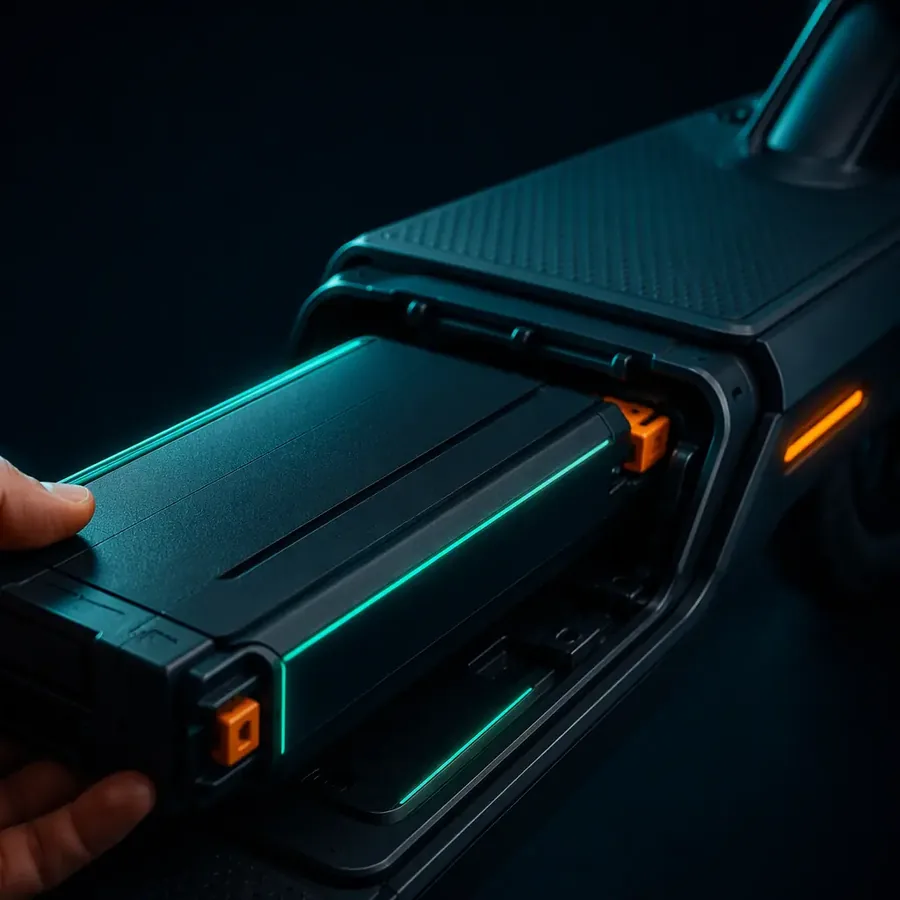
The pack itself needs a fleet-specific BMS: charge counting, cell balancing, and remote state-of-health reporting through the vehicle's telematics link. Operators with 10,000 packs want to know which serial numbers are aging before they fail, not after. Chemistry choices, NMC for energy density, LFP for cycle life, and the 2027 EU Battery Passport implications are detailed in our e-bike battery technology guide. Also specify a pack designed for 800+ charge cycles: at 1.2 charges per scooter per day, that is roughly the 18-month service life.
Telematics, Locking, and Anti-Vandalism Hardware
A fleet scooter without telematics is a rental liability, not an asset. The hardware requirements:
- Connectivity, 4G LTE module with fallback to Bluetooth mesh for dense urban coverage. The module must support remote firmware update (OTA), because recall-style controller fixes happen in every fleet's first year.
- Positioning . Dual GNSS (GPS + GLONASS/Galileo) with dead-reckoning assist for urban canyons. Sub-5-meter accuracy is required for geofenced parking enforcement in most permit cities.
- Locking . A motor lock (electronic brake lock) is mandatory; a cable lock adds weight and is often defeated. The motor lock must hold on a 10% grade with a 100 kg load.
- Anti-theft . Tamper detection on the battery compartment and controller, plus an audible alarm triggered by movement when locked. Theft-and-vandalism losses run 2–5% of fleet per year; hardware that raises the effort reduces it.
- Display . Fleet vehicles increasingly ship with a small QR/status display or none at all, relying on the rider app. Fewer screens = fewer failure points and less vandalism surface.
The telematics stack should be specified as an integrated unit with the controller, not an aftermarket add-on. Aftermarket installs void the thermal and vibration engineering of the vehicle and fail at 2–3x the rate of factory-integrated modules. If you are evaluating both scooters and e-bikes for a mixed fleet, the motor architecture decision, hub versus mid-drive, affects maintenance cost significantly; see our hub motor vs mid-drive comparison.
Compliance and Insurance: UL 2272, EN 17128, and Local Permits
Shared fleets carry a compliance stack that retail products do not:
- Vehicle certification, UL 2272 in the US and Canada (required by most city permits), EN 17128 for EU markets. These are not optional for fleet deployments; permit applications ask for them by name.
- Local operating permits . Most permit cities impose fleet caps, geofencing requirements, parking rules, and data-sharing obligations. The vehicle spec must satisfy the strictest permit in your launch city (e.g., a city that requires 25 km/h hard caps needs firmware-enforced speed limits, not just configurable ones).
- Insurance . Liability premiums track vehicle safety records. Certified vehicles with remote speed enforcement command materially better rates. The certification cost per unit, roughly $10–20 for UL 2272, is repaid in insurance and permit access.
- Battery transport. UN 38.3 applies to every pack; a fleet replenishment pipeline moving hundreds of packs weekly needs a documented DG transport process. The full EU versus US certification landscape for the vehicles themselves is in our EN 15194 vs UL 2849 guide.
The 3-Year TCO Model
Here is the model EMS-EBIKE uses with fleet operators to compare vehicles, replace the input assumptions with your own market data:
| Line Item | Year 1 | Year 2 | Year 3 |
|---|---|---|---|
| Vehicle cost (1,000 units @ $650) | $650,000 | $0 | $0 |
| Replacement vehicles (5% attrition/yr) | $32,500 | $32,500 | $32,500 |
| Spare parts & repairs | $65,000 | $95,000 | $120,000 |
| Charging labor (swappable packs) | $180,000 | $190,000 | $200,000 |
| Telematics & software (per vehicle/mo) | $48,000 | $48,000 | $48,000 |
| Insurance & permits | $95,000 | $90,000 | $85,000 |
| Total cost | $1,070,500 | $455,500 | $485,500 |
| Gross revenue @ $6 RPSD, 70% utilization | $1,533,000 | $1,533,000 | $1,533,000 |
At these assumptions the fleet turns positive in year one and nets roughly $1.6M over three years before corporate overhead. Two sensitivities dominate: RPSD (a $1 change moves the 3-year result by ~$765K) and repair costs (a 50% overrun on repairs removes ~$140K). Both sensitivities point at the same procurement strategy: spend on durability, not on invoice savings.
OEM Specifications for a 1000+ Unit Fleet Order
A fleet RFQ should read differently from a retail RFQ. The factory should receive:
- Frame: 6061 aluminum, reinforced stem, internal cable routing, IPX5 deck electronics
- Motor: 350–500W single hub motor, aluminum housing, thermal derating, modular replacement
- Battery: 36V 10.4–16Ah swappable pack, 800+ cycle design, BMS with charge counting and state-of-health reporting, UN 38.3
- Tires: solid or honeycomb (or pneumatic with puncture liner), reinforced sidewalls
- Brakes: rear drum + front E-ABS, motor lock holding 10% grade / 100 kg
- Telematics: integrated 4G LTE + dual GNSS, OTA firmware, tamper detection, no display (app-based)
- Compliance: UL 2272 (US) or EN 17128 (EU), firmware speed caps per permit
- Spares: module-level spare parts price list with RFQ; MOQ 100 units for custom branding and colors
EMS-EBIKE's shared-fleet program is built for exactly this spec, custom branding, swappable battery systems, and telematics integration on 4 parallel assembly lines under one quality chain. Standard lead time is 15–30 days after deposit for catalog fleet models, 30–45 days for full custom builds. If your deployment also includes delivery vehicles, the cargo e-bike and e-tricycle fleet guide covers payload and multi-shift battery planning. For the retail line you may want to run alongside the fleet, start with the electric scooter OEM guide . The segment and compliance decisions are the same, tuned for single-unit buyers instead of operators.
Get a Fleet Proposal with TCO Modeling
Tell us your deployment city, target fleet size, and operating model (swappable packs or dock charging). We will spec the vehicle, battery logistics, and telematics package, with UL 2272 or EN 17128 documentation and a 3-year TCO model built on your assumptions.
