
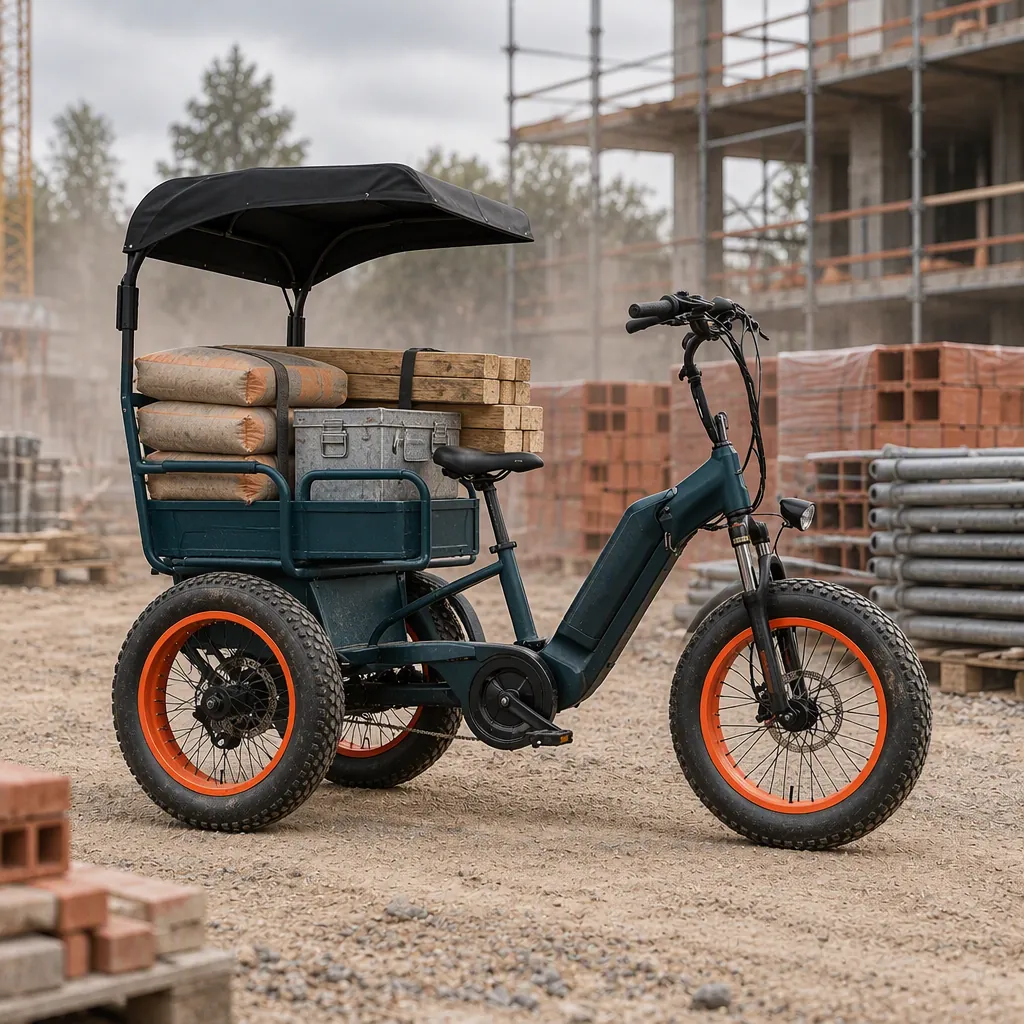
A construction site moves most of its material twice. The first move is by truck or van to the gate or the laydown area. The second move, from laydown to the hoist, to the work face, or across a fit-out floor, is where the money quietly disappears: a pickup idling in mud at 6 litres an hour, a van that cannot fit through the service corridor, or two labourers making eleven trips with 50 kg bags. That second move is a short, repetitive, heavy shuttle, and it is the one duty a cargo tricycle is genuinely better at than any truck. This guide covers what a job-site trike actually carries, how the four selection limits work, and the spec decisions that decide whether a site trike survives a full build.
Why the Laydown-to-Hoist Shuttle Is a Tricycle Job
The shuttle has four properties that make a light commercial vehicle the wrong tool and a trike the right one. It is short: typically 100–500 m, well inside any electric drivetrain's comfortable range. It is repetitive: on a multi-building site the same route runs dozens of times a day, so per-trip cost dominates over top speed. It is heavy per trip: bags, blocks and timber are dense loads where a 300–500 kg deck is doing real work. And it happens on ground that changes weekly, which is the harshest environment a cargo platform ever sees.
A trike answers all four: it runs on a fraction of the energy per trip, it fits through a 1.1–1.3 m wide opening, it needs no commercial licence plate, CDL or site vehicle permit in most jurisdictions, and it can be parked and charged from any 15A site circuit. The same crew-transport problem from the green side is covered in our landscaping trike guide, and the purchase-versus-run economics against a pickup are worked through in our cargo trike vs pickup cost guide.
Four Limits Decide the Spec, Not One Number
Payload is the number buyers ask for first and the number most often misunderstood. On our cargo platform the rating is 300 kg (EU) / 500 kg (non-EU), and that figure is a structural rating covering the frame, rear axle, tires and brakes together, not a motor claim. A trike that advertises 500 kg but ships grade-B tires and a single-drum rear brake is a 300 kg vehicle with a 500 kg sticker.
Equally important, the payload itself is bounded by four independent limits, and the lowest one governs the build:
- Frame and chassis rating. Our steel tube chassis carries a heavy-duty e-coat and powder coat for rust resistance, which matters because construction sites are wet, alkaline and full of abrasive dust.
- Tire load index. The dual rear setup on 3.75-12 tires is what allows the platform to reach the upper payload band; changing to a cheaper tire casing quietly lowers the real rating even if nothing else changes.
- Brake capacity. Hydraulic disc front plus dual drum rear with a parking brake is the configuration rated to stop a loaded vehicle, and brake capacity, not motor power, is what limits a safe downhill descent on site.
- Motor and controller thermal envelope. Sustained climbing loads the controller, not the motor badge, which is why the same 1000W nominal platform behaves differently on a 6% ramp and on a flat shuttle.
The full engineering breakdown of how these four limits interact, including the loaded-range caveat, is in our payload capacity guide.
What Each Job-Site Duty Actually Requires
Sites do not have one hauling profile, they have four, and each one maps to a different configuration. Specifying the wrong body for the duty is the most common and most expensive mistake in a site trike order.
| Site duty | Typical load | Body and drivetrain |
|---|---|---|
| Laydown-to-hoist bag shuttle | Cement, mortar, sand: 25–50 kg bags | Three-way drop-side box, 1000W, dual drum rear |
| Block and brick movement | Half-tonne shuttle loads | Drop-side or flatbed with tie-downs, 1000W–1200W with differential |
| Fit-out and interiors | Tools, doors, fixtures, 100–200 kg | Enclosed box or canopy, 800W, for finished floors |
| Spoil and debris removal | Mixed rubble, soil, offcuts | Hydraulic tipper body, 1200W with differential |
Box volume on this platform runs 150–500 L in welded aluminum sheet, galvanized steel, or insulated sandwich panel. For construction work the two sensible choices are aluminum with three-way drop-sides, because crews slide bags off the side instead of dragging them over a tailgate, and a hydraulic tipper body where spoil removal is a daily task. The trade-offs between flatbed, drop-side, tipper and enclosed bodies are compared in our canopy and body guide.
Loading, Weight Distribution and Why It Matters on Ramps
A construction load is not a delivery parcel. It is dense, it is loaded fast, and it is rarely centred. Two rules keep a loaded site trike stable:
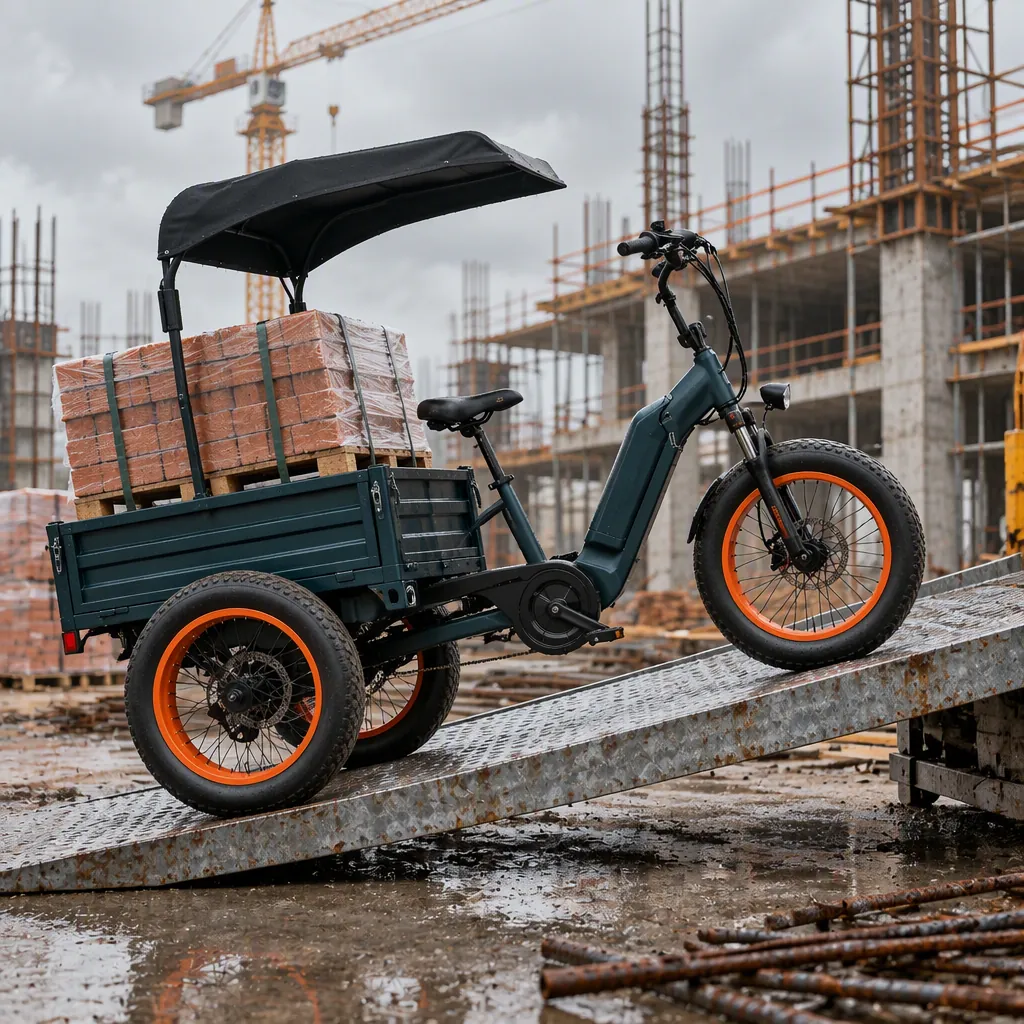
- Centre the load over the rear axle. A half-tonne pushed to the tailgate lifts weight off the front wheel, and on a ramp that is the difference between steering and sliding. The platform's differential drive keeps torque going to the loaded wheel rather than spinning the unloaded inside wheel on loose ground.
- Use the drop-sides as a loading aid. Side-hinged panels let two people load a pallet in one movement instead of eight bag lifts, which is both a speed and a back-injury calculation.
Weight distribution, tie-down practice and the suspension behaviour of a loaded box on rough ground are covered in our suspension guide, and the stability comparison against two-wheel platforms in our tricycle vs e-bike guide.
Motor, Gradient and the Loaded-Range Caveat
The platform spans 800W / 1000W / 1200W brushless hub motors with differential, on 60V 32Ah or 72V 40Ah lithium packs (LFP available). The selection logic for a construction site is gradient-driven:
- 800W — flat site shuttles and interior fit-out work, comfortably inside the 300 kg EU band.
- 1000W — the site-work default: loaded moves on gentle ramps, kerbs and temporary steel plates, up to the upper payload band.
- 1200W with differential — genuine gradients and repeated half-tonne climbs, where the differential is doing as much work as the extra power.
Be careful with range claims, including ours. The published figure is 50–80 km loaded at 200 kg on flat terrain. A construction shuttle at 400 kg with repeated ramp climbs will consume meaningfully more, so plan charging on the conservative end and treat the flat-terrain figure as the ceiling rather than the expectation. Charging itself is straightforward: 6–10 hours on the supplied 5A charger, which fits an overnight cycle on any 15A site circuit, exactly the same load as a site-office kettle. Motor selection and torque behaviour are covered in our motor power guide, and the voltage decision in our 60V vs 72V guide. Operators in hot climates should note that we recommend LFP chemistry for tropical and desert markets, where pack longevity under thermal stress matters more than energy density.
Rough Ground: Tires, Suspension and Site Survival
Construction ground, mud, gravel, rebar offcuts, wet plywood, is the fastest way to destroy a delivery-spec trike. Three specs decide whether the vehicle lasts the build:
- Tires. 3.00-12 front / 3.75-12 dual rear, reinforced load-rated carcass with a chunky tread. Tire load index and reform options are in our tires guide.
- Suspension. A spring rear setup keeps a loaded box from hammering the frame and the rider on broken ground; suspension types and their payload trade-offs are in our suspension guide.
- Frame protection. The chassis ships with heavy-duty e-coat plus powder coat specifically for this duty cycle; the daily washing and inspection protocol that keeps a site trike alive is in our maintenance guide.
Site Safety, Visibility and Crew Logistics
A site trike answers most site rules natively. Top speed is 25–35 km/h and the governor can be set to 25, 35 or 40 km/h to match a site speed limit, operation is near-silent, and there is no exhaust in enclosed spaces or basement levels. Three items still need specifying deliberately:
- Load securing. Tie-down points on the deck plus a strap protocol; a dropped half-tonne is a safety incident, not a cargo loss.
- Visibility package. Full LED lighting front and rear plus the optional beacon for low-light work; the reflectors ship as standard. The full safety configuration list is in our safety features guide.
- A designated charging bay. One 15A circuit per vehicle overnight, kept clear of pedestrian routes; fleet charging layouts are covered in our fleet charging guide.
Every vehicle ships with forward / neutral / reverse selection and an LCD showing speed, battery percentage and load indication. On a busy site the reverse gear is not a convenience, it is what lets a loaded trike back out of a corridor without a second person spotting.
Compliance, Inspection and the Paperwork That Matters
Cargo tricycles straddle commercial vehicle regulation in most jurisdictions, so it is worth stating plainly what the compliance package does and does not cover. Each platform is planned against CE for the full electrical system including the motor controller and BMS cell-balancing logic, RoHS material declarations for the electronics, UN 38.3 for the lithium pack, and ECE R10 electromagnetic compatibility, the EMC standard applied to four-wheeled commercial vehicles, which increasingly satisfies the radiated and conducted emissions expectations enforced by customs authorities in the EU, GCC and ASEAN regions.
On the 72V 40Ah pack used in heavy cargo configurations we design to UN 38.3 with particular attention to the crush and impact tests, given the higher stored energy compared with passenger variants. Each order carries cell, BMS and test-report documents in the export file, and every unit passes a per-vehicle inspection covering weld integrity on the cargo subframe, torque verification on all chassis fasteners, and a loaded road test with ballast to confirm brake balance and motor thermal behaviour under real duty cycles. What this does not replace is local road registration if the vehicle is used on public roads; that determination is jurisdiction-specific and is covered separately in our tricycle laws guide and insurance and registration guide.
Procurement Terms for a Site Fleet
Site fleet orders normally follow a predictable shape: MOQ 50 units per model, 15–30 days standard lead time, and 30–45 days for a first custom-branded run, with pre-production samples shipped before mass production so the box geometry and tie-down layout are proven against your actual loads rather than a rendering. Box customization adds roughly 10 days. The customization axes that matter most for construction are box material and configuration, motor power with hill-climb gearing, canopy or rain cover, shelving and partitions, a reverse alarm for enclosed-site safety, and GPS tracker integration with geofencing for fleet oversight.
For a first site rollout, the practical sequence is to run two to four vehicles on the hardest shuttle route for a full month before scaling. Measure the actual daily trip count, the real load weights, and where the crews park and charge. That single month of data will tell you more about the right body and motor combination than any specification sheet, including this one.
Spec a Job-Site Trike Program
Tell us your site size, material types and access constraints. We will specify payload, box configuration, tires and pack for your hauling duty cycle.
