
A solar farm is not one site. A 40 MW array is a chain of separate work fronts — the inverter pads, the string rows between them, the perimeter fence, the substation yard, the laydown area — and they are between 200 m and 1.5 km apart from each other. Most of the maintenance work that fills a solar technician's day is short, small and local: a torque check on one row, a replacement module, a vegetation cut along a fence line, a spare inverter carried to a pad.
That shape of work is where a pickup truck is at its least efficient and a three-wheeled work platform is at its best. This guide covers what a solar farm maintenance platform actually has to carry, the payload arithmetic that most procurement documents get wrong, the electrical load that no delivery-spec trike is built for, and the order terms that decide whether a 20-unit O&M fleet holds together.
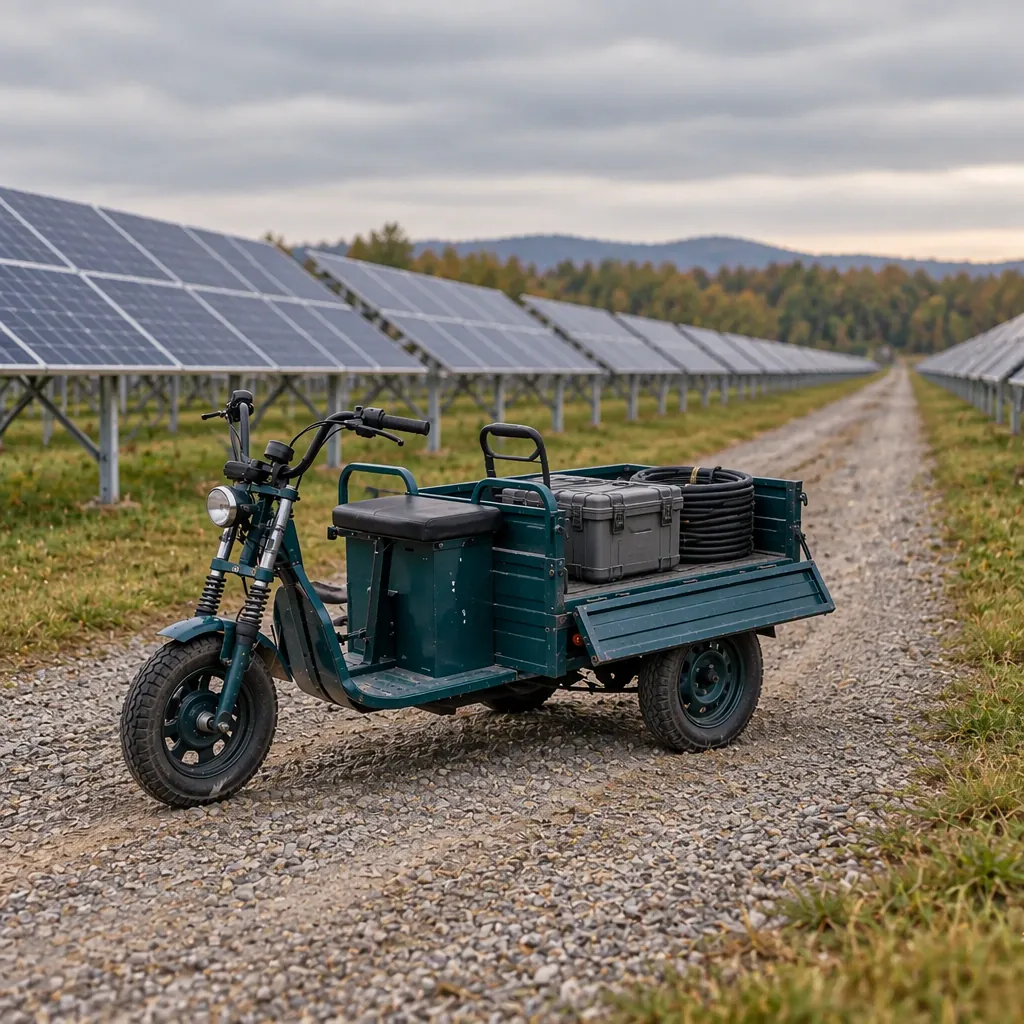
Why a solar site breaks the delivery-trike assumptions
A delivery trike is designed around one assumption: the vehicle leaves a depot loaded, runs a route, and comes back empty. Its payload number, its range number and its charging number are all computed on that cycle, as the payload capacity breakdown for cargo platforms sets out. A solar farm breaks all three at once, and in ways that a buyer comparing catalog specification sheets will not notice.
The first break is that the load is not carried, it is placed. A maintenance crew does not deliver 300 kg to one address. It moves 60–120 kg of tools, spares and instrumentation to eight separate work fronts across a shift, and at each front the vehicle becomes a work bench. The rear deck is opened, the tool cases come out, and the vehicle sits stationary for 40 minutes to two hours. What matters is not total payload but reachable payload at the point of work.
The second break is that the route is a loop with no road on it. Site service tracks are compacted gravel or graded dirt, typically 3–4 m wide, with drainage crown and occasional soft shoulders after rain. A 300 kg payload rated on flat asphalt behaves differently on a graded track at 12 km/h with a 6% cross slope, which is why tyre and tread choice for loose surfaces matters more here than on a road route.
The third break is the electrical one: the crew brings its own loads. A torque wrench, a laptop, an insulation tester, a portable lighting set, a module-level IV curve tracer. On a delivery trike, the only 12V load is the lights. On a solar maintenance platform, the accessories outlet runs a small workshop.
Measure four numbers before you choose a platform
Every specification conversation this factory has with a solar O&M buyer converges on four measurements. Collect these before discussing motor rating, and the platform choice usually makes itself.
- Longest single leg between work fronts, in minutes. Not kilometres — minutes at the speed the site track actually permits, which is usually 10–15 km/h rather than the 25–35 km/h the platform can do. A 1.2 km leg takes 5–7 minutes on a good track and 10–12 on a soft one.
- Number of fronts per shift. Eight to twelve is typical for a two-technician crew on a 20–50 MW site. Above fourteen, the vehicle spends more time in transit than in work.
- Heaviest single item lifted onto the deck. A replacement module is 22–28 kg for a modern 550–600 W frameless or framed unit. A spare string inverter is 35–65 kg. A portable IV tracer case is 15–25 kg. The single heaviest item, not the total, sets your deck height and lift geometry.
- Narrowest gap the vehicle must pass. Fence gates, row ends and inverter pad clearances are the binding constraint far more often than payload. Under 1.2 m clear and a 150–500 L box body will not pass.
Write these four numbers on one line before you open a supplier's specification sheet. If the longest leg is under 12 minutes and the fronts per shift are eight or more, you are specifying a work platform, not a transporter — and the payload-first conversation most buyers start with is the wrong conversation.
The payload arithmetic buyers get wrong
The cargo platform this factory builds is rated 300 kg in EU configuration and 500 kg in non-EU configuration, with a box volume of 150–500 L and a kerb weight of 150–220 kg before the box. Those numbers are not the constraint on a solar site. The constraint is what you choose to put on the deck, because a maintenance load is dense and awkwardly shaped rather than heavy and compact, and the work-rated platform specification starts from the bed for exactly this reason.
A realistic two-technician solar maintenance load breaks down like this: two tool cases at 18–25 kg each, one IV curve tracer case at 15–25 kg, a torque wrench set at 6–9 kg, 60 m of grounded extension lead at 8–12 kg, two spare modules at 22–28 kg each, a fastener and clamp kit at 10–15 kg, PPE and harness bags at 8–12 kg, and a cooler at 10–15 kg. That totals 150–220 kg — comfortably inside a 300 kg rating, with 80–150 kg of margin left for a third technician or a spare inverter.
Where the arithmetic goes wrong is volume, not mass. Two spare modules are 1.15 m by 1.35 m each. Laid flat, they consume the entire floor of a 500 L box and leave no room for the tool cases that have to come out at every front. This is the single most common specification mistake on solar maintenance builds, and the fix is not a bigger box — it is a module rack, either a vertical bracket set against the headboard or a roof-level carrier, so that modules travel vertically and the deck floor stays clear for cases.
| Load item | Typical weight | Volume behaviour | Where it should ride |
|---|---|---|---|
| Tool cases (2) | 18–25 kg each | Compact, stackable | Deck floor, forward of the axle |
| IV curve tracer case | 15–25 kg | Compact, fragile | Deck floor, padded, strapped |
| Spare modules (2) | 22–28 kg each | 1.15 × 1.35 m flat each | Vertical rack or roof carrier — never flat on the deck |
| Extension lead, 60 m | 8–12 kg | Bulk but light | Side pocket or under-deck tray |
| Fastener and clamp kit | 10–15 kg | Dense, small | Deck floor, low and central |
| PPE and harness bags | 8–12 kg | Soft | Against the headboard |
| Spare string inverter (occasional) | 35–65 kg | Large, heavy, one item | Deck floor over the axle, strapped, two-person lift |
Read the total column against the platform rating and you will see roughly 50% margin in mass and almost no margin in floor area. That imbalance is the design problem, and it is why the deck configuration matters more than the motor on this kind of build.
Deck configuration: flatbed, drop-side or enclosed
Three deck types are available on the same chassis, and on a solar site the choice is driven by what the crew does at each front rather than by what they carry.
Flatbed with stake sides is right when the deck itself is the work surface. Module clamp work, fastener sorting, and small component assembly all happen on an open deck at working height. A stake-side flatbed converts to a full flat surface in seconds by dropping the sides, which is exactly the behaviour a crew wants when a 2.2 m module has to lie flat for inspection.
Three-way drop-side box is right when the load needs containment and the crew works out of the vehicle all day. The 150–500 L box bodies are welded aluminium sheet for corrosion resistance and weight saving, or galvanised steel where impact loading is expected. On a solar site the aluminium option is usually the better trade: the load is not abrasive, and the corrosion environment around inverter pads and battery rooms is more punishing than the load itself.
Enclosed or insulated body earns its cost only when the vehicle carries temperature-sensitive equipment, and current string inverters and module-level electronics do not — the trade-offs are covered in the enclosed cabin platform guide. Reserve the insulated sandwich-panel option for sites that also carry cold-chain spares or that run in desert markets where a closed body protects instruments from direct sun and dust.
One deck option that is worth specifying on every solar build and is almost always omitted: a rear step and grab handle. Crews climb onto the deck 30–60 times a shift to reach modules and the rack. A step costs little at order time and is awkward to retrofit.
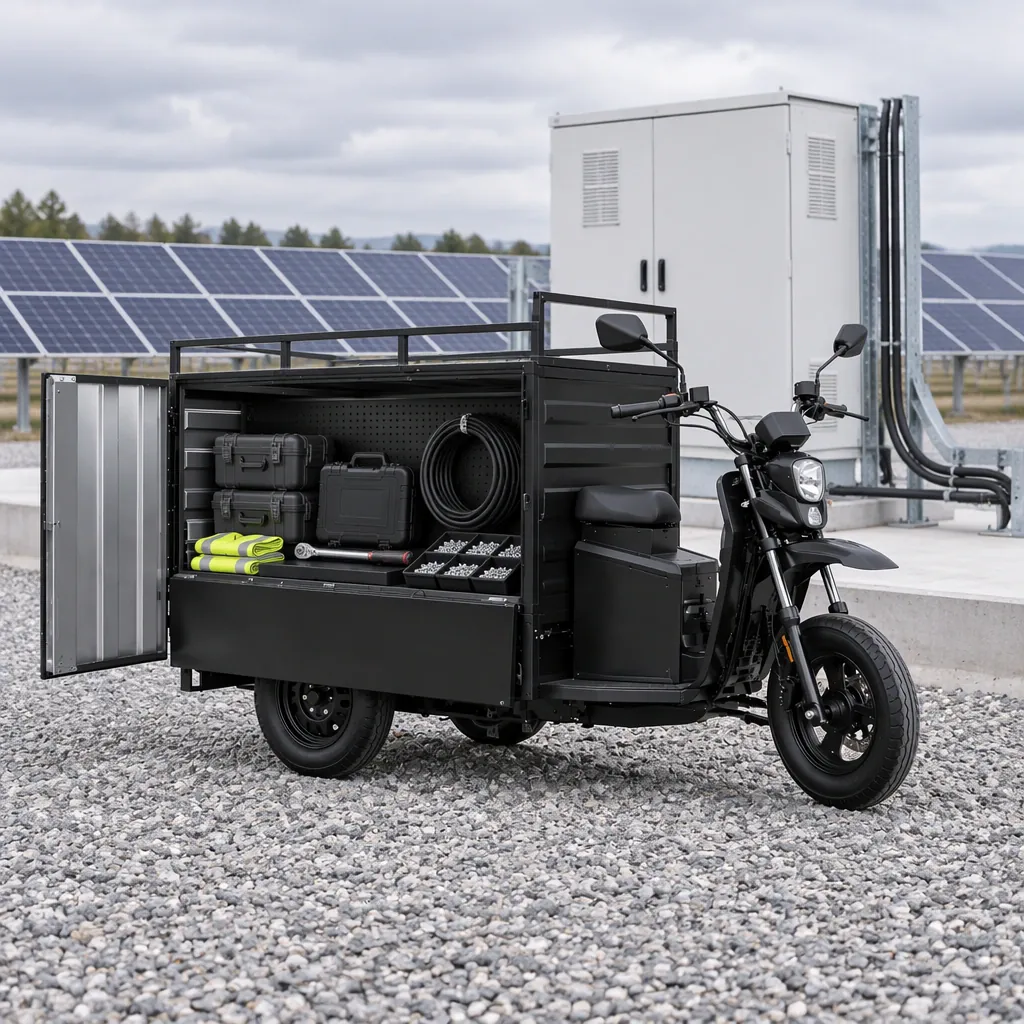
Terrain and the traction conversation you should have instead of a motor conversation
Solar sites are graded, not paved. Tracks are compacted aggregate over prepared subgrade, with a crown for drainage and soft shoulders that appear after any sustained rain. The failure mode is not hill climbing — most sites are flatter than the urban routes a cargo trike is designed for. The failure mode is lateral slip on a crowned track with a partially loaded deck.
Three specifications address it, in order of effect:
Rear axle loading. A three-wheeled platform puts roughly two-thirds of its loaded mass on the rear axle pair. Keeping heavy items forward of the rear axle line and low in the deck keeps the front wheel loaded enough to steer on loose aggregate. A deck loaded to the rear is the most common cause of "the front end washes out" complaints on site service tracks.
Tyre specification. The standard fitment is 3.00-12 front and 3.75-12 rear in dual configuration, load-rated. On aggregate, tread pattern matters more than width — a lugged or block pattern clears gravel and sheds mud, while a ribbed road pattern packs and glazes. Specify the pattern explicitly in the RFQ; it is a low-cost line item that buyers routinely leave to the supplier's default.
Parking brake and differential behaviour. A solar crew parks on a cross slope dozens of times a day, often on gravel, often with a technician standing behind the vehicle. The hydraulic disc front plus dual drum rear setup with a mechanical parking brake is the configuration to insist on. On loose surfaces the parking brake holds the vehicle on grades where the drum alone will creep.
Motor choice comes last. The 800 W, 1000 W and 1200 W options on this platform differ mainly in how much grade they sustain at a given payload. At 12–15 km/h on a graded site track, an 800 W unit with the differential carries the loads in the table above without thermal stress. The 1200 W option earns its cost when the site has real elevation change or when the deck is specified above 350 kg. Buying 1200 W to solve a traction problem is a common and expensive misdiagnosis; the 60V versus 72V platform comparison covers where the higher voltage actually pays back.
Electrical load: what a work platform has to power
This is the largest difference between a solar maintenance platform and a delivery trike, and it is the section most procurement documents leave out entirely. The deck loads are mechanical; the accessory loads are electrical, and they run all shift.
A realistic two-technician electrical list on a solar site:
- Laptop or rugged tablet for the monitoring platform: 45–65 W, running 6–8 hours.
- Portable IV curve tracer: 30–90 W while testing, typically 25–40% duty.
- Insulation tester and multimeter charging: 20–40 W intermittent.
- Portable lighting for early or late shifts: 20–50 W.
- Torque wrench and small power tool batteries: 60–120 W while charging.
- Two-way radio or site communications charger: 10–20 W.
Add a 15–20% conversion allowance and the realistic continuous accessory draw is 150–250 W, with peaks to 400 W when a power tool charger and lighting run together. That is not a vehicle lighting load. It requires a separate DC-DC converter and an accessory fuse block, and it should be specified as a line item on the order rather than added later.
Two supply architectures work. The simpler one is a 12V accessory bus fed from the traction pack through a DC-DC converter rated at 20–30 A, with a fused distribution block and two or three outlet positions on the deck. The more robust one is a separate 12V auxiliary battery charged from the traction pack, which keeps instruments alive while the vehicle is parked and the traction pack is isolated for maintenance.
The auxiliary battery also unlocks the solar option that matters on a large site: a roof-mounted panel that trickle-charges the auxiliary battery, which this platform's specification lists as extending daily range by 8–12 km on remote or off-grid sites. On a solar farm the irony is worth noting to buyers — the vehicle working the array can be partly charged by an array.
Charging at a solar site: the arithmetic that decides one unit or two
A 60V 32Ah pack on the 5 A standard charger takes 6–10 hours to full. On a solar site the practical consequence is that the platform is a night-shift asset: it comes back at the end of the day, plugs into the site office or workshop supply, and leaves full the next morning. That works for a single-shift O&M contract.
It stops working the moment the site runs two shifts, which happens during commissioning, repowering or after a severe weather event. Then the platform is out for 10–12 hours and charging for 8 of them, and the fleet needs either a second unit or a second charger at the other end of the site.
The decision rule that holds up in practice: count the hours the vehicle is stationary and near a power outlet, not the hours it is on site. If that number is above 8, one unit and one charger suffice. If it is 4–6, you need a second charger at a second location, which is cheaper than a second vehicle. A second charger is a line item starting at 50 units per configuration with a 15–30 day lead time, and it is nearly always the right first purchase — see the charger selection guide and the fleet charging capacity arithmetic.
Two site-specific charging constraints deserve early attention. First, inverter pads and substation yards are often the only places with power, and they are frequently the places where an earthed supply is not immediately available for vehicle charging — confirm with the site electrical contractor where the vehicle can be plugged in before you commit to a fleet size. Second, battery chemistry choice should follow the climate: the platform ships on NMC by default, and the LFP option is the one this factory recommends in tropical and desert markets, where pack longevity under sustained thermal stress outweighs energy density, as covered in the battery chemistry guide.
The documentation pack a solar O&M contract requires
Solar farms are usually owned by infrastructure funds and operated under EPC or O&M contracts, which means the vehicle procurement sits inside a documentation regime rather than a simple purchase. Expect the following to be requested, and expect a supplier who cannot produce them to be disqualified at the paper stage rather than the price stage:
- UN 38.3 transport test reports for the battery packs, with cell and BMS documents in the same file.
- EN 15194 or UL 2849 compliance letters depending on destination market, and RoHS and REACH substance declarations — the split between markets is set out in the EU versus US certification comparison.
- Per-order test reports — not a generic certificate from an earlier production run.
- Spare-parts availability commitment covering the O&M contract term, typically 5–8 years, matching the after-sales and spare-parts programme.
- Serial-number traceability from vehicle to battery pack and to cell batch, which is what an asset register entry requires.
Ask for the document pack before the sample, not after. A supplier that assembles it to your schedule is telling you something about how the production order will run.
How a solar maintenance fleet should be phased
The wrong way to buy is to convert the whole site crew at once. A solar site's work fronts are not uniform, and neither is the case for replacing every vehicle.
Phase one: one or two units on the highest-density loop. Pick the array block with the most work fronts and the shortest legs. Run it for a full quarter across a seasonal peak — for most sites that means the summer vegetation window, not the shoulder season. Measure four things: fronts visited per shift, minutes stationary versus in transit, deck loads actually carried, and how often the crew walked back to a pickup instead of using the platform.
Phase two: expand where the measurement says. If fronts per shift rose and the walk-back count fell, the loop is proven and the next block gets units. If the walk-back count stayed high, the constraint is usually deck layout rather than vehicle capability — a module rack or a different deck type, not a second vehicle.
Phase three: hold one pickup. Very few solar sites eliminate the four-wheel vehicle entirely, and they should not try. The pickup carries the items the platform is not designed for: a full pallet of modules, a 65 kg inverter on a long haul, a crew of four with a trailer — and where a trailer is the answer, the trailer matching guide sets the towing limits. A working fleet is a platform pair plus one retained pickup, not a platform fleet alone.
Order terms and how a first solar batch should run
OEM ordering on this platform starts at 50 units per model, with a 15–30 day standard lead time and 30–45 days for a first custom-branded run. Pre-production samples ship before mass production, which is the point at which deck layout, module rack position, accessory bus routing and tyre pattern should all be validated on your own site track rather than on a test pad.
The specification items that are worth locking in writing before the first batch, because they are cheap at order time and expensive to change afterwards: rear step and grab handle, vertical module rack, DC-DC converter rating and fuse block, outlet positions, tyre tread pattern, beacon light for site safety, and the exact deck body material and side configuration. Everything else — motor rating, battery capacity, colour, branding — can be varied between batches without re-engineering the platform.
One commercial note specific to O&M contracts: the vehicle will outlive the O&M contract that bought it more often than not. Specify the spare-parts list and the part numbers as an appendix to the purchase order, not as a verbal commitment, so that the second operator inherits a serviceable fleet.
Where a three-wheeled platform is the wrong answer
Honesty about limits is more useful than a longer feature list, so here are the cases where this platform should not be specified on a solar site.
A site that needs a full pallet of modules moved from laydown to the array is a forklift or telehandler job, not a trike job. A site whose service tracks are narrower than 1.2 m clear, or whose row spacing does not admit a 1.5 m wide vehicle, needs a smaller platform or a walk-behind solution. A site where the crew must carry a 65 kg inverter more than 500 m on every front should have a two-person lift plan and a vehicle with a low deck and a tailgate, not a standard box body. And a site in a market where three-wheeled vehicles face registration barriers for on-road use should confirm the site-access exemption in writing before ordering, since most solar service tracks are private and off the public road network — but that exemption is a legal question, not a vehicle question.
Send us your site layout, we will spec the platform
Bring four numbers to the conversation — longest leg in minutes, work fronts per shift, heaviest single item, narrowest gap — plus your site's typical track surface and the O&M contract term. If your work spans public roads as well as private service tracks, read the road-use rules for three-wheeled platforms before the order. The platform specification, deck configuration, accessory bus rating and charging plan follow from those in one call, and the document pack can be assembled against the tender schedule you are working to.
Send Us Your Site Layout and We Will Spec the Platform
Bring the longest leg in minutes, work fronts per shift, the heaviest single item and your narrowest gate clearance. Those four numbers decide deck configuration, accessory bus rating and whether the first purchase is a second vehicle or a second charger — and we can assemble the document pack against your O&M tender schedule.
