
Bottled water and beverage distribution is the densest, heaviest, lowest-margin route in urban logistics. A single 20-litre bottle already removes most of a light cargo bike's useful payload, the stops are metres apart, and the load is identical on every run. Which is exactly the profile an electric cargo tricycle is engineered for. This guide covers the three beverage builds we configure on the same three-wheeled platform, the payload arithmetic that decides how much liquid a trike can actually move, and how beverage fleets buy the build as an OEM program.
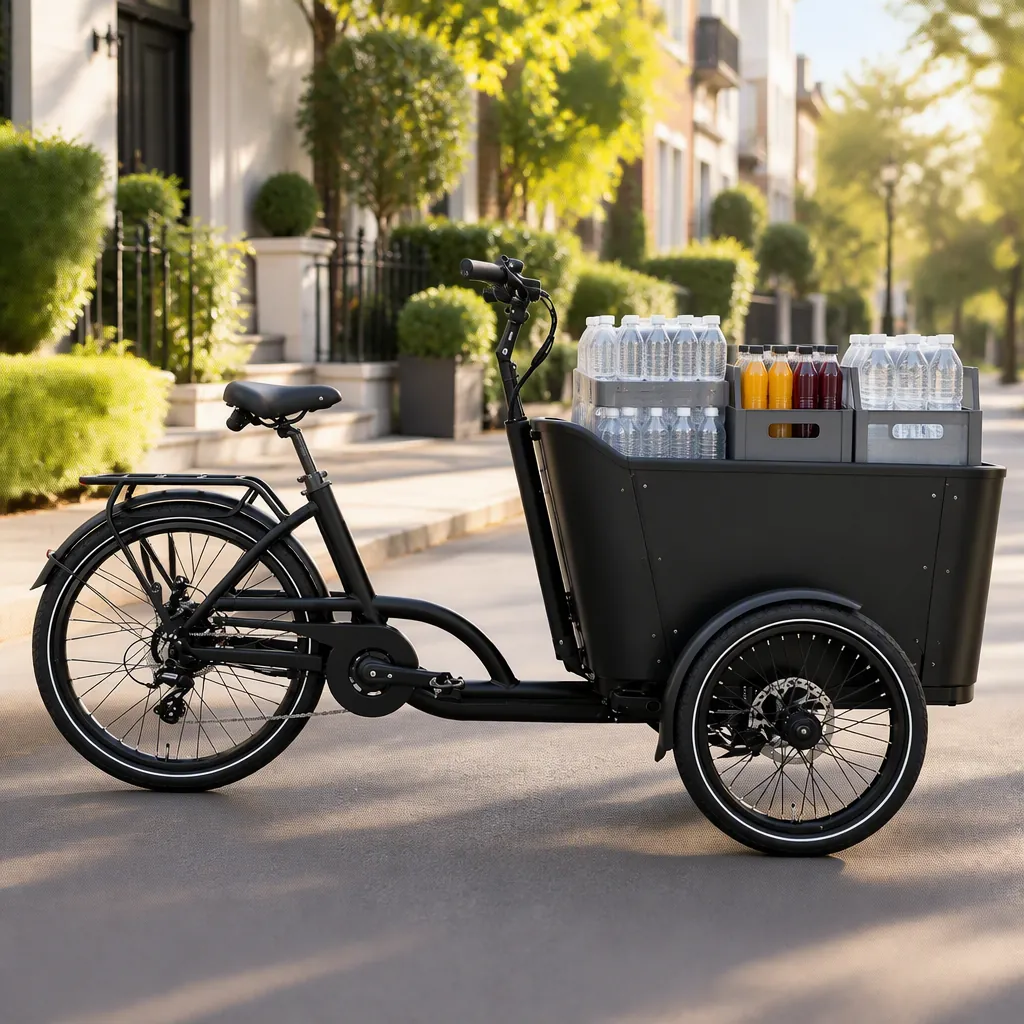
Why the Route Economics Favour Three Wheels
A beverage round is short, dense and repetitive: a residential street of 30 customers, a market row, a set of office floors. A delivery truck is oversized for that geography and burns $9–14 of fuel per 100 km carrying it. The same round on a three-wheeled electric cargo tricycle runs on roughly $0.30–0.60 of electricity per 100 km, and at the 20 mph (32 km/h) low-speed class it does not require a commercial driver's licence in most US states.
The second reason is stability at the stop. Water is a high, narrow load, and a two-wheeled cargo bike loaded with bottles becomes unstable every time it comes to rest and the rider has to hold it up while unloading. A trike with one front wheel and two rear wheels stands on its own at each doorstep, the rider dismounts, unloads with both hands, and mounts again. That single change is why beverage fleets converge on three wheels rather than two, and the platform trade-off is set out in our e-tricycle vs e-bike comparison.
The Three Beverage Builds
All three configurations below share the same chassis, drivetrain and battery. Only the load-carrying element changes, the crate box, the tank, or the vending body, which is what makes a mixed beverage fleet possible on one spare-parts inventory.
1. Bottled Water and Beverage Drops
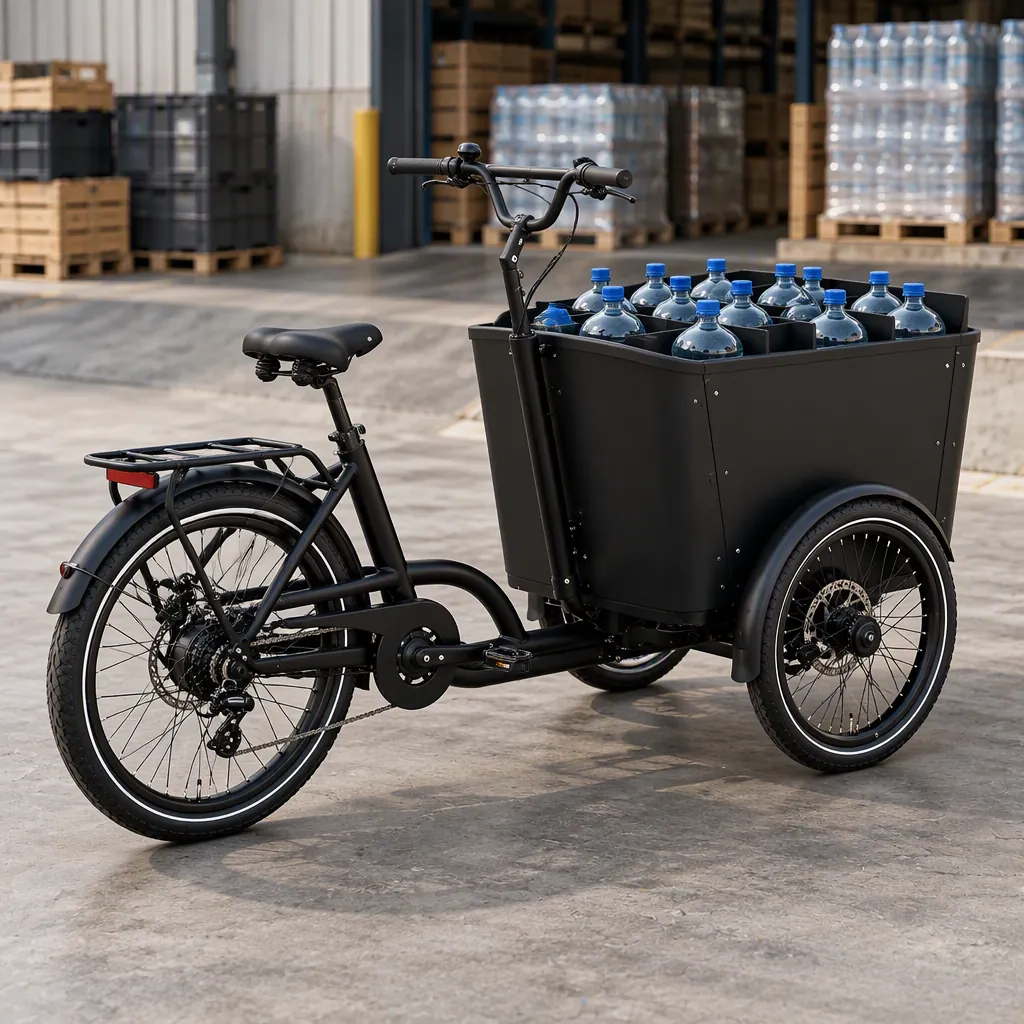
The volume build is a stackable cargo box with vertical dividers that hold bottles upright, a flat non-skid floor, and drop-side or rear access for fast unloading at a doorway. The standard box volume range is 150–500 L with drop-sides, so a bottle round is configured at the upper end of that range. Payload rating is 300 kg under EU rules and 500 kg for non-EU heavy builds . The non-EU figure is a frame-rail and axle-set limit, not a marketing number.
2. Tanker: Bulk Liquid and Refill Runs
Where a distributor refills containers instead of selling sealed retail bottles, the load is a sealed food-grade tank on the flatbed with a gravity tap or a small low-voltage pump. Because water is close to 1 kg per litre, the payload rating converts almost directly into litres per trip: a 300 kg EU build caps at roughly 300 L, a 500 kg non-EU build at 500 L. That covers dozens of refill customers or one large event drop per trip.
3. Event and Street Hydration
For markets, festivals and street vending the same platform carries a shaded canopy, insulated boxes for cold drinks, and a lockable drawer for cash. The vending body, power take-off for a small fridge unit and stall layout are covered in our mobile vending guide.
Payload Math: How Much Liquid a Trike Actually Moves
Box volume is the wrong number to buy on. Weight is the constraint, because water is dense and the trike has to start from a stop on a grade with the box full. The table below converts the platform's published ratings into beverage load per trip.
| Configuration | Payload Rating | Beverage Per Trip | Best Fit |
|---|---|---|---|
| EU-class crate box (drop-side) | 300 kg | ~300 L of bottled drinks | Residential and small retail drops |
| Non-EU heavy build | 500 kg | ~500 L of bottled drinks | Mixed residential and commercial rounds |
| Flatbed tanker (food-grade) | 300–500 kg | 300–500 L bulk liquid | Refill routes and large-event supply |
| Insulated vending body | 300 kg | Mixed chilled retail stock | Markets, festivals, street stalls |
Range is the second constraint. The platform is rated 50–80 km on a charge carrying 200 kg on flat ground; a full water box shortens that interval, and a hilly round shortens it further. The 60V 32Ah NMC and 72V 40Ah LFP packs behave differently here. LFP tolerates daily deep discharge and high ambient temperature better, which is why it is the recommended chemistry for tropical beverage fleets. The battery-versus-payload trade-off and the voltage decision are covered in our 60V vs 72V comparison.
Motor, Drivetrain and the Grade Question
A beverage trike starts from a standstill with a full box dozens of times a shift, so the requirement is torque at low speed, not top speed. The platform offers 800W, 1000W and 1200W brushless hub motors with a differential, running on 60V or 72V. The differential matters on this application specifically: without it the inside rear wheel scrubs through every tight doorway turn on a loaded trike, which wears tyres and tears up the surface under the customer's step.
How the three power ratings behave on a loaded grade is set out in our cargo tricycle motor power guide. The drivetrain choice between hub and mid-drive, and why hub motors dominate fleet serviceability, is in our hub vs mid-drive comparison.
Brakes, Tyres and the Water Load
Stopping a 500 kg gross trike on a wet street is the safety case that a beverage buyer should interrogate first. The platform uses hydraulic disc brakes at the front with dual drum brakes at the rear plus a parking brake . The parking brake is the detail that matters on a delivery round, because it lets the trike hold itself on a slope while the operator carries bottles to a door.
The running gear is 3.00-12 front and 3.75-12 rear dual wheels on leaf springs, sized for the load rather than for fashion. Tyre load ratings, tread choice for wet surfaces and expected service life are covered in our cargo tricycle tyres guide, and the full braking architecture in our brake systems guide.
Certification and Road Class for a Beverage Fleet
A beverage trike works on public roads and in commercial loading areas daily, so the compliance path is not optional. A 1000W / 32 km/h unit sits in the low-speed electric vehicle or Class 2 band in most US states, no licence, no registration, no insurance, while EU operation follows EN 15194 and local speed-limited categories. Electrical safety is UL 2849 in the US, with EN 50604 for the battery pack and UN 38.3 for transport, and the 1000W / 60V class also maps to eMark ECE R136 for some markets.
The two regimes are compared in our EU vs US certification guide and the full category breakdown is in our tricycle laws guide. A food-contact tank or an insulated food-grade body adds hygiene documentation, which a sourcing program should request at sample stage rather than at container stage.
Charging a Beverage Fleet Without Building Anything
Charging is the cost item beverage operators underestimate. The platform charges in 6–10 hours on a standard 5A charger from a normal 230V wall socket, which means a beverage depot needs no dedicated charging infrastructure at all. One socket per trike overnight, and the packs are removable if the depot prefers to charge them indoors on a shelf. The full cost per kilometre, the charger sizing and the depot layout are covered in our fleet charging guide.
Buying a Beverage Trike as an OEM Program
The buy has to be disciplined because the margin is thin. The platform's standard commercial terms are MOQ 50 units and 15–30 days production, with box or body customisation adding roughly 10 days and first-order branding 30–45 days. FOB pricing on the three power tiers is quoted per configuration, so the box or tank specification is what moves the number, not the motor.
The correct validation is a real-route sample: load the bottles the business actually carries, run the route the business actually serves, and verify three things. First, that the box holds bottles upright without rattling over paving. Second, that the trike starts from a stop on the worst grade on the route with a full box. Third, that the range survives an unplanned detour. The sample strategy, payment terms and inspection points are the standard terms in our OEM buying guide, and first-container planning is covered in the importing guide.
Spare-parts planning should be settled in the same conversation. Beverage fleets run daily, so brake pads, tyres, chargers and controllers are consumables on a known interval. The pipeline and stocking model are set out in our after-sales and spare parts guide.
Spec a Water & Beverage Cargo Tricycle
Tell us your drops per day, payload and box layout. We will quote the 800W–1200W three-wheeled cargo tricycle line with bottle dividers, food-grade tanker or insulated vending body, charging plan and container pricing, FOB China.
