
The motor architecture decision is the first fork in the road for any OEM e-bike project, and it is the hardest one to reverse. Swapping a battery pack or display late in development is a spec change; swapping the motor architecture is a frame redesign. Hub motors and mid-drive motors deliver completely different riding characteristics, cost structures, and maintenance profiles, and the right choice depends on which market segment your line targets. This guide gives OEM buyers the comparison table they need: torque and efficiency numbers, cost deltas, failure modes, and a decision framework mapped to product categories.
How the Two Architectures Work
A hub motor is a brushless DC motor built into the wheel: usually the rear wheel, that drives the axle directly or through an internal planetary gear reduction. The motor is the wheel; the drivetrain (chain, cassette, derailleur) is completely independent and only carries pedal power. Geared hub motors (the dominant type for commuters) use a planetary gear set to trade motor RPM for wheel torque; direct-drive hub motors have no gears and are heavier but simpler and virtually silent.
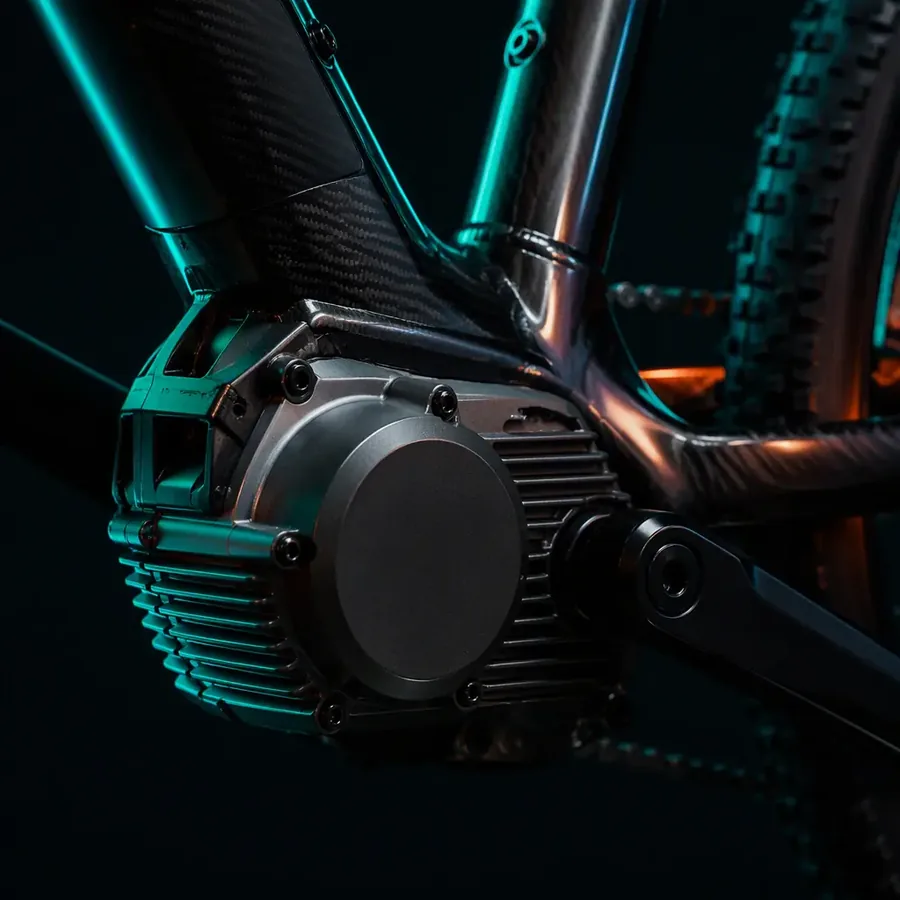
A mid-drive motor sits at the bottom bracket and drives the cranks, sending torque through the bicycle's existing drivetrain, chain, cassette, and derailleur. The motor torque is multiplied by the gear ratio you select, which is the fundamental advantage of the architecture: in a low gear, a mid-drive motor can deliver two to three times the wheel torque of a hub motor with the same motor rating. The cost is mechanical complexity and drivetrain wear, since the chain and cassette now transmit motor torque as well as pedal torque.
Torque, Climbing, and Gear Multiplication
Motor ratings are stated in watts, but what riders feel, and what determines hill-climbing capability, is torque at the wheel. The comparison is stark:
| Architecture | Typical Motor Torque | Wheel Torque (low gear) | Hill Climb (10% grade) |
|---|---|---|---|
| Geared hub 500W | 55–65 Nm | 55–65 Nm (fixed) | 12–16 km/h |
| Geared hub 750W | 70–85 Nm | 70–85 Nm (fixed) | 14–20 km/h |
| Mid-drive 250W (Bafang M420) | 80 Nm | 160–240 Nm (1st–2nd gear) | 18–25 km/h |
| Mid-drive 750W (Bafang M620) | 160 Nm | 320–480 Nm (1st–2nd gear) | 25–35 km/h |
The practical consequence: a 250W mid-drive motor out-climbs a 750W hub motor on steep grades because it can shift into low gear. This is why the EU market, capped at 250W continuous by EN 15194 . Is dominated by mid-drive systems for hilly cities, while the US market, with its 750W class limits, runs mostly hub motors. If your target market is Lisbon, San Francisco, or Chongqing, the mid-drive argument writes itself.
Efficiency and Real-World Range
Hub motors spin at wheel speed, which is inefficient at low speeds and high torque demands, exactly the conditions of hill climbing and stop-start city riding. Mid-drive motors spin the motor at its efficient RPM band use the gears to match speed, which gives them a measurable efficiency advantage in urban profiles:
- Flat, steady cruising: hub and mid-drive are within 2–3% of each other. The hub's direct drive path has slightly lower drivetrain losses.
- Stop-start city riding: mid-drive recovers 10–15% more range per kWh because every acceleration happens at efficient motor RPM.
- Hilly terrain: mid-drive delivers 20–30% more range than an equivalent hub system on the same battery, the difference between a 60 km and a 78 km real-world range on a 48V 20Ah pack.
- Heavy loads (cargo): mid-drive's gear multiplication protects the motor from sustained low-speed overload; hub motors under cargo load run hot and can thermally derate.
For a buyer projecting fleet range requirements, this efficiency delta translates directly into battery spend. A mid-drive cargo line can often use a 48V 20Ah pack where a hub cargo line needs 48V 25Ah for the same duty cycle, roughly $60–90 per unit in battery cost savings, which partially offsets the motor price premium. Battery chemistry and pack sizing economics are covered in our battery technology guide.
Weight Distribution and Handling
Weight placement changes how a bike rides. A rear hub motor concentrates 4–6 kg at the rear axle, which improves rear traction (useful for fat-tire and cargo bikes) but makes the bike feel rear-heavy when lifted and slightly sluggish in quick direction changes. A mid-drive motor places 3–4 kg low and central at the bottom bracket, the ideal location for stability, and keeps the wheels light, which improves suspension response and maneuverability.
For commuter and trail bikes, the mid-drive's central mass is a clear handling win. For fat-tire bikes, the equation is more nuanced: the rear hub's weight over the driven wheel improves snow and sand traction, which is why many fat-tire builders accept the handling penalty for the traction benefit. Our fat-tire e-bike OEM guide covers the traction and torque trade-offs for that category specifically.
Maintenance and Total Cost of Ownership
The maintenance profiles diverge sharply after 5,000 km. A geared hub motor is a sealed unit: the gears run in grease, the bearings are the only wear item, and a typical hub motor outlives the frame. The chain and cassette, carrying only pedal power, last 2–3x longer than on a mid-drive. For a rental fleet or sharing operator, this is the decisive factor, hub systems routinely reach 15,000–20,000 km before any motor service, and the service is a bearing swap, not a rebuild.
A mid-drive motor transmits full motor torque through the chain, cassette, and chainring. Expect drivetrain replacement (chain + cassette) every 2,500–4,000 km under assist, and note that mid-drive chains are typically more expensive (e-bike-rated chains with reinforced pins). The motor itself is serviceable, the Bafang M-series opens for gear and seal replacement, but requires trained technicians. Fleet operators should budget $40–80 per bike per year in additional drivetrain parts for mid-drive lines versus hub lines.
OEM Cost Comparison: The BOM Impact
For an OEM buyer, the cost delta is the most quoted number in the negotiation. At factory level, the motor system BOM difference for a 750W-class bike is:
- Geared hub system (motor + controller + display + PAS): $95–140 per unit
- Mid-drive system (motor + controller + display + PAS + reinforced drivetrain): $280–420 per unit
- Direct-drive hub system: $60–90 per unit, but with the weight and hill-climb penalties noted above
Mid-drive adds roughly $150–280 per unit to the landed cost versus an equivalent hub system. At a retail price point above $1,800, the margin can absorb it; below $1,300, it cannot. This is the single biggest reason hub motors dominate the sub-$1,500 retail segment, and why the two architectures rarely compete head-to-head in the same price band.
Beyond the motor itself, mid-drive frames need a reinforced bottom bracket shell and chainstay area to handle the torque input, which adds $10–20 in frame cost and can restrict which off-the-shelf frames you can use. Hub motor frames need the dropout width and axle spec matched to the motor, a simpler, cheaper constraint. The full procurement picture, MOQs, lead times, and payment terms, is in our OEM e-bike buying guide.
Decision Framework by Product Category
The right architecture maps cleanly onto product categories. Use this as your starting point, then adjust for your specific market:
- City commuter (flat, sub-$1,500 retail): geared hub 500–750W. Lowest cost, lowest maintenance, sufficient performance.
- City commuter (hilly, EU 250W limit): mid-drive 250W. The only way to get real climbing performance within the EN 15194 power cap.
- Fat-tire (snow, sand): geared hub 750W+. Rear traction benefit; simpler and cheaper than mid-drive at the required power level.
- Mountain / trail (premium): mid-drive 750W (M620-class). The gear multiplication and handling win decisively off-road.
- Cargo (heavy payload, hilly): mid-drive for torque and thermal endurance; hub acceptable for flat-city cargo.
- Fleet / rental / sharing: geared hub. The maintenance savings dominate every other consideration at fleet scale.
One final consideration: certification. The motor architecture does not change the certification path (EN 15194 / UL 2849 apply to the electrical system regardless), but the power class you choose for your motor, 250W EU, 750W US, or 1000W+ moped, determines which certification and registration regime applies. Decide the architecture and power class together, not sequentially, because the frame, drivetrain, and compliance documents all depend on both.
At EMS-EBIKE, we build both architectures in-house: geared hub systems from 500W to 1000W for commuter, fat-tire, and fleet lines, and mid-drive builds (Bafang M420/M620 and equivalent) for premium commuter, mountain, and cargo lines. Our 4 parallel assembly lines run under one quality chain with 15–30 day standard lead times, and our engineers will walk through the torque and efficiency math against your target market before you commit to tooling.
Get a Motor Architecture Recommendation for Your Line
Tell us your target market, terrain, retail price point, and duty cycle. We will spec the motor, controller, and drivetrain, with cost breakdown and certification documents for your region.
