
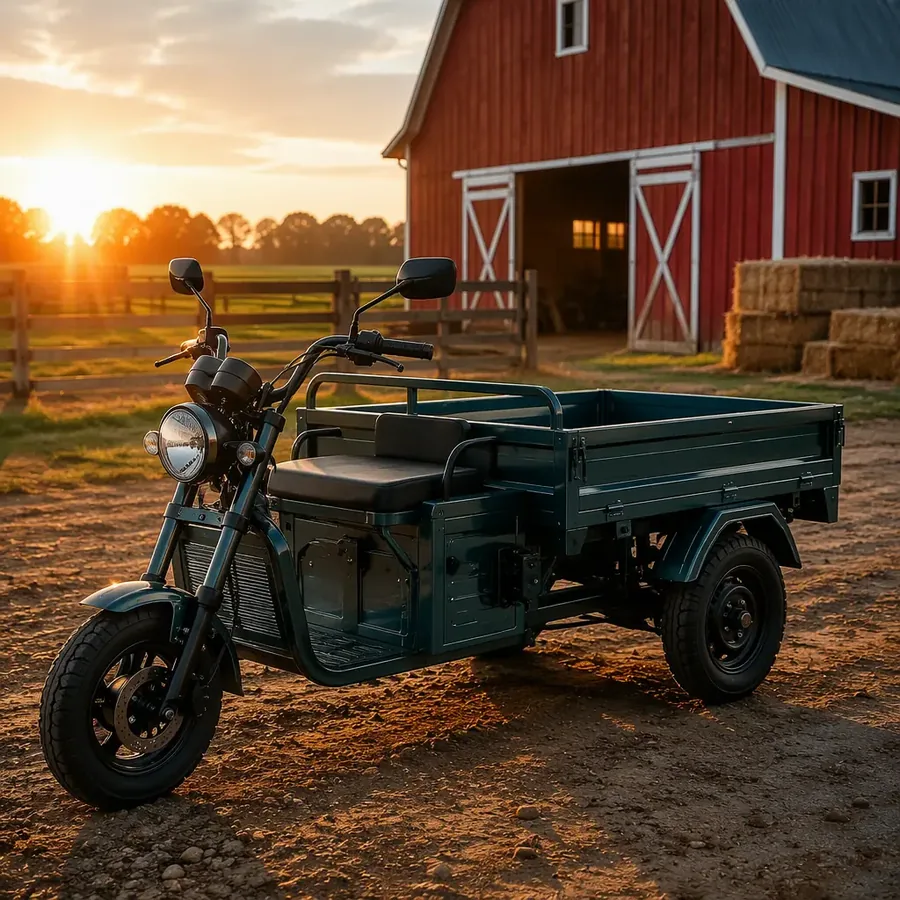
In 2023, a short video of a Chinese-made electric tricycle, what Americans now call the "three-wheeler" and what Chinese buyers casually call sanbengzi . Drove through a suburban American neighborhood and broke the internet. The clip showed something most Western viewers had never seen: a small, boxy three-wheeled electric vehicle hauling groceries, carrying passengers, and costing less than a used golf cart. Within a year, importers across the US were ordering container loads of cargo tricycles for farms, small towns, and delivery routes. This is not a novelty video trend. It is a structural shift in what a practical utility vehicle costs. For importers and distributors, the question is no longer whether the category works, but how to spec and certify it correctly. This guide breaks down why the three-wheeler caught on in America, what buyers actually demand, and how to source it as an OEM program.
Where the 'Three-Wheeler' Boom Started
The US boom traces back to a specific cultural moment: Chinese families sending electric tricycles as gifts to relatives in the US. A Chinese son-in-law imported a small electric trike for his American father-in-law, and the videos of the elderly man proudly driving his new "three-wheeler" around his neighborhood went viral across TikTok, YouTube, and Chinese social media. Millions of viewers saw a vehicle that was:
- Cheap . A complete, road-legal utility trike costs $1,250–1,550 FOB China, versus $35,000+ for an entry-level pickup truck.
- Self-explanatory . No clutch, no gears to learn, no motorcycle license required in most states. Twist the throttle and go.
- Useful immediately . It carries groceries, tools, feed bags, passengers, and even small livestock loads on the same trip.
- Low maintenance . A brushless hub motor, a sealed lithium battery, and drum brakes. The entire drivetrain has about a dozen moving parts.
The video trend created a search spike: "electric tricycle," "e-trike for adults," and "three wheel electric truck" queries grew steadily through 2024–2026 as dealers and importers scrambled to source supply. The demand is not a meme. It is a price-performance gap that the Western market simply had no product to fill.
The Price Math: $1,400 vs $35,000
The core driver of the US three-wheeler boom is arithmetic. Compare the total cost of ownership for the two most common rural utility vehicles:
| Cost Item | Electric Cargo Tricycle | Entry Pickup Truck |
|---|---|---|
| Purchase price | $1,250–1,550 FOB | $35,000–45,000 |
| Fuel / energy per 100 km | $0.30–0.50 (grid charging) | $10–15 (gasoline) |
| Insurance per year | $0–150 (golf-cart class in many states) | $1,200–2,000 |
| License requirement | None in most states | Driver's license + registration |
| Maintenance, year one | ~$50 (brake pads, tire pressure) | $800–1,500 |
| Payload | 300 kg (EU) / 500 kg (non-EU) | 700–1,000 kg |
The trike does not replace a pickup for highway hauling, it replaces the second car for the 80% of trips that are under 10 km: feed store runs, market trips, farm inspections, mail routes, and neighborhood errands. For those trips, the trike is one-fiftieth the purchase price and essentially free to run. The full battery and range engineering behind that cost picture is covered in our battery technology guide.
Why Farms and Small Towns Are the Sweet Spot
The buyers who stuck around after the viral moment were not city commuters, they were rural operators. The pattern repeats across the US and Canada:
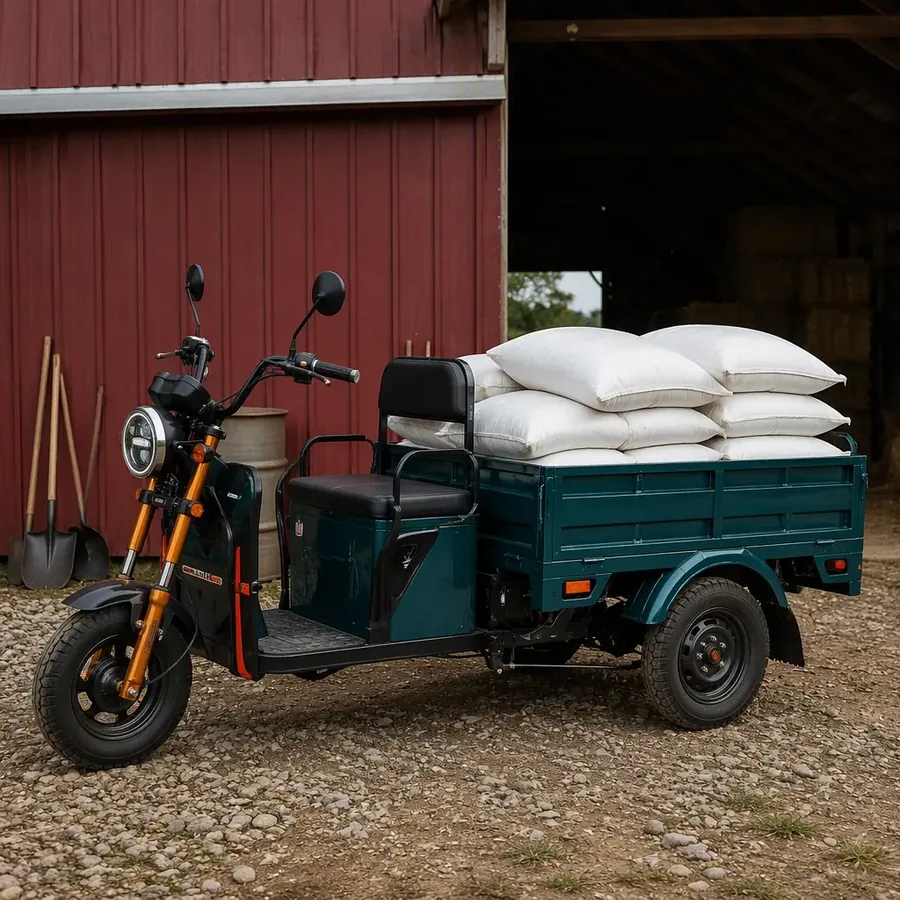
- Small farms and homesteads . Moving feed bags, tools, water containers, and produce between buildings. A 500 kg payload tricycle with a 150–500L drop-side box replaces a tractor trailer for daily chores and costs less than the tractor's tires.
- Small-town households . One-car families where the second driver needs an independent vehicle for errands within town limits. Speed-limited to 25–35 km/h, the trike is legal on most local roads without registration.
- Delivery and last-mile operators . Rural mail, pharmacy, and food delivery routes where a van is overkill. The operating-cost math for these routes is detailed in our cargo e-bike and e-tricycle fleet guide.
- Retiree and accessibility users . The stability of three wheels, the low step-over, and the reverse gear make the trike the practical bridge between a mobility scooter and a car. The passenger variant of this market is covered in our passenger e-tricycle OEM guide.
The common thread: these users need a vehicle that is cheap, indestructible, and simple . Exactly the design brief of the Chinese rural utility trike, which was engineered for village roads, farm work, and owner repair.
What American Buyers Actually Spec
Importers who succeeded in the US boom did not import the cheapest possible trike, they imported the right spec. The specification that survives the market:
- Motor. 800W is the entry point; 1000W and 1200W hub motors with a differential are the volume sellers. The differential matters: a solid rear axle drags the inside wheel in tight farmyard turns. Our hub vs mid-drive comparison explains why hub motors win this category on cost and serviceability.
- Battery, 60V 32Ah NMC for the standard build, 72V 40Ah LFP for the heavy-duty version. Range of 50–80 km loaded covers a full day of farm errands. Swappable packs are a differentiator for fleet users who cannot wait for charging.
- Payload and box, 300 kg for EU-classified units, 500 kg for the non-EU heavy build, with box volume from 150L to 500L. Drop-side boxes (flatbed sides that fold down) are the most requested US feature, they turn the box into a flat platform for odd loads.
- Reverse gear . Non-negotiable for US buyers. Backing out of a barn or loading dock with a 500 kg load without a reverse gear is a dealbreaker.
- Brakes . Hydraulic disc front plus dual drum rear with a parking brake. Rural buyers test-stall the trike on a grade; the parking brake is what gets sold.
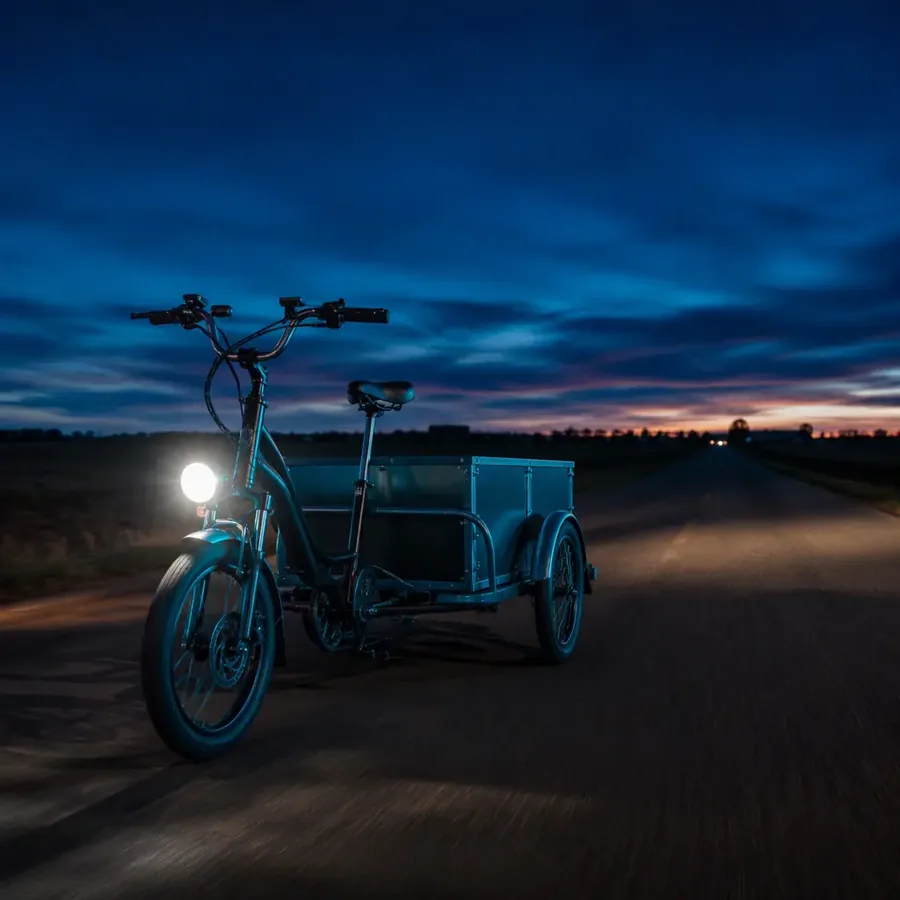
- Lighting . Full LED with optional beacon light. Visibility on unlit rural roads is a safety and liability issue; buyers spec the beacon for road use.
These specifications map directly to the EMS-EBIKE cargo tricycle program: 800W / 1000W / 1200W brushless hub with differential, 60V/72V lithium (LFP available), 300/500 kg payload, 150–500L drop-side boxes, reverse gear, hydraulic disc front + dual drum rear, and full LED. The full configuration table and OEM options are on our cargo e-tricycle product page.
Legal Class: Why No License in Most States
A big part of the US appeal is that the trike avoids the vehicle-registration maze. The classification depends on speed and power:
- 750W / 20 mph (32 km/h) throttle units . Classified as Class 2 e-bikes (or state low-speed electric tricycle rules) in most states: no license, no registration, no insurance. This is the legal path that makes the category fly.
- 1000W–1200W / 25–35 km/h units . Many states treat these under low-speed vehicle or NEV rules, with local variation. Importers typically configure the controller for a 20 mph top speed to stay in the no-license class, while keeping the higher motor for torque and hill climbing.
- US certification. UL 2849 covers the electrical system for Class 2 products; the complete EU/US certification comparison is in our EU vs US certification guide.
The takeaway for importers: spec the 20 mph controller limit, document the UL certification, and you have a no-license utility vehicle in most states. Which is exactly the pitch that sells the trike to rural first-time buyers who have never owned a motorcycle.
The OEM Opportunity for Distributors
For distributors, the US three-wheeler boom is a margin story. Typical dealer economics on the category:
- Landing cost, $1,250–1,550 FOB plus freight and duty lands a standard 1000W unit at roughly $1,800–2,200 in the US.
- Street price, $2,800–4,500 for the standard build; $4,500–6,500 for the 1200W heavy-duty version with the 500L box.
- Gross margin. 30–55%, with the heavy-duty version carrying the higher margin because there is less direct online competition.
- Return rates . Lower than e-bikes because the buyer's use case (farm chores, errands) is concrete and the product is simpler to maintain.
The same buying discipline applies as to any OEM program: factory audits, sample verification, certification documentation, and spare-parts commitments. The negotiation structure, MOQ, lead time, payment terms, first-article samples, is the standard pattern covered in our OEM buying guide.
How to Source Your First Container
If you are entering the category, the practical path is:
- Choose the spec. 1000W / 60V 32Ah / 300–500 kg payload / 300L drop-side box is the volume configuration that resells fastest in the US.
- Request samples . One unit for a 2-week farm test: hill climb loaded, range with a full box, reverse-gear operation, brake stop from 32 km/h.
- Verify certification, UL 2849 for the electrical system, and confirm your state's classification for a 20 mph throttle trike.
- Plan the container . A 40-foot container fits roughly 60–80 cargo tricycles knocked-down or 40–50 assembled; FOB China with CIF options is standard.
- Build the service story . Stock brake pads, tires, controllers, and a handful of batteries; the rural buyer will not ship a trike back for a flat tire, but he will buy the spare from you.
The three-wheeler is not a passing trend. It is the cheapest utility vehicle on four... on three wheels. Importers who spec it correctly, certify it for the no-license class, and support it with spares have a durable, high-margin category that the Western market did not have five years ago.
Spec Your Three-Wheeler Container
Tell us your target market, payload needs, and box configuration. We will quote the 800W–1200W cargo tricycle line with UL 2849 documentation, sample lead times, and container pricing, FOB China.
Spec a Passenger E-Tricycle for Your Mobility Channel
Tell us your target markets, rider profile, and distribution channel (dealer, senior-living, or online). We will spec the track width, step-over height, battery, and certification path, with stability and brake test data included in the sample phase.
