
On a cargo e-tricycle the component doing the most work is the one buyers rarely ask about. The rear axle and its differential let the two rear wheels spin at different speeds through a corner, split torque across both wheels, and carry the whole payload from the frame to the road. On this platform the drive unit is an 800W / 1000W / 1200W brushless hub motor with an integrated differential on a 60V/72V pack, and the axle is engineered around a 300 kg (EU) / 500 kg (non-EU) rated load. This guide sets out how the differential and rear axle actually work, why two rear wheels matter to stability and tire life, and what a buyer should specify in an OEM order.
What a Differential Actually Does on a Cargo Tricycle
Without a differential, both rear wheels would be locked to the same axle shaft and forced to turn at identical speed. In a corner the outer wheel travels a longer arc than the inner one, so a locked axle makes the outer tire scrub . It slips sideways and fights through the turn. On a light two-wheeler that is a little extra wear; on a 150–220 kg trike carrying a loaded cargo box it becomes hard steering, rapid tire wear, and real strain through the axle and hub bearings.
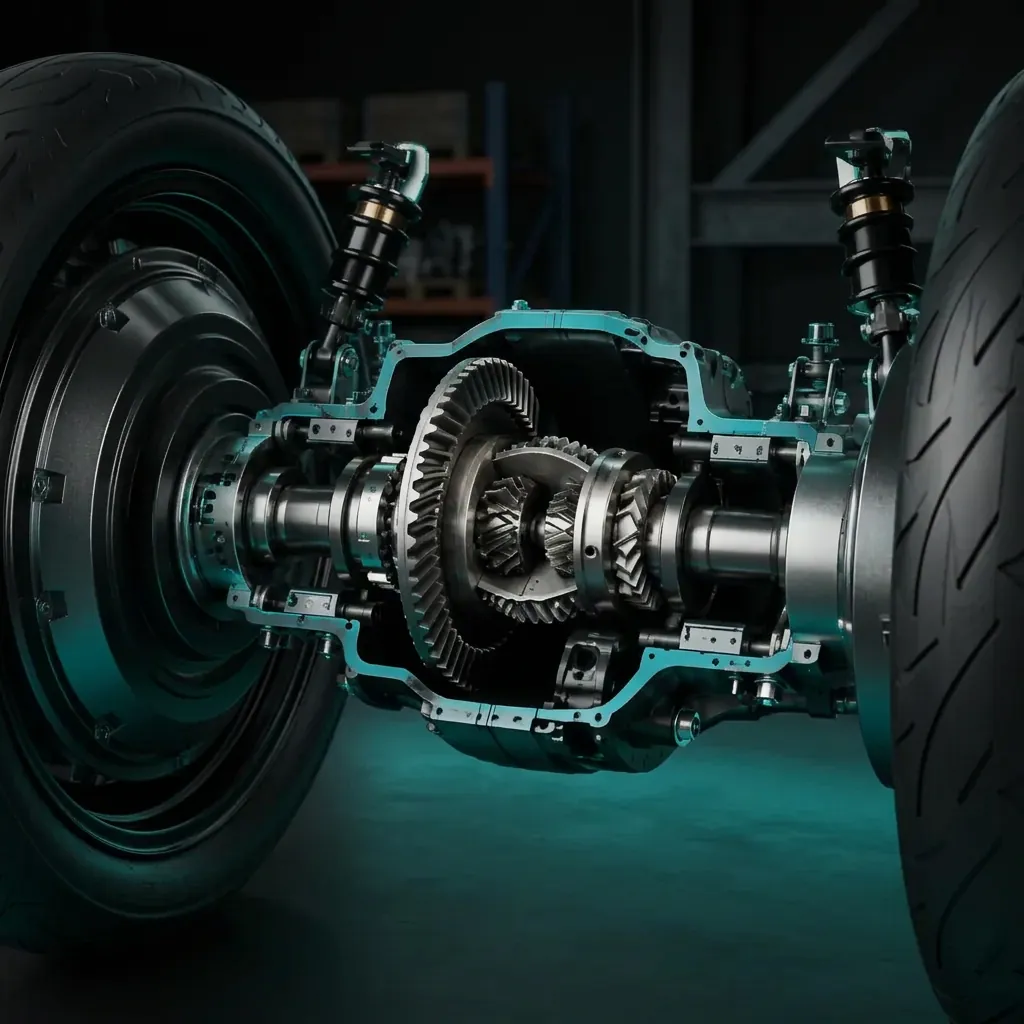
The differential solves this by splitting motor torque between two half shafts while letting each rear wheel rotate independently. Inside the housing a ring gear drives a differential case holding bevel pinion gears; those pinions drive side gears connected to each half shaft. Going straight, the pinions spin with the case and send equal speed to both wheels; in a turn the pinions also spin on their own axles, letting the outer wheel overrun the inner one. The result is smooth, scrub-free turning at any load.
The Rear Axle Is a System, Not a Bar
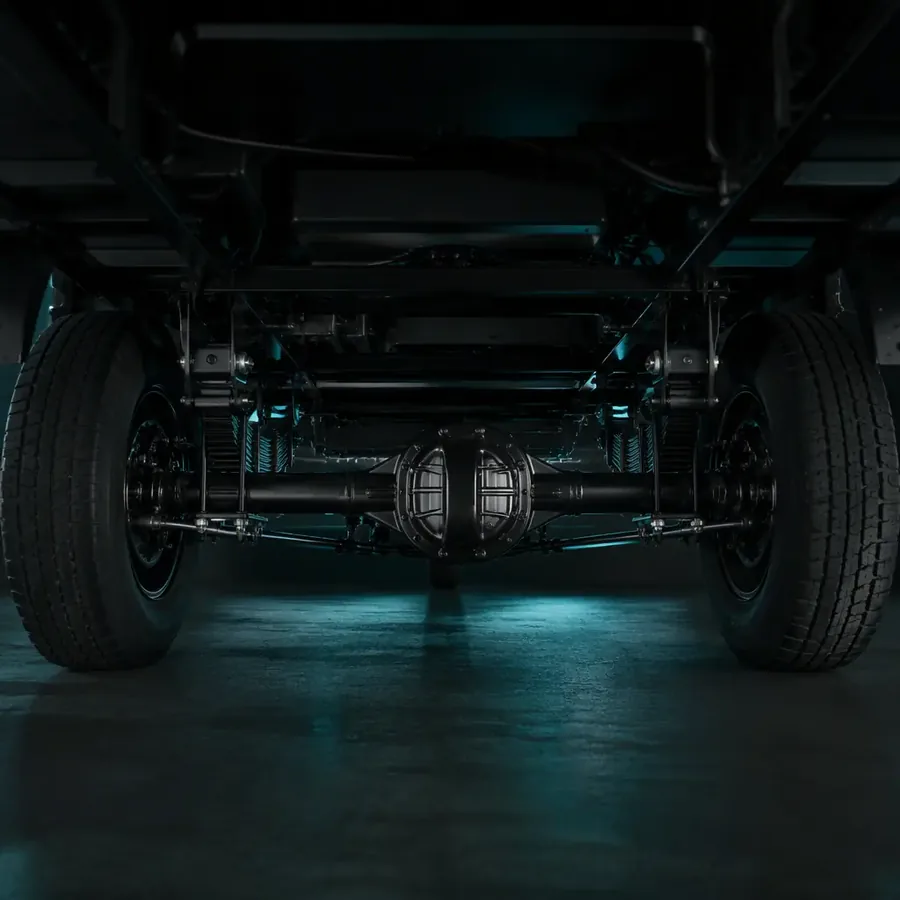
The rear axle is easy to picture as a single shaft, but on a load-carrying trike it is a compact system. It comprises the differential housing and ring gear, two half shafts, the wheel hubs and bearings, and the axle tubes that locate the wheels under the chassis. Because the two rear wheels each carry a share of the payload, everything from the hub bearing to the tire sidewall is rated for the load, not just for rolling.
The steel tube chassis on this platform is built around that axle, with 3.00-12 tires up front and 3.75-12 load-rated tires at the rear . The rear pair being the ones that take the drive and the payload. The dual rear layout is what makes a cargo tricycle stable under an offset load; a single rear wheel would want to tip the moment a 300 kg box is slid to one side. Suspension and tire choice on that axle are covered in our suspension guide and tires guide.
Hub Motor and Differential Are One Unit
On a cargo tricycle the motor and differential sit together on the rear axle rather than as two separate parts. The brushless hub motor surrounds one end of the axle; the ring gear, spun by the motor through the reduction drive, turns the differential, which then drives both half shafts. This package wraps the drivetrain into the rear wheels and removes the chain, cassette and derailleur of a mid-drive, which is why hub-with-differential dominates on the cargo platform.
A 3-speed hub plus a Forward / Neutral / Reverse selector is handled at the axle, and the whole line is sized to climb grades under load. The continuous motor rating is the real spec to compare, an 800W unit suits a flat urban route, while a 1200W unit buys the torque to pull a full box up a ramp. Which rating to choose for your terrain and payload is worked through in our motor power guide, and the build itself in our manufacturing process guide.
How the Drive Carries a 300–500 kg Payload
The load path is worth following once. Torque leaves the motor and turns the ring gear; the differential casing splits it to the two side gears; each side gear drives a half shaft; each half shaft turns a wheel hub; and the tire distributes it to the road. The payload and trike weight, up to 500 kg combined in the non-EU build, loads the axle tubes and the tires, not the motor. That is why the axle, hub bearings and rear tires are the load-rated components, and why the frame, axle and tires are chosen as a set.
The interplay between load and drive is the most misread spec on a trike. A heavier box means more rolling resistance and more torque demand per hill, so the axle is specced in the same step as the battery and motor. We lay out the relationships between payload, motor rating, tire load index and range in our payload capacity guide, and the drive-and-pack sizing in the 60V vs 72V guide.
Turning, Reverse and the 3-Speed Gearbox
A differential is symmetric, so the trike reverses as easily as it goes forward: the controller simply flips motor direction and the ring gear turns the other way. The axle therefore needs no separate gearbox to back up, the reverse shown on the LCD is a motor command. That lets a cargo trike back a loaded box into a bay or a bay using just a switch, a real advantage for a delivery run or a vendor at a market.
The 3-speed selector changes the drive ratio through the reduction, trading top speed for torque or the reverse. Between the differential, the 3-speed and the hydraulic disc front / dual drum rear with a parking brake, the axle gives you turning, backing up and holding on a slope. The stability geometry, track width and centre of gravity, is detailed in our safety features guide, and stopping under load in the brake systems guide.
What to Specify in an OEM Order
If you are outfitting a fleet, the axle spec is where a small oversight becomes a big repair bill. On this platform a cargo e-tricycle is specced with the brushless hub motor with differential, a 60V 32Ah or 72V 40Ah pack, 3.00-12 / 3.75-12 load-rated tires, and the hydraulic disc front / dual drum rear brake set. The buyer controls three things that change the result more than any sticker number:
- Load and tire index: state the maximum combined load and confirm the rear tire load index covers it with margin, tires guide.
- Motor rating for grade: pick 800W / 1000W / 1200W against the steepest loaded climb on your route, motor power guide.
- Reversing and payload: confirm the axle carries the rating you intend, payload capacity guide.
- Braking under load: verify the parking brake holds at rated load on your slopes, brake systems guide.
Because the axle ties frame, motor, battery and tires together, a wholesale spec is safer than a list of parts. Our engineering desk works from a dimensional drawing of the platform that shows the axle, load path and clearances up front, and the broader sourcing terms, MOQ, samples, lead time and what to demand, are set out in our cargo e-tricycle OEM guide and OEM buying guide.
Maintenance: The Axle Work Most Owners Forget
A sealed differential needs little attention, but the axle wears where it is easiest to ignore. Rear hub bearings take the loaded miles, so they should be checked for play and repacked on a service interval rather than replaced on failure. The rear tires, being the load-carrying pair, wear on the drive and under heavy load. A worn rear tire on a loaded trike is a stability risk, not just a cost. The parking brake and the rear drum adjusters should be serviced with the bearings, because a drum that slips under load is the most dangerous failure on a hill.
The full preventive list, bearings, drums, brake cables, hub maintenance and electrical checks, is in our maintenance guide, with the reliability picture in the after-sales & spare parts guide. You will not open the differential often; you do have to check everything that carries the load.
Spec the Axle on Your Platform
Tell us your payload, route and grade, and we will send a dimensional drawing and axle/drivetrain spec for the cargo platform. So you can see the load path before you commit.
