
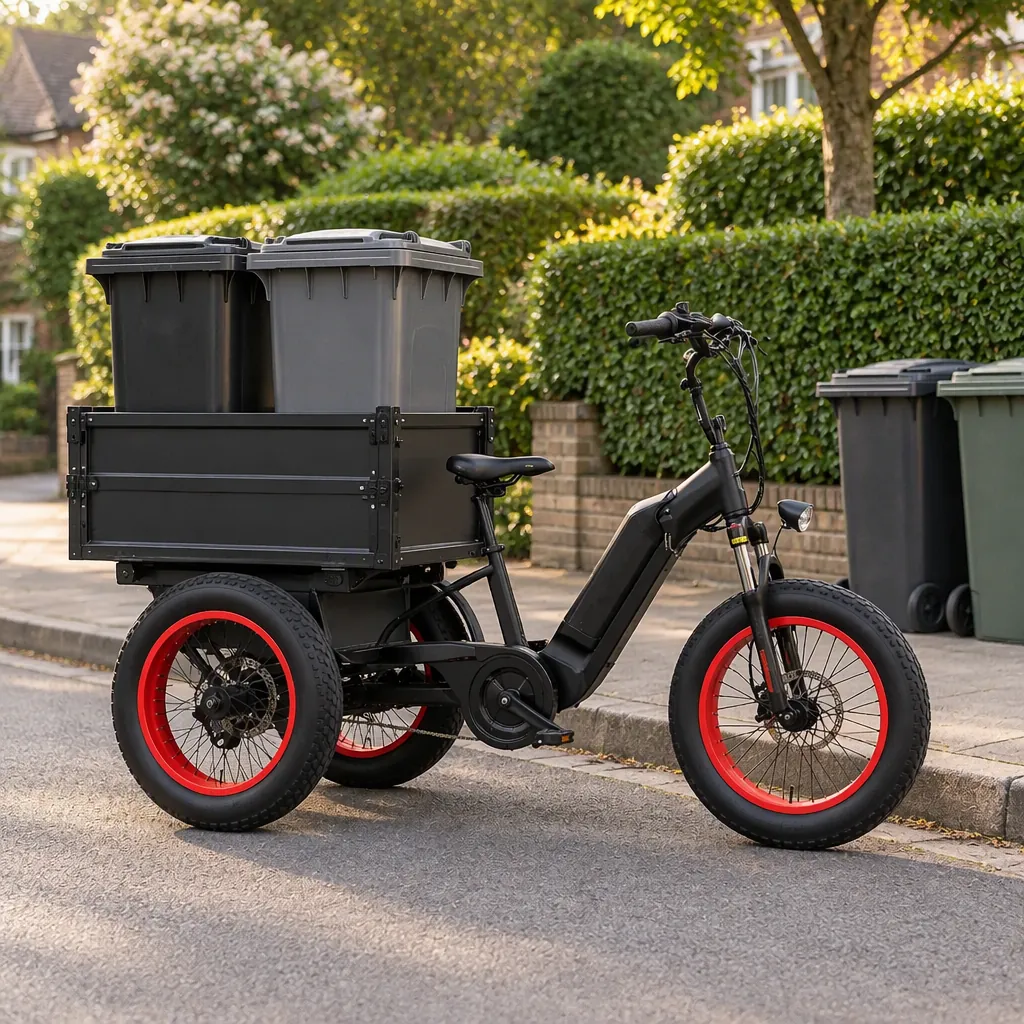
Waste collection is the least glamorous transport job in any city, and the most predictable. The same loop, the same stops, the same bins, every day. That predictability is exactly why an electric cargo tricycle beats both a full-size packer truck and a pickup on dense collection routes: the duty cycle is short, stop-heavy and slow, which is the worst possible use of a combustion truck and close to ideal for a 300–500 kg electric platform.
Sanitation departments and private waste contractors are already piloting trikes in alleys, market districts, park loops and gated communities where a packer physically cannot go or is wildly over-specced. This guide covers the route math, the bin and payload envelope, the dumping options, the drivetrain specs that decide durability, and the procurement documents that determine whether a pilot becomes a fleet purchase.
Why Waste Routes Are Rethinking the Truck
Three cost lines squeeze sanitation budgets at once: fuel, labour, and the vehicle itself. A rear-loader packer runs $200,000+ and burns diesel idling between stops. On a dense urban loop the truck spends most of its shift crawling bin to bin at walking speed — terrible utilisation for a 15-tonne asset.
A cargo e-tricycle sits at the other end of the curve at $1,250–1,550 FOB, carries 300 kg (EU) / 500 kg (non-EU), and recharges overnight on a standard 230 V socket drawing under a dollar of electricity. The route types that switch first:
- Alleys and pedestrian zones. Where a truck cannot fit and crews currently haul bins by hand. A 1.1–1.3 m wide trike with a 500 kg deck turns a two-person carry into a one-person drive.
- Markets, old towns and tourist districts. High bin density, short distances, and noise restrictions that favour a near-silent vehicle.
- Gated communities, campuses and parks. Private operators running daily rounds where a pickup is overkill and a packer is not permitted at all.
The common thread is stop density beats payload per trip. When a route has 40+ stops per kilometre, small frequent loads win. Over large territories with scattered stops the arithmetic inverts — that pattern is worked through in our rural last-mile delivery guide, and collection routes are its dense urban mirror image.
The Route Math: Trike vs Packer Truck on a Dense Loop
Model a 6 km alley-collection loop with 45 stops and a crew of two. The packer completes it in one pass but burns fuel, needs a licensed driver, and blocks the alley while it works. The trike runs two passes of 300–500 kg each, on a 25–35 km/h platform that costs cents per kilometre:
| Cost line | Packer truck | Waste-collection trike |
|---|---|---|
| Purchase price | $200,000+ | $1,250–1,550 FOB |
| Energy per shift | $25–60 diesel | $0.60–1.20 electricity |
| Operator licence | CDL / heavy-vehicle class | None in most US states (Class 2 path) |
| Route access | Main roads only | Alleys, footpaths, pedestrian zones |
| Stops per shift | 150–300 | 120–250 (two passes) |
| Maintenance / year | $8,000–15,000 | Hundreds |
The trike does not replace the packer on transfer runs. It replaces the second truck — the one doing local rounds while the packer shuttles to the transfer station. Municipal buyers comparing platforms should read our public fleet e-bike guide for the RFQ and tender mechanics that apply to trikes as well. The cost side of the same comparison is itemised in the cargo trike vs pickup cost guide and at fleet scale in the cargo delivery fleet guide.
What a Sanitation Trike Carries: Bin Sizes and Payloads
Collection trikes are specced around the bin, not the vehicle. The cargo box has to swallow the containers the route actually uses:
- 120L wheelie bins (EN 840). The European standard. Two to three fit a 500L box with room for loose bags.
- 96-gallon / 365L carts. The US residential standard. One upright, plus a second laid on its side or a full load of loose bags.
- Loose bags and market waste. Demands solid sides or a liner — not an open flat rack.
| Spec | Value |
|---|---|
| Payload | 300 kg (EU spec) / 500 kg (non-EU spec) |
| Cargo box | 150–500L, aluminium/steel with drop-sides option |
| Kerb weight | 150–220 kg (without cargo box) |
| Tires | 3.00-12 front / 3.75-12 rear (dual) |
| Top speed | 25–35 km/h (governor settable 25 / 35 / 40) |
| Range | 50–80 km at 200 kg load, flat terrain |
Payload decides the route: a 500 kg rating covers a full shift of commercial bins, while 300 kg suits residential rounds. The load-rating engineering behind those numbers — frame, brakes, tires and motor specced as one system — is covered in the tricycle motor power guide.
Dumping and Loading: Drop-Sides, Tipping and the 150–500L Box
How the load leaves the box matters as much as how it gets in. Four options, ordered by how often we build them:
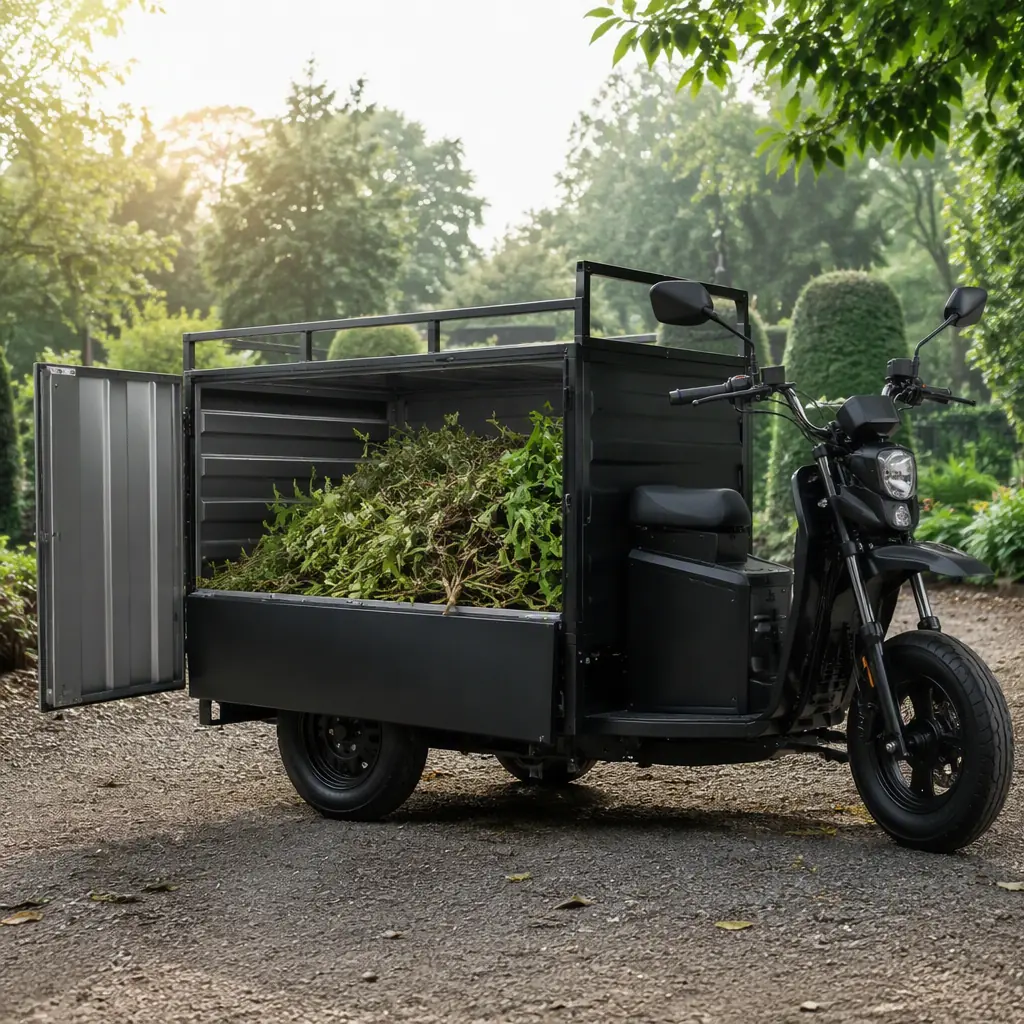
- Drop-sides (side-hinged panels). The default for waste. Crews slide bags and bins out sideways instead of lifting over a tailgate. Standard across the 150–500L range.
- Tipping box. Manual or electric tilt that dumps loose waste into a compactor or transfer container. Spec it when the route ends at a pit or hopper.
- Tailgate ramp. For wheeled bins: roll the bin up, tip it in, roll it out at the stop. Faster than lifting on high-frequency cart routes.
- Removable liner or insulated panel. For wet or odorous streams, and for routes that mix organic collection with general waste.
For organic and green-waste rounds, a tipper body paired with a washable liner is the usual configuration — a hinged drop-side box is fine for bagged waste but punishing to empty by hand when the load is wet and compacted.
Specs That Matter: Motor, Brakes and Load Ratings
A collection trike spends its day at low speed under varying load, which puts the stress on the drivetrain, the brakes and the rear axle rather than on top speed. The platform to specify:
- Motor: 800W / 1000W / 1200W brushless hub motor with differential, 60V or 72V. The differential is not optional on a dual-rear-wheel trike — without it, every tight turn scrubs the inside tire and loads the axle.
- Battery: 60V 32Ah or 72V 40Ah lithium (LFP available), heavy-duty BMS. The 60V/72V decision is covered in the 60V vs 72V guide.
- Brakes: hydraulic disc front + dual drum rear with a parking brake. Stopping a 500 kg load on a cambered alley requires the parking brake to be a real brake, not a hill-holder — see the brake systems guide.
- Chassis: steel tube with heavy-duty e-coat and powder coat. Collection work means constant damp, grit and leachate; coating quality is a durability spec, not a cosmetic one.
- Controls: LCD with speed, battery percentage, load indicator and reverse gear, plus forward/neutral/reverse selector. Reverse is used every shift in dead-end alleys.
- Lights: full LED system with optional beacon. Essential for pre-dawn rounds on unlit service roads.
Safety configuration deserves its own review before a fleet order — the safety features guide covers the visibility and stability items that matter most on low-speed commercial duty.
Battery and Shift Planning for Collection Routes
Collection routes are short, which is the trike's biggest operational advantage: one overnight charge covers the shift. The arithmetic that matters for planning:
- Charge time: 6–10 hours on the standard 5A charger from a 230 V socket — a single-shift, overnight-charge pattern with no infrastructure build.
- Energy cost: a 60V 32Ah pack is roughly 1.9 kWh, so a full charge is well under a dollar at most commercial tariffs.
- Range: 50–80 km at 200 kg on flat terrain. A 6 km loop with two passes and stop-start losses sits comfortably inside that envelope.
- Two-shift operation: a single trike cannot cover two shifts on one overnight charge. Either add a second vehicle, use a swappable pack, or run a higher-current charger mid-day.
Fleet-level charging layout, including how many vehicles one yard circuit can support overnight, is worked through in the fleet charging guide. Cold-weather range loss and the winter protocols that offset it are in the winter operations guide.
Procurement Notes for Municipal Buyers
Public-sector purchasing runs on a different axis from commercial buying: compliance documentation, multi-year service commitments, and accountability shape the decision. Four questions to settle with any supplier before a pilot:
- Compliance path. Which framework applies locally — EN 15194, UL 2849, or a Class 2/3 low-speed vehicle route — and can the supplier produce the corresponding letter? The US/EU regulations comparison maps the options.
- Duty-cycle declaration. Ask for range and payload claims stated against a defined duty cycle (for example 200 kg on flat terrain), not a best-case figure.
- Multi-year spares. Sanitation fleets run 5–8 year cycles. Tire sizes (3.00-12 front / 3.75-12 rear), brake shoes and battery packs must be contractually available for the full term. See the spare parts pipeline guide.
- Whole-life cost. Compare against the truck's fuel, licence and maintenance lines, not against the purchase price alone — and include the tender mechanics covered in our OEM buying guide.
Spec a Waste-Collection Trike Fleet
Tell us the loop length, stop count, bin standard and payload per pass, and the export team will return a configuration — motor tier, box volume and body type, battery capacity and charger count — against a defined duty cycle. OEM orders start at 50 units per model with a 15–30 day standard lead time (30–45 days for a first custom-branded run), and pre-production samples ship before mass production.
Build a Waste-Collection Trike Pilot
Start with two to four units on your hardest route for one full month. Measure payload per pass, stops per charge and actual energy cost, and compare against the second-truck line item you are trying to retire. That single month of real data beats any modelled comparison — and it is the evidence a tender committee will ask for.
Build a Waste-Collection Trike Pilot
Tell us your route density, bin sizes, and collection schedule. We will spec the box layout, dump option, pack size, and charging plan for your sanitation routes.
