
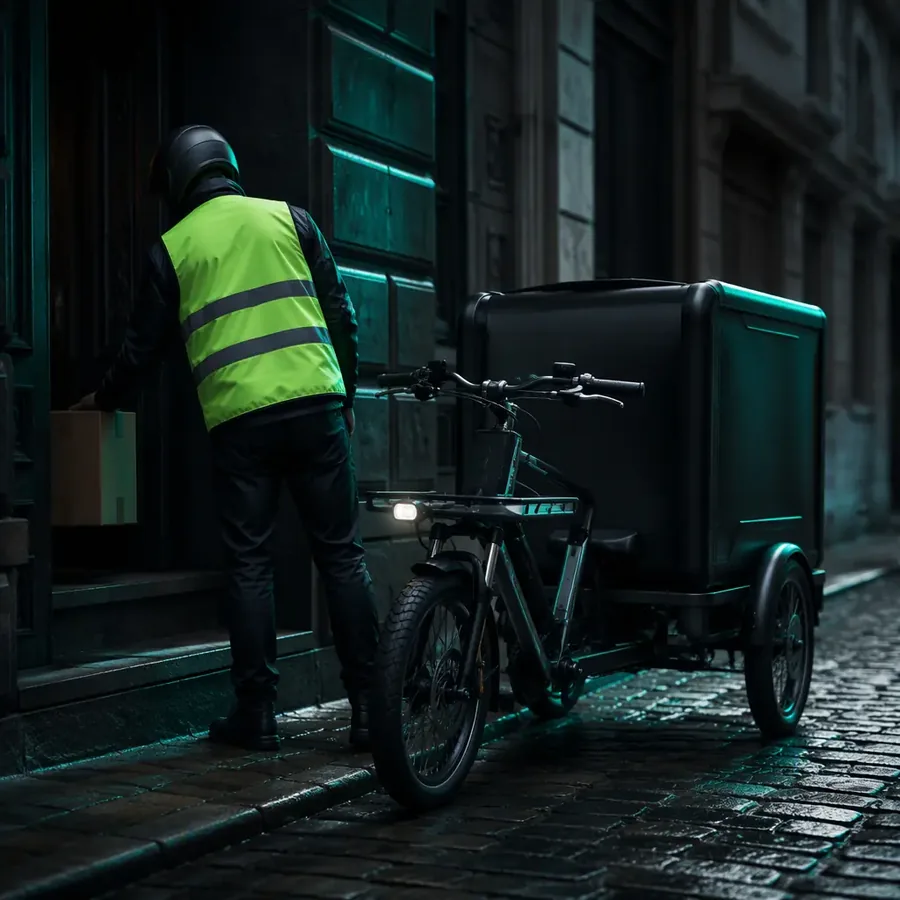
The courier and parcel delivery industry is rediscovering the cargo e-tricycle. But the vehicle doing the work is increasingly the cargo e-tricycle with three wheels and 300 kg of real payload, not the two-wheel cargo bike. The reason is route economics: courier companies that switched from vans to cargo bikes cut fuel and parking costs but hit a payload wall, and the two-wheelers could not carry the daily volume. The three-wheeled cargo trike carries 150–500 L of locked cargo, holds 300–500 kg, needs no motorcycle license in most markets, and costs roughly $1,250–1,550 FOB, a fraction of the $30,000+ van it replaces on dense urban routes. This guide covers the route economics, the vehicle spec, and the fleet playbook for courier and parcel operators.
The Route Math: Why Trikes Beat Vans on Dense Routes
The courier industry's core metric is cost per stop. On a dense urban route with 40–80 stops per day, the van's advantages (bulk volume, speed between zones) are irrelevant and its costs dominate:
| Cost factor | Delivery van | Cargo e-tricycle |
|---|---|---|
| Vehicle cost | $28,000–45,000 | $1,250–1,550 FOB |
| Fuel/energy per day | $18–35 | $0.50–1.50 |
| Parking per stop (urban) | $3–8 / violation risk | $0 (bike lane / curb) |
| License required | Driver's license + DOT | None (Class 2 most states) |
| Insurance (annual) | $2,500–5,000 | $300–600 |
| Stops per shift | 60–120 | 40–80 |
| Cost per stop (dense route) | $2.50–4.50 | $0.60–1.20 |
The crossover point is consistent: below about 3 km between stops, the trike wins on cost per stop; above that, the van's speed advantage returns. That is why the trike's home turf is downtown, campus, resort, and dense-suburb courier work, exactly where our rural last-mile delivery guide shows the same logic playing out in the opposite direction for low-density routes.
Box Design: The Spec That Decides the Route
Unlike food delivery (insulated boxes, hot cargo, see our food delivery trike guide), parcel couriers need secure, sortable, weatherproof cargo volume. The box spec that matters:
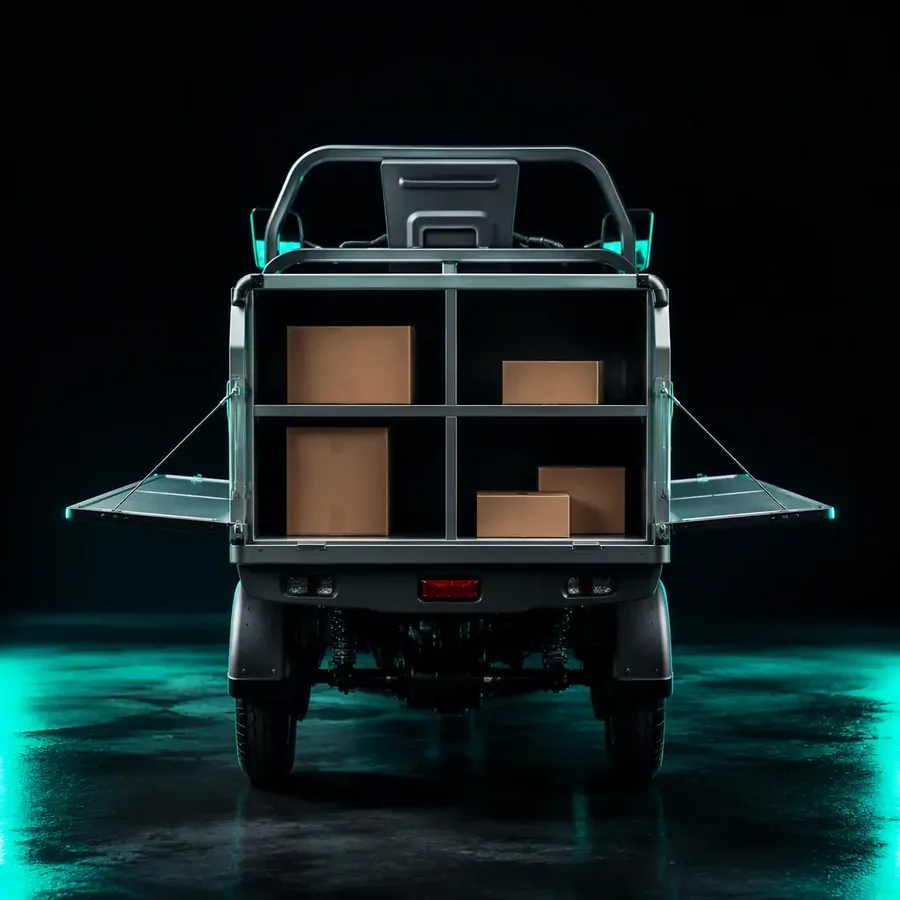
- Lockable volume of 150–500 L, EMS-EBIKE's cargo trike boxes range from 150 L (urban courier, 300 kg) to 500 L (parcel and freight, 500 kg). The box locks as standard; unattended drop-off is a core courier workflow.
- Compartmentalization . Dividers or shelf rails for small parcels, envelopes, and documents; a courier without compartments spends 30 seconds per stop digging through a pile.
- Drop-side or rear access . Side-hinged drop-sides make curb-side loading ergonomic. The 150–500 L box with drop-sides is the configuration EMS-EBIKE builds for parcel fleets.
- Weather sealing. IP54+ box sealing and a canopy option keep parcels dry; the cold-weather and rain protocol for both cargo and electronics is in our canopy and all-weather guide.
Payload and Power for Parcel Routes
Parcel routes punish underspecced vehicles. The average parcel is 2–5 kg, but a courier loads 60–100 parcels for the first loop of the day, 300–500 kg of cargo before the route starts. The spec that carries that load:
- 1000W motor with differential . The export volume rating; carries 300–500 kg and holds speed on 6–8% grades. The 800W vs 1000W vs 1200W decision framework is in our cargo trike motor power guide.
- 60V 32Ah or 72V 40Ah pack . A full day of multi-stop courier work draws 60–80% of a 60V 32Ah pack; operators on double shifts run the 72V option or swap packs. The pairing logic is in our 60V vs 72V guide.
- Hydraulic disc front + dual drum rear brakes . Loaded trikes stop long; the brake spec and stopping-distance verification are non-negotiable on courier routes with 40+ stops.
- Reverse gear . Couriers back out of loading docks and narrow alleys daily. The three-speed forward/neutral/reverse selector on EMS-EBIKE cargo trikes is a route-saver, not a luxury.
The full cargo trike spec sheet, motor, battery, brakes, payload, box sizes, is documented in our cargo e-tricycle OEM guide, and the fleet-level motor and torque requirements for payload routes are modeled in our cargo delivery fleet guide.
Legal Class: What the Courier Company Must Check
Before a courier company commits a fleet, the vehicle class in the operating cities decides everything:
- US . The 750W Class 2 build (20 mph throttle) needs no license, no plate, and no insurance mandate in most states, which is why it dominates US courier deployments. Higher-power builds fall into state NEV or moped rules. The state-by-state fragmentation is mapped in our US and EU trike regulation guide.
- EU . The 250W EPAC path needs no license but caps payload-grade capability; the L2e path (up to 45 km/h) needs eMark type approval, a plate, and an AM/B license. Certification scope and cost for both paths are in our EU vs US certification guide.
- Commercial use . Even where the trike needs no license, the courier company should confirm commercial liability coverage and local cargo-vehicle rules; a few cities classify any cargo box over a volume threshold as a commercial vehicle.
The Fleet Playbook: Running 10–50 Trikes
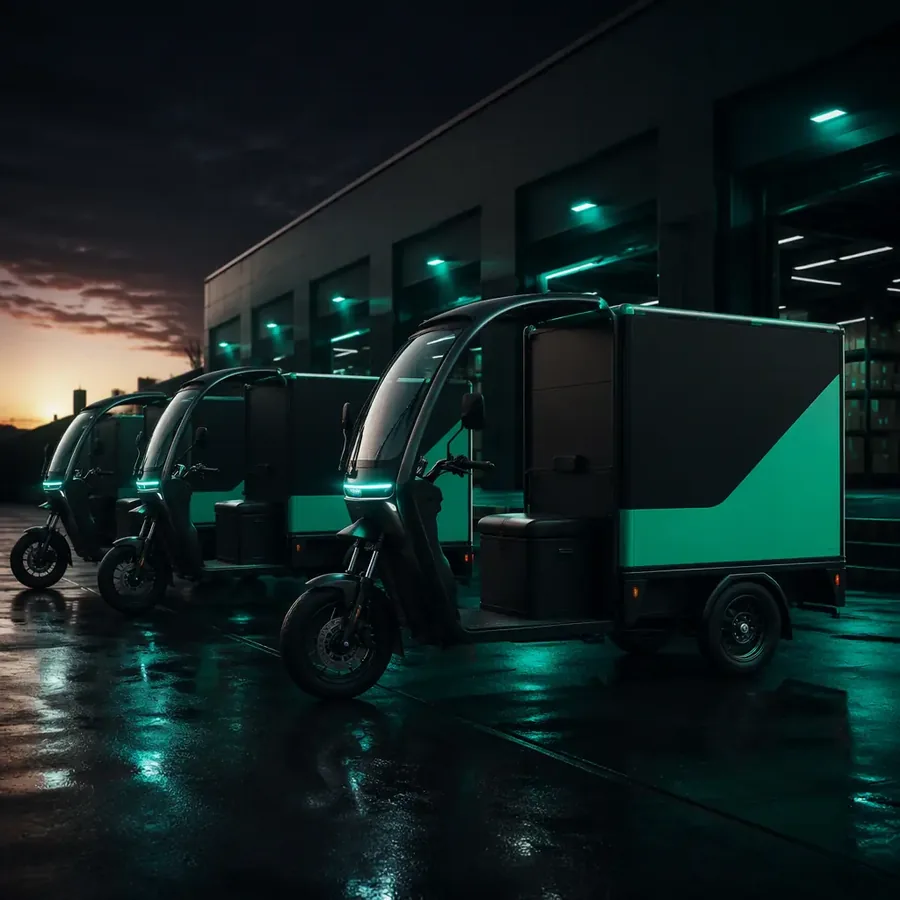
Operators running courier trike fleets converge on these five systems:
- Telematics and tracking . Every trike with GPS; the fleet management layer is the same one documented in our cargo fleet guide.
- Dock-and-swap charging, 2 packs per trike, 60-second swaps at the depot between loops; no trike waits for a charge at midday.
- Pre-shift checklist . Tires, brakes, battery, box lock, lights: the 5-minute checklist from our maintenance guide, run per shift instead of per week.
- Spare-parts buffer . Brake pads, tubes, tires, controllers, and one spare motor per 10 trikes. The wear-item budget that keeps availability at 95%+ is in our maintenance cost guide.
- Seasonal planning . Winter range drop (15–30% on cold packs) means the fleet plan must budget an extra pack rotation in Q1; the cold-weather charging protocol is in our battery technology guide.
Procuring the Fleet: What to Put in the RFQ
For a courier fleet, the RFQ should specify: motor rating and brand, controller current, box volume and lock type, drop-sides, brake configuration with stopping-distance data, payload rating with test method, battery capacity and swap mechanism, telematics compatibility, and the certification documents for each operating city. EMS-EBIKE supplies courier fleets with 800–1200W cargo trikes, 60V/72V packs, 150–500 L lockable boxes with drop-sides, and a 12-month vehicle / 24-month battery warranty, at 50-unit MOQ and 15–30 day lead times. The procurement structure, payment terms, inspection, and shipping, is in our China import guide, and the cost comparison against vans and pickups is in our trike vs pickup truck analysis.
Spec a Courier Trike Fleet for Your Routes
Tell us your daily stops, average parcel volume, and operating cities. We will spec the motor, lockable box, battery swap system, and certification path, with route-grade test data and a sample unit before fleet production.
