
A quarry maintenance planner does not usually ask whether an electric tricycle can carry a load. The tonnage question answers itself in the first minute. What stalls the evaluation is the terrain: a haul road graded at twelve percent, a stockyard of uncompacted crushed stone, a dust load that defeats every exposed bearing on site. This guide covers the eight numbers that decide whether the platform survives a quarry schedule, and where the honest limits sit.
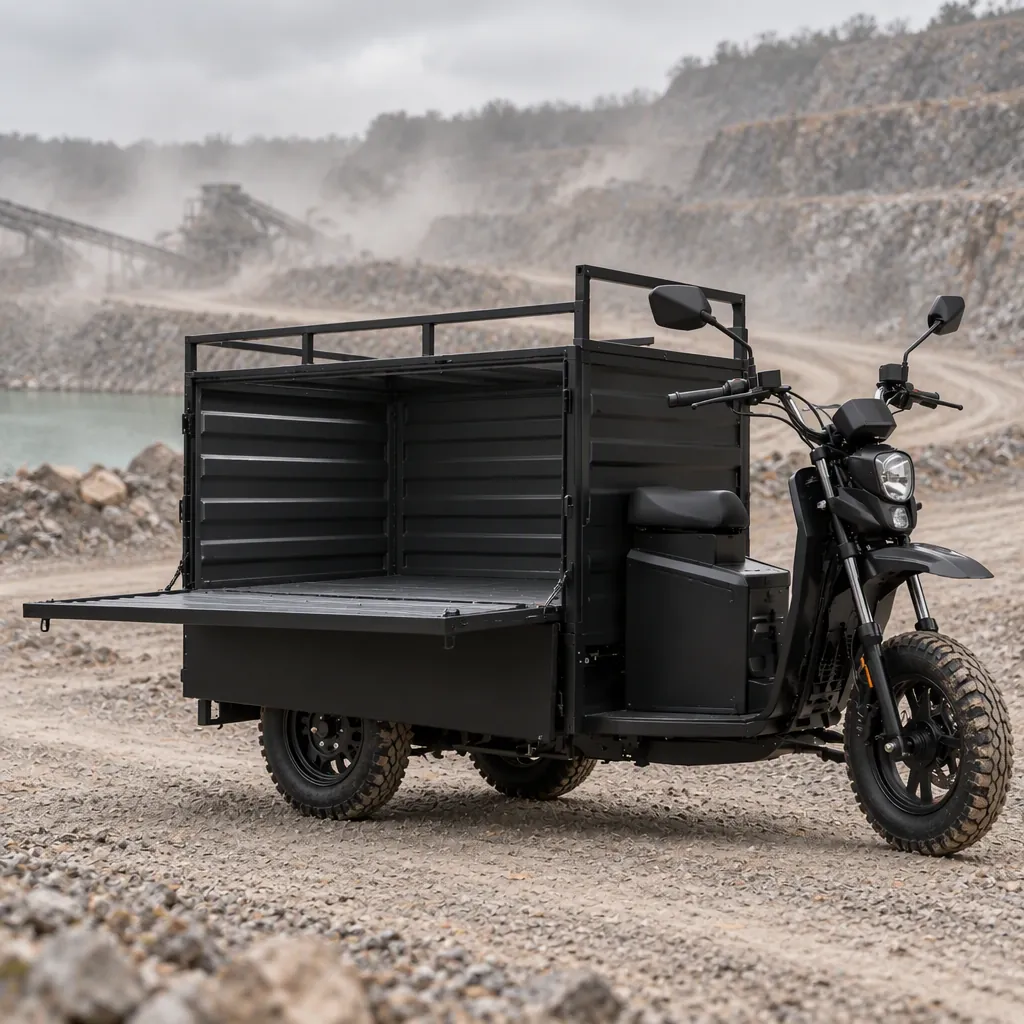
Where a Site Trike Fits on a Quarry, and Where It Does Not
Mine and quarry sites run two very different material flows, and the platform only serves one of them.
The flow it does not serve is extraction haulage: moving blasted rock from the face to the primary crusher. That work is measured in tonnes per hour over distances of hundreds of metres on grades that routinely exceed what a three-wheeled chassis can hold, and it belongs to articulated dump trucks and rigid haulers. No one is replacing a forty-tonne hauler with a battery tricycle, and any supplier who suggests otherwise has not visited a pit.
The flow it does serve is everything around the edge of extraction. That includes:
- Diesel, oil, grease and coolant runs from the site store to fixed plant and to the workshop.
- Replacement filters, hydraulic hoses, GET (ground-engaging tool) teeth, bucket pins and wear plates distributed to the service bays.
- Sample bags, core trays and assay consignments moved from the drill rig or the face to a core shed or site laboratory.
- Explosives accessories moved from the magazine to the charging area, in the quantities a shot actually needs.
- Dust suppression, spill-kit, PPE, signage and barricades distributed around the pit perimeter and the weighbridge.
- Waste segregation and canteen or camp supplies on a fixed daily loop.
Common to every one of those tasks is a low payload, a short distance and a high frequency. That is the exact profile a cargo e-tricycle is built for, and it is also the profile where a light commercial van or a telehandler is wasteful.
Two framing decisions follow from this. First, the tricycle is a distribution vehicle on a site, not a haulage vehicle in a pit. Second, the procurement case is not made against a haul truck at all. It is made against the light van or ute that currently does the store runs, and against the labour hours currently spent walking parts out to the plant.
The Duty Profile Numbers You Need Before Any Spec Discussion
Four measurements describe a site distribution duty cycle completely. Collect them before talking to a supplier, because every subsequent specification decision depends on them.
| Number | What to measure | Why it decides the spec |
|---|---|---|
| Route length and repetitions | Metres for one complete store-to-plant loop, and how many times per shift | Sets the daily distance, which sets the battery requirement |
| Total ascent per loop | Cumulative vertical gain, not the single steepest grade | Determines motor power tier and whether a low gear range is needed |
| Payload per run | Weight of a typical load, and the heaviest single item it must carry | Sets chassis rating, and whether the heaviest item is even feasible |
| Surface condition | Sealed, compacted gravel, loose crushed stone or ungraded track | Drives tyre choice, brake duty and maintenance interval |
A quarry store loop of 1.8 km, run nine times a shift, with 42 m of cumulative climb and a typical load of 180 kg, is a completely different procurement from a 400 m flat yard loop carrying 60 kg of filters. Collecting these four figures takes a site engineer half a morning and eliminates most of the guesswork that otherwise ends up priced into an oversized unit.
Add a fifth number if the site operates more than one shift: the shift length. Charging arithmetic later depends entirely on how many hours the vehicle is actually parked between duties.
Grade and Payload: Where the Physics Actually Stops
Grade is the constraint that ends more quarry trials than payload does, and it is the one most often mis-specified by quoting a single gradient figure. If the route climbs continuously rather than once, the platform tier question is covered in more depth in our guide to specifying a heavy-duty cargo e-tricycle.
On a three-wheeled chassis, the limit on a climb is not the motor's peak rating. It is the combination of continuous motor thermal capacity, controller current limit and the traction available at the driven wheels. Fitting a 1200W motor instead of an 800W unit improves the climb, but it also draws more current and produces more heat in a dusty environment where the controller's cooling is already compromised. The relevant platform figures for the cargo line are an 800W, 1000W or 1200W brushless hub motor with differential, running on 60V or 72V, with hill-climb gearing available on the higher tiers.
Payload has a regulatory layer that surprises buyers outside Europe. The same vehicle family is rated at 300 kg in European markets and 500 kg in non-European markets, and the difference is vehicle classification rather than mechanical strength: the European L2e category caps the payload including the driver, while markets in Southeast Asia, Africa and South America accept the full rated figure. The frame, motor and battery are identical. For a quarry site outside Europe, the working number is the higher one, but the compliance plate and documentation package must match the destination market, so the target market has to be stated on the enquiry.
Three payload realities matter on a site specifically:
- Distributed versus point load. A 400 kg load of bagged cement spread across a flatbed is a different structural problem from a 400 kg crusher liner sitting on one corner. Point loads concentrate stress at the box floor and the subframe mounts, so describe the heaviest single item, not only the total.
- Box volume against density. Site consumables are heavy and compact, camp supplies are light and bulky, and dust-suppression water is very dense indeed. The cargo box range of 150 to 500 litres covers all three, but the box configuration has to match the load type: a fixed flatbed with stake sides for bagged material, three-way drop-sides for mixed loads, or an enclosed lockable body for high-value spares and tools.
- The rating is not a duty-cycle rating. A vehicle rated for a payload can carry it. Whether it can carry it nine times a shift, five days a week, on loose stone, without accelerated axle and brake wear is a separate question answered by maintenance interval and by the margin you choose to hold.
The practical guidance is to specify the platform at roughly 70 percent of its rated payload for regular site work. That leaves margin for the heavier-than-expected load, the second person on the vehicle, and the accumulation of dust and caked mud that adds real weight over a shift.
Brakes, Tyres and Axle: What Fails First on a Loose-Surface Site
On a sealed urban route, drivetrain wear dominates the maintenance log. On a quarry site, the wear order inverts, and the running gear consumes the budget instead. The brake architecture itself is covered in our breakdown of cargo tricycle brake systems, and the load the chassis is asked to hold is covered in the guide to payload capacity as a system limit.
The platform runs hydraulic disc brakes at the front and dual drum brakes at the rear, with a parking brake. That combination is deliberate for dusty duty: a drum brake on the rear encloses the friction surfaces, which is why it is specified for environments where an exposed disc would pack with abrasive dust within days. On a site where the surface is crushed stone rather than concrete, rear brake adjustment and inspection interval should be treated as a scheduled consumable, not a breakdown response. Braking performance also degrades measurably when the vehicle is loaded and the surface is loose, so a loaded braking test on the actual haul road, not on the tarmac at the factory gate, is the only meaningful acceptance test.
Tyres tell the same story. The standard fitment is 3.00-12 at the front and 3.75-12 dual at the rear, load-rated and reinforced. On loose crushed stone those tyres work hard, and sidewall damage from sharp rock is a normal failure mode rather than a defect. Two consequences for procurement:
- Specify the tyre size as an absolute part number in the supply contract, and confirm the supplier can keep supplying that exact size as a spare. A tyre that cannot be reordered in twelve months turns a working vehicle into a parked one.
- Set a realistic tyre budget from the start. On abrasive surfaces, expect tyre consumption to be the single largest running cost line, above electricity. Our cargo tricycle tyres guide covers sizes, load ratings and sidewall wear in detail.
The third wear point is the rear axle group, and the leaf-spring specification that absorbs loose ground is explained in our suspension guide. The differential matters more on a site than on a road, because a vehicle without one drags the inner rear wheel through every tight turn, and a quarry yard is nothing but tight turns around stockpiles and plant. The steel tube chassis with heavy-duty e-coat and powder coat resists the abrasion that sandblasts paint off in a season, and leaf-spring rear suspension is the appropriate specification for ungraded ground where a stiff chassis would transmit every stone into the load.
Dust, Heat and the Battery: Specification for a Harsh Environment
Quarry duty stresses a battery system in two ways that a delivery fleet never experiences, and both are predictable enough to design around.
The first is thermal load, and the pack architecture underneath it is described in the battery pack specification guide. Ambient temperatures on an open pit bench in summer, plus the radiant heat off a working face, push the pack well above what a shaded urban route sees. For sites in tropical, desert or high-summer-temperate conditions, lithium iron phosphate (LFP) chemistry is the specification to argue for. The reasoning is cycle life under thermal stress: LFP tolerates sustained heat and deep cycling better than NMC, and on a site the pack is being cycled hard every shift. The platform is supplied with a 60V 32Ah or 72V 40Ah pack and a heavy-duty BMS, and NMC is the default, so LFP has to be explicitly requested at enquiry stage.
The second is particulate ingress. Fine rock dust is abrasive and conductive, and it finds every unsealed connector. Two mitigations belong in the specification:
- Rear-box battery mounting rather than under-deck mounting, keeping the pack out of the direct blast of dust thrown up by the front wheel.
- An explicit statement of the expected dust exposure in the enquiry, so the supplier can confirm the controller and connector sealing and the maintenance schedule that goes with it. Sealing expectations are not identical to a road vehicle's, and assuming they are is how a fleet discovers the problem in month four.
Charging arithmetic on a site follows a simple rule: the vehicle must be parked long enough to accept a full charge between shifts. Where a depot has to serve several units, the sizing method is set out in our fleet charging guide. The pack charges in 6 to 10 hours on a 5A charger, which fits a single-shift operation comfortably if the vehicle returns to a powered point overnight. A two-shift operation does not fit, and no amount of pack capacity resolves it, because the constraint is charger current rather than stored energy. The three honest options in that case are a second vehicle, a battery swap arrangement, or a higher-current charging point at the depot.
Range figures need the same care. The published loaded range of 50 to 80 km assumes 200 kg on flat terrain. A quarry loop with 12 percent grades and loose surfaces will return materially less, and quoted top speed of 25 to 35 km/h is the ceiling on a good surface. Budget at 60 percent of the flat-terrain figure for a site route and the plan will hold.
Site Rules That Have Nothing to Do With the Vehicle
Every operating quarry has safety and control frameworks that apply to a new vehicle regardless of how capable it is, and ignoring them delays commissioning more often than any technical fault.
- Traffic management plan. A tricycle on a site where haul trucks operate needs a defined route, and in most operations that means a light-vehicle corridor physically separated from the haul circuit. The acceptable practice is not a judgement call for the supplier.
- Visibility at the interface. Where a light vehicle must cross or share the haul road, the standard mitigation set applies: high-visibility marking, a rotating beacon and a positive communication protocol with the haul truck operator. The platform supports a full LED lighting system and an optional beacon, and both should be specified rather than retrofitted.
- Speed governance. The speed governor is settable at 25, 35 or 40 km/h according to local regulation, and on a site the lower setting is usually the correct one, matched to the site's light-vehicle limit rather than to the road regulations.
- Fitment of the right warning devices. A reverse alarm is available as a factory option. On a site with fixed plant and mobile equipment, a reversing light-vehicle is a genuine hazard, and retrofitting an alarm to a delivered fleet is more expensive than specifying it at order.
- Restricted-zone discipline. No tricycle should be used within an active blast exclusion zone, under a working face, or on a stockpile crest where edge collapse is possible. These are operating rules, and they need to be written into the vehicle's site induction rather than assumed.
One further point is worth stating plainly to whoever signs the order. This is an off-road, site-internal platform. It is not a road-registered vehicle, and using one to run between two sites on a public road is outside its configuration. Where a site needs a vehicle that crosses public highways, that requirement has to be raised before specification, not discovered afterwards.
Procurement: What to Put in the Enquiry and the Contract
A quarry enquiry that arrives as a single sentence about price produces a quotation nobody can act on. The following items make the difference between a quote and a usable specification.
| Enquiry item | What to state |
|---|---|
| Site conditions | Destination country, altitude, summer ambient temperature range, dust exposure, surface type |
| Duty profile | Loop distance, repetitions per shift, cumulative ascent, shift count |
| Payload | Typical load weight, heaviest single item, box volume required |
| Box configuration | Flatbed with stake sides, three-way drop-sides, enclosed lockable body, or shelving interior |
| Battery | Chemistry preference (LFP where thermal stress is a concern), capacity, fixed or swappable mounting |
| Motor tier | 800W, 1000W or 1200W, and whether hill-climb gearing is required |
| Site safety fitment | Beacon, reverse alarm, speed governor setting, GPS tracking if the site requires it |
| Fleet size | Units in the first order and the expected annual replenishment |
The commercial baseline for this platform is 50 units as minimum order quantity, with a 15 to 30 day standard lead time. A first custom-branded run takes 30 to 45 days, and box customization adds time on top: roughly 5 days for a steel box with hinged lid, 10 to 15 days for an insulated body, and 15 days for a refrigerated unit. Box dimensions outside the standard 150 to 500 litre range carry a one-time engineering fee. Pre-production samples ship before the mass production run, which matters far more on a quarry evaluation than on a delivery fleet, because the sample is the only opportunity to test on the actual haul road.
Four contract terms deserve explicit attention for site duty:
- Spare parts continuity. Name the tyre sizes, brake shoes, brake pads and controller as items the supplier must be able to supply after the warranty period, with a stated supply horizon.
- Service interval made specific. Ask for the recommended inspection interval for a dusty, loose-surface duty cycle in writing, rather than accepting the road-use interval.
- Acceptance test on site. Define the acceptance criteria as a loaded run on the customer's own haul road, on the customer's own gradients, with the brakes checked at the end of it. A factory tarmac test does not reproduce site duty.
- Documentation package. Each order carries cell, BMS and test reports, with CE documentation covering the full electrical system, RoHS material declarations and UN 38.3 battery transport testing. The compliance documentation set has to match the destination market stated at order.
Running a Pilot Before Committing a Fleet
The cheapest risk reduction available is a two-vehicle pilot on the hardest route the site actually operates, run for a full month across the full weather range the season will bring.
A useful pilot measures more than whether the vehicle completes the loop. The same logic applies on the factory side of a site, which is why a warehouse and in-plant material flow pilot is worth reading alongside this one. Keep a simple daily log of distance covered, payload carried, charge consumed, time parked on charge, and any unplanned stoppage. Also record brake adjustment events and tyre condition at the end of the month. Those five records produce the only reliable picture of what a unit costs to run on this site, and they convert the fleet decision from an estimate into a measured number.
Two questions should be answered explicitly at the end of the pilot, and the inspection items that generate the answers are listed in our maintenance guide. First, did the vehicle still complete its full shift on the last day of the month as it did on the first, with the same payload and the same charge margin? Second, did the surface conditions cause failures that a different tyre or a different brake specification would have avoided? If the answers are yes and no, the specification is sound. If either misses, the fix is a specification change, and it is far cheaper to make it on two units than on fifty.
The most common pilot failure is not a technical one. It is the same mistake that makes a winter duty evaluation unrealistic when it is run in mild weather. It is running the pilot on the easy route, in the dry season, and then buying a fleet for the hard route in the wet. Run the pilot on the worst duty the site has, because that is the condition the fleet will actually meet.
The Short Version
An electric cargo tricycle does not belong in extraction haulage and should not be evaluated against a haul truck. Where the site also runs a construction-materials yard, the overlap with our construction duty guide is considerable. It belongs on the site distribution loop: stores to plant, consumables to service bays, samples to the core shed, PPE and spill kit around the perimeter. Specify it against the light van it replaces, on a route with a measured length, ascent, payload and surface condition. Choose LFP where thermal stress is real, hold payload at about 70 percent of the rated figure for consistent duty, treat tyres and rear brakes as scheduled consumables rather than warranty events, and buy the beacon and reverse alarm at the factory rather than fitting them later. Then run a two-unit pilot on the worst route for a month, and let the log decide the fleet size.
Spec a Site Distribution Trike
Send us the loop length, cumulative ascent, surface type, expected payload, the heaviest single item you need to move and your destination market. We will confirm the motor tier, battery chemistry and box configuration that fit that duty cycle, set the speed governor and site safety fitment at the factory, and quote the spare parts package with it. FOB China, MOQ 50 units, 15–30 day lead time.
