
A plant manager replacing hand-carts and a leased forklift with a light electric platform is usually told the answer is a truck. It is rarely a truck. The loads that actually move through a factory in a day — a pallet of castings, a cage of finished assemblies, a box of consumables going across two buildings — are the ones a three-wheeled electric platform moves cheaper, faster and with far less paperwork than anything that requires a licensed driver and a service contract. What decides whether an industrial e-tricycle works on your floor is not motor power. It is whether the platform physically fits the aisles, doors and ramps you already have.
This guide is written for the people who spec that platform: plant engineers, warehouse operations managers, and the procurement staff who have to defend the choice on a payback calculation. It works through the constraints that actually eliminate platforms, the payload envelopes the loads themselves set, the duty-cycle and charging arithmetic, and the pilot-fleet terms worth asking a manufacturer for.
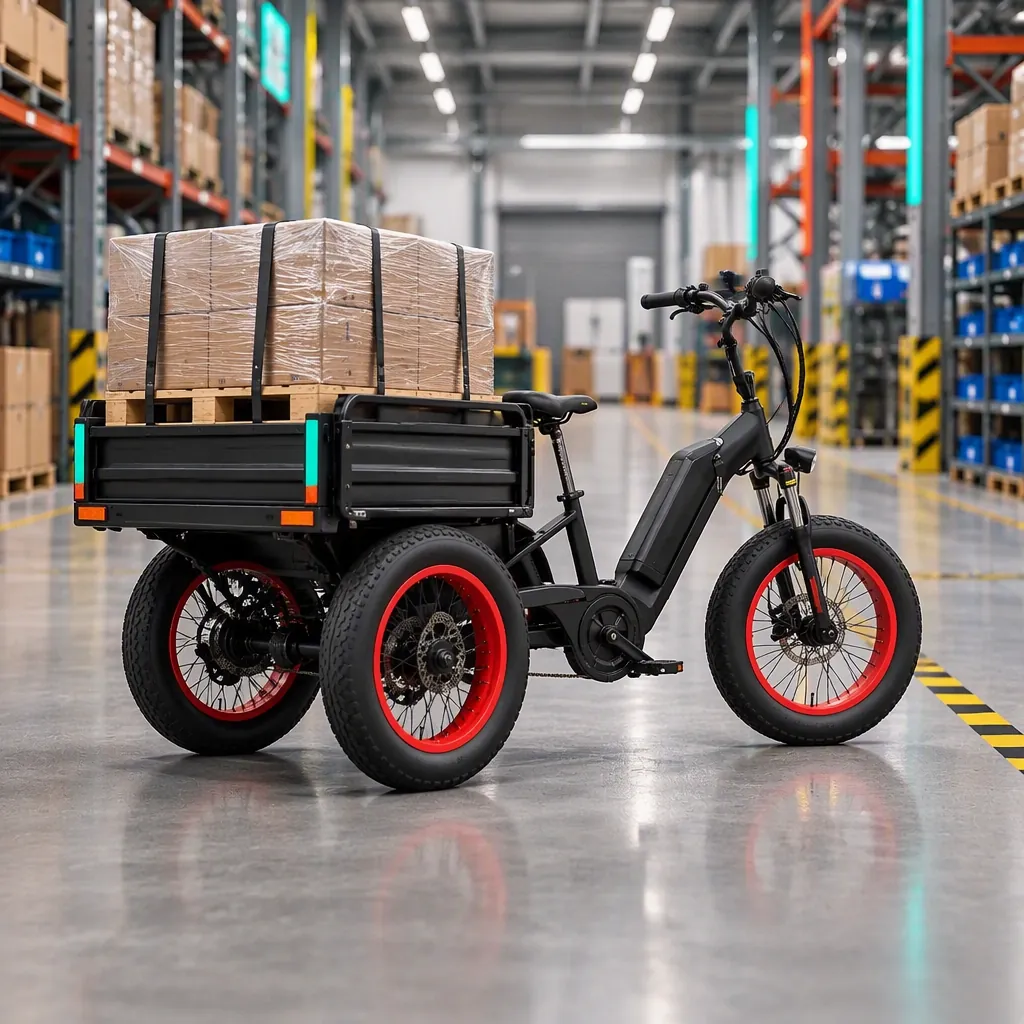
Why In-Plant Material Flow Is Not Last-Mile Delivery
The first mistake in spec a platform for a factory is to reuse the requirements of a delivery fleet. The two duty cycles look similar on a datasheet and are almost opposites in practice, and the difference decides the entire specification.
A last-mile delivery vehicle spends its day covering distance on public roads, braking and accelerating with traffic, and its range is the binding constraint. An in-plant vehicle covers very little distance — a large factory is often under two kilometres from end to end — but it performs a large number of discrete load & unload operations, repeatedly climbs the same ramp or dock plate, and passes through the same doorways hundreds of times per shift. Its binding constraints are manoeuvring envelope, stop-start duty on the drivetrain, and where it is stored and charged between shifts.
| Constraint | Last-mile delivery | In-plant material flow |
|---|---|---|
| Distance per shift | 60–100 km | Often under 15 km, many short legs |
| Binding limit | Range and public-road range anxiety | Aisle width, door width, ramp grade |
| Load events | 10–40 drops | 40–150 load/unload cycles |
| Surface | Public road, curbs, traffic | Sealed floor, dock plates, expansion joints |
| Operator | Road-legal rider, licence questions | Any trained staff member on site |
| Real cost driver | Battery capacity | Downtime per shift and turnaround at the dock |
That table changes the specification in a concrete way. A platform bought for in-plant work sized on delivery logic comes back with the largest battery in the catalogue and the longest wheelbase — and then gets stuck at the first narrow aisle or refuses to turn inside a cross-dock. The correct order of sizing is geometric first, then load, then electrical.
Start With the Constraints That Eliminate Platforms
Before comparing motors or battery chemistries, take four measurements. Each one independently disqualifies platforms, and each takes about ten minutes with a tape measure.
Aisle width and turning envelope
Measure the narrowest aisle the vehicle will regularly use, at racking height — not at floor level, where pallets often overhang. A three-wheeled platform tracks differently from a four-wheeled one: with a single front wheel it turns far tighter, but the rear end swings. For most industrial e-tricycle platforms, plan for roughly 1.6–1.9 m of clear aisle to pass and turn comfortably; below about 1.4 m you are into pedestrian-scale equipment and should be looking at a powered hand-cart instead. Measure the turn you actually have to make, not the aisle alone — a 2 m aisle that ends in a 90-degree corner into a 1.2 m doorway is a 1.2 m problem.
Door and gate clearances
The binding number is usually a personnel door or a fire-rated opening, not the main roller shutter. Note both width and height, and note whether the door has a threshold, a lip or a self-closing arm. Standard industrial tricycle platforms are built around a cargo box width in the 1.0–1.3 m region; if a regular route passes through anything narrower, either the route or the box changes, and the box is the cheaper thing to change.
Ramp and dock-plate grades
Grades are where payload claims and reality diverge. A platform rated for 500 kg on the flat will climb far less when the grade is steep, and the motor that is adequate on level concrete will thermally derate on a repeated 10–15% ramp. Measure the steepest grade on the regular route as a percentage, and treat anything above about 8% as a case for stepping up the motor tier rather than the battery. Dock plates and expansion joints also matter for a different reason: they are impact events, and they load the tyres, suspension and frame far harder than the payload number suggests.
Floor type and load rating
Most factory floors take this without comment, but mezzanine floors and older suspended slabs have point-load limits. A loaded platform concentrates its mass on three contact patches, so the relevant figure is the wheel load, not the vehicle weight — and the rear pair on a loaded tricycle carries the majority of it.
The Payload Envelope Your Loads Actually Set
Payload is not one number. It is a set of four, and the smallest one governs. Using the platform specification this factory builds to as the worked example:
| Envelope | Figure | What it governs |
|---|---|---|
| Rated load capacity | 300 kg (EU) / 500 kg (non-EU) | The legal and engineering ceiling of the platform |
| Range at load | 50–80 km at 200 kg, flat terrain | How many legs per charge — degrades fast above 200 kg |
| Box volume | 150–500 L, drop-sides | The bulky-but-light loads (packaging, plastics, foam) |
| Wheel and tyre rating | 3.00-12 front / 3.75-12 rear dual | Point loads at dock plates and expansion joints |
The practical method is to list the ten most common moves on the floor and record the weight and cube of each. Three patterns usually emerge, and they pull in different directions:
- Dense loads (castings, metal stock, full drums) hit the load-capacity ceiling long before they hit the box volume. These need the higher motor tier and the dual rear wheels, and they are the loads that punish a single-rear-wheel design.
- Bulky loads (packaging, empty totes, foam, insulation) hit volume first and weigh very little. These are the loads where a drop-side box earns its place, because a 400 L load of foam at 60 kg is a one-person job to handle but impossible to stack on a flatbed.
- Mixed loads are the majority in most plants, and they are why the drop-side box is the default specification rather than a flatbed or a fixed enclosure. A box with drop-sides carries a palletized dense load one trip and an awkward bulky load the next.
One caution on the payload number: capacity is an engineering limit of the whole vehicle — frame, axle set, brakes, tyres and motor together. It is not a licence to load to the limit on a steep ramp every trip. Build in headroom, and if the regular route includes a grade, treat the rating as the ceiling for the flat and derate from there.
Duty Cycle, Charging and Where the Vehicle Lives
An industrial platform is only as productive as its charging window. In-plant vehicles are unusually well suited to battery electric operation because their downtime is predictable: the vehicle is idle between shifts, and that is when it charges.
The arithmetic for a shift is straightforward. A platform using the 60V 32Ah pack with a 5A charger needs roughly 6–10 hours to come back to full. That fits an overnight window comfortably and does not fit a two-shift operation with a single vehicle — the second shift either needs its own vehicle, a swap pack, or a higher-current charger. Working out which of those three applies is the single most valuable calculation in the whole specification, and it is done before the order is placed, not after.
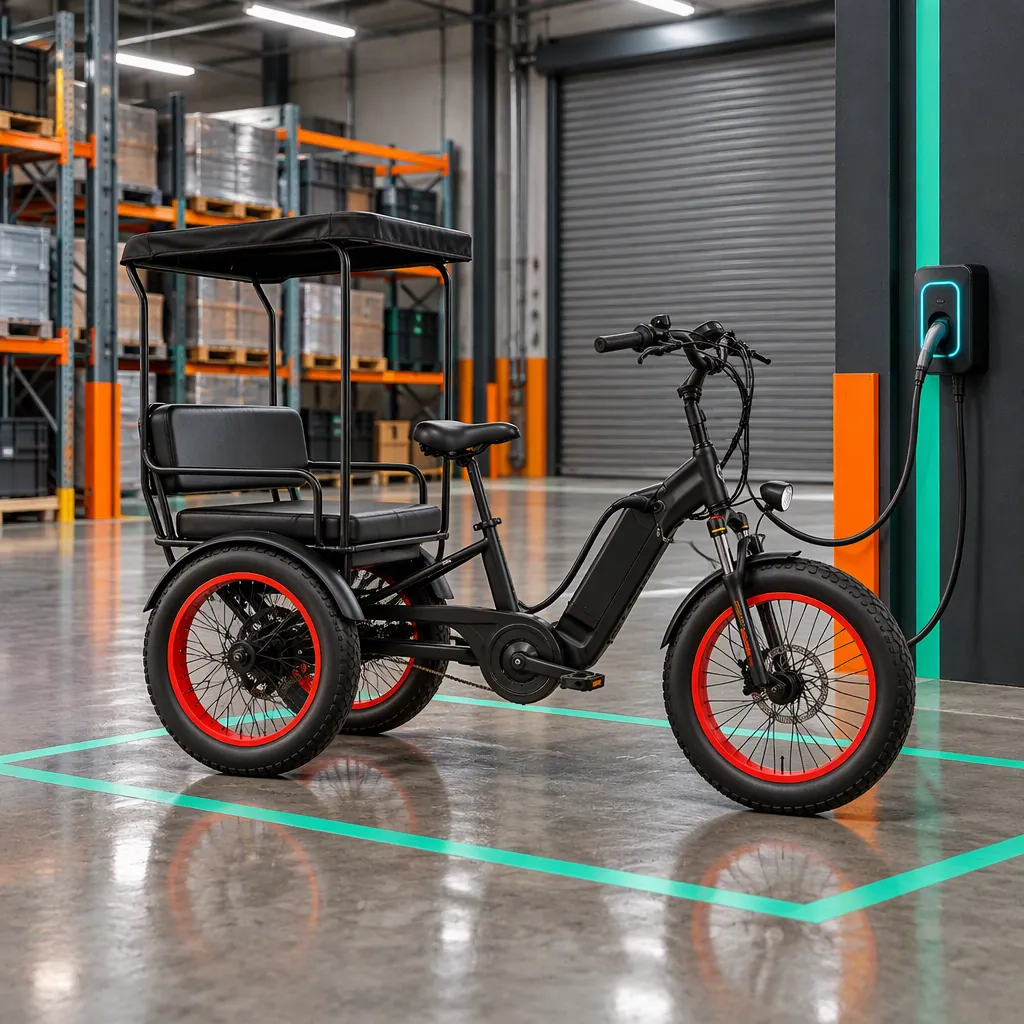
Two practical points follow. First, decide where the vehicle lives. A platform parked in a corridor is a platform that will be moved, and a moved platform is a platform that will be left unplugged. Give it a marked bay with a dedicated outlet, next to the area it serves. Second, note that charging is not the only energy input on the floor — solar top-up options exist on some platforms and add a useful few kilometres a day for vehicles that sit outside, but they are a supplement, not a substitute for a charging bay.
What the Platform Specification Should Cover
An industrial duty cycle is hard on a drivetrain in a specific way: constant stop-start with a full load, on a flat floor, with the motor at low speed and high torque for much of the day. That places particular demands on the parts that a road-oriented design would not stress.
| System | Specification to look for | Why it matters in-plant |
|---|---|---|
| Motor | 800W / 1000W / 1200W brushless hub with differential, 60V/72V | Torque at low speed, and a differential so the rear pair does not scrub on tight turns |
| Battery | 60V 32Ah / 72V 40Ah lithium, LFP available, heavy-duty BMS | Shift-length capacity; LFP for hot or high-cycle environments |
| Range | 50–80 km loaded at 200 kg, flat terrain | Far more than a shift needs — headroom is the point |
| Brakes | Hydraulic disc front + dual drum rear with parking brake | Parking brake is non-negotiable on any grade or dock |
| Frame | Steel tube chassis, e-coat + powder coat | Corrosion resistance in wash-down and humid areas |
| Cargo box | Aluminium or steel, drop-sides, 150–500 L | Mixed-load flexibility without a second vehicle |
| Speed governor | Settable at 25 / 35 / 40 km/h | Match site safety policy without buying a different platform |
Two specification choices deserve separate mention because they are routinely omitted in first-pass scoping. The differential matters more in a factory than on a road: without it, a loaded three-wheeled platform scrubs its rear tyres through every tight turn on a sealed floor, which shows up as tyre cost and as floor marking wear months later. And the settable speed governor is what allows one platform to be governed to walking pace in a shared pedestrian area and to a higher setting on a long perimeter route, with no change of hardware.
Safety, Visibility and Site Rules
A factory floor is a shared space with pedestrians, and an electric platform is quiet — which is the safety issue people underrate. Two requirements follow directly from that.
Visibility comes first. High-visibility colour options and decal panels exist for exactly this reason, and on a platform that shares space with pedestrians they are worth having even where not mandated. Full LED lighting, including a warning light option, matters most at aisle ends, door thresholds and blind corners. Second is institutional rather than technical: define the routes, define who may operate the vehicle, and define the pedestrian crossings. A platform governed to a low speed in a shared area solves most of the incident risk on its own, and it is a settings change rather than a purchase.
Note also what an industrial e-tricycle is not, from a compliance standpoint. It is not a road-registered vehicle, and it should not be treated as one in the specification. If a route crosses a public road, that is a separate conversation about legality and licensing, and it is worth having early — a platform bought for the plant floor may not be a platform that may legally cross the street.
Pilot Fleet: What to Order First and What to Ask For
The sensible first order for in-plant material flow is a pilot: two to four units on the routes that represent the hardest cases, not the easiest. Run them for a full month across shift changes, peak movements and wash-down cycles before committing to a fleet.
From a manufacturer, the terms worth confirming in writing are these:
- Pilot quantity and lead time. OEM orders typically start at 50 units per model with 15–30 days standard lead time — but first custom-branded runs run 30–45 days, and a single pilot unit is a different conversation. Establish which applies before planning the installation date.
- Pre-production samples. Confirm that a sample ships before mass production and that you sign off on the build that the sample represents.
- The documentation pack. Ask what test reports, declarations and supporting documents travel with the order. Battery transport documentation and cell and BMS records are the ones that cause delays at import if they are missing.
- Consumables and spares. Tyres and brake components are the in-plant wear items. Confirm the tyre specification that ships and that replacements are available in the same sizes — 3.00-12 front and 3.75-12 rear on this platform — rather than a comparable-looking substitute.
- Serviceability. Ask what a service visit covers and what the expected service interval is under a stop-start duty cycle, which is harder on brakes than road use.
Run the pilot against a baseline. Record the trips made, the time per trip, and the trips that had to fall back to the old method, and compare that to what the hand-cart or leased forklift was doing. That comparison — not a battery specification — is what carries the fleet decision through procurement. It also usually surfaces the real obstacle: it is rarely the vehicle, and usually a route, a doorway or a charging bay that needs ten minutes of work first.
For the surrounding decisions, the platform's payload engineering is covered in how payload capacity is actually determined, the specification-to-quote process in the cargo e-tricycle OEM guide, and the supplier verification checklist is worth reading before signing a fleet agreement. If the duty cycle includes repeated climbing or overload, steep-terrain and overload engineering covers the higher motor tiers, and the manufacturing process explains what the build quality checks actually test. Charging across several shifts is worked through in the fleet charging guide, and for speed-governor and site-rule questions the safety features guide is the companion read. Building-services and site-work applications follow similar loading logic to the construction site platform guide.
Send us the aisle, door and ramp measurements. We will tell you which platform fits.
Share your narrowest aisle, the door the route passes through and the steepest grade on it, plus the two or three heaviest loads you move in a shift. An export engineer will come back with the motor tier, battery configuration and box volume that suit the route — and say so honestly if a three-wheeled platform is the wrong answer for your floor.
