
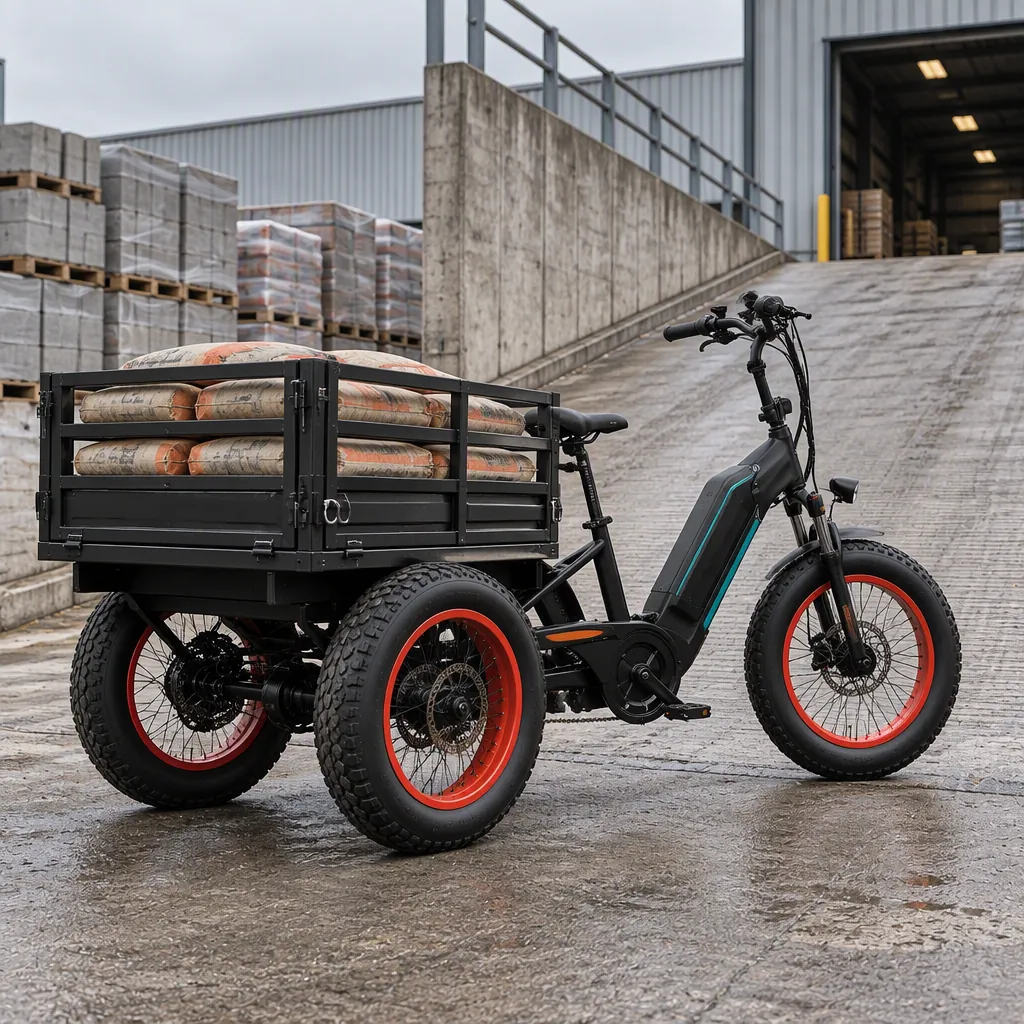
A cargo trike that performs perfectly on a flat distribution route can fail inside a month on a hillside quarry road or a mountain delivery round. The vehicle is the same class, the payload rating reads the same on paper, and yet one of them comes back with a cooked controller and a scored brake drum. That gap is not marketing — it is the difference between a payload rating measured on flat ground and a duty cycle that includes gradient, overload and heat.
This guide is written for the buyer specifying a heavy-duty cargo e-tricycle for genuinely hard work: steep terrain, sustained overload, or both. It covers what actually fails under those conditions, how the 1200W LFP platform differs from the standard 800W build, the gradient and axle limits that decide whether a route is feasible, and the exact line items to put in a heavy-duty RFQ. Every specification below is a real number from our Shenzhen production line, not a rounded marketing figure.
Why a Payload Rating Is Not a Duty-Cycle Rating
The first misunderstanding that produces failed fleets is treating the payload number as the whole specification. It is one output of a system, and under heavy duty three constraints bind simultaneously.
Gradient multiplies torque demand, not weight. Hauling 400 kg on the flat asks the motor for a certain torque. Hauling the same 400 kg up a sustained 12–15% incline asks for roughly two to three times that torque, sustained, because the motor must now also lift the mass against gravity. A drivetrain that sits comfortably inside its thermal envelope on flat ground can be running at its continuous limit on a hill, and thermal damage accumulates quietly over weeks.
Braking is the underrated heavy-duty failure. Everything a trike lifts up a hill it must also bring back down. A 400 kg payload descending a long gradient generates brake energy that no flat-route duty cycle prepares the system for. Drum brakes that are correctly specified for city delivery will glaze and fade on a sustained descent; this is why heavy-duty configurations move the front brake to hydraulic disc and keep the dual rear drums as a secondary system.
Heat is cumulative in a way buyers never see in a spec sheet. Controller and motor thermal derating is usually invisible in a short test ride. On a heavy-duty route, the derating shows up as a vehicle that loses power twenty minutes into a shift and recovers after a stop — a symptom operators often misdiagnose as a battery problem when it is a thermal one.
What the Heavy-Duty 1200W Platform Changes
Our cargo platform ships in three build tiers, and only the top tier is intended for sustained steep or overloaded work. The differences are not cosmetic.
| Specification | Light 800W | Standard 1000W | Heavy-Duty 1200W |
|---|---|---|---|
| Motor | 800W hub, 60V | 1000W hub, 60V | 1200W hub with hill-climb gearing, 72V |
| Battery | 60V 32Ah NMC | 60V 32Ah NMC | 72V 40Ah LFP |
| Range (loaded) | 50–60 km | 60–70 km | 70–80 km |
| Payload (EU / non-EU) | 300 / 500 kg | 300 / 500 kg | 300 / 500 kg |
| Cargo box volume | 150–300L | 200–400L | 300–500L |
| Vehicle weight | 150–180 kg | 170–200 kg | 190–220 kg |
| Brakes | Hydraulic disc front + dual drum rear | Hydraulic disc front + dual drum rear | Hydraulic disc front + dual drum rear, parking brake |
| Price (FOB) | $1,250–1,550 | $1,580–1,880 | $1,880–2,250 |
| MOQ | 50 units | 50 units | 50 units |
Two entries in that table deserve emphasis because they are the ones heavy-duty buyers skip.
The 72V step is the real threshold. The 800W and 1000W tiers run at 60V. The heavy-duty tier moves to 72V, and that is a system-level change rather than a battery swap: at the same current draw, 72V delivers proportionally more power, which is exactly what a hill-climb route needs. It also drops the current per phase for a given power level, and lower current means less resistive heating in the controller and wiring. On a sustained gradient that thermal difference is the difference between completing a shift and derating halfway through it.
LFP is the correct chemistry for hard duty, not just a longevity upgrade. The heavy-duty tier uses a 72V 40Ah LFP pack rather than NMC. LFP tolerates both thermal stress and deeper discharge cycles better — the practical consequences are a longer usable service life under daily heavy loads and a materially lower thermal risk in hot climates. For operators in tropical or desert markets pushing a loaded vehicle up gradients in ambient heat, LFP is the specification that keeps the pack inside its safe envelope.
Gradient: How to Work Out Whether a Route Is Feasible
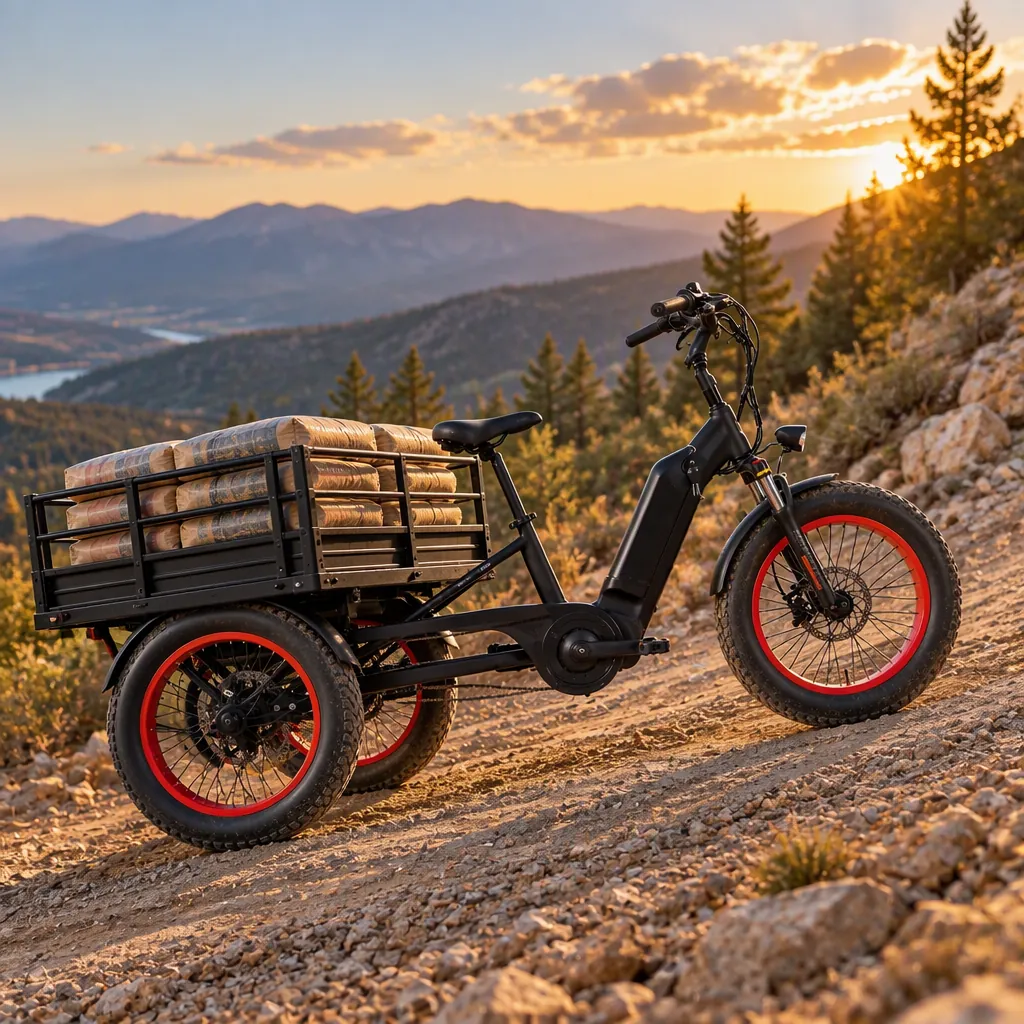
Buyers rarely ask the right feasibility question. They ask "what is the payload?" when they should be asking "at what gradient, over what distance, and for how long?"
The practical test is to characterise the worst sustained climb on the route, not the average. A route that is 90% flat with one 14% climb of 300 metres is a steep-terrain route, because that climb is the constraint that sizes every component in the drivetrain.
Three questions that settle it
First, what is the steepest sustained gradient on the loaded leg — measured over the whole climb, not sampled at the steepest metre. Second, how long does that climb last, because thermal limits are a function of duration and a 300 m climb and a 3 km climb are different problems even at the same gradient. Third, does the route descend the same gradient loaded, which determines the brake specification. A trike that climbs a hill empty and descends it loaded needs the braking side of the specification treated as seriously as the motor side.
Matching the build tier to the terrain
As a working rule, flat urban distribution under roughly 300 kg suits the 800W tier. Mixed terrain with moderate inclines suits 1000W. Any route with sustained gradients above roughly 10–12%, or sustained payloads at the top of the rating, belongs on the 1200W 72V LFP tier with hill-climb gearing. The cost difference between tiers is real but small against the cost of a fleet that cannot complete its route — the FOB spread across the three tiers is $1,250–1,550 up to $1,880–2,250, which is a fraction of one failed vehicle's replacement.
The Axle and Brake Limits That Fail First
Under heavy duty the drivetrain is rarely the first thing to break. The components that carry and stop the load are.
The rear axle is a system, not a bar. A heavy-duty cargo trike drives through a differential that splits torque to both rear wheels, and at 300–500 kg of payload the axle carries bending loads that a lightly-loaded trike never generates. The relevant specification details are the axle tube wall thickness, the bearing spec, and whether the differential is rated for the torque the motor can actually deliver at the wheel. Our platform pairs the 1200W motor with a differential as a matched unit rather than a general-purpose axle — on a hill-climb build that matching is not optional, because an axle rated below motor torque is a warranty claim waiting for its first steep grade. The differential and rear axle guide covers how the drive unit carries payload, and the suspension guide covers the load path that protects it.
Load-rated tires are part of the structure. The heavy-duty platform runs a 3.00-12 front tire and 3.75-12 dual rear tires, and those are specified as load-rated rather than merely sized to fit. A tire operating at the top of its load index on a hot road surface is a blowout risk, and on a trike a rear blowout under a full box is a stability event, not a roadside inconvenience. Dual rear wheels are also what let the platform carry a wide, heavy box without the single rear wheel becoming the load-concentration point.
Braking must be sized for the descent. The platform's hydraulic disc front plus dual drum rear arrangement with a parking brake is the configuration we specify for loaded work. The parking brake matters more than buyers expect on a heavy-duty route: a trike parked loaded on an incline without an independent parking brake is a runaway vehicle, and that is a site safety issue as well as a product liability one.
Overload: Margin, Not Just Rating
Heavy-duty fleets overload. Not recklessly — but route reality pushes vehicles past the intended figure regularly, and the specification question is how a build behaves when it happens.
The published rating is 300 kg for EU-spec and 500 kg for non-EU configurations, with box volume from 150 to 500 litres. Those are engineering limits of the chassis, axle and brake package taken together, not a marketing target. What heavy-duty buyers should specify is margin behaviour: how the vehicle responds in the 10–20% band above the intended working load. A build that merely meets the rating has none; a build specified with the 1200W 72V drivetrain on the same 300/500 kg chassis has both the torque to move a temporarily overloaded vehicle and the thermal headroom to do it without derating.
This is where the payload rating and the duty-cycle rating visibly diverge. Two trikes can both be rated 500 kg while only one has the motor, controller, axle and brake package to sustain that load up a gradient for a full shift. The payload capacity guide breaks down the four separate limits — tire, brake, frame and motor — that combine into a rating, and why the lowest of the four governs.
What to specify as overload protection
Three items are worth writing into a heavy-duty order. A load indicator on the LCD display, which our platform includes as standard, gives the operator a real-time reading rather than a guess. A thermal-aware controller with documented derating behaviour protects the motor instead of letting it cook. And a reinforced cargo subframe with verified weld integrity on the box mounting points, since the subframe is where an overloaded box translates load into the chassis. Every unit we ship goes through a per-vehicle inspection covering weld integrity on the cargo subframe, torque verification on all chassis fasteners, and a loaded road test with ballast to confirm brake balance and motor thermal behaviour under realistic duty cycles.
Battery and Charging on a Heavy-Duty Route
The heavy-duty platform's 72V 40Ah pack gives 70–80 km loaded, and charging runs 6–10 hours on the supplied 5A charger. On a hard route both numbers need interpreting rather than reading literally.
The recovered range figure is quoted loaded at 200 kg on flat terrain. A route that climbs sustained gradients under a heavier payload will consume energy faster, and the honest way to plan is to treat gradient work as a multiplier on consumption rather than assuming the published figure. Operators running genuinely steep routes should size their daily range expectations against the climb content of the route, and use the 60V versus 72V comparison to understand what the voltage step does to available power before committing to a fleet size.
For multi-shift heavy-duty operations the charging arithmetic becomes a fleet design problem rather than a vehicle one: a 6–10 hour charge against a shift structure dictates how many packs and chargers each vehicle needs. Our fleet charging guide works through the depot power calculation, and if the route involves cold conditions the winter operations guide covers how low temperature changes both available capacity and charging behaviour.
OEM Options That Matter for Heavy-Duty Builds
Beyond the standard configuration, four customisation options are the ones heavy-duty buyers actually order.
LFP chemistry in place of NMC, which we recommend as the default for tropical, desert or otherwise high-ambient-temperature markets where thermal stability and cycle life matter more than energy density per kilogram.
Motor power and hill-climb gearing scaled to the route, from 800W on flat urban distribution through to 1200W with gearing for cities or sites built on steep terrain.
Reinforced box construction in the material that matches the duty — welded aluminium sheet for corrosion resistance and weight saving, galvanized steel for impact-heavy cycles, or insulated sandwich panel for cold-chain work. Box configuration ranges from a fixed flatbed with stake sides to a three-way drop-side body that converts to a flatbed in seconds, and a hydraulic tipper for loose material.
Fleet safety and tracking hardware, including GPS tracker integration with geofencing, a reverse alarm for site safety compliance, and a solar roof panel that trickle-charges the auxiliary battery for an additional 8–12 km of daily range.
Compliance on Steep-Terrain and Heavy-Duty Orders
Heavy-duty cargo configurations sit close to the boundary between light electric vehicle and commercial vehicle regulation in several markets, so compliance should be planned per market rather than assumed.
Our standard package covers CE marking across the full electrical system including the motor controller, RoHS documentation mapping electronics to compliant material declarations, UN 38.3 testing for the battery pack, and ECE R10 electromagnetic compatibility planning. That last item carries more weight on heavy-duty configurations than buyers expect: cargo tricycles straddle commercial vehicle regulation in many jurisdictions, and ECE R10 is the EMC standard applied to four-wheeled commercial vehicles, satisfying the radiated and conducted emissions expectations that customs authorities in the EU, GCC and ASEAN regions increasingly enforce on electric cargo carriers.
UN 38.3 testing deserves particular attention on the heavy-duty tier because the 72V 40Ah pack stores considerably more energy than a passenger or light-cargo pack, and the crush and impact tests are where that difference matters. If your market applies type approval to three-wheeled commercial vehicles, raise it at enquiry stage so the build is planned against the right framework from the start rather than retrofitted afterwards. Our EU versus US certification guide and the insurance and registration guide cover the market-by-market position for three-wheeled platforms.
Specifying a Heavy-Duty Cargo E-Tricycle: The RFQ Checklist
Fill these in before requesting a quote. A supplier who cannot answer the gradient and thermal questions is not building hill-climb vehicles.
- Steepest sustained gradient on the loaded leg, as a percentage, with climb length in metres.
- Descent profile for the same leg, loaded — this sizes the brake specification.
- Intended working payload and the realistic overload band, not just the rating you hope to observe.
- Route length and shift structure, so range and charging design are sized together.
- Ambient temperature range, which decides NMC versus LFP.
- Cargo type and box configuration — flatbed, drop-side, tipper, insulated, with volume in litres.
- Market and regulatory framework, so certification is planned rather than discovered.
- Fleet size and delivery schedule, against the 50-unit MOQ and the 15–30 day standard lead time.
Orders start at 50 units per model, with a 15–30 day standard lead time and 30–45 days for a first custom-branded run, and pre-production samples ship before mass production so the build can be validated on your own route. The compliance package includes cell, BMS and test-report documentation in the export file, and gradient, thermal and overload questions are answered by an export engineer on one call — no obligation.
The Short Version
Heavy-duty cargo trike selection comes down to four decisions. Match the drivetrain tier to the gradient, not to the payload number alone — sustained climbs above roughly 10–12% belong on the 1200W 72V LFP build. Specify LFP chemistry if the vehicle works in heat. Treat the axle, load-rated tires and brakes as the primary heavy-duty components, because they fail before the motor does under a full box on a descent. And buy margin rather than a bare rating, because routes overload vehicles and the builds that survive the practice are the ones with torque and thermal headroom to spare.
Spec a Heavy-Duty Cargo Trike
Tell us the steepest sustained gradient on your route, the working payload and overload band, your ambient temperature range and your market. We will quote the matching build tier — up to the 1200W 72V LFP platform with hill-climb gearing — plus the certification file for your market. FOB China, MOQ 50 units, 15–30 day lead time.
