
Electric scooters are the highest-volume product in the personal mobility export business, roughly 6.5 million units shipped worldwide in 2025, with the EU, US, and Southeast Asia absorbing most of the volume. They are also the category where importer margins get destroyed fastest, because the spec sheet hides the component decisions that separate a 300-cycle scooter from a 1,500-cycle one. This guide breaks the category into the three segments buyers actually order, foldable commuter, performance dual-motor, and off-road, and gives you the specification ranges, compliance requirements, and factory checkpoints that matter when sourcing from a Chinese manufacturer.
The Three E-Scooter Segments Buyers Actually Order
Most OEM RFQs for scooters fall into one of three segments, and the differences between them are not cosmetic. The foldable commuter segment competes on weight, folded size, and price; the performance segment competes on power, speed, and battery; the off-road segment competes on suspension, tire, and frame strength. Trying to build one platform that serves all three usually produces a scooter that wins none of them, so your first decision is which segment your brand distribution channel can defend. The table below is the reference range EMS-EBIKE uses when a buyer sends an RFQ without a full spec:
| Spec | Foldable Commuter | Performance Dual-Motor | Off-Road |
|---|---|---|---|
| Motor | 250–350W front hub | 2 × 500–1000W hub | 500–1000W hub, high torque |
| Battery | 36V 7.5–10.4Ah (270–374Wh) | 48V 15–21Ah (720–1008Wh) | 48V 15–18Ah (720–864Wh) |
| Top speed | 20–25 km/h | 45–80 km/h | 35–55 km/h |
| Weight | 11–14 kg | 25–38 kg | 28–40 kg |
| Tires | 8.5–10" solid or pneumatic | 10–11" pneumatic | 10–11" knobby, tubeless |
| Key standard | EN 17128 / UL 2272 | UL 2272, eMark if >25 km/h | UL 2272, eMark |
One market note before the segment details: the EU treats scooters above 25 km/h or 250W as L1e vehicles, which changes homologation, insurance, and helmet rules. If your target market is the EU and you want to avoid the L1e path entirely, you are designing a 250W scooter capped at 25 km/h. If you accept L1e homologation (eMark), the performance ceiling disappears. That single decision shapes every component below.
Foldable Commuter Scooters: Specs That Define the Class
The commuter segment is a weight and price war, but the buyers who come back for repeat orders are the ones who specified correctly the first time. The four specs that determine success:
- Folded size and weight . The class benchmark is a sub-13 kg scooter that folds to roughly 105 × 40 × 45 cm (fits under a train seat or beside a desk). Above 14 kg, the "last mile" story collapses. Achieving this requires a 6061 aluminum frame, a 250–350W motor, and a 36V pack with 18650 cells rather than cheaper prismatic cells.
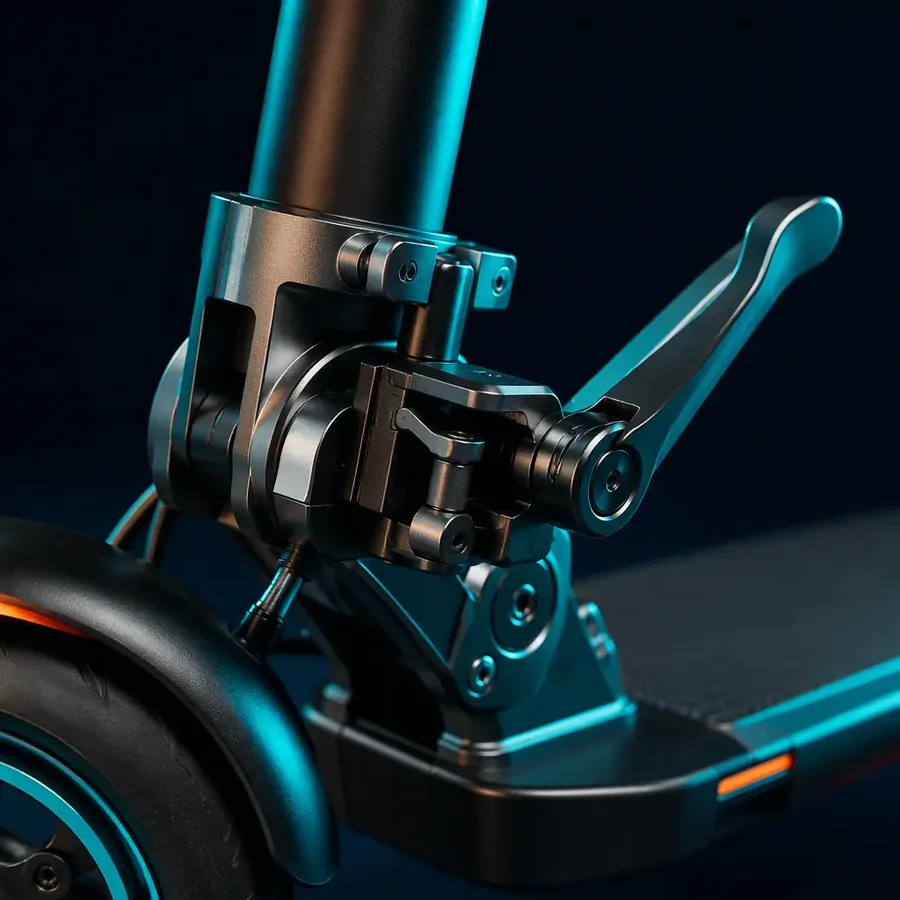
- Folding mechanism . The hinge is the highest-failure component in the segment. Specify a double-latched hinge (primary latch + safety catch) and test it to 10,000+ folding cycles. Hinges that fail in month three are the #1 source of warranty claims and bad reviews.
- Tires . Solid tires eliminate flats but transmit vibration; pneumatic tires ride better but need tubes. The current sweet spot is an 8.5–10" pneumatic tire with a puncture-resistant liner. For rental and sharing applications, solid or honeycomb tires win on maintenance despite the ride penalty.
- Braking . A rear drum brake plus front electronic brake (E-ABS) is the minimum for 25 km/h. Disc brakes appear on higher-end commuters but add weight; the electronic brake regenerates a small amount of charge and extends pad life.
Battery sizing for commuters is straightforward: a 36V 10.4Ah (374Wh) pack delivers 25–35 km of real range for a 70 kg rider in mixed city riding. If your buyer wants 40+ km advertised range, you are either moving to a 36V 13Ah pack or accepting that the advertised number will be challenged in reviews. The chemistry and BMS decisions: including why EMS-EBIKE defaults to NMC with a low-temperature charge cutoff for northern European orders, are covered in our e-bike battery technology guide.
Performance Dual-Motor Scooters: Power and Battery Math
The performance segment is where dual-motor architecture earns its keep. Two 500W motors produce roughly 1,400–1,600W of combined peak power and, critically, distribute it across both wheels, which changes hill climbing from a stall risk to a non-event. The segment's real numbers:
- Hill performance . A dual 500W scooter holds 30–35 km/h up a 10% grade with an 80 kg rider; a single 500W scooter drops to 18–22 km/h on the same hill. This is the spec that decides buyer satisfaction in hilly cities (San Francisco, Lisbon, Medellin).
- Battery demand . Sustained high discharge means the pack must be rated for continuous 30–40A draw. A 48V 20Ah pack with high-drain cells (Samsung 50E or equivalent) handles this; a pack built with standard 18650s will sag, trigger low-voltage cutoff on hills, and age fast.
- Speed and legality, 45–80 km/h scooters are L1e territory almost everywhere. For the US market, many importers ship a 25 km/h "commuter mode" as the default firmware with an unlockable performance mode, and rely on UL 2272 certification for retail shelf access. The compliance trade-offs between the EU and US systems are detailed in our EN 15194 vs UL 2849 certification guide.
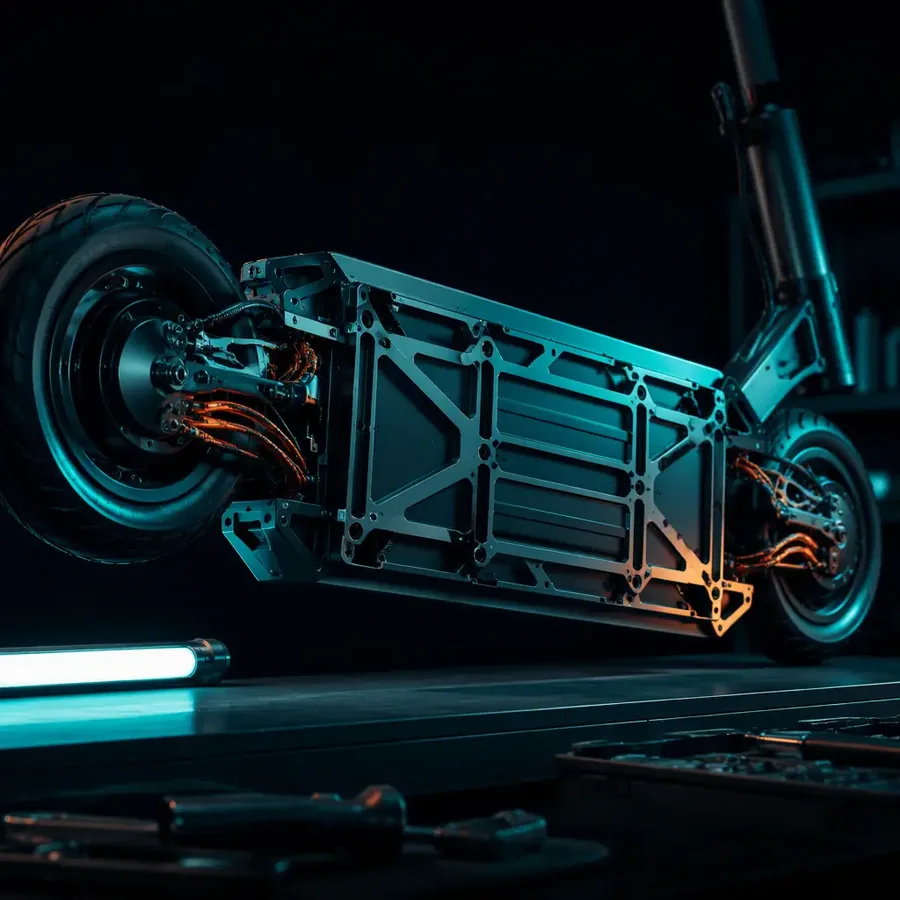
Thermal management separates good performance scooters from bad ones. Dual motors at sustained load generate serious heat; specify motors with aluminum housings and hall-sensor temperature monitoring that derates power at 100–110°C core temperature. Without thermal limiting, a summer hill climb can demagnetize rotor magnets permanently. A failure mode that shows up as sudden power loss at 6–8 months, long after the factory warranty conversation has ended. Motor architecture and its maintenance cost differences are covered in our hub motor vs mid-drive comparison.
Off-Road Scooters: Suspension and Tire Engineering
The off-road segment is smaller but sticky: buyers are enthusiasts who pay for components, and the category has far less price pressure than commuters. The engineering requirements are specific:
- Suspension. 90–120 mm of travel is the functional minimum for trail use. Fork designs vary: dual spring forks, single-sided with linkage, or hydraulic. For OEM programs, specify a fork with adjustable preload. Riders differ by 40 kg and a fixed fork is wrong for half of them.
- Tires, 10–11" knobby tires with reinforced sidewalls, tubeless-ready rims. Tubeless with sealant is not optional for off-road: a sidewall cut on a tubed tire strands the rider; with tubeless it self-seals.
- Frame strength . The deck and stem take repeated landing loads. Specify 6061 aluminum with a reinforced stem weld and test to the standard the buyer's market requires (many US retailers now require UL 2272 for any scooter they stock, off-road included).
- IP rating . Off-road means mud and water. Specify IP54 minimum for the deck electronics and a sealed battery compartment; connector corrosion is the segment's most common premature failure.
Off-road scooters share their component strategy with fat-tire e-bikes, high torque at low speed, strong wheels, aggressive tires. If your brand is already in the fat-tire e-bike segment, the fat-tire OEM guide walks through the parallel spec decisions (torque, wheel build, and brake sizing) that apply almost unchanged.
Component Quality: Where Cheap Scooters Fail
Every importer knows the retail price gap between a $299 scooter and a $899 scooter. The component differences behind that gap, in order of how quickly they fail:
- Controller . Cheap controllers use undersized MOSFETs and no thermal protection; they fail as sudden power loss at 4–8 months. Specify a controller with current limiting rated 1.5x the motor's continuous draw.
- Battery cells . The single biggest cost lever. Name-brand cells (Samsung, LG, Panasonic) versus generic cells is a 15–25% pack cost difference and a 3–4x cycle-life difference. If your retail warranty is 12 months, generic cells will cost you in claims.
- Charger . A genuine 2A smart charger with CC/CV profile protects the pack; a $3 charger without proper termination overcharges and is the leading cause of pack swelling. Specify the charger brand in your RFQ, not just the connector.
- Bearings and bolts . Wheel bearings and folding-hinge bolts are the unglamorous parts that determine whether a scooter is quiet at month 12. Specify sealed bearings and zinc-plated or stainless hardware.
Quality control on these components is where a factory's process matters more than its brochures. EMS-EBIKE runs every scooter through a 7-point functional test, motor draw, brake function, folding latch, controller communication, charger profile, battery voltage balance, and a 200 m road test, before packing, with AQL 2.5 sampling on top. The full QC and inspection framework, including third-party inspection scheduling, is in our OEM e-bike buying guide.
Compliance: UL 2272, EN 17128, and Battery Rules
Scooter compliance is a different map than e-bike compliance, and getting it wrong blocks retail distribution. The three layers:
- UL 2272 (US) . The electrical system standard for personal e-mobility devices. It covers the battery, BMS, controller, and wiring as a system, with abuse testing (overcharge, crush, thermal). It is effectively a precondition for US retail and for most US city sharing permits. Certification adds roughly $10–20 per unit and 6–10 weeks to the first-order timeline.
- EN 17128 (EU) . The PLEV standard covering safety requirements and test methods for e-scooters up to 25 km/h. It is the documentation path for the commuter segment; faster scooters need L1e homologation with eMark instead.
- UN 38.3 + transport rules . Every lithium pack crossing a border needs UN 38.3. A 48V 20Ah (960Wh) pack ships by sea as Class 9 DG; air freight of packs above 100Wh requires IATA DGR approval, which is expensive enough that most scooter importers ship by sea. This is a cost line many first-time buyers forget, plan it into your landed-cost model.
For fleet buyers, compliance stacks differently: UL 2272 or EN 17128 per vehicle, plus local operating permits and insurance per city. The procurement framework for 1,000+ unit deployments, utilization math, swappable battery logistics, telematics, is in our shared e-scooter fleet guide.
OEM Sourcing Checklist for Electric Scooters
When you send the RFQ, the factory should receive a specification that locks down every variable above. A complete scooter order spec looks like this:
- Segment: foldable commuter / performance dual-motor / off-road (pick one per SKU)
- Frame: 6061 aluminum, 11–14 kg target weight, double-latched folding hinge tested to 10,000 cycles
- Motor: 250–350W (commuter) or 2 × 500–1000W (performance), aluminum housing, thermal derating above 100°C
- Battery: 36V 10.4Ah or 48V 20Ah, name-brand cells, BMS with low-temperature charge cutoff, IP54 compartment
- Tires: pneumatic with puncture liner (commuter) or tubeless knobby (off-road), reinforced sidewalls
- Brakes: rear drum + front E-ABS minimum; hydraulic disc for off-road
- Compliance: UL 2272 for US, EN 17128 (or L1e eMark) for EU, UN 38.3 for all packs
- MOQ: 50 units catalog, 100 units custom color, 500 units custom tooling
At EMS-EBIKE, scooters run on the same lines as our e-bikes and e-tricycles, 4 parallel assembly lines under one quality chain. Standard lead time is 15–30 days after deposit for catalog models, 30–45 days for first OEM orders with custom paint. If you are also planning an e-bike line alongside the scooters, the motor power class decision, 250W for the EU, 750W for the US, is covered in our e-bike motor power guide, so you can spec both categories in one visit.
Get Scooter Specs and Pricing for Your Market
Tell us your target segment (foldable, performance, or off-road), target market, and volume. We will recommend the motor, battery, and compliance package, with UL 2272 or EN 17128 documentation for your region. First sample within 15 days for custom builds.
