
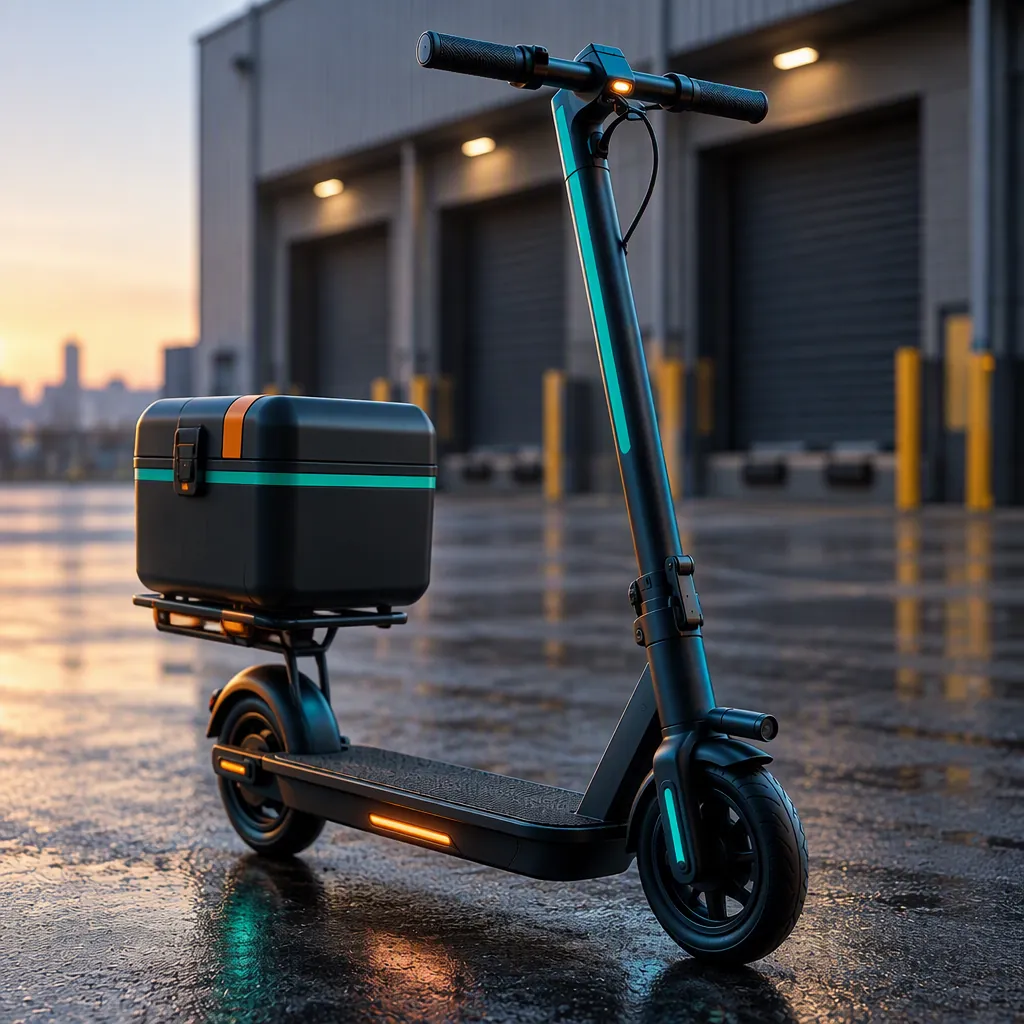
A delivery rider on a consumer e-scooter finishes a real shift with a cracked steering column, two dead batteries and a brake lever that no longer returns. That is not a maintenance problem — it is a procurement problem. Meal, parcel and grocery fleets put their vehicles through duty cycles that retail-spec machines were never designed to survive, and the failure always shows up after the warranty conversation has already gone badly.
This guide is written for the operator or distributor sourcing a delivery scooter fleet. It covers the four duty-cycle classes fleets actually run, the platform specs that map to each, the swappable-battery arithmetic that decides whether a shift is profitable, and the frame and electrical standards that insurers and road authorities check. Every specification below is a real platform number from our Shenzhen factory, not a marketing range.
Why Retail E-Scooters Fail in Delivery Duty
The gap between a commuter scooter and a delivery scooter is not a matter of degree. It is a different set of design constraints, and four of them dominate.
Shift distance. A commuter rides 4–8 km each way. A delivery rider covers 80–120 km per shift across the same operating day. A consumer scooter rated for 20–40 km does not merely fall short — it forces one or two mid-shift charging stops, and every charging stop is unpaid idle time against a delivery margin that is already thin.
Frame fatigue. The steering column and head tube take the worst of it. Under daily curb drops, pothole strikes and kerb-hopping with a loaded cargo box, standard welds develop stress cracks within months. Fleet-grade builds reinforce all six primary stress points, use sealed bearings throughout, and specify corrosion-resistant fasteners rather than plated ones.
Rider weight plus cargo. A delivery rider is typically heavier than the average commuter and carries a loaded box on the rear rack or between the legs. Platform load ratings that look generous at 120 kg turn into a marginal 90 kg of usable margin once rider, cargo box, insulated liner and spares are counted.
All-weather exposure. Delivery does not stop for rain. Water ingress into the controller and battery compartment is the single most common electrical failure in delivery scooter fleets, and it is a specification decision made at purchase, not a maintenance decision made later.
The Four Delivery Fleet Duty-Cycle Classes
Fleets that buy badly usually buy one scooter model for four different jobs. These are the four classes that matter, and what each actually requires.
Class 1: High-frequency food and grocery (urban core, 2–3 km radius)
Short hops, dense stops, constant mount and dismount, 12–40 stops per shift. Total distance is modest but the stop count is punishing on brakes, kickstands and deck grip. Priority is brake durability and low step-through height, not maximum battery capacity. Rear disc plus front electronic ABS is the appropriate brake configuration here; solid honeycomb or foam-filled tires eliminate punctures, which are a disproportionate downtime cause on a stop-dense route.
Class 2: Parcel and courier (urban to inner-suburban, 5–15 km radius)
Mixed distance with a heavier, bulkier load and more time at speed. The dominant constraint is cargo volume and mounting rigidity — a parcel box that shifts under braking destabilises the whole vehicle. Look for a reinforced rear rack rated to the loaded box weight, and a chassis with enough torsional stiffness that the front wheel does not wander when the box is loaded unevenly.
Class 3: Long-range suburban delivery (20–40 km radius)
This is the class that most often gets mis-specified. A rider covering 80–120 km in a shift cannot do it on one charge from a consumer pack. Either the fleet accepts a mid-shift charge rotation or it buys swappable batteries. For most operators running suburbs, swap is the cheaper solution than a larger single pack, because the second pack is charged on depot power while the vehicle stays earning.
Class 4: Off-road, campus and industrial-site delivery
Gravel yards, unpaved service roads, warehouse aprons and campus paths. Stability on loose surfaces is the whole problem, and that is a suspension and tire question. Recommended platform is the dual-motor off-road configuration with dual suspension and deep-tread pneumatic tires; single-motor builds lose traction under load on gravel at the first sign of a gradient.
Platform Specs That Map to Delivery Duty
These are the numbers we quote on fleet enquiries. Match the class above to the row below rather than trying to buy one model for everything.
| Platform | Motor | Battery | Range | Payload | Best fleet duty |
|---|---|---|---|---|---|
| City Scooter | 250W / 350W / 500W hub | 36V 10Ah / 36V 13Ah / 48V 10Ah, removable deck pack | 20–40 km (ECO, 75 kg rider) | 100–120 kg | Class 1 food and grocery, dense urban stops |
| Foldable Scooter | 250W / 350W front hub | 36V 7.5Ah / 36V 10Ah | 15–30 km | 100 kg | Multimodal courier legs, car-boot last mile |
| Off-Road Scooter | 1000W single / 1000W+1000W dual (AWD) | 48V 18Ah / 60V 20Ah | 45–65 km (ECO, varied terrain) | 120–150 kg | Class 4 campus, yard and unpaved routes |
| Performance Scooter | 2000W+ dual motor | 60–72V 30Ah | 70–100 km | Moped-class fleet duty | Class 3 long-range suburban, moped replacement |
For reference on the tricycle side of the same problem — where payload runs to 300 kg and above on a fixed route — our cargo delivery fleet guide covers the three-wheel platform economics, and the cargo versus passenger platform comparison explains when a trike beats a two-wheeler outright.
Battery Strategy: Why Swap Beats a Bigger Pack
The battery decision is the single largest line in delivery fleet total cost of ownership, and fleets routinely get it backwards by buying the largest single pack available.
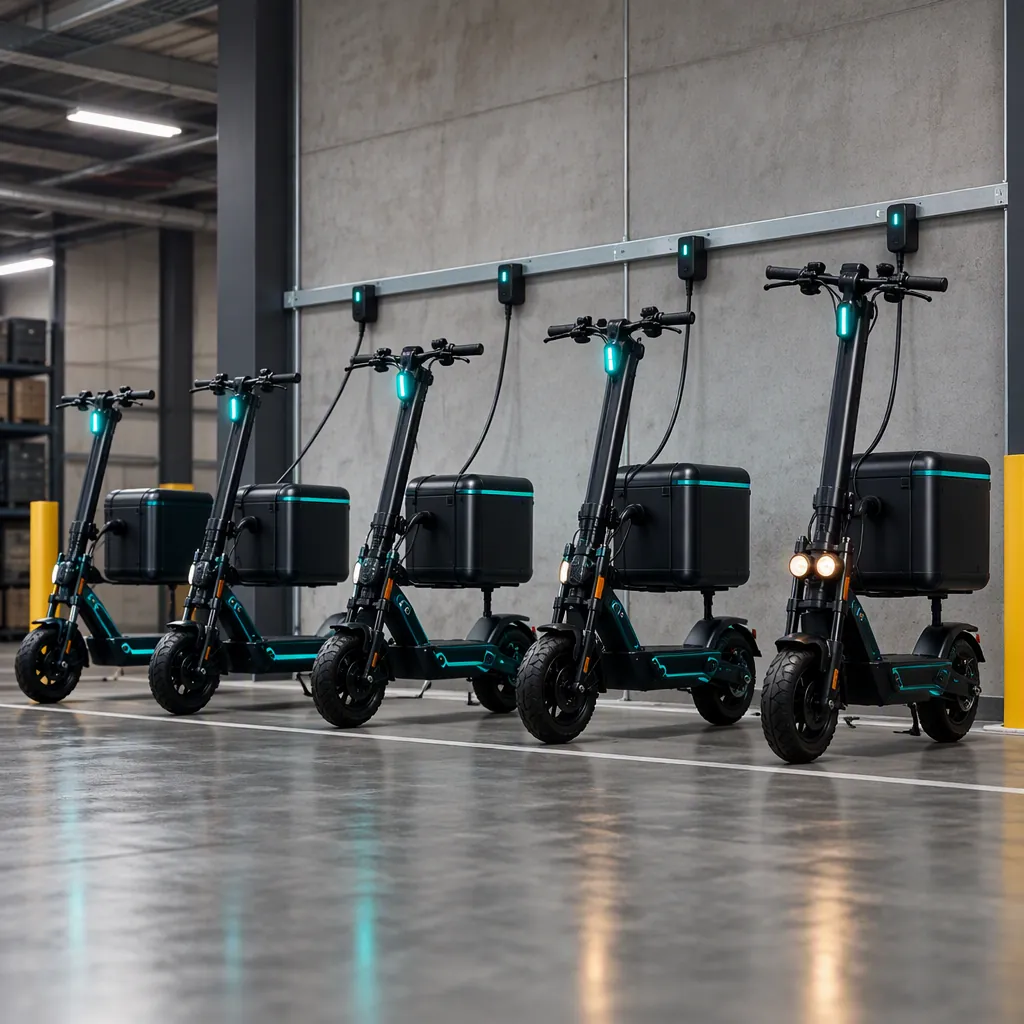
The arithmetic that matters is not watt-hours. It is minutes of vehicle downtime per shift. A 48V 10Ah pack charges in 4–6 hours on a standard 2A charger. Whichever way the fleet structures that, the vehicle is stationary for some part of it. Swappable architecture converts that downtime into a depot-side activity: the rider arrives, exchanges the pack in under a minute, and leaves with a full charge.
What a swap-ready specification requires
Three things must be specified at order, because none of them can be retrofitted cheaply. First, a removable pack with a quick-release rail rather than a sealed integrated battery — the City Scooter platform uses a removable deck pack for exactly this reason, while the Foldable platform houses the pack in the downtube or deck. Second, a connector rated for repeated mating cycles, because a connector that is fine when mated twice a year will not survive twice a day. Third, the BMS must support Depot charging so that multiple packs can be charged simultaneously without individual supervision.
Charger count is the real depot constraint
Fleets that buy swap-capable vehicles and then discover the depot cannot charge the packs have bought nothing. Work out the charger count from shift structure first: a 4–4–4 three-shift rotation needs three packs per vehicle and enough chargers to replenish all three inside the longest shift window. Our fleet charging guide works through the power math and the depot capacity calculation in detail.
Frame, Electrical and Compliance Standards for Delivery Fleets
These standards are not optional extras. Insurers reference them, road authorities check them, and they determine whether the fleet is insurable at commercial rates at all.
- EN 17128 — the European standard for personal light electric vehicles, covering electrical safety, construction and test methods. This is the baseline for EU street legality on scooter platforms.
- UL 2272 — the North American electrical systems safety standard for e-mobility devices, covering the battery and charging system as a unit. Required for US insurance and increasingly for marketplace and fleet contracts.
- EN 15194 — the e-bike equivalent, relevant where the fleet runs 250W pedal-assist cargo bikes rather than throttle scooters, and the standard fleet insurers reference for commercial cargo bike underwriting.
- UN 38.3 — lithium battery transport testing, required for compliant shipping of packs and spares. Every order we ship carries cell, BMS and test-report documents in the export file.
- ECE R100 — battery system certification against overcharge, short circuit, thermal runaway and vibration, and the relevant standard for vehicles operating at 60V and above.
- IP65 on the motor, controller and battery compartment — withstands low-pressure water jets from any direction. This is the specification line that separates an all-weather delivery vehicle from a fair-weather one.
- DOT-compliant reflectors and lighting — satisfies road-registration requirements across North America and is a prerequisite for night-shift legality.
The compliance file is assembled per order with your company as the responsible party, which matters when a fleet insurer asks for documentation naming the operator rather than the factory. Our EU versus US certification guide compares the two regulatory paths requirement by requirement, and the insurance and registration guide covers what underwriters actually ask for on fleet policies.
Telemetry, Security and the Operational Stack
Fleet scooters spend their lives parked in public space, which makes them a materially different security problem from a consumer vehicle kept indoors overnight.
Standard consumer scooters use Phillips-head and hex fasteners that any rider can remove with off-the-shelf tools. Fleet-grade builds require tamper-proof Torx security screws, pin-lock axles and a welded-on telematics module that disables the motor if the tracker is removed. Without the welded-on specification, a stolen vehicle is worth more in parts than the tracking subscription is worth in recoveries.
On the software side, specify Bluetooth connectivity with a white-label app rather than a consumer app. The distinction is who controls the fleet data. A white-label app supports ride tracking, per-vehicle speed locking, OTA firmware updates, geofencing and anti-theft alerts under the operator's brand. Speed locking in particular is what lets one fleet serve multiple markets with the same hardware: 250W firmware-locked for EU EN 17128 compliance, 350W mid-tier, or 500W peak for markets without wattage caps.
Two further specification items that only show up after deployment. First, key management — a fleet needs key-alike or badge-based access, not one physical key per vehicle, or the dispatch desk becomes the bottleneck. Second, residual and warranty terms on a fleet scale, which our after-sales and spare parts guide covers alongside the wear-item stocking list every depot should hold.
Total Cost of Ownership: The Lines Fleets Forget
Purchase price is the smallest part of the comparison against a petrol moped or a van. The lines that decide the outcome are the ones that do not appear on the invoice.
| Cost line | Petrol moped | Delivery e-scooter fleet |
|---|---|---|
| Energy per 100 km | Litres of fuel per 100 km at pump price | A small fraction of the petrol figure on depot electricity |
| City access | Congestion and low-emission zone charges where applicable | Zero charge, standard cycle parking |
| Scheduled service | Oil, plugs, filters, belt and clutch wear | Brake pads, tires, bearings — no combustion service items |
| Rider requirement | Licence and endorsement in most jurisdictions | Class-dependent; many markets permit without licence at 25 km/h |
| Downtime driver | Mechanical failure, fuel stops | Battery state, punctures, water ingress — all addressable by specification |
The downtime row is the one that separates a good fleet purchase from a cheap one. A punctured pneumatic tire on a stop-dense route costs the rider most of a shift; specifying solid honeycomb or foam-filled tires on Class 1 vehicles removes that line entirely. Water ingress costs a controller and potentially a pack; specifying IP65 electronics removes that line. Every one of these is a decision made on the purchase order, and none of them can be fixed by a maintenance schedule afterwards.
Ordering: MOQ, Lead Time and Customisation Axes
OEM orders start at 50 units per model, with a 15–30 day standard lead time from deposit and 30–45 days for a first custom-branded production run. Pre-production samples ship before mass production, which is the point at which a fleet should be testing the actual duty cycle rather than a datasheet.
The customisation axes that matter for fleet buyers, all available without retooling charge on our scooter platforms:
- Deck colour and grip tape — Pantone-matched anodising with laser-cut grip patterns and your logo debossed into the tape surface
- Motor power tuning — 250W firmware-locked, 350W mid-tier, or 500W peak by destination market
- Battery capacity tier — 10Ah entry, 13Ah standard range, or 15Ah extended using LG M50T cells, with Samsung or Panasonic alternatives for UN 38.3 documentation
- Tire type — pneumatic for ride comfort, solid honeycomb for zero-maintenance fleet use, or hybrid foam-filled
- Telematics and app — Bluetooth module with white-label app for tracking, speed locking and OTA updates
- Lighting package — standard LED or high-output bar for night-shift visibility
Fleets that also run cargo routes should compare the two-wheeler case against the three-wheel alternative before committing the whole order to scooters; our courier and parcel trike guide covers where the extra wheel pays for itself, the food delivery trike guide covers the insulated-box configuration, and the supplier selection guide sets out the six verification gates to run on any factory before placing a fleet order.
Getting the Specification Right the First Time
Three questions settle most fleet specifications before the quote stage.
What is the duty-cycle class? Pick from the four above. A fleet running Class 1 and Class 3 routes should buy two platform configurations, not one compromise.
How does the battery refresh during the shift? Swap, charge rotation, or a single large pack. Swap is almost always the lowest total cost for anything running more than 40 km per shift.
What does the insurer need to see? EN 17128 or UL 2272 for the platform, UN 38.3 for the packs, IP65 for weather exposure, and documentation naming the operator. Confirm this before the order, because retrofitting a compliance file onto a delivered fleet is slow and occasionally impossible.
Answer those three and the rest of the specification falls out. The platforms above are production builds with published numbers, and duty-cycle questions are settled in one call with an export engineer — bring your stops per day, your shift distance and your rider weight, and we will map the configuration rather than quote a catalogue item.
Spec a Delivery E-Scooter Fleet
Tell us your duty-cycle class, shift distance, rider and cargo weight, and depot charging arrangement. We will quote the matching platform with swappable battery architecture, fleet telemetry and the compliance file for your market — FOB China, MOQ 50 units.
