
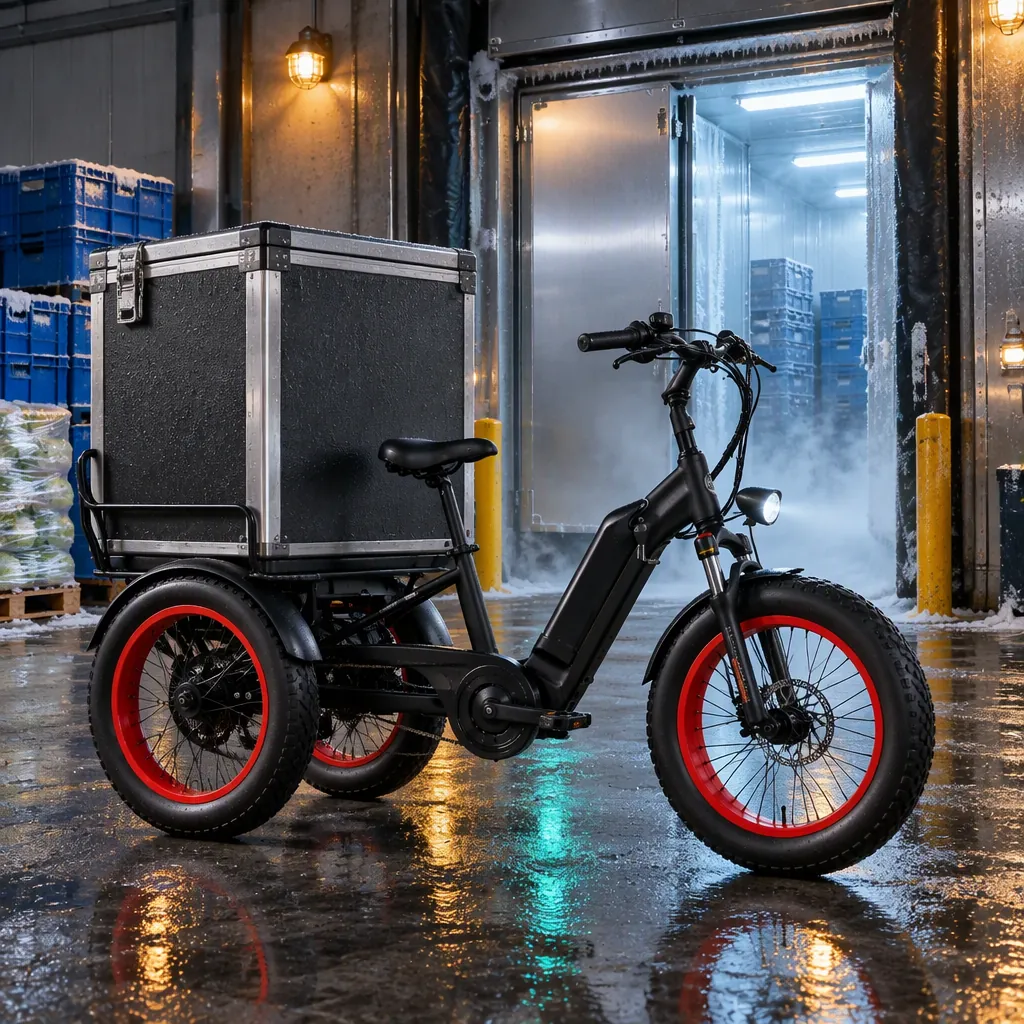
A cold store and a food distribution centre look like one facility on a site plan and are run as two businesses. The cold store sells temperature-controlled space per pallet position. The DC sells movement: cases in, cases out, on a schedule promised to a buyer. Between them sits a stretch of concrete maybe 40 metres long, crossed by at least two doors,
Most buyers who approach a cargo tricycle supplier for this job start from the delivery-route question: how far will it go on a charge? That is the wrong first question here. A cold-store trike does not travel a route. It travels a loop, dozens of times a shift, and the limit is not distance but the time the load spends in the warm band between anteroom and trailer. The second limit is the pack: a lithium pack sitting at low temperature does not deliver rated amp-hours when you key on, and fleet size is written in hours of available energy, not kilometres.
Why a cold store breaks the assumptions a delivery route makes
A route has a shape: start full, discharge over distance, return empty. A cold store has no such shape. The trike leaves a staging area, crosses a dock apron, waits outside a door for a lift truck to clear the frame, enters an anteroom at around +4 C, waits again, enters a blast-freezer room or a -18 C holding room, is unloaded by hand, and comes back out. Then it does it again, maybe 25 times in a shift.
Four things break the route model at once. Dwell time, because in the anteroom that wait is the product's exposure window. Door cycles, because every pass through a strip curtain dumps warm humid air into the cold room. Thermal mass, because an insulated box that has sat in a -18 C room is cold-soaked and so is the pack underneath it. And washdown, because no delivery-route specification accounts for a vehicle hosed twice a day.
Fleet sizing here is a function of cycle count, cycle duration and pack temperature, in that order. Distance per shift may be 6 km and hours per shift may be nine. The trike that covers the loop faster beats the trike with the bigger battery, provided it can recharge during the break.
Measure the three loads and four dimensions before choosing power
The three load types
- Euro crates and tote boxes. 600 x 400 mm footprint, stacked four or five high, handled by hand.
- Pallets. A Euro pallet is 1200 x 800 mm and 800 to 1000 kg loaded, far beyond any tricycle here. Pallets move by pallet truck or forklift; the trike carries picked cases and split pallets.
- Roll containers and food bins. 700 to 850 mm wide, up to 1.8 m tall, on castors. A 500 L box with drop-sides removed takes two roll containers if the floor plate is flat and the load can be strapped to the headboard; most cannot, and the bin goes on a trailer.
The four dimensions that decide the platform
- Aisle width between racking. Picking aisles in a food DC are frequently 2.4 to 2.8 m clear. A trike with a 1.2 m box needs roughly 1.9 m to turn 90 degrees out of that aisle, which fits; a 1.5 m box on a wider track does not.
- Freezer door width and threshold height. A 1.4 m clear opening with a 25 mm insulated threshold is not the same problem as a 1.2 m opening with a 60 mm raised sill. The second stops a loaded 1000 W trike dead, and the operator drags it through by hand, which is how frames bend.
- Ramp and ramp-plate slope. Dock levellers run 1:8 to 1:12. A 300 kg gross trike on a wet 1:8 plate with dual rear drum brakes will hold, but the same trike at 500 kg with a 150 kg operator will not stop on the downside without the parking brake set.
- Floor finish and washdown drainage. Epoxy floors with a 1.5 percent fall toward trench drains are standard. Polished concrete with no fall is common in older cold stores, and that surface at -18 C after a door opening is genuinely slippery. Tyre compound matters more here than motor power.
Circuit 1: dock apron to blast-freezer anteroom
This is the short, heavy, high-frequency circuit, and usually the one that justifies the fleet. The trike loads at a warm-side staging bay, runs 30 to 80 m across the apron, passes a strip curtain, and drops in the anteroom. Cases of frozen product at 12 to 15 kg each, stacked to box height, fill the box volume before they reach the payload.
Frequency is the defining number. This loop runs 20 to 30 times per shift, so brake heat and tyre scrub at the threshold outrun route-duty wear rates, and the operator spends more time mounting and dismounting than driving. Forward/neutral/reverse at the handlebar and a one-handed parking brake are why the trike beats a pallet truck.
Specify the 1000 W or 1200 W brushless hub motor with the differential, because the apron has crossfall and one rear wheel will spin on a wet patch under load. The 800 W version suits flat covered aprons under 200 kg. Keep the box at 150 to 300 L: a bigger one invites overloading past the 300 kg EU limit, and the rear axle pair pays for it.
Circuit 2: picking aisles to consolidation bay
The second circuit is the opposite problem. Loads are light, often under 150 kg, the picks are tall and there are many stops. The trike might do 40 stops in a 400 m run.
For this circuit the box should be a drop-side body or a low-sided open box with a headboard. An insulated panel adds mass and load-floor height, and buys nothing when the run is entirely inside the cold envelope. What you need is tie-down points every 300 mm along the side rails, a load floor that drains, and a 300 to 500 L box with drop-sides the picker can load from either side of the aisle.
The governor setting matters more than motor choice. At 25 km/h the trike shares a picking aisle with pedestrians and manual pallet trucks without a spotter. An LCD showing speed, battery state, load indication and reverse status lets a supervisor audit behaviour without telemetry, which in a food facility often decides whether a vehicle gets adopted or parked.
Circuit 3: reverse logistics out of the building
Cardboard is bulky and light, so volume limits before payload; returnable crates are dense, so payload limits first; waste bins are wet. This is where a drop-side body earns its place: drop both sides, load from three directions, hose the floor plate out afterwards. The pattern is well documented in our guide to cargo tricycles for waste collection, and the loading discipline transfers directly to a food DC's back-of-house run.
Keep the reverse-leg vehicle separate from the freezer-leg vehicle if the budget allows. A box that has carried wet waste should not go back into a blast-freezer anteroom on the next circuit without a washdown, and washdown costs time you do not have at shift change.
Circuit 4: hygiene and washdown between shifts
This is the circuit that quietly destroys vehicles built for outdoor delivery work. Add sub-zero temperatures on the freezer side and you get freeze-thaw cycling on every fastener, connector and seal.
What the vehicle must survive is testable. The electrics should hold IP54 minimum, and our production acceptance for spray exposure is 10 L/min for 3 minutes with the system powered, then an insulation resistance check above 1 MΩ at 500 V DC. Ask any supplier to reproduce that test on video with your serial number visible.
Galvanised or powder-coated steel with sealed box sections is the minimum; open C-channel that holds water rusts from the inside out. Floor plates should be aluminium tread plate with drainage holes and a removable mat, and wiring should run in sealed conduit above the floor line, not clipped under the load bed.
Water ingress into a drum brake cuts friction until it dries, and in a freezer it may not dry during a shift. That is the argument for hydraulic disc front plus dual drum rear rather than drums all round, and for a parking brake that is mechanical rather than a hydraulic line hold. Our guide to cargo tricycle brake systems covers wear patterns in wet duty.
Box configuration: insulated panel or open drop-sides
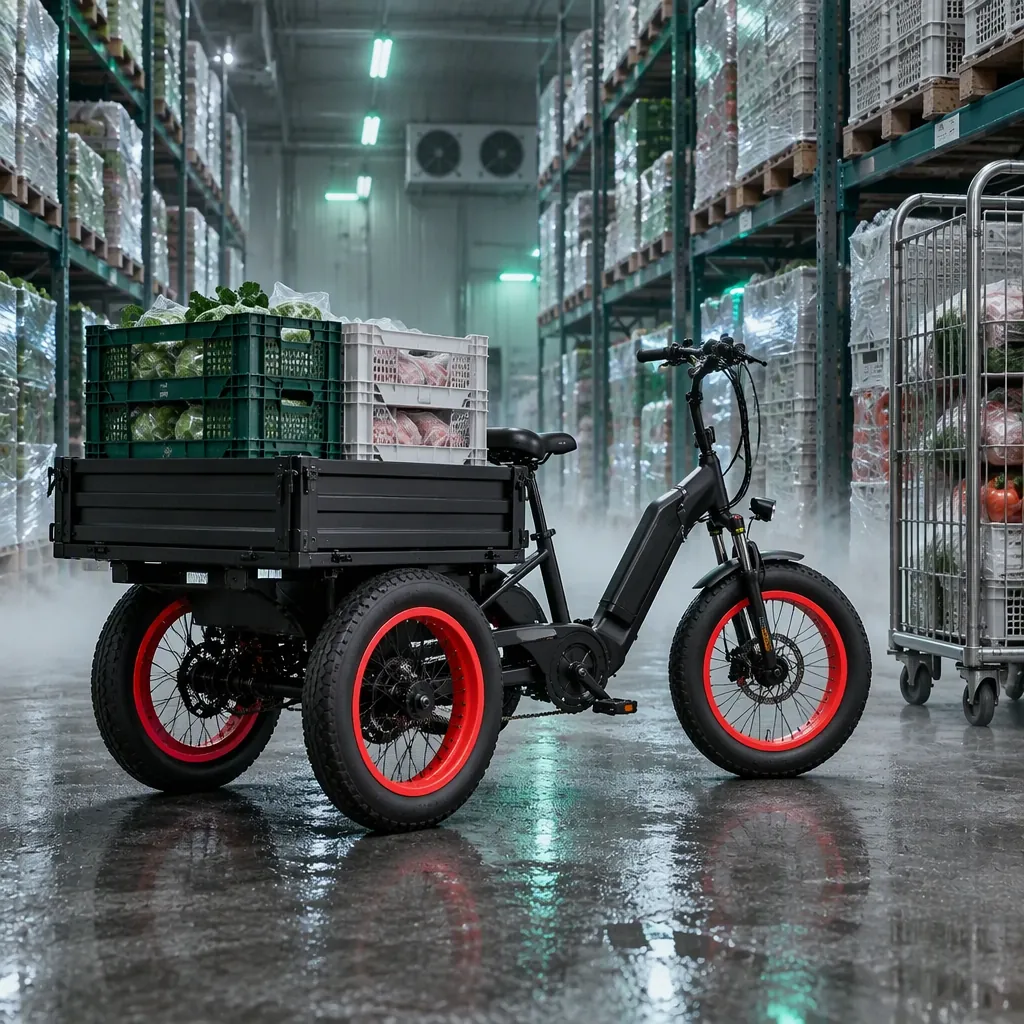
Two box families sit on this platform and the choice is a process decision, not an engineering preference.
The insulated box pays only when the load crosses a warm band. Four minutes from a +4 C chill room through an unheated dock to a +4 C trailer buys a degree or two at the product surface. Twenty minutes because the trailer is late buys considerably more. If the trike never leaves the cold envelope, the insulated box is 40 to 60 kg of dead weight plus a narrower door aperture.
One chassis and one box family means one set of spares, one training module and one ramp plate everything fits through. Mixing three insulated boxes with two open bodies doubles spare panel inventory and forces whoever draws the open trike to relearn loading. In a 12 to 20 unit fleet, standardise on the box that covers 80 percent of circuits and buy a trailer for the rest. The warehouse tricycle guide sets out the same logic for indoor-only duty, where the open body almost always wins.
Payload and weight distribution: the axle pair, not the headline number
Every quotation leads with a payload figure and every payload figure is a simplification. The 300 kg EU rating and the 500 kg non-EU rating come from the frame rail section and the rear axle group.
With a rear-mounted box the load sits over the rear axle pair, which helps traction and cuts the front brake's share of stopping. An operator of 85 to 110 kg forward and 300 kg of product behind puts static distribution near 30/70. Every kilogram past the rating lands on the leaf spring pack and rear tyres, and the first symptom is uneven rear wear and a rear drum that fades on a ramp plate.
The floor plate decides how the load is distributed. A 2 mm aluminium tread plate lets the operator slide a 200 kg stack to the headboard; thin steel on cross members deflects and the operator stops loading properly. Ask for the load rating per square metre at the centre of the floor, not just total payload. Our payload and capacity guide walks through the axle-by-axle arithmetic, including why dual rear wheels carry more than the tyre load index suggests when the differential works on a crossfall.
Cold, lithium and the charging arithmetic that decides fleet size
Two chemistries are offered: 60 V 32 Ah NMC and 72 V 40 Ah LFP. LFP is the recommendation for hot climates and high-cycle duty, and its real advantage there is cycle life rather than cold performance. Both lose usable capacity at low temperature. Do the arithmetic on hours, not kilometres; here is a worked example for a 20-unit fleet using only the figures this platform carries.
- Nominal energy. 60 V x 32 Ah = 1,920 Wh for the NMC pack. 72 V x 40 Ah = 2,880 Wh for the LFP pack.
- Useful energy cold. De-rate the NMC pack by 30 percent for part-shift cold soak to 1.33 kWh; de-rate LFP by 20 percent to 2.3 kWh. These are planning assumptions, not datasheet claims; replace them with measured numbers from your pilot unit.
- Energy per circuit. A 1.2 km dock loop with 25 stops at 300 kg on a flat apron consumes roughly 0.09 to 0.12 kWh, because stop-start dominates. Take 0.11 kWh: about 12 circuits per shift on the de-rated NMC pack and 21 on LFP.
- Shift demand. If the DC needs 18 circuits per shift, NMC needs 2 trikes per shift position where one LFP trike covers it. Across three shifts that is 5 units versus 8.
Charge time is 6 to 10 hours at 5 A depending on pack and depth of discharge. Ten hours does not fit an 8-hour shift, so back-to-back duty needs an opportunity charge at the break or a second pack. The 60 V 32 Ah pack at 5 A takes about 6.4 hours from empty in theory and longer from a cold start, because the BMS limits current until the cells are in a sane temperature band.
The rule: buy the pack with more usable kWh when cold, charge on a schedule that includes the break, and count circuits rather than kilometres. Our fleet charging guide covers break-time charging and circuit planning, and the battery pack guide explains what the BMS is doing when it refuses current at -5 C.
Tyres, brakes and the parts that fail first
The platform runs 3.00-12 front and 3.75-12 rear on dual rear wheels, carrying the box and load over a floor that alternates dry, wet and glazed at the thresholds. Accept a shorter service interval in exchange for grip: a rear slide at the threshold with 300 kg aboard is a product loss event, not a tyre cost event. Our cargo tricycle tyres guide covers tread choice by surface.
Brakes: hydraulic disc front, dual drum rear, plus a mechanical parking brake. In washdown duty the rear drums should have stainless or coated internals, and the service interval should be halved relative to route duty until the fleet has a wear record. Expect the first brake inspection at 500 km rather than 1,500 km.
Connectors and the controller come third: every door cycle is a humidity event and every freezer entry a condensation event. Sealed connectors with dielectric grease, a controller above the splash line and a battery box venting outside the frame rather than into the load area add years of life. The maintenance guide sets out an inspection sheet that suits this duty cycle.
Safety on a shared floor: pedestrians, forklifts and blind corners
A food DC floor is shared with pedestrians, manual pallet trucks, ride-on pallet trucks and forklifts, often in the same 2.4 m picking aisle at the same time. A cargo trike in that mix is a 150 to 220 kg vehicle carrying up to 300 kg of product with a blind spot directly behind the box and a stopping distance that is longer than a pedestrian expects. None of that is solved by the vehicle alone, but a handful of specification choices make a serious incident much less likely.
Set the governor deliberately. The platform offers 25, 35 and 40 km/h, and inside the building envelope the answer for every unit is 25 km/h. Reserve the higher settings for apron-only and yard-only units where nothing crosses in front of the box. A governor the operator can change is a governor the operator will change, so specify a keyed or code-locked setting and put it in the fleet policy rather than the operator manual.
Add the warning beacon on any unit that crosses a traffic route or shares an aisle with forklifts, and pair reverse with an audible signal in pedestrian areas. Blind corners at racking ends are where incidents cluster; a convex mirror on the racking post costs less than the trike's front mudguard and prevents more damage. Where the circuits can be separated physically, do it, even if the freezer loop then runs 15 m further per pass. Removing a conflict point is worth more than 40 seconds.
The specification table for cold-store duty
| Parameter | Cold-store baseline | Variation by circuit |
|---|---|---|
| Payload rating | 300 kg (EU) / 500 kg (non-EU) | Do not exceed on the freezer loop; reverse-leg loads often exceed it unnoticed |
| Cargo box | 300 L insulated sandwich panel, drop-sides available | 150-300 L insulated for Circuit 1; 300-500 L open drop-sides for Circuit 2 |
| Motor | 1000 W brushless hub with differential, 60 V | 1200 W for ramp plates and crossfall; 800 W only on flat covered aprons under 200 kg |
| Battery | 72 V 40 Ah LFP | LFP for multi-shift duty; 60 V 32 Ah NMC for single-shift, low-cycle sites |
| Charging | 6-10 h at 5 A, opportunity charge at break | Two packs per unit if shifts run back to back with no break |
| Range | 50-80 km at 200 kg on flat ground | Treat as a circuit count, not a distance, when cold-soaked |
| Brakes | Hydraulic disc front, dual drum rear, parking brake | Stainless or coated drum internals for washdown; halve first service interval |
| Tyres | 3.00-12 front, 3.75-12 rear, dual rear wheels | Softer compound where door thresholds glaze; accept shorter life |
| Suspension | Leaf spring rear | No change; the loaded leaf spring is what the payload rating assumes |
| Curb weight | 150-220 kg | Insulated box adds 40-60 kg; check ramp plate rating |
| Speed / governor | 25 km/h inside the envelope | 35-40 km/h only for apron and yard-only units, keyed setting |
| Instrumentation | LCD speed, battery, load, reverse; forward/neutral/reverse | Use for supervisor audit rather than telemetry |
| Electrics | IP54, insulation above 1 MΩ after spray test | Dielectric grease at connectors; controller above splash line |
| Options | Warning beacon, solar top-up (+8-12 km) | Beacon mandatory for forklift-shared aisles; solar for yard units only |
| Certification | CE, RoHS (EU 2015/863), EN 15194, UN 38.3 | UL 2849 / UL 2271 for North America; eMark (ECE R136) for EU road use |
| Price | FOB USD 1,250-1,550 | Insulated box and LFP pack sit at the upper end of the band |
Order terms: MOQ, lead time, samples and the first-month pilot
MOQ is 50 units. Lead time is 15 to 30 days, and 30 to 45 days for a first order with customisation. FOB is USD 1,250 to 1,550 depending on box type, chemistry and options. For a 20-unit cold-store fleet, the MOQ means either a shared order with a distributor or a first order that covers replacement units and spares, which in a washdown environment is not a bad thing to hold on the shelf.
The quality system has specific numbers attached. Incoming inspection runs AQL 2.5 Level II. Cells are rejected outside a 3 mΩ internal-resistance window or a 0.02 V open-circuit delta, which is the most useful defence against a pack that fails in year two. Torque verification is 25 N·m at the handlebar clamp, 40 N·m at the axle nuts and 18 N·m at the brake caliper mounts. BMS overcharge protection is set at 54.6 V and over-discharge cutoff at 36 V on the 36 V and 48 V class packs. Hub motors are accepted on a dynamometer at 82 percent peak efficiency. Batteries run a thermal chamber from -20 C to 60 C and 200 cycles at 45 C with under 15 percent capacity fade. Spray testing is IP54 at 10 L/min for 3 minutes with electricals powered, with post-spray insulation above 1 MΩ at 500 V DC. Outgoing inspection is AQL 1.0 Level II, sampling 50 units from a 200-unit batch, and every chassis runs a 2 km chassis-dynamometer road simulation before the 1.2 m carton drop test.
Ask for a sample before mass production and run it a month on the real circuit, not a test track. Log pack temperature at start and end of shift, count circuits per charge, record every threshold the trike struggled with, and time the washdown. That month will change your battery choice more than any datasheet. The cargo e-tricycle OEM guide covers the sample and inspection protocol, and the cargo bike supplier logistics guide covers spares and shipment.
Where to start
Measure your three loads and four dimensions this week, then run one trike on Circuit 1 for a month with pack temperature logged: door-cycle count, hours below zero, the actual box temperature at handover and the kWh the shift consumed. A month of that data settles the chemistry question, the box question and the fleet count far more reliably than any supplier range table, because it is measured inside your own temperature gates rather than on a flat test track in mild weather.
Map the temperature gates before you map the budget
Send us your aisle clear widths, freezer door openings and thresholds, apron gradients, circuit loads and the temperature band each leg runs in, and we will come back with a platform mix, one box family per circuit, the charging arithmetic for your shift pattern, and an FOB quotation with the certification pack for your market.
