
Around one in seven people worldwide lives with a disability that affects mobility, and the share keeps rising as populations age. Standard e-bikes and e-scooters assume two things their riders often cannot deliver: balance and the leg strength to swing over a high top tube. For a distributor, municipality or medical-device importer looking at the accessible mobility category, that is a market gap, not a niche. This guide covers the engineering that actually matters on an adaptive electric tricycle, delta three-wheel stability, a step-through frame, seated-height charging, and an ISO 7176 regulatory path, and how to buy one as an OEM or procurement programme.
Why Two Wheels Fail Many Riders
The e-mobility industry has concentrated on able-bodied commuters, and the result is a set of design assumptions that quietly exclude a very large group. Riding a two-wheeler needs dynamic balance, grip strength for brake levers and throttle, and the personal ability to recover from a wobble at any speed. For someone with reduced muscle mass, a balance disorder, an amputation, arthritis, or a neurological condition that affects coordination, those demands make a bicycle or scooter effectively unusable rather than merely uncomfortable.
The design fix is geometry, not just a bigger motor. A delta trike layout, two rear wheels and one front wheel, gives intrinsic static stability when standing or stopped, and stays upright through low-speed corners. It is the configuration that turns an "assistive device" into something a rider can actually operate independently. The safety-first framing of this population, balancing margins versus speed, is developed in our electric tricycle safety features guide.
Delta Stability and the Step-Through Frame
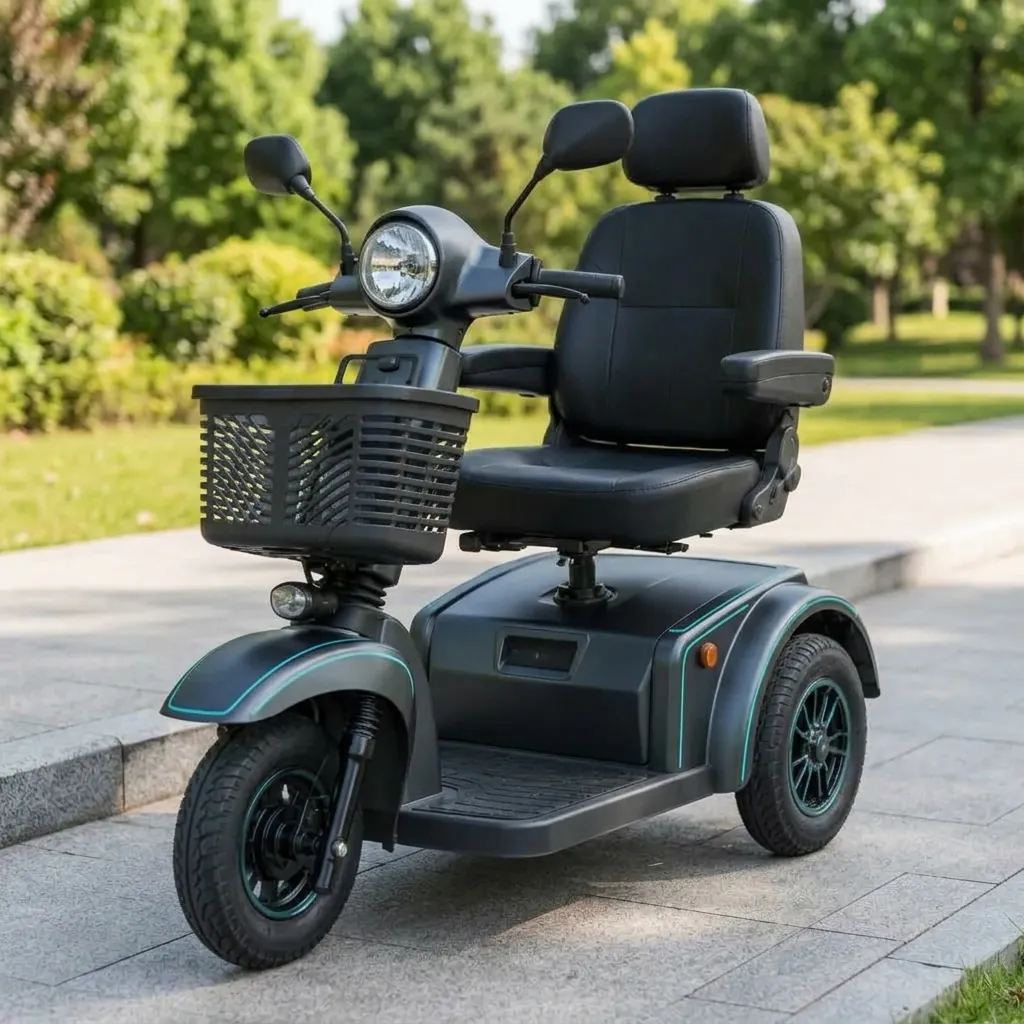
Two numbers tell most of the accessibility story on an adaptive e-tricycle. The first is the step-over height: a genuinely accessible platform keeps it down to roughly 35 cm, so a rider with a stiff hip or a prosthetic can step across rather than swing a leg. The second is the rider capacity: the platform below is engineered for 150 kg, which covers bariatric users and a rider plus a cane or walker.
Stability under turning is the part most factories get wrong. A trike cornering at normal speed has to steer the front wheel with Ackermann geometry, resist body roll through anti-roll design, and balance the rear differential so the two rear wheels do not scrub or lift. Sloppy versions tip in corners, which defeats the whole purpose. The motor and controller choices that keep a loaded trike stable and responsive from a standstill are covered in our motor power guide, and the tyre and wheel choices that matter for kerbs and setts are in our tires guide.
Seated-Height Charging: Removing the Physical Barrier
An e-bike battery weighs 3–5 kg and normally has to be lifted, aligned and pushed into a frame cavity. A task that is genuinely impossible for many users with limited upper-body strength or fine-motor issues. The accessible answer is a battery that charges on board, without removal, positioned at seated height, with large-toggle connectors and a simple LED charge indicator.
A user should never have to lift a pack above waist height or manipulate a small latch to keep their vehicle running. On-board charging with a low-mount connector also removes the need to carry a battery indoors. That single design decision is a big part of why a delta trike can be self-serve and independent, rather than a device that needs a family member or carer to operate. Charging infrastructure for a whole fleet, swapping racks, charging docks and the economics, is covered in our fleet charging guide.
Speed, Range and the Drive Prescription
Accessibility is about safety margins, not top speed. The recommended configuration is a 500W hub motor on a 48V 20Ah battery giving about 50 km of real-world range, with a low maximum speed and a walking-speed reverse mode so a rider can creep into a tight spot or back out of a doorway unaided.
| Spec | Adaptive Delta Trike | Why It Matters |
|---|---|---|
| Motor | 500W hub | Enough torque from a stop, low top speed for safety |
| Battery | 48V 20Ah, on-board charge | ~50 km range; no lifting, no removable pack |
| Step-through height | 35 cm | Step across, not swing over |
| Rider capacity | 150 kg | Bariatric users and rider + walker |
| Seating | Adjustable captain seat, armrests | Support and comfort for long rides |
| Steering | Ackermann + anti-roll | No tipping in normal corners |
| Reverse | Walking-speed mode | Maneuver unaided in tight spaces |
Range is the practical ceiling on a route. If you plan reimbursement-funded or community delivery trips, the battery chemistry and lifecycle that keep a fleet running day after day are explained in our battery technology guide.
Regulatory and Reimbursement Path
Accessible mobility sits at the junction of e-bike regulation and medical-device frameworks, and the paperwork is often what makes or breaks a programme. In the EU, a non-invasive mobility aid that does not penetrate the body or administer substances falls under Class I of the Medical Device Regulation. The reference test framework is ISO 7176 . The wheelchair standard, used for static stability (part 1), brake effectiveness (part 3) and fatigue testing (part 8). Combined with EN 15194, these documents form a credible regulatory and reimbursement package.
Reimbursement varies sharply by country. In Germany a mobility aid can qualify for statutory health insurance (GKV) when it is prescribed and listed in the Hilfsmittelverzeichnis directory; in the US, Medicare Part B covers durable medical equipment meeting the device classification; in France the MDPH funds approved devices; in Australia the NDIS funds assistive technology. Each requires its own evidence pack, which is why a factory that can supply device-classification guidance and pre-formatted reimbursement templates is worth more than one that only ships frames. The certification and market-entry differences between the EU and US are mapped in our EU vs US certification guide, and the regulation-by-location details are in our electric tricycle laws guide.
Buy-in Models: Distributor, Municipal and Retail
| Channel | What the Programme Needs | OEM Deliverable |
|---|---|---|
| Medical-device distributor | Device classification, reimbursement docs, clinician-facing material | Platform + full regulatory document pack |
| Municipal / community | Slow-speed stable platform, staff trained on charging, spares | Vehicle + spares kit + training in one bid |
| Retail inclusive range | 3-model range, assembly training, spare-parts flow | Whitelabel platforms, branding, compliance pack |
Municipal and community-transport programmes are a natural fit for a low-speed delta trike, and the after-sales reality of keeping a government fleet alive is covered in our after-sales and spare parts guide.
Specify an Adaptive E-Tricycle as an OEM Programme
When you buy, confirm the MOQ . Typically 50 assembled units, or more with a custom seat and frame spec. And insist on a sample that is fitted, not just assembled: mount the actual captain seat, set the handlebar for the rider group you serve, and charge the battery through the seated-height connector you intend to ship. Run that sample through a real route with a realistic rider, verify that the rider can mount and dismount on their own, confirm the trike does not lift a wheel in a normal corner at the loaded capacity, and check the range survives a detour.
For reimbursement-driven or clinical channels, ask the factory for device-classification guidance and reimbursement documentation templates up front. Those are part of the product on this category, not an afterthought. The first-container planning, lead time and Incoterms for importing a first batch are covered in our importing electric tricycles from China guide, and the full buyer's checklist for a first OEM order is in our OEM buying guide.
The same delta platform also serves passenger and tour-charter uses where a stable, low-slung three-wheeler is the whole point, our passenger tricycle tourism and rental guide covers that side of the market, and the broader adaptive product line is on our accessibility industry page.
Spec an Adaptive E-Tricycle
Tell us your rider group, target market and whether you need device-classification and reimbursement documentation. We will quote the delta trike platform with a step-through frame, captain seat and on-board charging, FOB China.
