
A service van spends most of its day parked. A field-service technician loads tools and parts in the morning, drives to a first call, works for forty minutes, drives to the second call through the same congested district, and repeats. In a dense urban service territory the van is a rolling store that carries two hundred kilograms of stock to deliver maybe fifteen of it, while paying commercial-parking rates, low-emission-zone charges and a driver licence category for the privilege. The question a growing number of trade contractors are asking is narrower than “should we electrify”: which of the daily calls can a cargo tricycle carry, and what has to be true before the first van is retired rather than duplicated.
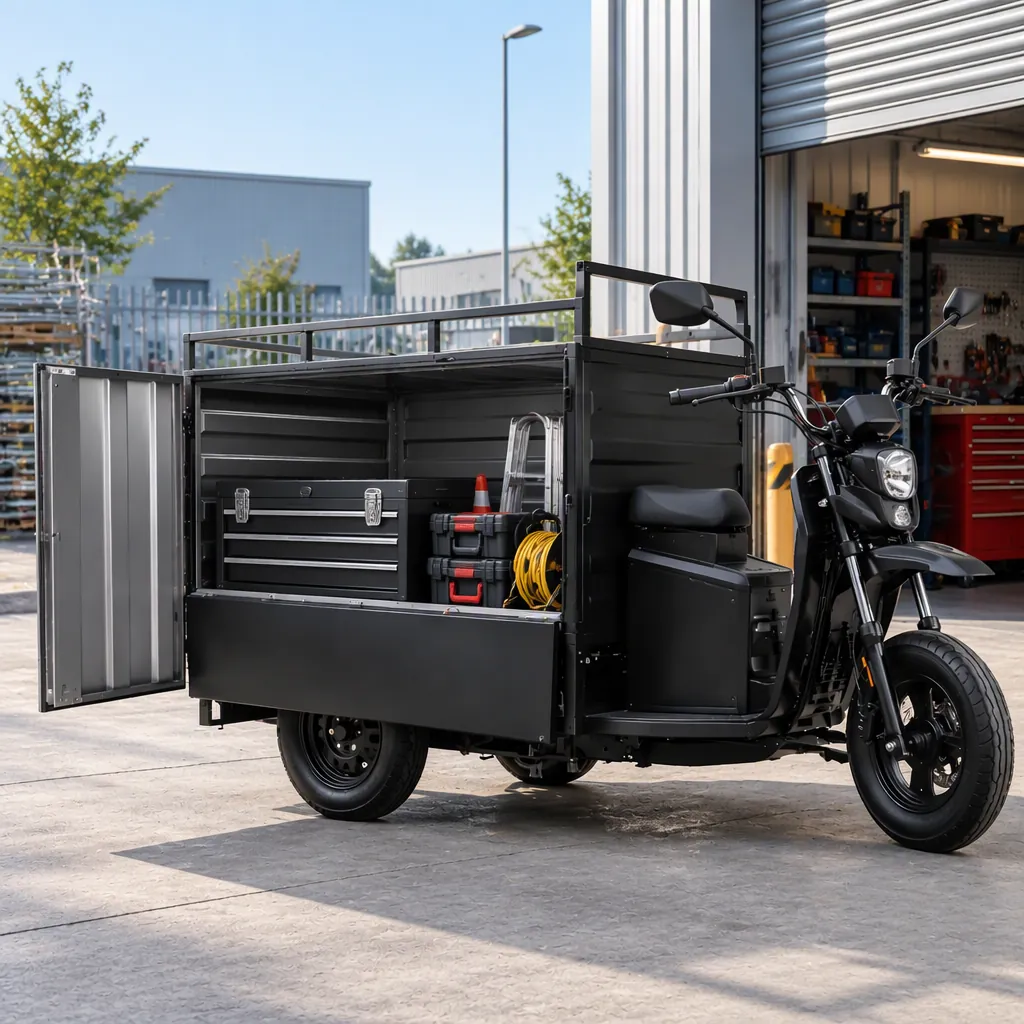
This guide is written for the contractor who already runs vans and is deciding where a three-wheeled platform earns a place. It covers the duty analysis that separates a real field-service route from a parts delivery, the specification that a service load actually demands, the arithmetic of spares capacity, and the order terms that matter when you buy twenty units instead of one. Every figure below comes from our own cargo and utility trike platforms, not from a generic industry estimate.
What Makes a Field-Service Route Different From a Delivery Route
The most common planning mistake is treating a service call like a parcel drop. They look similar on a map and behave nothing alike in a depot. A delivery route is a monotonic unload: the vehicle leaves full and finishes empty, stops are seconds long, and the payload is known before the shift starts. A field-service route is a circuit with dwell time: the vehicle returns to the same stops, carries a diagnostic load rather than a shipment, and the payload that matters is the tool set that must be on board whether or not it is used.
| Duty dimension | Parcel delivery | Field service / trade call |
|---|---|---|
| Payload profile | Parcel volume, unloads to zero | Tool and parts kit, stays on board all day |
| Stop duration | 30–120 seconds | 20–90 minutes on site |
| Load at end of shift | Empty | Nearly full, plus removed parts |
| Critical constraint | Volume and route density | Lockable storage, kerbside access, ground clearance |
| Failure cost | Late parcel | Second trip back to the depot for a missing part |
| Charging window | Full shift + overnight | Overnight, plus opportunistic mid-shift at a fixed base |
That second-to-last row is the one that changes the specification. A parcel trike is designed to swallow volume; a service trike is designed to keep a heavy, organised, lockable kit on board for eight hours and still leave the technician room to work out of the back of it at the kerb. The box is a mobile workshop, not a shipping container.
Which Calls Belong on a Trike and Which Belong on a Van
Before any vehicle is ordered, classify the territory. In most urban service territories the call mix splits into recognisable bands, and the split is stable enough to plan against.
- In-territory, light kit, high call density. Short urban hops where the technician needs hand tools, a diagnostic unit, and a handful of common spares. This is the band a cargo trike wins outright: stops are close, parking is scarce, and the total carried weight is well under the platform rating.
- In-territory, heavy or bulky kit. Jobs that need a full replacement assembly, a gas bottle, or a long ladder. The trike can carry the consumables and the diagnostic side, but the heavy single item still needs a van or a scheduled drop.
- Cross-territory or long-radius calls. Anything that leaves the dense zone and runs on speed-limited roads belongs on four wheels. A trike governed at 25–35 km/h is a city instrument, not a highway one.
- Emergency and out-of-hours callout. Keep one van in the pool for the jobs that cannot wait for a trike to charge or that fall outside the urban perimeter.
A practical first cut is to pull three months of job records by postcode and flag every call inside the dense zone that did not require a heavy single item. That flagged set is your trike territory, and for many urban trade contractors it is between a third and a half of total call volume. The trike does not need to cover the whole book to justify itself; it needs to cover the band it is genuinely better at.
Specifying the Platform Around a Service Kit, Not a Shipment
Once the territory is defined, the specification follows from the kit. A field-service trike is specified in four layers: what it must carry, how far between charges, how it is organised at the kerb, and how it survives being worked out of every day. Our cargo platform gives the baseline figures to plan against.
| Specification | Value | Why it matters for field service |
|---|---|---|
| Motor | 800W / 1000W / 1200W brushless hub with differential | The differential is essential on kerb-to-kerb manoeuvring; a locked rear axle scrubs tyres on every tight turn into a parking bay |
| Battery | 60V 32Ah / 72V 40Ah lithium, LFP available | LFP suits hot-climate territories and daily deep cycling; matches an eight-hour duty day with overnight charging |
| Load capacity | 300 kg (EU) / 500 kg (non-EU) | Comfortably exceeds a typical hand-tool kit with spares; headroom for consumables restocked at the depot |
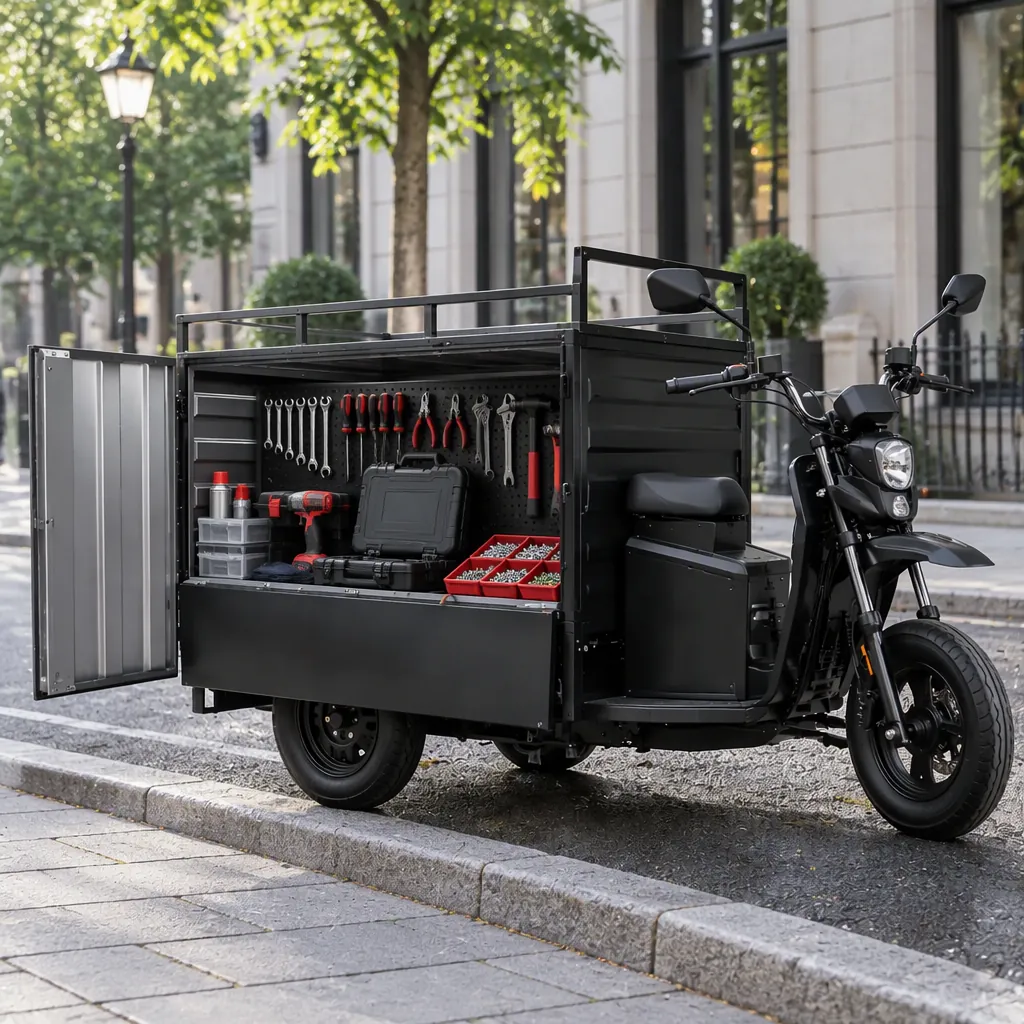
| Cargo box | 150–500L, drop-sides, optional insulated lining | Drop-sides let a technician work directly out of the box at the kerb instead of unloading to the ground |
| Range | 50–80 km loaded (200 kg, flat) | Covers a full urban call circuit with margin; the loaded figure is the one to plan from, not the unladen one |
| Brakes | Hydraulic disc front + dual drum rear, parking brake | The parking brake matters on kerbs and inclines where the trike is left standing during a call |
| Tires | 3.00-12 front / 3.75-12 rear (dual), load-rated | Reinforced load-rated tyres survive kerb strikes and continuous full-kit weight |
| Display | LCD with speed, battery %, load indicator, reverse | Reverse gear is a genuine daily need when backing out of a customer driveway |
| Lights | Full LED, beacon optional | High-visibility signalling matters when the trike is parked at the kerb in traffic |
One specification decision deserves its own note: the tool and equipment storage. For utility-duty service work, the platform is available with a lockable tool and equipment storage box and either a flatbed or enclosed cargo rear, with the utility configuration built around a 1000W motor, 60V 30Ah battery and an 80 km range at 200 kg payload. That is the variant to discuss when the call mix is dominated by maintenance and facility work rather than pure parts movement, because the lockable box turns the vehicle into a secure mobile workshop that can be left at the kerb between visits.
The Spares Arithmetic: How Much Stock a Trike Should Carry
The value of a service trike is not measured in fuel saved but in first-visit fix rate. Every part the technician did not carry is a second trip, and a second trip costs more than the part. So the box should be sized by the Pareto of your own job history, not by the box volume on the spec sheet.
- Pull the parts consumed on the flagged service band. Take the last three months of tickets inside the dense zone and list every part fitted, with quantities. Sort descending.
- Find the 80% line. In most trade categories a small set of fast-moving items covers the large majority of consumptions. That set is the trike's standing kit.
- Weigh the standing kit, not the box capacity. A kit that covers the 80% line typically lands well inside the 300 kg EU rating once tools, diagnostic gear and a person are accounted for. The remaining capacity is the headroom for the day's removals and returns.
- Add the removals side. Service work generates removed parts, packaging and cores that travel back. Budget box volume for both directions, not just outbound.
- Prove it on one route for a month. Run a single trike on the highest-density route for four weeks and log every second trip caused by a missing part. That log is the real specification, and it usually settles the argument better than any calculation.
Charging a Service Fleet Without Building a Depot
A service fleet has a simpler charging shape than a delivery fleet, and this is often the reason the business case works. Calls are based from one fixed yard, so the vehicle returns to the same place every night and charges on a standard supply while the workshop is closed. There is no need for corridor infrastructure or opportunity charging on the route.
With a 5A charger, a 60V 32Ah pack returns from a working discharge in roughly six to ten hours, which fits an overnight window comfortably. A 72V 40Ah pack takes longer and may want a second shift of charging or a higher-current charger, so the pack choice should follow the shift pattern rather than the other way round. The honest constraint is this: a single trike on a two-shift roster cannot charge fast enough between shifts on a standard charger, so a two-shift service operation either runs two trikes, adds a higher-current charger, or keeps one van covering the overlap. Plan the roster before ordering the fleet, because the roster, not the road, sets the number of vehicles.
What the Van Comparison Actually Turns On
The temptation is to present the trike as a like-for-like van replacement. It is not, and presenting it that way invites a failed pilot. The honest comparison is per duty band, and the numbers that move are acquisition cost, running cost, parking availability and whether the vehicle can complete the call without a second trip.
| Cost line | Service van | Service trike | Note |
|---|---|---|---|
| Acquisition | High, five figures typical | A fraction of that, FOB $1,250–1,550 for the cargo platform | Per-unit capital is the headline difference |
| Urban parking | Commercial bays, permits, low-emission charges | Kerbside, cycle-and-light-vehicle space typical | Territory-dependent; verify local rules |
| Running cost | Fuel, service intervals for a combustion drivetrain | Electric charge, minimal drivetrain service | Largest saving on high-stop routes |
| Throughput | Higher on long-radius and heavy-item calls | Higher on dense in-zone light-kit calls | This is why the fleet is mixed, not replaced |
| Licence | Standard car or van category | Often no licence category change at governed speeds | Confirm against your local classification |
Read as a fleet decision rather than a vehicle swap, the conclusion is usually a mixed pool: trikes carry the dense in-zone, light-kit band; one or two vans cover the heavy-item, long-radius and emergency work. The trike does not have to beat the van everywhere to win. It has to beat it on the band where the van is least efficient, and that band is usually the largest single slice of urban call volume.
Order Terms for a Twenty-Unit Rollout
Buying a service fleet is a different exercise from buying one demonstrator, and the terms that matter are the ones that keep twenty identical vehicles serviceable for years.
- MOQ and lead time. OEM orders start at 50 units per model with a 15–30 day standard lead time, extending to 30–45 days on a first custom-branded run, and pre-production samples ship before mass production.
- Spare-parts continuity. Confirm that tyres, brake components and the battery pack remain orderable in the same specification for the life of the fleet. The tyres are 3.00-12 front and 3.75-12 rear dual, and they must stay sourceable as matched sets.
- Configuration consistency. Fix the box layout, kit mounting and livery once, and hold it across the order so a technician can move between vehicles without relearning where anything lives.
- Compliance documentation. Ask for the document pack with the units, covering the battery transport and safety test reports. Our orders carry cell, BMS and test-report documents in the export file.
- Service framework. For a fleet sized for daily commercial duty, agree the inspection interval and the reporting cadence up front rather than after the first failure.
Running the Pilot Before Committing the Fleet
The lowest-risk path is one trike, one route, one month, measured. Set the pilot on the highest-density service route in the territory, keep the van on standby for the heavy-item calls, and log four numbers: calls completed per day, second trips caused by a missing part, energy cost, and parking time saved. Those four numbers will either justify the second and third trike or tell you the territory is not ready. A pilot that is designed to produce a decision, rather than to prove a preference, is what turns a field-service electrification idea into a fleet that is still running two years later.
Contractors who want to see how the specification wraps around a service kit can work from our construction site cargo guide for the tool-carrying pattern, our in-plant and warehouse guide for the lockable-storage logic, and our spare parts guide for keeping a mixed pool serviceable. Where the fleet is publicly funded, the procurement framing in our public fleet procurement guide transfers directly, and the running-cost structure is laid out in our fleet financing guide. The load figures themselves are drawn from our payload capacity guide, and the charging-window arithmetic from our fleet charging guide.
Size a Cargo Trike Around Your Call Territory and Kit
Tell us your densest service zone, the weight of your daily tool and parts kit, and whether your roster runs one shift or two. We will send the platform configuration, box and storage layout, and FOB pricing for a fleet order.
