
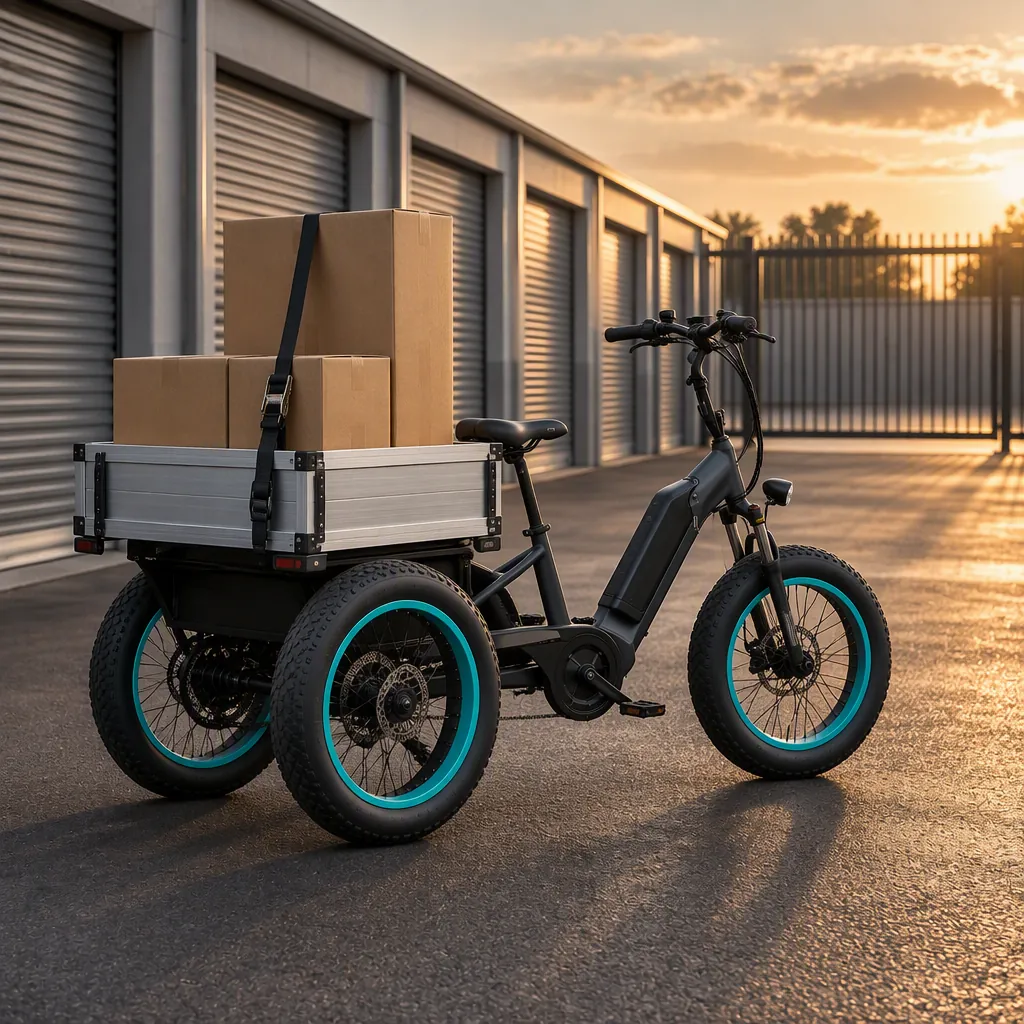
A self-storage site is a short-haul container yard with a customer-facing front door, and that combination breaks the two vehicles operators normally buy. A pickup truck is over-specified for a 90 m haul between a loading bay and unit 214, and it cannot do 40 of those in one afternoon without a driver walking half of them. A hand truck or pallet jack is perfect inside the aisle and useless the moment the load has to cross the forecourt. The electric cargo tricycle sits exactly between them: it carries the same pallet that will fit through a unit door, needs a 1 m gap rather than a 3 m lane, and turns inside the 6 m aisle a truck has to reverse out of.
This guide is for operators, facility managers and regional groups buying for a property portfolio, not for consumers. It covers the duty cycles that actually exist at a storage site, the geometry that eliminates most platforms before power even enters the conversation, the payload grading that matches a truck-and-driver budget against a trike-plus-part-timer budget, and the procurement terms that matter when you are buying four to twelve units rather than one. Payload, box volume, drivetrain grades and pricing below are this manufacturer's own platform numbers, not industry estimates.
Why a Storage Site Is Neither a Warehouse Nor a Delivery Route
Storage yards get compared to warehouses and to last-mile delivery operations, and both comparisons produce the wrong vehicle. The differences that matter are all about distance, dwell time and who is standing next to the load.
- Haul length in metres, not kilometres. The working distance at a single-property site is almost always 50–300 m: bay to unit, unit to unit, or gate to drive-up row. This is below the threshold where an operational vehicle's road speed matters and above the threshold where walking stops working.
- Stops are long and irregular. A delivery courier stops for 60–90 seconds. A storage handover stops for 10–30 minutes while a customer decides which boxes go back to the car. The vehicle spends most of the shift parked, which changes what you should be paying for.
- The load never leaves the site. Nothing is being transported to a destination; it is being repositioned between two points on the same property. No public-road registration, no route planning, no customer-facing tracking.
- Two different crews use it. Staff-manned line-haul and customer-facing drive-up duty are separate jobs with different speeds, different safety exposure and sometimes different vehicle configurations. Buying one spec for both is how fleets end up with machines that are wrong for each.
- Peak load is seasonal and lumpy. Month-end, moving season and university semesters all spike at once, then the site goes quiet. A vehicle that costs nothing when parked beats a vehicle with a driver on payroll during the quiet weeks.
That last point is the commercial argument. A cab-and-bed truck with a driver is a fixed daily cost whether it moves or not. A cargo trike with a removable key is a capital item that sits idle at no cost — and can be handed to a part-time staffer during a spike week without a licence or a road-worthiness conversation. The wider fleet economics behind that trade-off are worked through in our cargo delivery fleet guide.
The Four Duty Cycles That Actually Exist at a Storage Property
Before specifying anything, separate the work into the jobs your team genuinely performs. Most storage sites run three of these four, and the mix — not the total volume — determines how many vehicles you need and of which grade.
| Duty | Typical haul | Load profile | Critical spec |
|---|---|---|---|
| Unit-turnover line-haul | 100–300 m, repeated 20–40×/day | 1–3 pallets, moving cartons, appliances | Box volume and drop-side access |
| Drive-up row assistance | 50–150 m, on demand | Loose boxes, mattresses, rolled goods | Low deck height and open top |
| Site logistics and upkeep | 50–200 m, scheduled | Signage, locks, cleaning kit, green-waste bins | Flatbed and tipper option |
| Cross-site transfer between two properties | 1–5 km on public road | Overflow storage, customer relocations | Road legality and range |
Cross-site transfer is the one duty that changes the vehicle class: taking a load onto a public road brings registration, insurance and lighting requirements with it, which is a different procurement conversation. The other three are internal logistics and can run on an unregistered industrial vehicle. If your site model includes a satellite annexe, read the legal constraints in our US and EU regulation comparison before you assume one platform covers all four duties.
The Door and Aisle Geometry That Eliminates Most Platforms
This is the step operators skip and then regret. A storage site is a set of hard physical constraints, and if the vehicle does not fit the constraints, no motor rating, battery size or accessory package rescues the purchase. Measure these four numbers before you look at a single specification sheet.
- Unit door aperture. A standard interior roll-up door is 1.5 m wide by 2.1 m high, and a drive-up door is 2.4 m wide by 2.4 m high. A trike with a 1.2 m wide drop-side box drives straight in; anything wider requires the load to be handled off the vehicle at the threshold, which is exactly the labour you were trying to remove.
- Aisle width. Interior aisles are frequently 2.4–3 m between unit faces. A cargo tricycle at roughly 1.0–1.2 m overall width leaves 0.6–1 m of working clearance on each side — enough to open a drop-side and step alongside. A 1.8 m wide utility vehicle does not, and a truck cannot enter at all.
- Turning envelope at the aisle end. Dead-end aisles are the norm. A tricycle with a differential rear axle turns in roughly its own length without scrubbing the outer tire; a vehicle with a fixed rear axle under load grinds the tyre and marks the floor on every turn. Check the end-of-aisle space against the platform you are considering.
- Ground surface and threshold. Unit thresholds have a lip; drive-up aprons are usually asphalt with a camber for drainage. Small wheels and low ground clearance catch on both. This is where the 3.00-12 front and 3.75-12 dual rear tire specification earns its place — see the tricycle tires guide for how load-rated tire sizes map onto surface conditions.
The practical test: load the vehicle at the bay, drive the exact route to the furthest unit, open the box inside the aisle, and reverse out. If any of those four steps needs a second person or a hand truck, the platform is wrong for the property regardless of what it costs.
Line-Haul Duty: Matching Payload to the Turnover Cycle
For the internal haul between bay and unit, payload capacity should be sized off a single turnover, not off the day's total. If the largest single move your site handles is two pallets of household goods plus a washing machine, sizing for one and a half tonnes of total daily throughput is buying capability you will never use on a property that will never let you use it.
The platform this guide is written around is graded across three configurations. All figures are FOB China, per unit, on a 50-unit minimum order.
| Specification | Light 800W | Standard 1000W | Heavy-Duty 1200W LFP |
|---|---|---|---|
| Motor | 800W hub, 60V | 1000W hub, 60V | 1200W hub, 72V |
| Battery | 60V 32Ah NMC | 60V 32Ah NMC | 72V 40Ah LFP |
| Range (loaded) | 50–60 km | 60–70 km | 70–80 km |
| Payload (EU / non-EU) | 300 / 500 kg | 300 / 500 kg | 300 / 500 kg |
| Box volume | 150–300 L | 200–400 L | 300–500 L |
| Vehicle weight | 150–180 kg | 170–200 kg | 190–220 kg |
| Price (FOB) | $1,250–1,550 | $1,580–1,880 | $1,880–2,250 |
| MOQ | 50 units | 50 units | 50 units |
The payload distinction is an engineering limit, not a marketing figure: the EU rating of 300 kg including the driver follows from L2e classification, and the non-EU market rating of 500 kg reflects the same chassis rail and axle set without the regulatory cap. It is the same vehicle either way.
Two configuration choices do most of the practical work at a storage property:
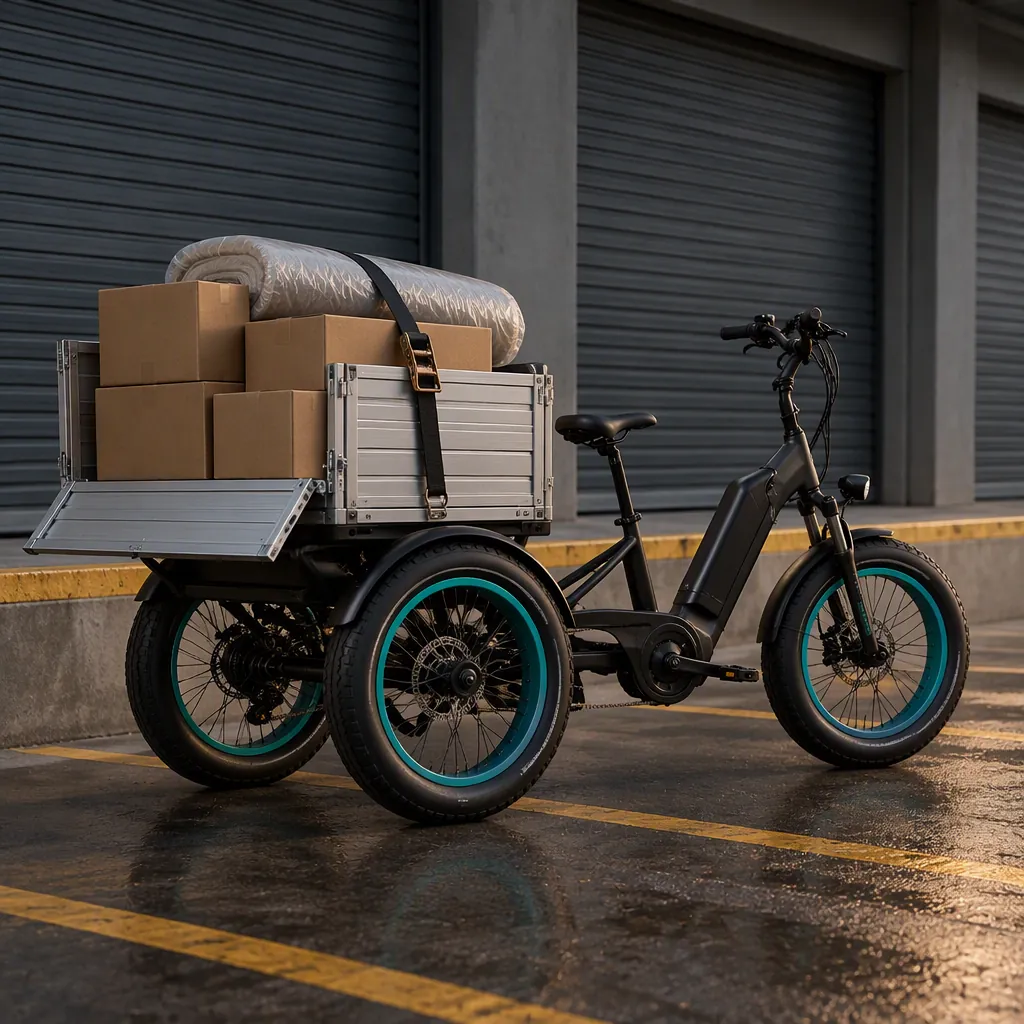
- Drop-side aluminium box. Opening a side wall turns the box into an open work surface at waist height, which is what a two-person handover actually needs. A fixed high-sided box forces everything over the tailgate. Box volumes run 150–500 L depending on grade, with the long dimension matching a standard pallet so a load can stay strapped as one unit.
- LFP over NMC for the heavy grade. LFP packs deliver in the region of 2,000-plus charge cycles against roughly 800-plus for NMC, and they tolerate the shallow partial-charge rhythm of yard duty better. A storage site charges opportunistically — an hour here, two hours there — and that pattern is the main argument for LFP even though the 72V 40Ah pack costs more up front. Fleet-scale charging arithmetic, including how many vehicles one circuit can support overnight, is covered in the fleet charging guide.
Jockey Tractors and Pallet Trucks: What the Trike Replaces and What It Does Not
Operators usually arrive at this decision after comparing against two other options, so it is worth being explicit about where each one wins. This is not a claim that a cargo tricycle replaces everything on the yard.
| Task | Jockey tractor / yard truck | Pallet truck (manual or electric) | Cargo tricycle |
|---|---|---|---|
| Moving a sealed pallet rack to a unit | Best — towing and heavy grade | Good on flat, hard surfaces | Adequate to 300–500 kg; not for towing |
| Loose multiple-trip handovers | Over-specified; long load/unload | One pallet per trip | Best — mixed loads, no pallet needed |
| Interior aisle at 2.4–3 m | Cannot enter | Works, but no weather protection | Best — fits, turns, carries tools |
| Exposed forecourt in rain or heat | Cab protects operator | Load exposed | Box protects load; operator needs wet kit |
| Cost per unit | Highest, plus driver | Lowest, but labour-bound | Mid — one trike covers many manual trips |
The pattern that works at most mid-size properties is one jockey tractor or a shared yard truck for bulk movements, plus one or two cargo trikes that absorb all the short repeated work the larger vehicle is badly suited to. The trike does not remove the pallet truck; it removes the twenty times per day the pallet truck would have been walked down an aisle by a staff member.
If your site also maintains its own grounds or handles green-waste removal, a tipper or hydraulic-lift configuration can share the same platform — the trade-offs are set out in our hydraulic tipper guide, and the reasoning behind buying two differently configured vehicles rather than one compromise vehicle is worked through in the grounds crew fleet guide.
Drive-Up Aisles and Customer-Facing Duty
Drive-up rows are the highest-visibility duty and the one where a specification mistake is most expensive, because customers are standing next to the vehicle while it happens. Three requirements dominate.
- Low deck height and open top. Customers unload and reload their own vehicle beside yours. A deck around knee-to-waist height means boxes move in one motion; a high-sided box means everything is lifted over a wall. This is the single most common complaint about repurposed delivery vehicles on storage sites.
- Slow-speed control and a genuine parking brake. A drive-up apron has a camber and often a slope toward the drainage channel. On an incline with 300 kg aboard, a parking brake has to hold the vehicle, not merely discourage rolling. The brake specification that makes this safe on loaded gradients is covered in the brake systems guide.
- Visibility and audibility around pedestrians. An electric trike is near-silent, and storage forecourts are pedestrian-heavy with customers reversing out of parking bays. Full LED lighting and a reversing tone are not accessories on this duty; they are the safety case. The wider visibility and stability considerations are set out in the safety features guide.
One configuration note specific to customer-facing work: keep the load box open and shallow rather than enclosed. Sheltered boxes are right for line-haul because they protect goods and can be left loaded overnight, but at a drive-up row the driver needs to see where the load is at a glance and reach it without a ladder. Some operators run one enclosed-box unit for line-haul and one flatbed or drop-side unit for customer duty on the same site, which is cheaper than buying an expensive compromise twice.
Throughput and Staffing: How Many Vehicles a Property Actually Needs
Vehicle count should come from the duty-cycle arithmetic, not from the unit count. The workable method is to measure the three numbers that actually vary between properties.
- Longest loaded haul on site. Bay to furthest unit, one way. At most properties this lands between 100 and 300 m.
- Trips per turnover day. Count the actual number of bay-to-unit movements across your busiest day of the year, not an average week.
- Load and unload dwell per trip. For a staff line-haul this is 5–10 minutes; for a customer-assisted handover it is 10–30 minutes.
A trike running a 250 m haul at yard speed completes the movement in well under two minutes, so the dwell time dominates the calculation completely. In practice, one vehicle covers a staff line-haul duty cycle for most single-property sites, because the constraint is how long the vehicle sits loaded at a unit rather than how fast it travels. A second vehicle becomes the right answer when customer-facing drive-up duty competes with line-haul for the same machine during peak weeks, or when a property runs two physically separated drive-up rows.
For a portfolio, the useful framing is that vehicles are per-property capital items while the operating model — who drives, who maintains, where it charges — is a regional decision. Consolidating spares and service across properties is worth more than consolidating vehicles, and it is the argument for standardising on one platform grade portfolio-wide rather than buying whatever was locally available. Multi-site service and parts continuity is covered in the spare parts pipeline guide.
Procurement Terms for Storage Operators
Storage groups buy differently from municipalities and differently from last-mile fleets: the order is small, there is rarely a procurement department, and the person approving the spend is usually the same person who will operate the fleet. Six terms are worth pinning down before you commit.
| Term | What to require |
|---|---|
| Minimum order | 50 units at platform level. A single-property order is normally placed as part of a regional group allocation — ask what allocation your property can draw from. |
| Lead time | 15–30 days for a standard configuration. Branded or custom box work adds roughly 10 days on top of the standard window. |
| Configuration lock | Fix box length, drop-side or fixed, insulation, canopy and tipper option before the order, not after. These are build-time choices. |
| Spares continuity | Tire sizes, brake shoes, battery packs and controllers must be contractually available for the life of the fleet. A trike is kept for years, not seasons. |
| Documentation | Dimensioned drawing, BOM and FOB quotation should come back within one business day of a spec enquiry. If a supplier will not produce a drawing, they will not produce the vehicle to it either. |
| Pilot before rollout | Run one vehicle at your highest-turnover property for a full peak cycle before committing the portfolio allocation. |
Two questions resolve most supplier uncertainty early. First, ask for range and payload claims stated against a defined duty cycle — for example 200 kg of load on flat terrain — rather than a best-case figure. Second, request a live factory walkthrough covering the assembly line, a loaded road test and a close-up of the differential axle and box welds. Both are standard for this platform and both expose a supplier who is reselling rather than building. The wider buyer's checklist for OEM terms is in the OEM buying guide.
Running the Numbers Before You Buy
Put a storage-site case together as an internal-logistics decision, because that is what it is. The comparison that matters is not trike versus truck; it is trike plus existing staff versus a hired vehicle plus a driver plus the labour hours currently spent walking loads.
- Capital. $1,250–1,550 for the 800W light grade, $1,580–1,880 for the 1000W standard, $1,880–2,250 for the 1200W LFP heavy grade, all FOB China, all on a 50-unit minimum order. A single property drawing from a group allocation is effectively buying at portfolio pricing.
- Running cost. A 60V 32Ah pack is roughly 1.9 kWh, so a full charge costs well under a dollar at commercial tariffs, and a charge takes 6–10 hours on the standard 5A charger from a normal 230 V socket. No charging infrastructure build is required, which is usually the deciding line item for a site with no spare electrical capacity on the forecourt.
- Labour recovered. Price the walking hours, not the vehicle. A 250 m bay-to-unit haul performed with a hand truck and two staff is the cost the trike actually removes; once that is on the spreadsheet the payback period is usually measured in seasons rather than years.
- Utilisation reality. Storage demand is seasonal and spiky. A vehicle that costs nothing while parked is a materially better fit for that demand curve than a driver on a daily rate, and it can be redeployed between properties in a portfolio without renegotiating anything.
Where a property also has a maintenance or grounds function, the same vehicle can share duty with the site upkeep work, which improves utilisation through the quiet weeks. The economics of that shared-use pattern are covered in our municipal public works guide, which works through the circuit-based duty model that storage yards and grounds teams have in common.
Frequently Asked
Can a cargo tricycle carry a standard pallet through a unit door?
A 1.5 m by 2.1 m interior roll-up door accepts a 1.2 m wide drop-side box directly, which is the standard configuration at box volumes from 200 L upward. A drive-up door at 2.4 m by 2.4 m clears both the box and the canopy. If your unit doors are narrower than the standard roll-up, measure before specifying — the box width is a build-time choice, not an adjustment.
Does the 300 kg EU limit mean we cannot use the full payload?
The 300 kg EU figure includes the driver and follows from L2e vehicle classification; the same chassis and axle set is rated 500 kg in non-EU markets. For internal site-only duty with no public road use, the relevant number is what the chassis and axle are engineered for, and a storage yard move is well inside that envelope. Confirm which rating applies to your jurisdiction with your supplier before the order.
How many cargo tricycles does one storage property need?
Most single-property sites run one vehicle for staff line-haul and add a second when customer-facing drive-up duty competes for the same machine during peak weeks, or when two drive-up rows are physically separated. The constraint is dwell time at the unit rather than travel speed, so one vehicle covers more trips than most operators expect.
Can the same vehicle handle customer handovers and site maintenance?
Yes, with a drop-side or flatbed configuration rather than an enclosed box. The box choice is the variable: enclosed for line-haul where loads sit overnight, open drop-side for customer-facing and upkeep duty where the load changes constantly and needs to be seen. Many sites end up with one of each rather than a compromise.
What does a storage fleet order actually require?
A 50-unit minimum at platform level, 15–30 days for standard configurations and roughly 10 additional days for branded or custom box work. Configuration — box length, drop-side, insulation, canopy, tipper — is locked at order. A dimensioned drawing, BOM and FOB quotation are normally returned within one business day of a specification enquiry.
Next Step
Measure four numbers at your site: unit door aperture, aisle width, end-of-aisle turning space, and the longest loaded haul. Those four decide the platform before payload or budget come into it. Send them with your unit count and turnover pattern, and you will get a configuration recommendation, a dimensioned drawing and an FOB quotation for the property — plus a pilot plan for your highest-turnover site.
Spec a Storage-Site Tricycle Fleet
Tell us your unit count, aisle width, door dimensions and turnover pattern. We will spec the box layout, drivetrain grade, pack size and charging position that fit the site before you buy anything.
