
A stocked pond fails on two clocks. The first is oxygen: once a load of fish is netted and lifted out of water, the countdown starts and does not pause for a flat tyre or a gate that will not open. The second is temperature, which decides how long that countdown is before the fish stop being recoverable. Everything else about a farm tricycle, the motor, the battery, the box, the tyres, matters only in how much it steals from those two clocks.
This guide is written for the people specifying the vehicle: pond managers restocking a cage, hatchery staff moving fingerlings to a second site, farm crews running feed and nets around a levee circuit, and the transport planners who quote for live haulage. The numbers here come from the platform we build, a three-wheeled cargo electric tricycle with a 300 kg (EU) / 500 kg (non-EU) rated deck, and from the physics of moving water, not from a brochure. Where a figure is an engineering limit we say so; where it is an assumption we label it.
For buyers comparing platform shapes before they commit, the general case for a three-wheeler against a pickup is set out in our cost comparison against a pickup, and the surface and stability behaviour that decides whether a loaded deck stays upright on a wet levee is covered in the stability guide. This article assumes both and deals only with the live-load problem.
Why a pond round is an oxygen clock, not a delivery route
A delivery route is judged on stops per hour. A pond round is judged on minutes of air. Netting, lifting and loading a fish is the moment its oxygen debt begins, and the debt accumulates at a rate set by water temperature, water volume per kilo of fish and how much the load is shaken in transit. A trike that arrives forty minutes earlier with the same tank is worth more than a trike with twice the payload that arrives late.
This is why the spec conversation should not open with motor power. It should open with four numbers that come from the site, not from the vehicle:
- Total live weight to move in one go, in kilos of fish, separate from the water that has to travel with them.
- The longest leg in minutes, from the pond gate to the release point, measured at the speed the surface actually allows.
- The narrowest passage on the route, gate or levee top, in metres, with the vehicle empty and loaded.
- The release method at each pond, whether fish are tipped down a chute into open water, lowered in a container, or walked across a bank in a tank that has to be lifted by hand.
Those four numbers eliminate platforms faster than any spec sheet. A site that needs 400 kg of fish in one lift is not talking about this class of vehicle at all; a site moving 120 kg of fingerlings across 600 m of levee is squarely in it, and the question becomes how much water travels with that 120 kg.
The four duties that share the word haulage on a fish farm
Fish farms do not run one job. They run at least four, and they pull the specification in opposite directions. Treating them as one round is the most common reason a fleet ends up with vehicles that are wrong for three of the four.
Duty 1: harvest lifts, high density over a short distance
When a cage or pond is cropped, the fish are concentrated and heavy, and the trip is short, often under 300 m, between the net and the grading or purge tank. Here the payload limit binds first and the clock is tight because the fish are crowded in the net before they are even lifted. What helps is a deck that can take the weight over a short wheelbase route and a tank that can be filled and emptied fast, not a long range.
Duty 2: restocking runs, moderate density over a real distance
Moving stock from a hatchery or nursery pond to a grow-out pond is the round that a farm tricycle actually improves. Loads are moderate, the distance is a few kilometres of farm track or public road, and the constraint is how many trips the release window allows. Feed, nets and grading screens can ride out on the empty return leg, which is the whole economic argument for this platform: you are not paying for a fish-only vehicle.
Duty 3: fingerling and fry transfer, low weight and a hard oxygen limit
Fingerlings weigh very little and carry almost no water of their own, so payload is never the limit. What binds is the oxygen budget, because small fish have a far higher metabolic rate per kilo than market-size fish and a bag of them can be lost in a short hot trip. This duty is specified around tank capacity, aeration and shade rather than around the motor.
Duty 4: dry-duty circuits that keep the ponds running
Feed sacks, lime, sampling gear, aeration spares, seine nets, boots and the vacuum for the inlet screens all move around the same site every week. These runs are the reason a farm trike pays back: the vehicle is not idle between stock movements. A drop-side deck that converts to a flatbed in seconds handles a pallet of feed as easily as a tank, and that flexibility is covered in the payload and capacity guide.
Water is the payload: the arithmetic buyers get wrong
A fish weighs what it weighs, but a tank of fish weighs the fish plus the water. At roughly 1 kg per litre, the water dominates everything. This is not a detail; it decides whether your target load fits on the deck at all.
Take a stated deck rating of 300 kg for EU-market operation. Four hundred litres of water plus the tank shell, the pump, the battery and the driver's own weight is already past that rating before a single fish is loaded. Practical live loads on this platform therefore look nothing like "300 kg of fish"; they look like a fraction of that, chosen to keep total gross weight inside the rating.
| Load case | Live weight | Water carried | Tank & equipment | Approx. gross added | Fits the EU 300 kg deck? |
|---|---|---|---|---|---|
| Fingerlings, bagged and boxed | 20–30 kg | 40–60 L | Insulated boxes, ice packs | ~90–110 kg | Yes, with margin for a second trip |
| Restocking run, medium stock | 80–100 kg | 120–160 L | Tank shell, pump, aeration | ~240–300 kg | At the limit; two runs is safer |
| Harvest lift, short leg | 150–200 kg | 200–300 L | Netted bins, no full tank | 380–520 kg | No, this is non-EU 500 kg territory |
| Dry duty, feed or nets | — | — | Pallets, crates, tools | 200–400 kg | Pallet by pallet, not by the tonne |
Read that table as a planning tool, not a certificate. The gross figures are ordinary sums of mass in litres and kilos; the 300 kg and 500 kg ratings come from our own product page for the cargo platform, where they are quoted as EU and non-EU configurations respectively, and they describe the deck and axle assembly, not a licence to load to the last kilo. The right working target on a farm is the one that keeps the vehicle inside its rating with the surface, gradient and braking behaviour your tracks actually have.
Tank or bin: which container the fish travel in
There are two honest ways to move live fish on a small vehicle, and they suit different duties.
Open bins with continuous aeration
Food-grade bins, 100 to 200 L, strapped over the rear axle, with a battery aerator running from the vehicle's own 12 V supply or from a small self-contained unit. Bins are cheap, stackable when empty, individually liftable when full, and they let a crew drop one load at one pond and keep moving with the other. Aeration is the entire safety case, so the aerator must be on a circuit that survives the vehicle being switched off, and the battery that feeds it needs its own charge routine.
Insulated tanks with recirculation
A single tank, 150 to 300 L, with a lid, a pump and a return line, holds temperature far better than open bins and is the right choice for fingerlings and for hot-weather work. It is also heavier and harder to manhandle, so it only makes sense when the tank stays on the vehicle across several ponds, and the deck has to be strong enough at the mounting points rather than just at its centre. Our platform is offered with an insulated sandwich panel body and a 40 mm PU insulated box option, both of which are described on the body and canopy options page; the insulation matters as much for keeping heat out of a fish tank as for keeping it in a cold box.
Either way, the container decision has a control in it. A vessel that can be tipped, drained and scrubbed between ponds is not optional equipment on a farm, because moving fish between water bodies is exactly how disease and invasive plants travel. Washdown and hygiene-grade specification, the same thinking that governs a butcher's cold loop, applies to a fish tank that is refilled at a different pond every hour.
The levee problem: width, doors and wet clay
Most pond sites were never designed around a vehicle. The tracks between ponds are built for a quad bike, a barrow or a tractor, and the levee top is often a strip of grass on a bank that has been deliberately made narrow. Three measurements decide whether a cargo tricycle can do this work at all.
- Gate and gap widths. Measure the narrowest passage with the vehicle fully loaded, because a tank overhanging the rear axle changes nothing but a drop-side body that is wider than the gate is a stopped run. Where gates are tight, the body choice is decided before the motor choice.
- Levee crown width and edge behaviour. A bank with soft shoulders will not hold a loaded three-wheeler that drifts an inch off centre. The stability behaviour of a delta-layout trike on soft, sloping ground is covered in our stability guide, and a levee is the case it was written for.
- Gradient at the pond edge. The last twenty metres are usually the steepest and the wettest, dropping from the crown to the water. That is where traction and braking are tested, not on the flat farm road.
On wet clay and grass, tyre choice matters more than motor power. The platform runs 3.00-12 at the front and 3.75-12 duals at the rear, load-rated and reinforced. On a fish farm the rear pair carries the tank and the loose surface, so tyre pressure and tread pattern are a maintenance decision worth reviewing with your own tracks in mind; the trade-offs are set out in our tyre selection guide. Braking on wet ground is the other half: hydraulic disc at the front, dual drum at the rear and a parking brake, which matters because a loaded vehicle stopped on a levee slope while the crew nets fish must not creep.
Feed, not fish, is what the vehicle is doing most days
Stock movements happen in bursts, a few times a season. Feed happens every day, and on many farms twice. A 25 kg sack of floating pellet is awkward rather than heavy, and the real cost of feeding by hand or by barrow is the number of trips and the crew time they consume.
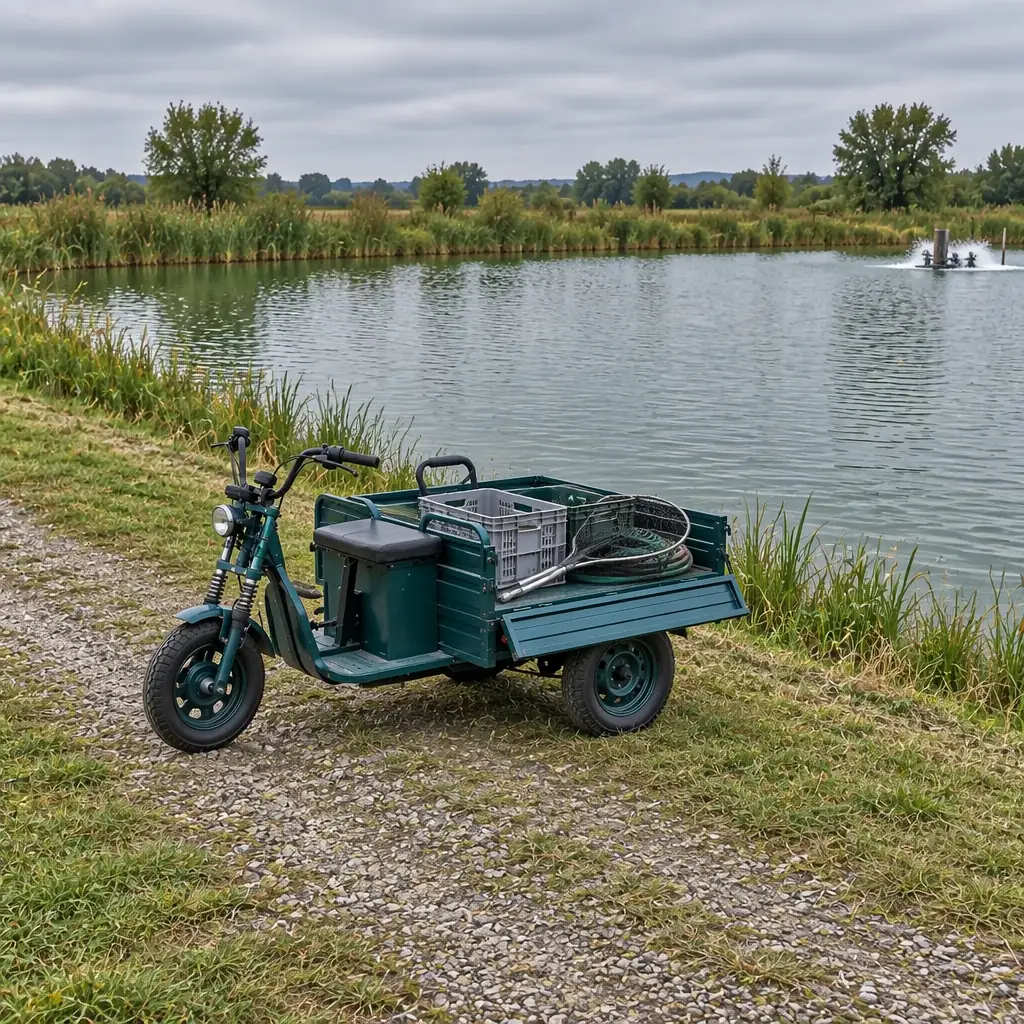
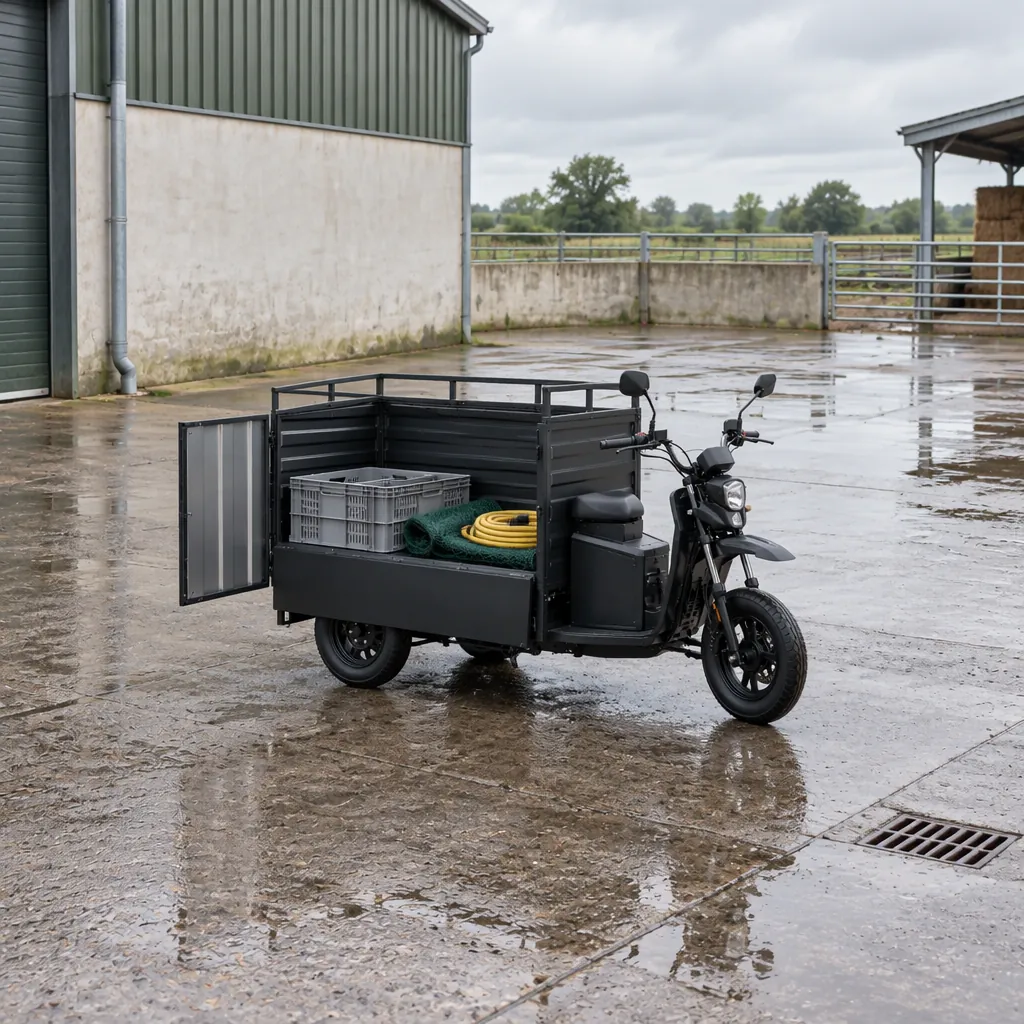
This is where a drop-side body earns its place on a fish farm. The deck converts to a flatbed so sacks can be loaded by pallet from the store and offloaded at the feeder station, and a three-way drop-side body lets a crew reach the whole floor of the load bed from any side rather than climbing in. For sites running an automatic feeder line, the same vehicle carries spares on the same circuit. The arithmetic that decides whether one vehicle is enough is the same one that governs any circuit duty: total circuit time per feed round, multiplied by rounds per day, compared with the hours a shift actually has. The method is set out in our fleet and charging guide, and it usually shows that the constraint is not range, it is how many minutes the vehicle spends being loaded.
Charging at a pond site: the outlet is the real constraint
Fish farms are usually far from a good electrical supply. The charging point may be a shed at the head of the site, a pump house with a single socket, or a generator that runs only when the aeration is on. The platform's charging figures are 6 to 10 hours on a 5 A charger for the 60V 32Ah and 72V 40Ah packs, which tells you the vehicle is an overnight-charge asset, not one that can be topped up between ponds.
The practical consequences are straightforward. If the vehicle does two shifts a day, the charger count has to match the shift count, not the battery capacity; a bigger pack only delays the moment the vehicle joins the charging queue. Where the site has no grid, a solar option that adds a small daily range is worth more than a larger pack for the same money, because it removes one queue. Background on pack chemistry, cycle life and the case for LFP in hot climates is in the battery pack guide; for a farm in a hot region, pack longevity under thermal stress matters more than saving a few kilos.
Where a farm trike stops: the honest limits
A cargo tricycle is not a live-haulage truck, and any supplier who tells you otherwise has not read the regulations. Three cases where this platform is the wrong tool:
- Large fish over a long distance. Market-size fish moved by road for an hour need purpose-built tankers with oxygen injection and water exchange. A deck-mounted tank on a three-wheeler does not carry enough water to keep that load alive, and the payload rating simply does not reach the numbers involved.
- Any duty that requires a crane lift. If your release method lifts a full tank over a bank, no amount of deck capacity helps; the vehicle must be able to stay out of the lift path.
- Ponds with no vehicle access at all. Where the last hundred metres is a footpath or a flooded bank, the stock arrives on a barrow regardless of what is parked at the gate.
Winter is a fourth constraint worth naming. Cold water holds oxygen better, which lengthens the safe transfer window, but cold also reduces usable battery range and stiffens hydraulic seals. What actually changes on a winter round is the plan, not the vehicle; our winter operation guide covers the temperature effects on range and charging that apply at a pond site just as they do at a depot.
Specification to put in the request for quotation
Bring your own numbers to the quote and the configuration follows. This is the list we would ask a farm buyer for, and the platform values we build to.
| Item | What to send | Platform value or option |
|---|---|---|
| Live load per trip | Kilos of fish plus litres of water | 300 kg (EU) / 500 kg (non-EU) deck rating; 150–500 L body volume |
| Body form | Tank over axles, bins, or flatbed for feed | Drop-side body converting to flatbed; fixed flatbed with stake sides; insulated sandwich panel body; 40 mm PU insulated box |
| Drive | Gradient, surface, longest loaded climb | 800W / 1000W / 1200W brushless hub motor with differential, 60V or 72V |
| Battery | Rounds per day, charge window, climate | 60V 32Ah / 72V 40Ah lithium, LFP available, 6–10 h at 5 A |
| Range expectation | Circuit length per shift | 50–80 km with 200 kg on flat ground |
| Brakes and parking | Levee gradients, crew leaving the vehicle loaded | Hydraulic disc front, dual drum rear, parking brake |
| Tyres | Surface: grass, clay, gravel, concrete apron | 3.00-12 front, 3.75-12 rear dual, load-rated |
| Electrical extras | Aerator supply, lighting for early starts | LCD display with load indicator, full LED lighting, optional beacon, forward/neutral/reverse selector |
| Documentation | Destination market | UN 38.3 transport testing; cell and BMS test documents with the export file |
| Commercial | Volume and branding plans | MOQ 50 units; 15–30 days standard, 30–45 days for a first custom-branded run; pre-production sample before mass production |
Two of those rows deserve a note. The range figure is quoted with a 200 kg load on flat terrain, which is a different condition from a levee circuit with a full tank, so expect a shorter working range and plan charging accordingly. And the documentation pack is not a marketing line: moving a lithium pack by sea requires UN 38.3 test evidence, and the same dossier is what a farm's own insurer will ask for when the vehicle is parked in a pump house. The fuller picture of what a first import order carries is in our import guide.
A first-month plan rather than a purchase
Run one vehicle against one duty for a month before expanding, and measure four things: minutes per pond round, kilos of fish per trip as actually loaded, the number of feed rounds a single overnight charge will support, and any point on the circuit where the crew had to stop and get off. That last one is the most useful number in the list, because it tells you whether the limiting factor is the vehicle, the body configuration or the site itself. A farm that measures those four things for a month buys the right second vehicle without a second study.
The same discipline applies when a site grows into a mixed fleet. Ponds, yards and buildings on one property rarely need one platform; the reasoning behind splitting vehicle roles is set out in our cargo versus passenger platform comparison, and it holds on a fish farm as much as it does in a warehouse. If the site also sprays, washes or carries waste oil, the washdown-grade and corrosion specification discussed in the waterfront and salt-exposure guide is the nearest comparable case to a permanently wet yard. Get the container, the body and the braking right for the wet ground, and the motor is the easiest part of the specification to settle.
Spec a Trike Around Your Pond Round
Tell us the live weight per trip, the water you need to carry and the narrowest gate on your levee. We will come back with a body form, a container layout and a tank, aerator and charging plan matched to your site.
