
The question arrives in the enquiry box in almost the same words every week: are electric trikes stable? It is a fair question, and the honest answer is that three wheels are stable at rest and can be unstable in motion, because resting stability and turning stability are two different properties and only one of them is obvious in a showroom. A rider who steps onto a stationary trike feels a solid platform. A rider who turns that same trike at 20 km/h with 400 kg in the box on a cambered road is running a physics problem that the showroom never tested.
This guide answers the question the way a fleet buyer needs it answered: which measurements actually predict stability, what our own platform does and does not claim, where a three-wheeled layout stops being the right tool, and what evidence to demand from any factory before signing. If you are still deciding between layouts, the passenger e-tricycle guide covers the seating and geometry side, and the cargo versus passenger comparison covers which platform suits which duty.
The Short Answer, Stated Honestly
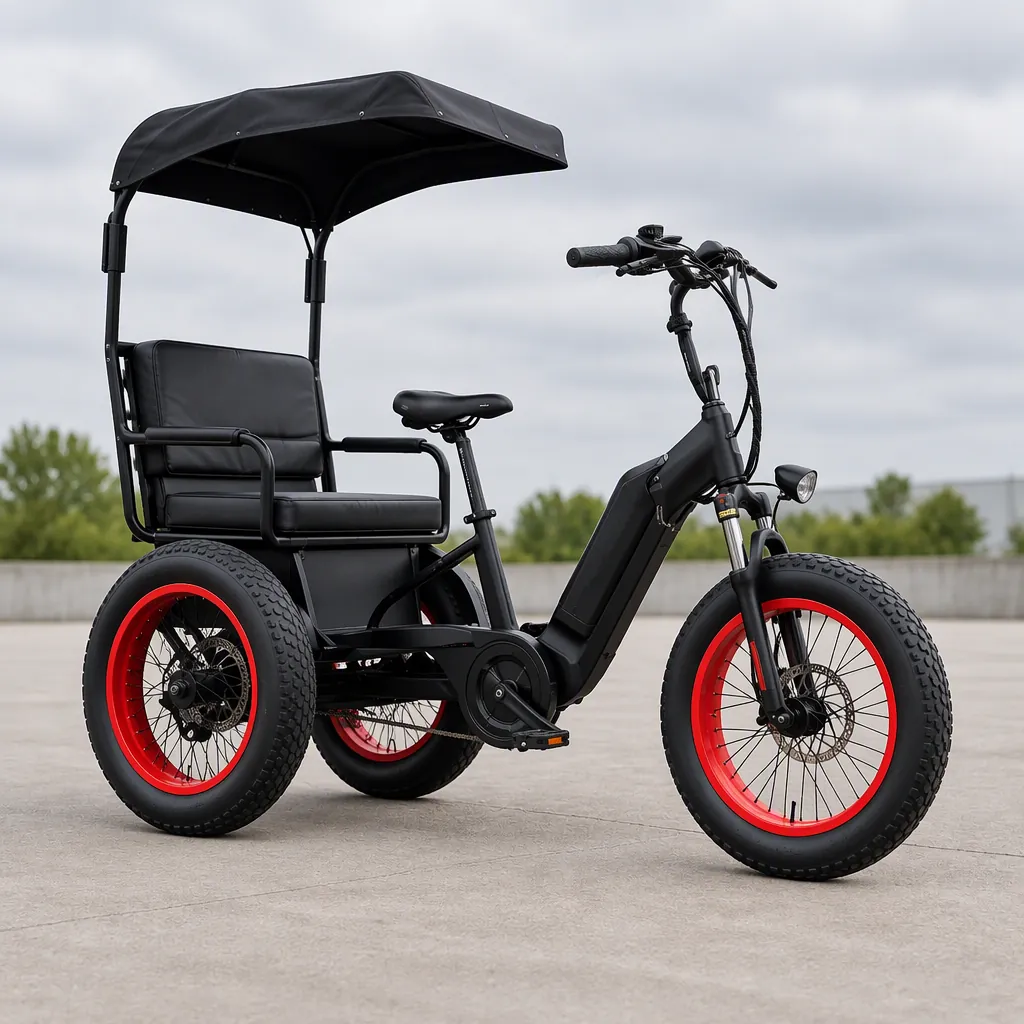
A delta tricycle, meaning one wheel at the front and two at the rear, is more stable than a two-wheeler at low speed, at rest, on loose surfaces and when carrying an off-centre load. That is a real operational advantage and it is why delivery fleets, farms and municipal crews run them. It is not more stable than a four-wheeler in a fast turn, and it can be less forgiving than a two-wheeler in one specific situation: a turn taken at speed with a tall, heavy load, where the lateral force has enough leverage over the rear track to lift the inside rear wheel.
The engineering statement behind that is simple. A vehicle tips when the overturning moment about the outer wheel contact line exceeds the restoring moment of the weight acting through the centre of gravity. For a trike, widening the rear track increases the restoring lever arm, and raising the centre of gravity increases the overturning lever arm. Those two numbers, not the wheel count, decide the outcome. Everything else in this guide is about controlling them.
The Four Numbers That Decide Whether a Trike Feels Stable
When a buyer reports that a trike feels “tippy”, one of four numbers is almost always the cause. Ask for all four in writing before you approve a sample.
1. Rear track width, read against loaded height. Track width alone means nothing. The useful ratio is rear track divided by the height of the centre of gravity with the rated load in the box. A wide track with a tall container on top is a rollover profile. A narrower track with a low container can be the safer vehicle. This is why a flatbed build and a high-sided box build on the same chassis behave completely differently, and why the box specification belongs in the stability conversation rather than in the bodywork conversation.
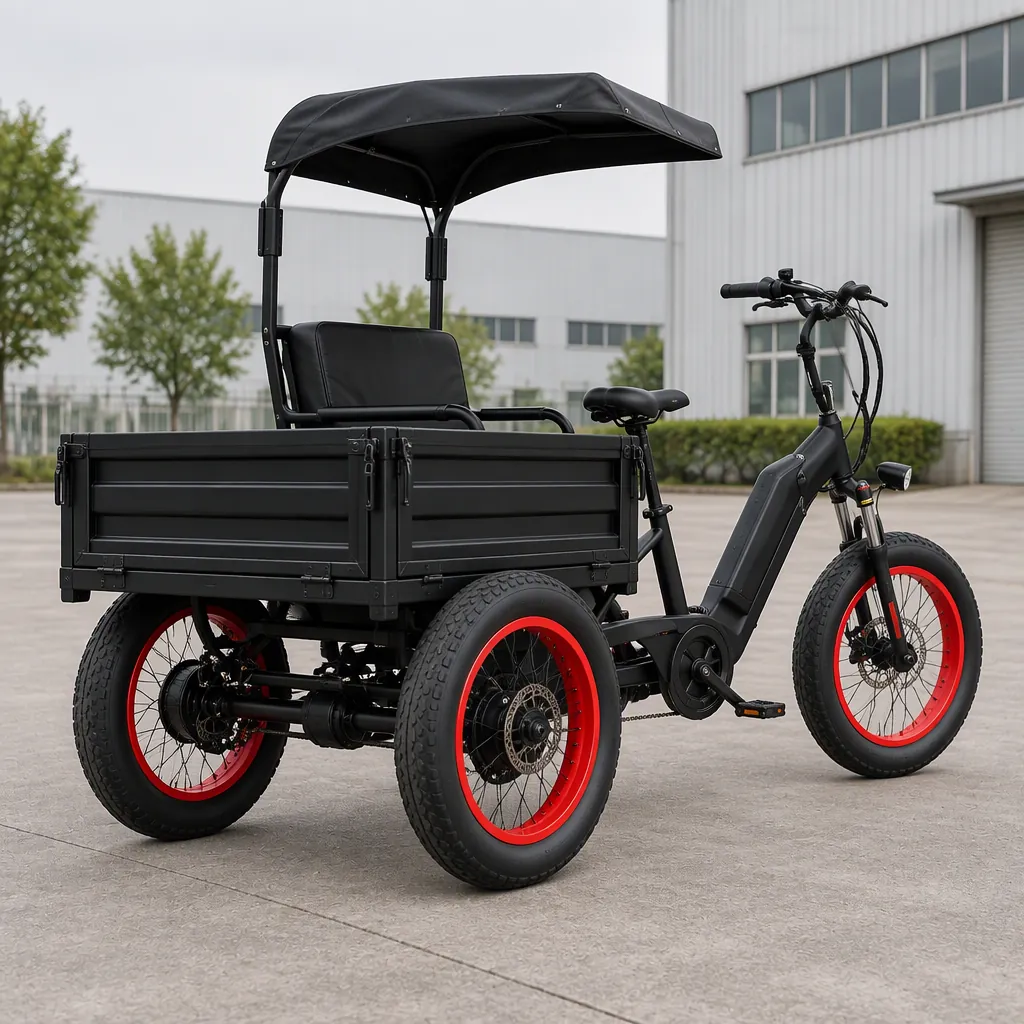
2. Whether the rear axle is driven through a differential. On a delta cargo platform with a single driven rear axle, the differential lets the two rear wheels rotate at different speeds through a turn. Without one, the outer wheel is forced to travel the same arc as the inner wheel, so the pair fights the surface. On dry asphalt that shows up as scrubbed tyres and a vehicle that resists tightening a line. On a wet or gravel yard it shows up as the rear stepping out at low speed, which is exactly where operators least expect it. Our cargo platform specifies a brushless hub motor with differential across the 800 W, 1,000 W and 1,200 W tiers, and the 18-month drivetrain warranty explicitly covers the differential lock mechanism. If a competing quote does not state the differential, ask directly, because the answer changes how the vehicle behaves in every tight turn.
3. Where the cargo box actually sits relative to the rear axle. Load behind the rear axle acts as a lever on the front wheel, unloading it. Unloaded front wheels lose steering authority, which on a trike appears as vague, disconnected steering rather than as obvious understeer. The box should sit within the wheelbase envelope for the loads the vehicle is rated to carry. A long overhang looks generous in a photo and feels light and imprecise on the road.
4. Suspension behaviour at rated load, not at kerb weight. A leaf-spring rear setup that rides comfortably empty can reach the bump stops at rated payload. When it does, ride height drops at the rear, the centre of gravity moves rearward and downward in a way the original geometry did not assume, and the front unloads further. The suspension question is therefore not “is it comfortable” but “does it still have travel left at 500 kg”.
What Our Platform States, and What It Does Not
We would rather publish a short list of real numbers than a long list of adjectives. These are the figures that appear on our own cargo tricycle specification page and they are the ones a buyer can hold us to.
| Property | Cargo platform | Why it matters for stability |
|---|---|---|
| Layout | Delta: one front wheel, two rear wheels | Rear axle carries the lateral restoring moment; front wheel steers |
| Drivetrain | 800 W / 1,000 W / 1,200 W brushless hub with differential | Differential prevents rear-wheel fight and scrub in tight turns |
| Rear suspension | Leaf spring, reinforced load-rated | Keeps geometry predictable at rated payload |
| Brakes | Hydraulic disc front, dual drum rear, parking brake | Asymmetric braking on a trike can induce yaw; dual rear drums keep the rear axle balanced |
| Tyre format | 3.00-12 front / 3.75-12 rear, dual rear | Wider rear contact patch raises the lateral grip ceiling |
| Rated payload | 300 kg (EU) / 500 kg (non-EU) | The EU figure includes the driver; the limit is regulatory, not mechanical |
| Loaded range | 50–80 km at 200 kg, flat terrain | Stated at a defined load, so range claims are comparable |
| Speed | 25–35 km/h, governor settable | Governor is the single most effective stability control you can fit |
| Kerb weight | 150–220 kg without cargo box | Heavier vehicle resists lateral disturbance but needs more brake |
What we do not publish is a headline track width, wheelbase or centre-of-gravity height, because those figures differ by box configuration and by market. A flatbed utility build, a 500 L drop-side box and an insulated cold-chain body are three different vehicles on one chassis, and quoting one track width for all three would be misleading. Instead, a dimensional drawing with the track, wheelbase and loaded height for your specific box is issued with the quotation, and confirming the loaded centre-of-gravity height is part of the pre-production sample review covered in the golden sample and first-article approval guide.
Turn Behaviour by Surface: Where a Trike Wins and Where It Bites
Stability is not one property, it is a table of surface and manoeuvre combinations. The same vehicle that feels planted on a warehouse floor can feel nervous on wet clay.
Dry sealed road, gentle turns. The best case. Rear tyre grip is predictable, the differential does its work, and the intrusion of a three-wheeled geometry is minimal. This is the environment most stability claims are implicitly written for.
Dry sealed road, fast 90-degree turn. The stress case for loaded trikes. The faster the entry speed and the taller the load, the sooner the inside rear wheel unloads. Two controls matter here: entry speed and load height. A 500 L box loaded to the top with a dense material is at the wrong end of both.
Wet asphalt, painted markings, metal drainage covers. Grip drops sharply and unevenly. On a two-wheeler the failure mode is a slide; on a trike it can also be a tip, because lateral grip at the rear axle is what generates the overturning moment. Reduce speed before the marking, not on it.
Gravel, packed earth, construction yards. Here the trike is usually the more predictable vehicle, because a third contact point reduces the chance of a wheel losing grip entirely. The limit moves from tipping to traction and braking distance. The brake and axle behaviour on a loose surface is covered in more detail in the quarry and mine site distribution guide.
Camber, cross-slope and loading ramps. A camber adds a permanent lateral component that pushes the vehicle toward the low side, so the restoring margin is reduced before the driver does anything. Loading ramps and dock plates combine a camber with a height change at the moment the load is highest. If your route includes drive-up loading, stability belongs in the site survey, not only in the vehicle spec.
Snow, ice and standing water. Studded or heavily treaded tyres help, but on ice the failure mode is lateral loss of grip at all three wheels, and no geometry fixes that. The operational answer is speed restriction, route choice and, in extreme cases, seasonal tyre change, which the winter operating guide sets out ride-height and tyre advice for.
Load Placement: The Cheapest Stability Upgrade You Can Make
Most instability incidents on cargo trikes are loading incidents, not engineering incidents. Three rules cover almost all of them.
Keep the mass low and inside the wheelbase. Dense goods belong on the floor of the box, not stacked to the lid. A 40 kg item on the floor and the same item at the top of the box are the same weight and a very different vehicle.
Do not load one rear corner hard and leave the other light. The asymmetric case is the one that lifts a wheel in a turn even when the total mass is well within the rating. If your operation routinely moves one heavy irregular item, that is the load you should test on the sample, not the neatly distributed demo load.
Reduce the load before you reduce the speed limit as a substitute. A governor set to 15 km/h with a 500 kg load in a high box is a compromise that hides a specification error. Choose the box height and payload class for the duty, then use the governor for site rules rather than as a stability correction.
The Evidence to Ask a Factory For
A resting tilt test is not a stability test. If a supplier sends a photograph of a trike parked on a slope and calls it stability verification, you have learned nothing about the vehicle under load in motion. Six questions separate a real answer from a brochure answer.
One: the dimensional drawing with loaded height. Track width, wheelbase, box floor height and box height, with the rated load included. This is the document that lets your own engineer run the overturning calculation rather than accept a claim.
Two: the differential specification in writing. Which axle, whether it is open or locking, and whether the lock is covered by warranty. On our platform the differential lock is named in the 18-month drivetrain warranty alongside winding failure and gear-tooth breakage.
Three: brake balance evidence at rated load. Our dyno cycle verifies brake force distribution, and the outgoing inspection runs a loaded road test with ballast to confirm brake balance and motor thermal behaviour. Ask any supplier what their equivalent is, and at what payload it is performed.
Four: a loaded road test, witnessed or filmed. Our factory walkthrough option includes a loaded road test with 300 kg of ballast. A test with ballast at the rated figure tells you more than a hundred marketing renders.
Five: the payload rating rationale. Ask why the figure is what it is. On this platform the EU 300 kg limit is a regulatory limit that includes the driver under the L2e classification, while the non-EU 500 kg figure is the full mechanical rating, and the frame, motor and battery are identical between the variants. A supplier who cannot explain the difference between a regulatory limit and a mechanical limit has not engineered the number.
Six: fastener torque ranges. Torque verification is performed on every safety-critical fastener with digital torque wrenches that log to the unit's quality passport: handlebar clamp bolts at 25 N·m, axle nuts at 40 N·m and brake caliper mounts at 18 N·m. A wheel that loosens in service is a stability failure, so this paperwork is part of the stability file, not the admin file.
When a Tricycle Is the Wrong Answer
A guide that only says yes is not a guide. Four duties should send you elsewhere.
Consistently fast road work above 40 km/h. A three-wheeled platform at speed on cambered roads demands more from the driver than a four-wheeled light commercial vehicle. If the duty is a road route at 50 km/h, buy a van or a quadricycle.
Very tall, dense or awkward single loads. If the regular cargo is a 2 metre tall stack, the centre of gravity problem cannot be solved by the chassis. Change the load handling, not the vehicle.
Steep sustained gradients with full payload. Grade is a torque and brake question more than a stability question, and it has a real physics ceiling. The grade and payload analysis for site work sets out where the physics stops and why a higher motor tier is the answer rather than a bigger battery.
Sites with cross-slopes above the vehicle's design envelope. Some yards, ramps and quays are simply outside a trike's envelope. Two units of preparation beats one incident: survey the site first.
What the Driver Can Do, and What Only the Specification Can Fix
It is worth separating the two, because buyers often ask for driver training when the real problem is a specification mismatch.
What training fixes: entry speed into turns, braking before rather than during a turn, loading discipline, and awareness of camber and of wet markings. These are real and cheap gains, and a rider who understands that the rear axle is what generates lateral force will drive a trike very differently from one who does not.
What training cannot fix: a box that is too tall for the duty, a chassis without a differential on tight-turn routes, an axle driven without load-rated suspension travel, or a speed governor set above the site's surface conditions. If a fleet reports repeated “near-miss” incidents after training, the answer is usually one of those four, and it belongs in the next order's specification rather than in a refresher session.
Proving It on Your Own Route
No article settles this question for your operation. A pilot does. Ask for two to four units, run them on your hardest route for a month at your worst permissible load, and run the load configuration you would normally forbid rather than the one that flatters the vehicle: the single heavy item in one corner, the full box, the wet morning. Record the near-misses, because they are the data that will decide your next order.
The sample itself should be approved in a structured way, with the dimensional drawing, the loaded test and the signed-off configuration all fixed before production begins. That process is set out step by step in the first-article approval guide, and the wider question of verifying the factory behind the sample is covered in the factory capacity audit guide.
Frequently Asked Questions
Are three-wheeled bikes more stable than two-wheeled ones? At rest, at low speed and on loose surfaces, yes, clearly. At speed in a turn with a tall load, not necessarily, and a trike can tip where a two-wheeler would only slide. The advantage is real but conditional.
Is a delta or tadpole layout more stable? Delta, with one wheel at the front and two at the rear, puts the lateral restoring moment at the loaded end of the vehicle, which is why it is the standard for cargo and for accessible passenger trikes. Tadpole layouts have other advantages in cornering grip but a narrower rear and a different load platform behaviour.
Do I need a differential on a cargo trike? If the route includes tight turns, yard manoeuvring or repeated low-speed positioning, yes. It prevents the rear wheels fighting each other, which is a stability and tyre-wear issue as well as a comfort one.
Can I make a trike more stable by adding weight low down? Ballast low in the frame lowers the centre of gravity and raises the restoring margin, but it also reduces payload capacity and increases braking distance. It is a legitimate option for a specific problem, not a substitute for correct specification.
Does a speed governor help stability? It is the single most effective control available, because overturning risk scales with the square of speed. Setting the governor for the surface and site rules, rather than for the road maximum, is the cheapest intervention a fleet can make.
The Decision in One Page
Three wheels give you a stable platform at rest and a predictable one at low speed, and that is a genuine operational advantage over a two-wheeler for cargo, passengers and access work. Whether the vehicle is stable in your operation is decided by four numbers: rear track against loaded height, the presence of a differential, the position of the box relative to the rear axle, and whether the suspension still has travel at rated payload. Ask for all four in writing, test the configuration you would normally avoid rather than the one that flatters the vehicle, and let a month on your own route settle the question that a showroom cannot.
Spec a Trike for Your Routes
Send us the box dimensions, the rated payload, the heaviest single item you move, your typical turn and surface conditions, and your destination market. We will confirm the motor tier, the differential specification, the box height that suits the duty and the governor setting for your site rules, then issue the dimensional drawing with track, wheelbase and loaded height for your configuration, together with the FOB quotation. MOQ 50 units, 15–30 day lead time.
