
A liveaboard boat is a house with no driveway. Everything the crew consumes — water, fuel, food, laundry, mail-order parcels, spare parts — arrives at a fixed point on a quay or towpath, and from there it has to travel the last fifty to two hundred metres to the hull. Most boaters solve this with a car parked at the marina gate, a folding trolley, and repeated trips. The question this guide answers is narrower: when does a three-wheeled cargo platform replace the car-and-trolley routine, and what has to be specified before a single unit is ordered.
This is written for two buyers. The first is a residential mooring operator, boatyard or marina that wants to offer a provisioning service to its liveaboard tenants. The second is a boat owner or small liveaboard community buying a shared unit. Both need the same thing: a platform whose geometry fits a quayside, whose payload matches a week of stores, and whose range is measured in round trips to the nearest chandlery rather than kilometres of open road. Every figure below is drawn from our own cargo and utility trike platforms, not from a generic industry estimate.
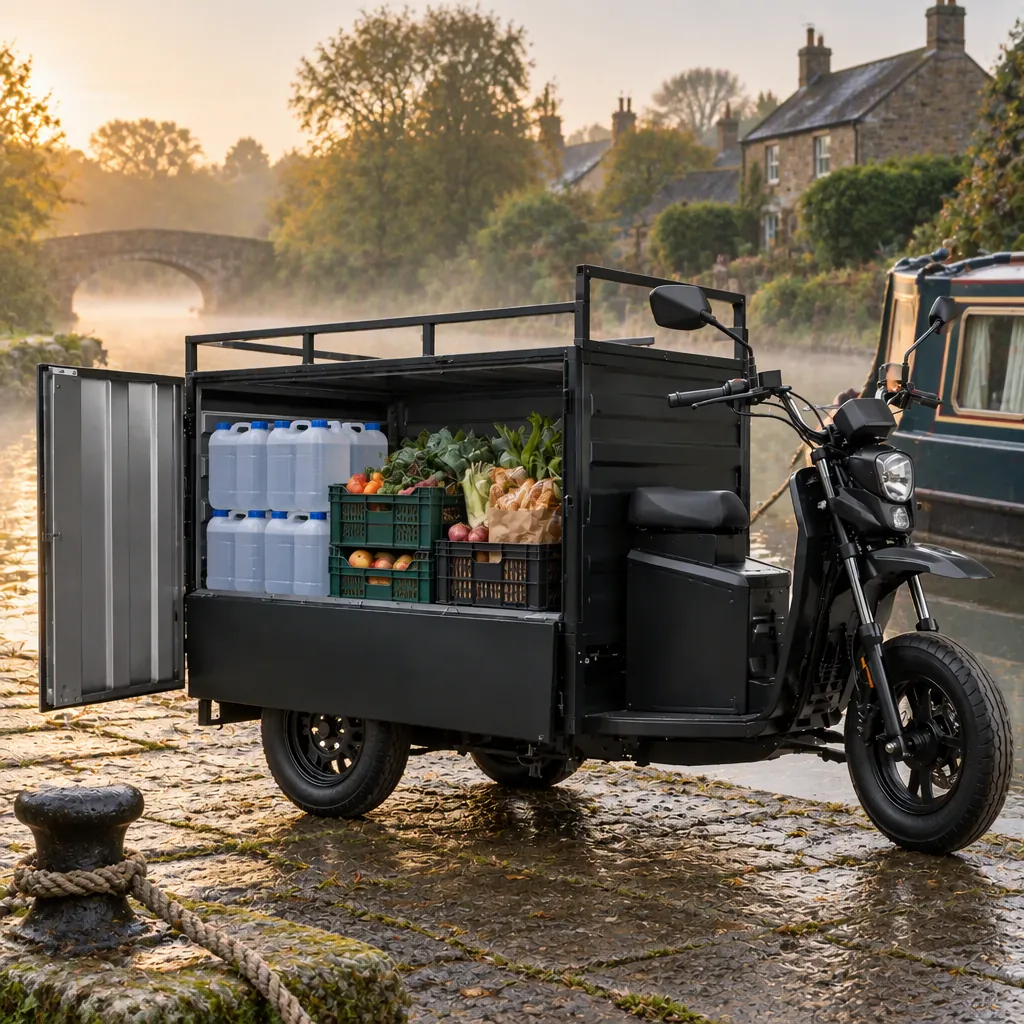
Why a Liveaboard Supply Run Is Not a Delivery Route
The first planning mistake is treating a provisioning run like a parcel round. They share a map but nothing else. A delivery route is a monotonic unload that starts full and finishes empty, with stops measured in seconds. A provisioning run is a short circuit with a heavy dwell: the trike leaves the quay empty, runs to the chandlery or water point, loads two hundred kilograms of stores, and returns to the same berth it started from. The payload that matters is not a shipment to be delivered but a load to be carried home, and the critical constraint is whether that load can be got from the quay edge onto the deck without a crane.
| Duty dimension | Parcel delivery | Liveaboard provisioning |
|---|---|---|
| Route shape | One-way, many drops | Out-and-back to a fixed point of supply |
| Payload direction | Starts full, ends empty | Starts empty, returns full |
| Stop duration | 30–120 seconds | 10–40 minutes loading at supplier |
| Critical constraint | Route density and volume | Quay access, gangway width, load transfer to deck |
| Terrain | Public road and kerb | Towpath, gravel, wet cobbles, occasional ramp |
| Charging point | Depot overnight | Shore power at the berth, or operator base |
That last row is the one that reshapes the whole specification. A delivery fleet charges at a depot it controls. A liveaboard provisioning trike charges wherever the mooring provides a supply, which is often a single 16 A shore-power pedestal shared with the boat itself. The charging arithmetic therefore has to be worked backwards from the pedestal, not from a convenient three-phase bay.
The Range Arithmetic That Actually Matters
Range figures for cargo trikes are quoted at a loaded speed on flat terrain, which is the right basis but the wrong unit. A provisioning run is not a long journey; it is a repeated short one. What matters is how many round trips the pack supports before it needs the berth, because that determines whether the trike can serve several boats in a day or only one.
Our cargo platform carries a 60V 32Ah pack as standard, with a 72V 40Ah LFP option on the heavy-duty build. On the flat, loaded to 200 kg, the standard pack delivers 50–60 km and the LFP build 70–80 km. Converted to provisioning work, a typical out-and-back run to a chandlery is four to eight kilometres, so the standard pack covers roughly seven to twelve round trips and the LFP build fourteen to twenty. In practice the daily cycle is one or two runs, which means range is never the binding constraint — charging time is.
| Config | Pack | Range (200 kg, flat) | Round trips @ 6 km | Full charge |
|---|---|---|---|---|
| Light 800W | 60V 32Ah NMC | 50–60 km | 8–10 | 6–10 h @ 5A |
| Standard 1000W | 60V 32Ah NMC | 60–70 km | 10–12 | 6–10 h @ 5A |
| Heavy-Duty 1200W | 72V 40Ah LFP | 70–80 km | 12–14 | 6–10 h @ 5A |
A full recharge takes six to ten hours at the standard 5A rate. For a residential mooring that is fine: the trike charges overnight on the same pedestal as the boat, and the two are rarely drawing at once. For a marina offering a paid provisioning service across thirty berths, it is the design constraint — a single trike cannot serve more than one full cycle per shift, so the operator either adds a second unit, fits the faster charger, or plans the service around a fixed morning and afternoon slot. Working that number out before ordering is the difference between a service that pays for itself and one that keeps a car on the books anyway.
The Quayside Geometry That Eliminates Most Platforms
A cargo trike that works perfectly on a road can be useless on a towpath. Four measurements decide whether a platform is viable before any specification is discussed, and all four are taken at the mooring, not at the dealer.
1. Towpath and gangway width
Many heritage canal towpaths are 1.5 to 1.8 metres of usable width with a soft, sometimes flooded edge. A trike with a 150–500 L box and a 3.00-12 front / 3.75-12 rear dual-wheel track needs roughly 1.1 to 1.3 metres of that width, leaving too little margin to pass a moored boat or a pedestrian on the narrowest stretches. Where the towpath narrows below about 1.6 metres for any length, a two-wheel cargo bike or a hand trolley is the honest answer, and no amount of motor power changes it.
2. Quay edge and load transfer
The trike stops on the quay; the payload has to reach the deck, often 0.5 to 1.2 metres below and across a gap. A drop-side cargo box is the decisive feature here: the 150–500 L box with folding sides lets stores be slid out on the quay side and handed down directly, rather than lifted over a fixed wall. A platform with a fixed, high-sided box makes every transfer a two-person lift. This single feature decides more liveaboard suitability than motor power does.
3. Gradients and ramps
Slipways, marina ramps and sloped quay approaches are common. Where the sustained gradient exceeds about eight percent under load, the choice is to step up a motor tier rather than add battery capacity. Our platform offers 800 W, 1000 W and 1200 W brushless hub motors with a differential driving the two rear wheels, and the 1200 W / 72V build is the one specified for ramped or sloped access. Adding cells to an underpowered motor buys heat, not climbing ability.
4. Surface and the wet edge
Towpaths and quaysides are wet, often muddy, frequently cobbled. The reinforced load-rated 3.00-12 front and 3.75-12 rear dual tyres, hydraulic disc front brake and dual drum rear with a parking brake are what keep a 200 kg load controllable on a slick edge. The parking brake in particular matters on a sloping quay: it lets the operator leave the loaded trike safely to open a gate or rig a line, rather than holding it by hand.
What a Week of Liveaboard Stores Actually Weighs
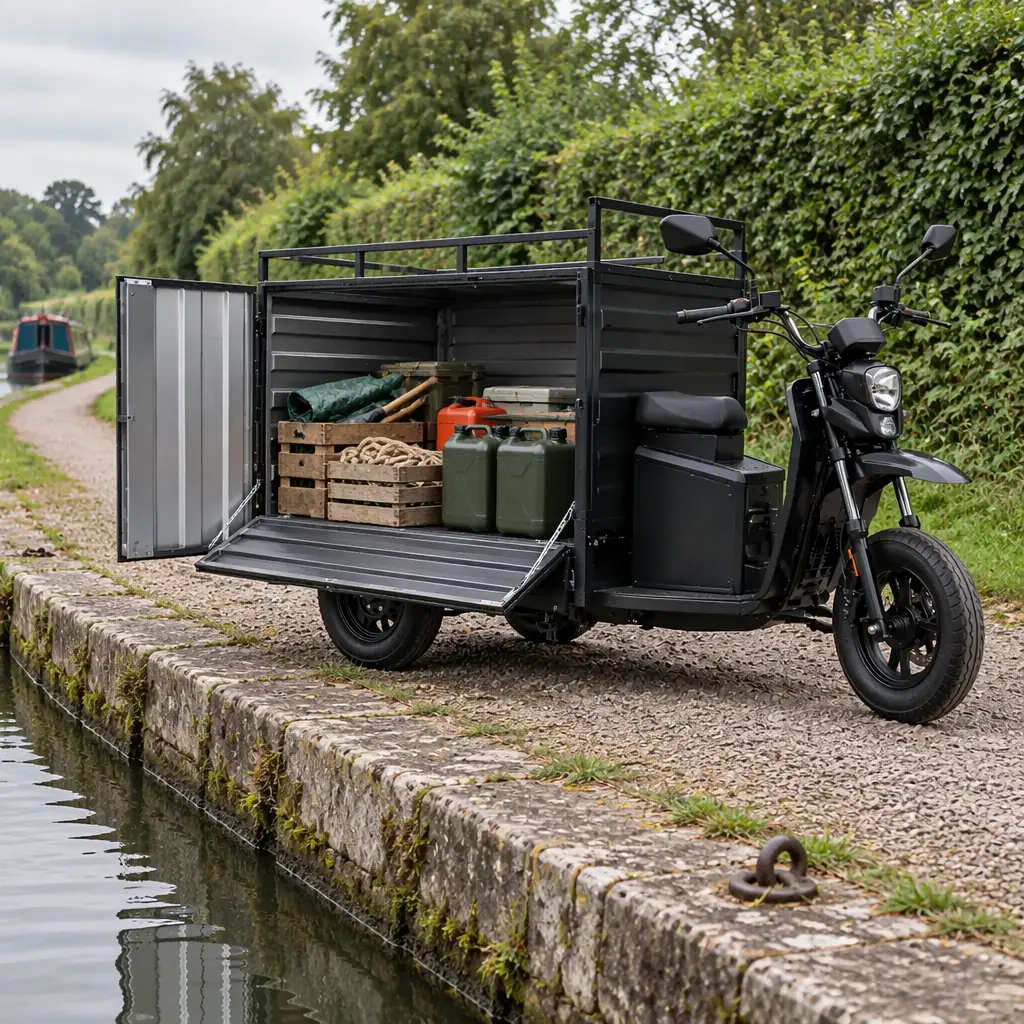
Liveaboard provisioning is water-dominant. The single heaviest recurring load is fresh water, and it dominates the arithmetic the way parcels dominate a delivery route. Working in the common container sizes gives a realistic envelope.
| Store type | Typical unit | Weight per run | Notes |
|---|---|---|---|
| Fresh water | 20 L jerry cans | 40–120 kg | Two to six cans; the dominant load |
| Diesel / heating fuel | 20 L cans | 20–60 kg | Three cans at 17 kg full each |
| Weekly groceries | Bagged shopping | 30–60 kg | Volume-heavy, weight-light |
| Gas bottle | 13 kg cylinder | ~25 kg | One full cylinder plus exchange |
| Coal / solid fuel | 25 kg bags | 50–100 kg | Winter only, dense |
| Parcels and spares | Cartons | 10–40 kg | Volume-driven, low density |
The realistic peak for a single provisioning run is 150 to 250 kg, which sits comfortably inside the platform's 300 kg (EU) and 500 kg (non-EU) load rating. The box volume of 150–500 L is the constraint that bites first on a volume-heavy run such as groceries and parcels: water and fuel are dense and fill the floor, while bags and cartons need the folding sides opened or a second trip. A liveaboard community running a shared unit should specify the larger 300–500 L box rather than the 150–300 L version, because the extra volume costs no payload and solves the volume-heavy runs.
Water, Fuel and the Case Against a Trailer
A common first instinct is to buy our box trailer and tow bulk loads. On a wide marina quay that works well. On a narrow towpath it does not: a trailer doubles the width the operator has to manage and makes reversing into a tight berth approach genuinely difficult, on a surface where grip is already marginal. The trailer also adds a second coupling point to secure before every run. For most liveaboard moorings the right configuration is a single trike with the largest practical box, not a trike plus trailer, and the trailer earns its place only where the quay is wide and the run is long. Our payload capacity guide works through the same load-versus-volume trade in more detail.
Corrosion, Mud and the Maintenance Reality
A canal-side platform lives in a harsher environment than a factory trike: persistent damp, mud, salt on coastal estuaries, and a wet deck edge. The e-coat plus powder-coat steel chassis resists rust better than a painted frame, but the operator should still plan for the same maintenance cadence as a boat. Our maintenance guide covers the schedule; the liveaboard-specific additions are washing the brakes and tyres after coastal runs, checking the battery compartment gasket seasonally, and keeping the charging connector dry at the shore-power pedestal. Where the mooring sits on tidal or estuarine water, the corrosion duty resembles a marina more than a canal, and the salt specification in our waterfront fleet guide transfers directly.
Charging From a Shore-Power Pedestal
Shore power is the practical constraint that separates a liveaboard deployment from a commercial one. A residential berth typically provides a 16 A supply shared between the boat and anything else plugged in. Charging the trike at the standard 5A rate draws within that budget comfortably, which is exactly why the 60V 32Ah and 72V 40Ah packs at six to ten hours are the right choice rather than a high-current pack that would trip the pedestal. The fleet charging guide sets out the arithmetic for larger moorings; for a single residential berth the rule is simpler — charge overnight, on the same supply as the boat, and never plan a mid-day top-up that competes with the galley or the heating.
Running the Numbers Before Buying
For a mooring operator weighing a provisioning service, three numbers decide the case. First, the distance from the berths to the nearest supplier: below about eight kilometres round trip, one trike covers the day. Second, the number of berths served and how many actually want the service — thirty berths rarely means thirty customers. Third, the cost of the alternative, which for most liveaboards is a car that already exists and a trolley that already works. The trike pays for itself where the alternative is a *second* vehicle, or where the mooring is in a low-emission or parking-restricted zone and the car is a recurring problem. Where the car is already there and the distance is short, the honest recommendation is to keep the car and buy a good trolley.
For a boat owner or a small liveaboard community, the decision is simpler. A shared trike between three or four neighbouring boats splits the cost and eliminates the repeated-trip friction that makes a weekly shop an ordeal. The platform specification is the standard cargo build: the 1000 W configuration with the 60V 32Ah pack and the large drop-side box covers every load in the table above with margin.
What to Put in the Purchase Specification
A liveaboard provisioning spec that avoids the common failures includes: the 1000 W or 1200 W motor with differential for sloped or ramped quay access; the 60V 32Ah pack as a minimum, LFP where the mooring is hot or the cycle count is high; the 300–500 L drop-side box; the full LED lighting set with a beacon where the towpath is shared with walkers at dusk; the hydraulic disc front and dual drum rear brakes with parking brake; and the reinforced 3.00-12 / 3.75-12 tyres. Our standard order terms are a 50-unit MOQ for a factory order and 15–30 days lead time, with custom box configurations adding roughly ten days. Fleet and mooring operators ordering in volume should confirm the spare-parts and after-sales terms, which our spare parts guide covers, and check the regulatory position for the jurisdiction, summarised in our US and EU rules guide.
The lowest-risk path is to run one trike on one mooring for a month before ordering more. Log four numbers: provisioning trips per week, average load carried, energy cost against the fuel the car would have used, and the time saved per trip. Those four numbers will either justify the second unit or show that the towpath is too narrow for the platform to help. A pilot designed to produce a decision, rather than to confirm a preference, is what turns a liveaboard provisioning idea into a routine that is still running two winters later.
Operators who want to see how the specification wraps around a supply run can work from our canopy and suspension guides for weather and surface protection, our water and beverage delivery guide for the water-load handling pattern, and our farm and ranch guide for the rural out-and-back duty cycle that most closely resembles a towpath run.
Size a Cargo Trike Around Your Mooring and Stores
Tell us your quay access, the distance to your nearest supplier, and the load a typical run carries. We will send the platform configuration, box layout, and FOB pricing for a mooring or fleet order.
