
An express carrier does not buy vehicles. It buys a number of stops completed per shift, and an electric cargo tricycle is only worth its invoice if it holds that number through rain, peak season and a battery that has been cycled four hundred times. That is a different specification problem from the one a retailer or a last-mile startup faces — and it is the reason carrier fleets reject general-purpose trikes within a season.
This guide walks through the four decisions that actually determine whether a tricycle fleet works inside a parcel network: matching the platform to route duty cycle, fitting the scan and load workflow, sizing depot charging against swap economics, and writing an OEM contract that binds the supplier to carrier-grade evidence. The specifications and test thresholds below are the ones we build to at our own factory — the numbers a carrier can verify, not the ones a brochure claims.
Platform vs Duty Cycle: What a Parcel Route Actually Demands
Parcel work splits into three duty cycles, and they do not share a specification. Getting this classification wrong is the most expensive mistake in fleet planning, because a trike bought for the wrong cycle fails on payload rather than on distance — usually in month three.
Residential stop-and-go. Short hops between stops, constant motor start torque, dozens of full stops per shift, low average speed but high duty on the brakes and controller. Here the constraint is thermal and mechanical, not range. A fleet running 60–90 stops over a 30–40 km route needs the motor to survive repeated 0–25 km/h pulls with a full box.
Commercial and high-street bulk. Fewer stops, heavier drops — business addresses taking multi-box consignments, retail restocks, and depot-to-depot transfers. Payload per stop rises sharply and the box volume becomes the binding constraint. This is where a 150–300L box runs out of space before it runs out of weight capacity.
Inter-hub shuttle. High mileage, fewer stops, tight arrival windows. Range and charging turnaround dominate; payload is secondary. A vehicle that cannot complete two round trips on one charge introduces a mid-shift charging stop that no carrier schedule accommodates.
The table below shows how our cargo platform is specified across those cycles. The measured figures are taken from the platform's published specification, and the loaded-range column assumes 200 kg of cargo on flat terrain — carriers operating in hilly terrain should derate it by roughly 20–25%.
| Specification | Light 800W | Standard 1000W | Heavy-Duty 1200W LFP |
|---|---|---|---|
| Motor | 800W hub, 60V | 1000W hub, 60V | 1200W hub, 72V |
| Battery | 60V 32Ah NMC | 60V 32Ah NMC | 72V 40Ah LFP |
| Range (loaded) | 50–60 km | 60–70 km | 70–80 km |
| Payload (EU / non-EU) | 300 / 500 kg | 300 / 500 kg | 300 / 500 kg |
| Box volume | 150–300L | 200–400L | 300–500L |
| Vehicle weight | 150–180 kg | 170–200 kg | 190–220 kg |
| Price (FOB) | $1,250–1,550 | $1,580–1,880 | $1,880–2,250 |
| MOQ | 50 units | 50 units | 50 units |
Two specification details matter more to carriers than the headline numbers. First, the drive uses a differential on the rear axle, not a single driven wheel — a trike without one scrubs the inner wheel through every turn, and under a loaded box that turns into accelerated tyre and axle wear. Second, the gear selector offers forward, neutral and reverse. Reverse is not a convenience feature on a parcel route; it is what lets a rider back out of a loading bay or a tight courtyard without dismounting and pushing a 200 kg vehicle.
The Scan Station: Where Vehicle Spec Meets Carrier Workflow
A parcel trike is part of a data pipeline. Every consignment gets scanned at pickup, on load, and at delivery — and if the vehicle layout makes those scans awkward, riders improvise, and improvised scans produce the exceptions that cost a carrier its service-level metrics.
Three layout requirements follow directly from that.
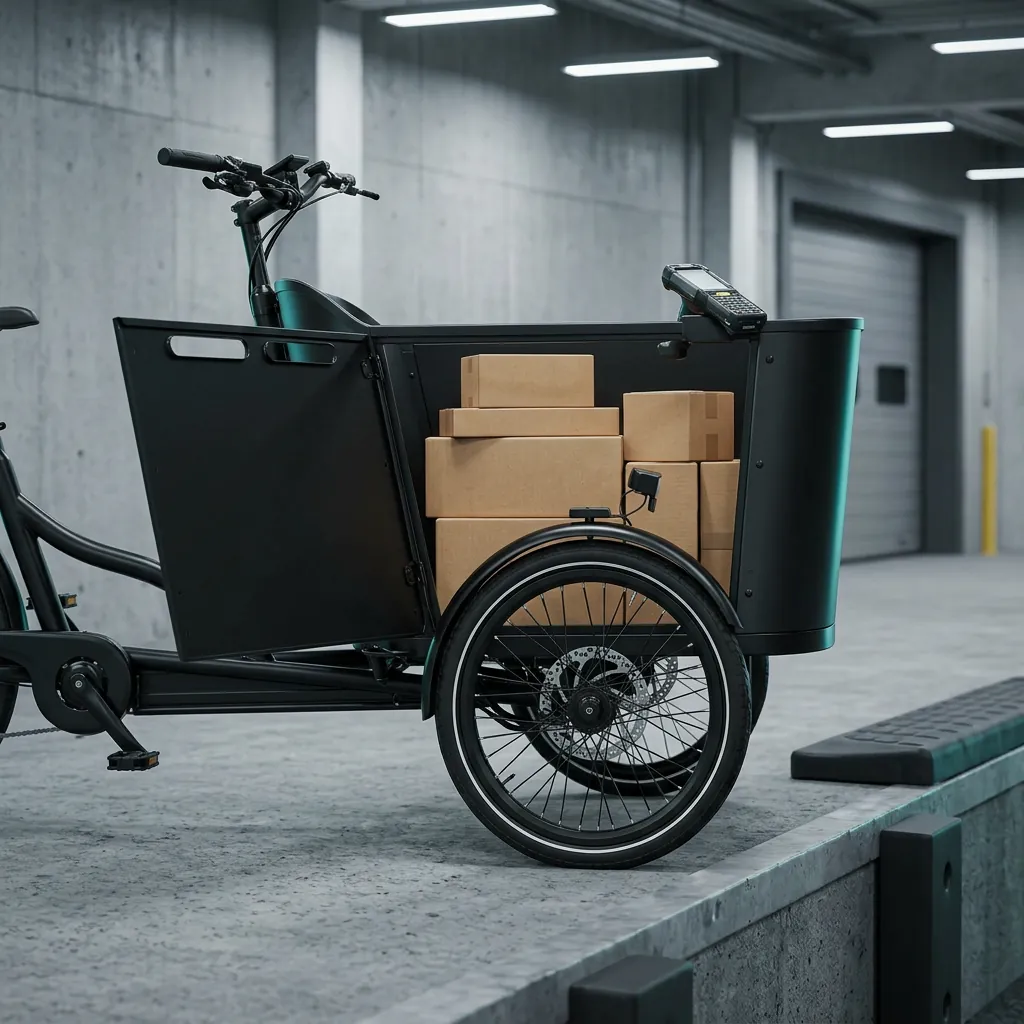
- The box must open on the roadside face, at working height. A top-opening box forces the rider to reach over the load, which slows every stop and increases handling damage on stacked consignments.
- The scanner needs a powered, fixed mount. Handheld scanners clipped to a jacket get dropped, and a scanner running on its own battery adds a second charging routine. A 12V accessory circuit off the main pack removes that entirely.
- The box interior must be compartmentalised and numbered. Route-sequenced compartments let a rider load once at the depot and pull each stop's consignment without searching. On a route with 70 stops, that search time compounds into the single largest controllable loss in the shift.
The practical specification consequence: box volume is not a single number but a layout decision. Our platform offers 150–500L across the three configurations, with aluminium or steel construction, drop-sides for oversized items, and optional insulated lining when the route includes temperature-controlled consignments. Carriers moving mixed freight should define the interior module grid in the RFQ rather than assuming the standard box will suit their scanning workflow.
Depot Charging Sizing and the Swap vs Plug Decision
Most fleet electrification failures are electrical infrastructure failures wearing a vehicle costume. A depot that plans to plug in thirty trikes needs to know the load that represents, and the arithmetic is straightforward once the pack specification is fixed.
Our standard 60V 32Ah pack charges from empty in 6–10 hours on the supplied 5A charger. The 72V 40Ah pack runs longer. That means a single shift per day per vehicle is achievable with overnight charging and nothing more ambitious than a domestic-grade circuit per trike.
Two shifts per day is where the decision becomes real, and there are only three answers:
- Overprovision the pack. Move to the 72V 40Ah LFP configuration with 70–80 km loaded range and cover both shifts on one charge. Simplest operationally; adds vehicle cost.
- Swap packs. Buy a spare pack per vehicle and change it between shifts. Requires the pack to be genuinely removable and the fleet to accept a second battery's capital cost. Our packs are designed for this — but it must be specified, not assumed.
- Charge in the window. Add chargers and a midday plug-in slot. Only works if the shift structure actually leaves a gap long enough for a meaningful top-up.
The LFP option deserves a specific mention for carriers, because it is chosen for a different reason than range. LFP packs tolerate deeper cycling and hold capacity across more cycles than NMC. For a vehicle discharged close to empty every working day, that changes the battery replacement interval — which is the largest single line in a five-year fleet cost model, not the purchase price. Carriers planning a four-to-five-year asset life should be asking for cycle-life evidence at the RFQ stage rather than discovering the difference at replacement time. Our thermal chamber gates new cell suppliers at 200 cycles at 45 °C with less than 15% capacity fade before approval.
Charging hardware itself should be specified with the vehicle, not sourced separately. Mismatched chargers are the most common cause of premature pack failure in fleet service, and the charger specification — voltage window, current rating, connector type, and charge-termination behaviour — must be declared per configuration in the order documents.
What a Carrier Must Verify Before Accepting a Fleet
Vehicle specifications are claims until they are measured. A carrier taking delivery of fifty units is entitled to the measurement records, and a supplier that cannot produce them is a supplier whose specification sheet is marketing.
At our factory every vehicle passes three gates, and the records travel with the order:
| Gate | What is measured | Acceptance threshold |
|---|---|---|
| Incoming (IQC) | Cell internal resistance and open-circuit voltage sorting, sampled to AQL 2.5 Level II | Reject beyond 3 mΩ IR spread or 0.02V OCV spread |
| In-process (IPQC) | Safety-critical fastener torque, logged to the unit's quality passport | Handlebar clamp 25 N·m, axle nuts 40 N·m, brake caliper 18 N·m |
| In-process (IPQC) | Battery BMS protection behaviour and compartment pressure-decay leak test | Overcharge 54.6V, over-discharge 36V, short-circuit response <200 µs; 3 kPa hold for 15 s |
| Outgoing (OQC) | Dynamometer acceleration and cruise efficiency mapping | 0–25 km/h under 6.8 s at 75 kg load |
| Outgoing (OQC) | IP54 spray chamber with the electrical system powered, then insulation resistance | 10 L/min for 3 min; >1 MΩ at 500V DC to frame ground |
Braking deserves its own threshold because parcel routes are stop-heavy: our bench measures 50–0 km/h stopping distance on a simulated 0.7µ surface, and the acceptance limit is 4.2 m on 160 mm rotors or 3.8 m on 180 mm at 75 kg system mass. A carrier whose routes are dense residential streets should specify the larger rotor and require the measurement.
Market access runs alongside vehicle quality. The certifications a parcel fleet needs to operate legally vary by lane — EN 15194 and CE/RoHS for the EU, UL 2849 and UL 2271 for North America, eMark ECE R136 where three-wheelers are registered, and UN 38.3 for battery transport. A carrier importing a fleet is responsible for the compliance file, so the supplier must deliver per-component declarations and test reports with the order rather than promising them later. Our certification package is issued by licensed labs and originals are available for review during RFQ calls — the details are documented on our quality and compliance page.
Sizing the Fleet and Writing the RFQ
Fleet sizing is a route-math exercise, not a vehicle-count guess. The workable method: take the stop count per route, the average loaded distance, and the acceptable shift length, then test each candidate platform against the worst day rather than the average one.
Once the platform is chosen, the RFQ should fix the terms that carriers most often leave vague:
- Duty cycle definition. Stops per shift, loaded distance, terrain, and the worst-case payload. This is the only sound basis for a range guarantee.
- Configuration lock. Exact motor, pack chemistry and capacity, box volume and internal module grid, rotor size, and charger specification per unit.
- Evidence package. AQL sampling plan, torque records, dynamometer efficiency results, spray-test results, and the certification file list with issue dates.
- Traceability commitment. The supplier must be able to trace a serial number to its cell batch, IR value and weld station. Ask for a demonstration on an existing unit before signing.
- Spares and support. Consumable list, warranty terms, and the response path for a fault that takes a vehicle out of service mid-shift.
Commercial terms for our cargo platform: MOQ 50 units, 15–30 days production lead time, with box and interior customisation adding roughly 10 days. FOB pricing runs $1,250–1,550 for the 800W configuration, $1,580–1,880 for 1000W, and $1,880–2,250 for the 1200W LFP build. For carriers comparing against light commercial vans, the operating-cost case is covered in our tricycle vs pickup analysis, and route economics per stop are modelled in our courier and parcel fleet playbook.
One process note worth carrying into the contract: our IQC regime escalates. A sub-supplier that fails incoming inspection twice in a quarter triggers an on-site audit within 14 days. Carriers should ask for the equivalent clause on the finished vehicle — repeated batch failures should trigger a supplier audit, not a credit note.
Specifying the Fleet for Your Routes
The difference between a parcel tricycle fleet that works and one that gets quietly retired to the depot corner is rarely the vehicle. It is whether the platform was specified against a real duty cycle, whether the box layout fits the scanning workflow, whether the depot can charge the pack within the shift structure, and whether the supplier can prove the vehicle was built to the numbers it quoted.
Carriers planning a fleet, a pilot batch, or a lane-by-lane comparison should send us their stop count, loaded distance, typical consignment mix and destination market. Our export engineers will respond with a configuration matched to that duty cycle, the evidence package list, and a container-optimised shipping plan.
Match a Tricycle Configuration to Your Route Duty Cycle
Send us your stop count per shift, loaded distance, terrain, consignment mix and destination market. Our export engineers will return a matched specification on the 300 kg EU / 500 kg non-EU cargo platform, the evidence package list, charger and box configuration options, and a container-optimised shipping plan — typically within one business day.
