
Grocery delivery is the last-mile category that breaks the van. An order is a mix of dry goods, chilled produce, frozen items and a sack of lemons. And it all has to arrive to sixty different houses in one tight window, at a cost per drop thin enough to keep a supermarket online. An electric cargo tricycle is not a smaller van; it is a different machine for a different route. It turns a residential loop into one cheap, quiet, door-to-door pass. This guide unpacks the multi-temperature box, the payload and route math, how cooling can really work on a trike, and how to spec one as an OEM program.
The Grocery Last-Mile Problem
Supermarket delivery is notoriously high-frequency and low-revenue-per-drop. A diesel van burns $9–$14 of fuel per 100 km, needs a commercial driver, and is over-sized for a residential street of thirty homes. The margin on an online order is so thin that a single wrong turn can wipe out the profit. An e-tricycle runs on $0.30–$0.60 of electricity per 100 km, needs no commercial license at the low-speed class, and is dimensioned for exactly the short, dense route a grocery round is. The fleet economics that decide whether this works on your own routes are modelled in our cargo e-bike and e-tricycle fleet guide.
The other half of the problem is time. Groceries are ordered in the morning to be delivered the same day or next. A trike that wheels past a queue of idling vans and drops straight at the door not only costs less to run, it is faster to the customer, which is the whole point of the category.
What a Grocery Trike Carries: The Multi-Temperature Box
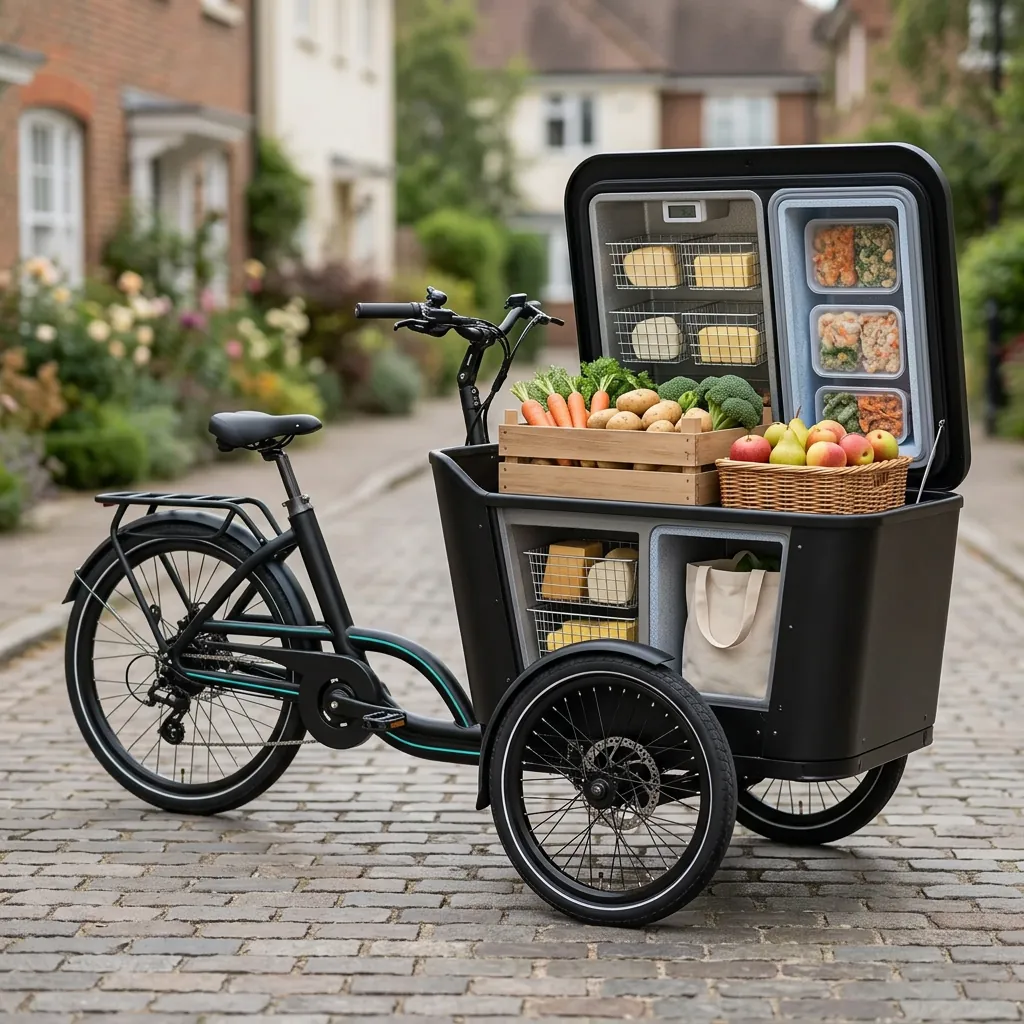
A supermarket order is not one payload, it is three. Ambient dry goods (pasta, tins, bread), chilled produce and dairy, and frozen items all travel together and each has a rule. The box on a grocery trike is therefore compartmentalised. The standard build is a stackable crate box with vertical dividers and a flat non-skid floor, plus insulated inserts so a chilled or frozen zone can be added per-run without reboxing the whole vehicle.
The box configuration options, drop-side, canopy, or enclosed, are detailed in our canopy guide. For a grocery round, the sealed compartment with a side access door is usually the right call, because the driver is opening and closing a box dozens of times a day.
Payload and Route Math for a Home-Delivery Round
The number that decides how many orders a trike carries is the weight limit. Groceries are dense. The rule of thumb for a mixed order is roughly 1 kg per litre of box space, with chilled and bottled items pushing it higher. A 300 kg payload (EU class) or 500 kg (non-EU) is enough for thirty to fifty average online orders, or a 25-stop residential round.
| Configuration | Payload | Typical Orders per Round | Best Use |
|---|---|---|---|
| EU-class crate box | 300 kg | 25–30 mixed orders | Dense residential loops |
| Non-EU heavy build | 500 kg | 40–50 mixed orders | Suburban and mixed rounds |
| Ambient + insulated chilled zone | 300 kg split | 20–30 orders w/ cold items | Supermarket home delivery |
Range is the second constraint. A loaded trike rated for 50–80 km on a single charge covers a full delivery shift, but a heavier load shortens it. The trade-off between battery and payload, and the 60V vs 72V decision, is covered in our 60V vs 72V comparison.
Motor and Power for Stop-and-Start Delivery
A grocery trike starts from a stop with a full load at every door, which is a torque problem rather than a speed problem. The difference between an 800W and a 1200W hub motor on a loaded start-stop route, and which to order for your terrain, is explained in our cargo tricycle motor power guide. Hub motors win this category on cost and serviceability because they have fewer moving parts, which is the trade-off set out in our hub vs mid-drive comparison.
Cooling Without a Cold-Chain Truck: Refrigeration on a Trike
Grocery delivery has to keep dairy and frozen items at temperature, but a full cold-chain truck is overkill for a street of thirty homes. The practical answer on a trike is a sealed insulated compartment with a passive or small active cooling unit, sized to a short route so it holds temperature rather than actively freezing from zero. The trade-offs between passive and active refrigeration, the power budget, and route design are covered in our cold-chain guide. For a supermarket round, a passive insulated zone that keeps chilled product cold for the length of a two-hour loop is usually enough, and it costs far less power than a compressor.
Fleet Economics and Reliability
A supermarket operates on repeat rounds, so the running cost matters more than the sticker price. With electricity instead of diesel, no commercial driver, and a three-wheeler that is far simpler to service than a van, the per-delivery cost drops enough to pay for the trike in a fraction of a year. Tire and brake wear are the two real consumables on a heavily loaded route, the tire guide covers the load ratings that matter, and the brake systems guide covers stopping distance under a full load. Both are worth specifying carefully before you commit to a fleet order.
Specify a Grocery Trike as an OEM Program
Grocery margins are thin, so the buy must be disciplined. Confirm the MOQ . Typically 50 assembled units or 100 with custom compartment layout and livery. Then run a sample on a real round: load the actual orders you carry, run the actual route, and verify that the box holds a mixed cold-and-ambient load without cross-temperature drift, that the trike starts from a stop on the worst grade on the route with a full load, and that the range survives an unplanned detour. The sample strategy, lead time and payment terms are the standard terms in our OEM buying guide, and first-container planning is in the importing guide.
Spec a Grocery Cargo Tricycle
Tell us your orders per day, payload and compartment layout. We will quote the 800W–1200W cargo tricycle line with ambient, chilled and insulated options, and container pricing, FOB China.
