
The picking crew reaches the row at first light, fills three crates, and then someone has to walk them back to the pad. That walk is the cost this vehicle is bought to remove. A berry farm or stone-fruit orchard is not a field with a road beside it — it is a grid of planted rows, a headland at each end, and a harvest window measured in days rather than weeks. Specifying a tricycle for that grid is a different exercise from specifying one for a delivery route, and the differences decide whether the machine works a full season or sits under a tarp by week three.
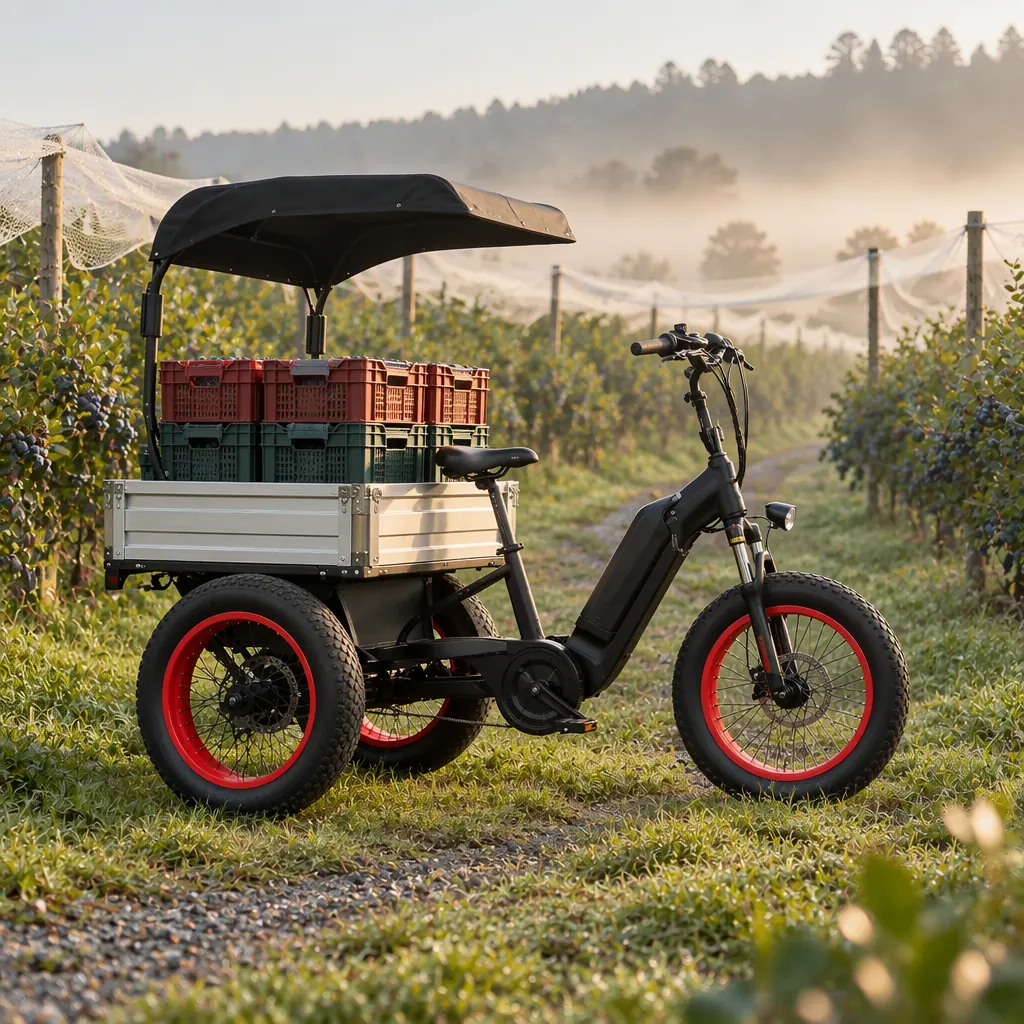
Why a berry farm or stone-fruit orchard is not a field with a road beside it
Most buying guides written for cargo trikes describe a delivery day: a depot, a manifest, thirty stops, a mix of parcel sizes. A soft-fruit or stone-fruit operation produces a completely different load curve, and four of its properties invalidate the assumptions a delivery specification is built on.
| Duty property | Delivery route | Soft-fruit / stone-fruit harvest |
|---|---|---|
| Load over a shift | Starts full, empties monotonically | Starts empty, fills, and must return loaded |
| Stops per shift | 20–40 addresses | One row end every 3–8 minutes; the crew works alongside |
| Hardest constraint | Payload and stop time | Row clearance and headland turning |
| Ground under the wheels | Sealed road or kerb | Grass, gravel, or bare cultivated soil with a cover crop |
| Cost of a failure | Late parcel, redelivered tomorrow | Fruit softens in the sun and the load is unsaleable |
| Season shape | Flat, year round | Six to ten weeks at near-continuous use, then light duty |
That last row is the one buyers underestimate. A vehicle that runs eight hours a day for nine weeks and then four hours a week for the rest of the year has to be specified for the nine weeks, because that is when the crop, the crew and the buyer's delivery slot are all committed at once. Everything below follows from that peak.
Four measurements that eliminate platforms before power matters
Do this before you discuss motor wattage, and do it with a tape on the block you actually pick, not on the tidiest one. Each of these can rule a platform out on its own, and none of them can be fixed later by ordering a bigger battery.
1. The clear gap between rows at the trunk line. Not the planting spacing — the distance a loaded vehicle can pass without touching canes, trunks, irrigation risers or trellis end posts. Measure at the tightest point of the block, then subtract a working margin for a temporary bin or a picker standing in the row. If the gap will not clear a platform with its mirrors and its box sides, the vehicle cannot serve that block at all and the block has to be served by hand or by a trailer at the row end.
2. Headland width at each row end. A three-wheeled vehicle turns in a wider arc than a two-wheeler, and reversing out of a row costs more time than any other manoeuvre in the block. If the headland is too narrow to turn in one movement, the crew will reverse the length of the row — and reverse gear at walking pace, on cultivated ground, with a load, is where a differential earns its price.
3. The lowest obstruction overhead. Trellis wires, hail netting, irrigation booms and the lowest limb of a mature tree all limit vehicle height once a canopy or a stake-side is fitted. A canopy can be specified, but not if it means every pass fouls the wire. See the canopy guide for how roof type changes both height and range.
4. The surface and the slope on the loaded leg. Grass, gravel and cultivated soil all raise rolling resistance, and the return leg to the pad is the loaded one. Walk the route at the heaviest hour of the day and note where water stands, where the cover crop is deep, and where the gradient exceeds what you would accept walking a loaded barrow up.
How harvest weight actually accumulates
Harvest loads are not one heavy object; they are many small objects that add up in round numbers, and the round numbers are what determine whether the platform is sized correctly.
A full standard harvest crate of soft fruit or stone fruit sits in the region of 10–20 kg depending on the crop and how full the pickers load it. Two rows worked by one crew across a morning produce a combined load in the range of 150–250 kg, and that load arrives at the pad stacked and lidless, so it needs a body with sides rather than a bare platform. Against the platform specification this site publishes for its cargo tricycle — 300 kg in EU-spec configuration and 500 kg in non-EU configuration — a single morning's crates sit comfortably inside the envelope, but a second collection added to the same return trip does not always.
Three practical consequences follow. First, plan the number of crates per return trip and write it into the crew instruction, rather than assuming the machine will take whatever is stacked on it. Second, count the crates together with the crew: if a picker rides in the back between rows, that body mass is part of the load and has to be counted, along with the ladders or picking aids the crew carries in and out. Third, allow for the wet weight. Crates that came in dry on Monday hold surface water after a night's rain or a dew-soaked morning, and the difference across a full load is enough to move a marginal trip into the overload range.
Payload is also a chassis limit rather than a single headline number, and the load lands on the rear axle pair. Our payload capacity guide sets out how tyres, brakes and frame each impose their own ceiling, and why the lowest of those ceilings is the real one.
Row clearance is the one number you cannot renegotiate
Buyers routinely open a quotation discussion with motor wattage. It is the wrong end of the problem. Power, battery chemistry, box body and even the number of vehicles are all negotiable against budget; the width of the vehicle is not, because a platform that will not enter the row contributes nothing regardless of what its specification sheet says.
The workable sequence is to fix the geometry first, then the body, then the drive. Take the four measurements above, decide which blocks the vehicle is allowed to serve and which stay hand-worked, and only then compare models. If two or three blocks are genuinely too tight, that is not a reason to abandon the vehicle — it is a reason to route the trike to the blocks it fits and to park a trailer or a bin at the headland of the blocks it does not, so a crew can still move fruit out by hand a short distance instead of carrying it to the pad.
Where the crop sits on a slope, the same logic applies to gradient. A loaded climb is solved with gearing and motor torque, not with additional battery capacity: range and gradient are different problems, and the cargo platform's motor range of 800 W to 1200 W is offered precisely because hill-climb gearing is a specification choice rather than a battery purchase. The motor power guide explains where the step between those ratings actually changes behaviour on a loaded climb.
Body configuration: crates, bulk fruit and the drop-side question
The body is what the crew touches every trip, and it decides how fast a row call clears. There are three workable configurations and one rule that governs all of them: the load has to come out over the side the crew is standing on. A body that only opens at the rear forces the crew to walk around the vehicle at every collection point.
Three-way drop-side body. This is the default for crate work, and the reason is mechanical rather than aesthetic. Crates are loaded over a low side at row level and unloaded over whichever side faces the pad, the bin or the trailer, without anyone climbing into the box. Sides that drop on three faces also let the body convert to a flatbed in seconds for the trips that are not harvest trips — stakes, netting, irrigation fittings, tools.
Fixed flatbed with stake sides. Cheaper and more rigid, and appropriate where the load is bulk rather than crated: loose fruit for pressing, green waste from pruning, or mulch and compost moving the other way up the block. The trade is that loading and unloading always happens from above or from the rear.
Hydraulic tipper. The right body when the load is dense and has to be discharged in one movement rather than unloaded by hand — prunings, soil, compost, and bulk fruit into a reception hopper. It is a heavier body and it costs payload, so it earns its place only where discharge is the bottleneck. Our hydraulic tipper guide covers the discharge geometry and what the mechanism does to the payload budget.
Across all three, the box floor should drain at its lowest point, because a body that holds wash water holds corrosion with it. The platform's box volumes run from 150 L to 500 L, which is the range in which the crate count, the flatbed area and the bulk load all have to be reconciled.
Charging arithmetic decides how many vehicles you need
This is the calculation that separates a one-vehicle answer from a two-vehicle answer, and it is almost never run before the first order. The published figures for the platform are a charging time of 6–10 hours on a 5 A charger and a loaded range of 50–80 km carrying 200 kg on flat ground.
Both numbers are true and neither is the constraint. A harvest day inside a block is short-distance and repetitive: a shuttle from a row end to a pad and back may be 300–800 m, repeated many times. Over a full shift that accumulates to a distance the pack can cover, so range is rarely the limiting factor in a berry block. The limiting factor is that the vehicle returns to the charging point in the evening with a partly discharged pack and needs a full overnight window before the next morning — and a full window is six to ten hours.
Two consequences follow for harvest week. If the vehicle runs one block per day, a single overnight charge covers it and no depot infrastructure is needed beyond a suitable outlet. If it must run a morning block and an afternoon block with a long loaded run between them, or if it is expected to keep working after the crew leaves, then one charge will not cover the day, and there are only three answers: a second vehicle, a higher-current charger, or a battery swap arrangement. Ordering a larger battery does not solve it, because a larger pack takes longer to refill on the same charger.
The same arithmetic sets how many vehicles a pad needs. Two crews working two blocks with a shared machine spend part of every day waiting for it; two machines sized for a single morning each cover the same ground with no waiting and a full overnight window on both. For depot power, outlet capacity and swap arrangements, the fleet charging guide works through the layout question.
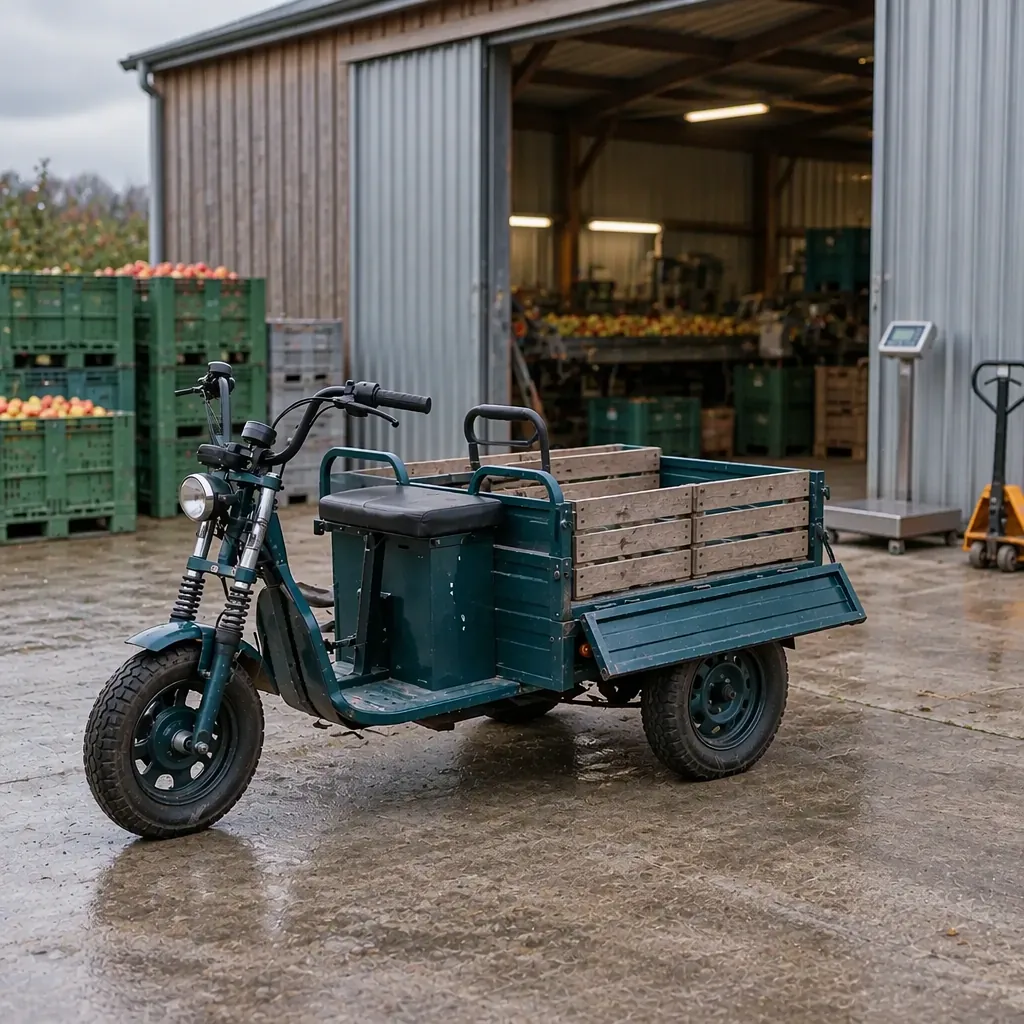
Slope, surface and the parts that fail first
An orchard or berry block puts load on the vehicle in ways a sealed road does not, and the service history shows which parts carry it. Three specifications matter more than the rest.
Tyres and the rear pair. The platform runs 3.00-12 front and 3.75-12 rear, dual rear wheels, load-rated and reinforced. On cultivated ground the rear pair carries the harvest load, and on a soft surface the load per wheel is what decides whether the vehicle cuts through the cover crop or rolls over it. Running the rear pair at the correct pressure for the load rather than at a single default pressure is the cheapest improvement available to a harvest fleet.
Brakes on a loaded descent. The platform uses a hydraulic disc at the front and dual drums at the rear with a parking brake. On a loaded descent to a pad, the parking brake is not a convenience — it is what holds the vehicle while the crew unloads on ground that is not level. The brake systems guide covers how disc and drum split their work under load.
The differential. A dual-rear axle without a differential drags both rear wheels through every tight turn, and in a row end that means scuffing the cover crop and putting a twisting load through the axle, every time, all season. In a berry block the tight turn is not an occasional event; it is the end of every row. Our differential and rear axle guide explains what the axle carries when the load sits on it.
Two further items belong in the order rather than in a later service visit. A canopy or rain cover protects both the fruit and the rider, provided the overhead clearance measured in the block allows it. Full LED lighting with an optional beacon matters less for road use than for the early-morning and late-afternoon passes when a crew on foot and a quiet vehicle share the same row end; the safety features guide lists the items a harvest buyer should confirm before delivery.
Quiet operation and the early start
Harvest work starts early for reasons that have nothing to do with convenience: fruit picked before the heat of the day holds better, and a crew that starts at first light gets through more rows before the temperature rises. An electric platform runs without an idling engine, which matters both for the crew working beside it and for any residential boundary the block shares. That is an operational advantage, not a marketing one, and it is worth stating in the order because it also sets the vehicle's speed policy — the platform's governor is settable at 25, 35 or 40 km/h, and in-field use almost never needs the top setting.
What to specify, and what to settle before the order
The specification table below is written for harvest duty rather than for road delivery. Every row is a decision that has to be made before the bill of materials is frozen, because most of them are difficult or impossible to change afterwards.
| Specification item | What to settle for harvest duty |
|---|---|
| Motor | 800 W for flat blocks; step to 1000 W or 1200 W where the loaded return leg climbs |
| Battery | 60V 32Ah standard; 72V 40Ah where the day has two blocks; LFP where ambient stays above 35 °C |
| Charging | 6–10 h on the supplied 5 A charger — confirm the overnight window against the harvest start time |
| Load capacity | 300 kg EU / 500 kg non-EU; write the crate count per return trip into the crew instruction |
| Body | Three-way drop-side for crate work; fixed flatbed with stakes for bulk; tipper only where discharge is the bottleneck |
| Box volume | 150–500 L — reconcile against crate count and flatbed area, not against a single figure |
| Tyres | 3.00-12 front, 3.75-12 rear dual, load-rated; set rear pressure to the load, not to a default |
| Brakes | Hydraulic disc front, dual drum rear, parking brake verified on the grade you actually unload on |
| Drivetrain | Differential on a dual rear axle; forward / neutral / reverse selector for row-end manoeuvring |
| Speed governor | Set to 25 km/h for in-field and farm-track use; higher settings only for road transfer |
| Canopy | Only where measured overhead clearance allows; confirm height with the frame fitted |
| Finish and drainage | E-coat plus powder coat on the chassis; box floor draining at its lowest point; stainless fasteners |
Four commercial terms belong alongside the technical table. MOQ is 50 units per model for an OEM configuration, which is a distributor or a multi-farm buying group rather than a single holding. Standard lead time is 15–30 days, and a first custom-branded run runs 30–45 days. Pre-production samples ship before mass production, and a sample should be trialled in the tightest block, at the busiest hour, before the order is released. Finally, ask for the document package — the platform's compliance set covers UN 38.3 battery transport testing and CE and RoHS declarations, with cell, BMS and test-report documents carried in the export file, and confirm that the tyre sizes named in the spare parts list match the sizes actually fitted.
Where a fruit operation also runs a nursery or a greenhouse alongside the block, the duty is closer to the nursery and greenhouse trike guide than to a harvest specification. Where it runs a mixed farm with livestock and feed, the farm and ranch guide covers the feed-store and fence-repair trips that fill the rest of the year. Buyers comparing a tricycle against a utility vehicle or a pickup should start with the golf cart comparison, which sets out where a light three-wheeler stops paying back.
Paying back inside a harvest window
The economics of a harvest vehicle are not annual. They are concentrated into six to ten weeks, and a machine that removes a walk and a second worker's time from every row call pays back when the crop is heavy, not when it is light. The comparison to make is not against a pickup's purchase price but against the number of return trips one worker makes per day at the moment the crop is at its peak, and what those trips cost when fruit is softening in the sun.
That is also the honest limit of the platform. It is not a tractor, it does not move bulk bins across steep or rutted ground, and it does not replace road haulage to a packhouse further away. It replaces the repeated short shuttle that a tractor or a pickup does inefficiently, at walking pace, all day, in a block too narrow for either.
Sizing a harvest trike against your own block
Send us the four measurements — the narrowest clear gap at the trunk line, the headland width at each row end, the lowest overhead obstruction with a frame fitted, and the gradient on the loaded return leg — together with your expected crate count per return trip and your harvest start time. We will come back with a platform recommendation, a body configuration and an FOB quotation, and where the numbers say a single machine cannot cover your day, we will say so rather than sell a second battery that cannot fix it.
Measure the row before you measure the budget
Send us the narrowest clear gap at the trunk line, the headland width at each row end, the lowest overhead obstruction with a frame fitted, the gradient on the loaded return leg, your crate count per return trip and your harvest start time. We will come back with a platform recommendation, a body configuration and an FOB quotation, and tell you plainly when one machine cannot cover your day.
