
Nobody buys a cargo tricycle because they want one. They buy it because a 40-seat propagation house needs 1,800 tray moves a week and the pickup truck cannot get past the second bench. This guide covers the specific case of a production nursery or greenhouse operation: how to size a platform to the narrowest aisle and the heaviest trolley, how propagation, container and dispatch duty pull the spec in different directions, how to compute the real weight of growing media instead of guessing it, and the OEM terms worth settling before the order goes out.
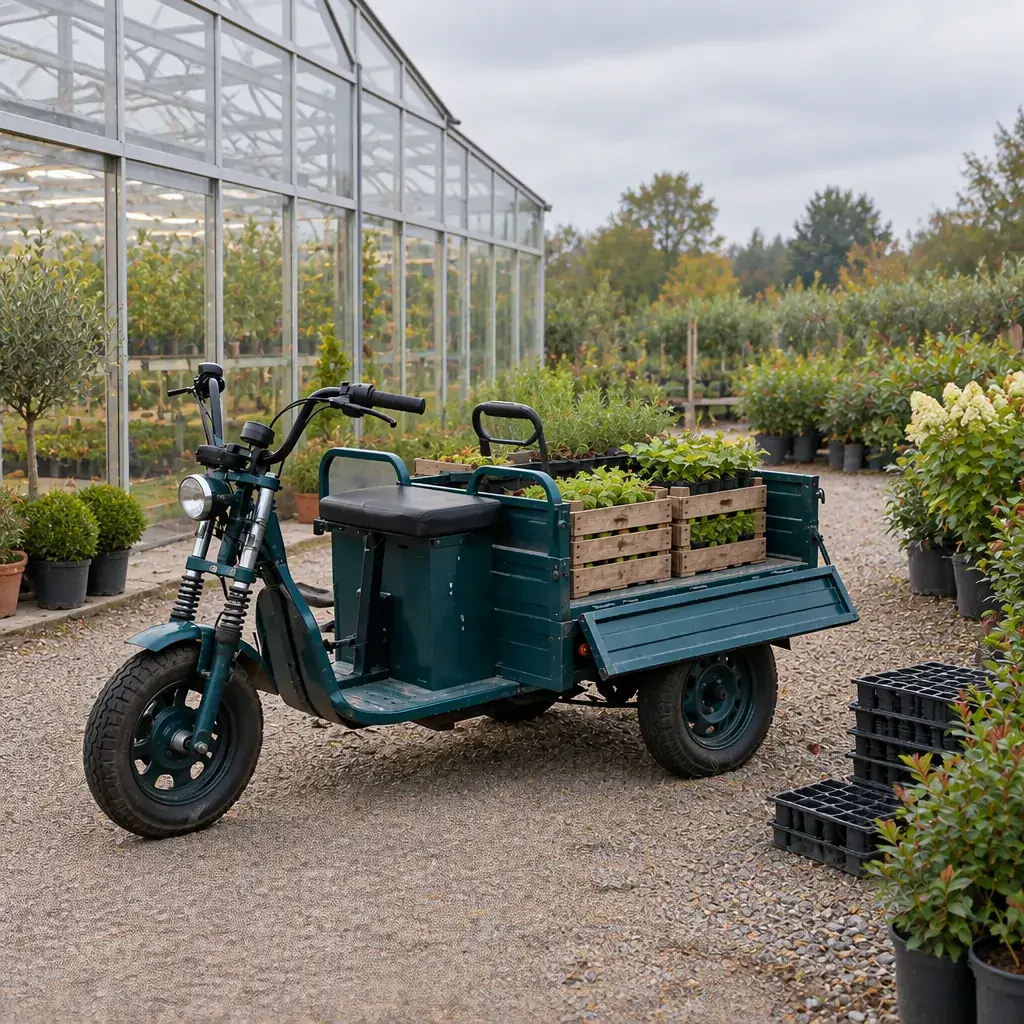
Measure the house before you look at a motor
The limiting factor on a nursery site is almost never payload. It is the widest thing that still has to fit down the narrowest gap. Four dimensions decide whether any vehicle works at all, and all four are measured with a tape before a specification sheet is opened.
- Bench path width. Between two rows of container beds or ebb-and-flow benches it commonly runs 1.4–2.0 m. A 1.2 m wide platform fits the wide path and fouls the narrow one.
- Doorway and tunnel. A standard poly-tunnel or glasshouse access door is often 1.0–1.2 m clear, with a threshold. Assume 950–1,050 mm of real passage after the door frame, and verify the threshold lip — a 40 mm step stops a laden vehicle more reliably than a 4% slope.
- Headland and turning circle. At the end of a bench run you get one or two vehicle lengths to reverse and realign. The compact turning footprint is one of the two genuine advantages a tricycle has over a utility vehicle.
- Ground surface. Concrete slab, gravel, or damp soil are three different traction problems. Ribbed or ag-pattern tyres on damp soil behave nothing like road tyres on a slab.
Write the four numbers down. Anything that does not fit the tightest of them is disqualified, regardless of its price or its payload rating.
Three different duties hide under the word “nursery”
A production nursery does not have one transport job. It has three, and they rarely want the same vehicle. This is the single most common mistake in specification: buying one platform sized for the heaviest of the three, then living with an oversized machine on all the light work.
| Duty | Typical load per move | Distance per move | What it actually wants |
|---|---|---|---|
| Propagation | 20–60 kg of plug trays | Seed line to germination house, 20–80 m | Flat, low deck. Trays must not tip. Speed is irrelevant; hand-loading height is everything. |
| Shifting / pot spacing | 150–400 kg of containerised stock or trolleys | Across the yard, 50–300 m, repeated all week | Drop-side or trolley-coupled. Load and unload speed dominates the whole business case. |
| Dispatch / despatch | 150–500 kg to the loading bay | Packing shed to bay, 100–500 m, against a cut-off | Payload and time-certainty. This is the only duty that benefits from the top motor tier. |
The dispatcher who buys a 1200W machine for a job that is 80% tray moving is over-capitalising on the exact duty that matters least, and the machine is also physically wider and heavier — which then hurts the tight-bench runs that dominate the week. Trolley-shifting is where the money is. Size for the shift duty first, then check dispatch fits inside it.
The weight of growing media is the number everyone gets wrong
This is the most valuable calculation on the page, because it is the one that is quietly mis-estimated on most nursery sites. Media is weighed by feel, then the vehicle is chosen on that feel, and the first wet week produces a bent axle or a snapped rail.
Growing media is heavy when it is saturated, and nursery stock is watered to saturation. Standard media runs roughly 550–700 kg/m³ dry. Fully saturated it climbs to roughly 850–1,000 kg/m³. Water alone in the medium accounts for the difference; the plant material adds relatively little.
- A standard 60 × 40 cm tray at 10 cm deep is 24 litres. Drained, that is roughly 20 kg. Hold 20–25 on a flatdeck and you are at 400–500 kg.
- A 5-litre pot straight out of an irrigation cycle weighs close to 5–6 kg. A hundred of them is 500–600 kg — and that is one layer of one trolley.
- An H-bench with a full propagation tray run can exceed a tonne. Nothing that should be pushed by hand should exceed roughly 300–400 kg. Beyond that, plan a towed trolley and keep it a vehicle job.
Once media weight is estimated honestly rather than assumed, the required scale of the platform usually shifts down one market tier — and the business case improves. This also explains why suppliers ask for media type and saturation state during specification: two identical looking orders are not the same vehicle if one is holding saturated 5-litre pots and the other is handling dry plug trays.
Trolley coupling beats hand-loading every time
On a shifting-heavy site the vehicle is almost never actually carrying the load. It is moving trolleys that hold the load — and a trolley-coupling platform eliminates the slowest step, which is transferring each tray by hand.
A standard Danish or table trolley runs 600–1,200 kg, so it takes two or three trolley moves to clear a house. If your loads need a bin instead of a bed, the trailer towing guide covers coupling and towed-weight limits. If a platform can couple and tow, the trays never leave the trolley. The purpose-built answer is a small steel yard tractor, but that is a dedicated machine with its own capital cost. A better fit for mixed sites is a fast-swap trolley coupling on the vehicle's standard hitch, paired with a drop-side box body for the work that is genuinely loose cargo or needs weather protection.
Two checks determine whether towing is viable on your site at all:
- Slope. Towing dramatically cuts the gradient a loaded vehicle can climb, and a nursery with any meaningful ramp should be quoted on towing duty, not on payload alone. Ask the slope and the towed weight together, never separately.
- Grade and surface. A low centre of gravity matters on a wet concrete ramp in a way it does not on a level apron. Braking should hold a loaded vehicle stationary on a wet ramp with a trolley attached, without rollback.
Where hand-loading cannot be avoided, reduce it with pallet-level loading, folding ramps and matched deck heights rather than by buying more payload. The payload capacity guide covers how load rating is derived and why the axle, not the box, is the real limit.
Charging arithmetic decides whether one vehicle is enough
Nursery work is shift-based and often runs seven days during the spring bedding season. The platform charges 6–10 hours on the standard 5A unit and delivers 50–80 km loaded at 200 kg. That sounds generous until it is divided by the number of short moves a real shift contains.
The correct calculation is minutes of work per charge, not kilometres. A propagation operation making 60–80 short moves a day over 20–80 m each, with the motor running most of the time in stop-start duty, will consume the pack faster than a dispatch run covering the same distance continuously. Compute from the duty cycle you measured in the three-duty table above, not from a range figure taken off a brochure.
Practical consequences worth planning for now:
- One vehicle per shift, with an overnight charge, works for single-shift sites. A 72V 40Ah LFP pack on a 5A charger needs most of a 10-hour window.
- Two-shift or extended-season operation needs a second pack or a second vehicle. Do not plan on charging a depleted pack between two shifts on the standard charger; the arithmetic does not allow it. Aerial runs of 20 minutes do not restore a day of stop-start work.
- LFP is the right chemistry where the vehicle works hot or is left on charge in a warm structure all season. It costs more up front and gives up some energy density, but holds up materially better than NMC under thermal stress and gives longer calendar life — which matters for a vehicle expected to serve many seasons.
Quiet operation is a genuine capability here
Greenhouses are unusual in that a quiet vehicle is not a comfort feature, it is an operational one. Propagation houses run strict temperature and humidity regimes, and opening doors constantly to admit a diesel or petrol vehicle disturbs them measurably. A battery platform produces no exhaust and very little heat, doors stay closed for longer, and the work can continue inside without the ventilation penalty.
It also makes an early start possible. Bench work and pre-dawn dispatch can begin before the site needs to make noise, and the same advantage applies to evening irrigation work. Two things to preserve when specifying: keep the tyres as narrow and smooth as the surface allows to minimise rutting and compaction in loose material, and specify a sealed motor and controller rated for wet, humid working conditions — a climate-controlled house is a hard environment for electronics.
Specification table for nursery and greenhouse duty
| In-vehicle / trolley geometry | Typical range | Why it matters in a house |
|---|---|---|
| Vehicle width | 1.0–1.2 m | Fit the narrowest bench path on site, not the average one |
| Motor | 800W / 1000W / 1200W hub with differential | Differential is non-negotiable on a hard surface — without it, every tight turn scrubs the inside rear tyre and marks the slab |
| Battery | 60V 32Ah / 72V 40Ah (LFP for warm or tropical houses) | Charge arithmetic is governed by the shift pattern, not the distance |
| Payload | 300 kg (EU) / 500 kg (non-EU) | Rate on the saturated-media figure, not the dry figure |
| Body | 150–500 L, drop-side or flatbed, three-way drop-side optional | A flatbed for trays; drop-side for loose media and recycling; the converting body covers both |
| Brakes | Hydraulic disc front, dual drum rear, parking brake | Must hold a laden vehicle on a wet ramp with a trolley behind it |
| Tyres | 3.00-12 front, 3.75-12 rear (dual), load-rated | Narrow enough to avoid rutting, rated for the real axle load |
The differential point deserves a second sentence because it is the one specification line that gets traded away for price and then regretted daily. On soft soil, a locked rear axle is a manageable nuisance. On a wet concrete apron or slab, it means every turn drags one wheel sideways, scuffs the surface, and accelerates tyre wear on precisely the surface where you do most of your turning.
Where the platform pays back, and where it does not
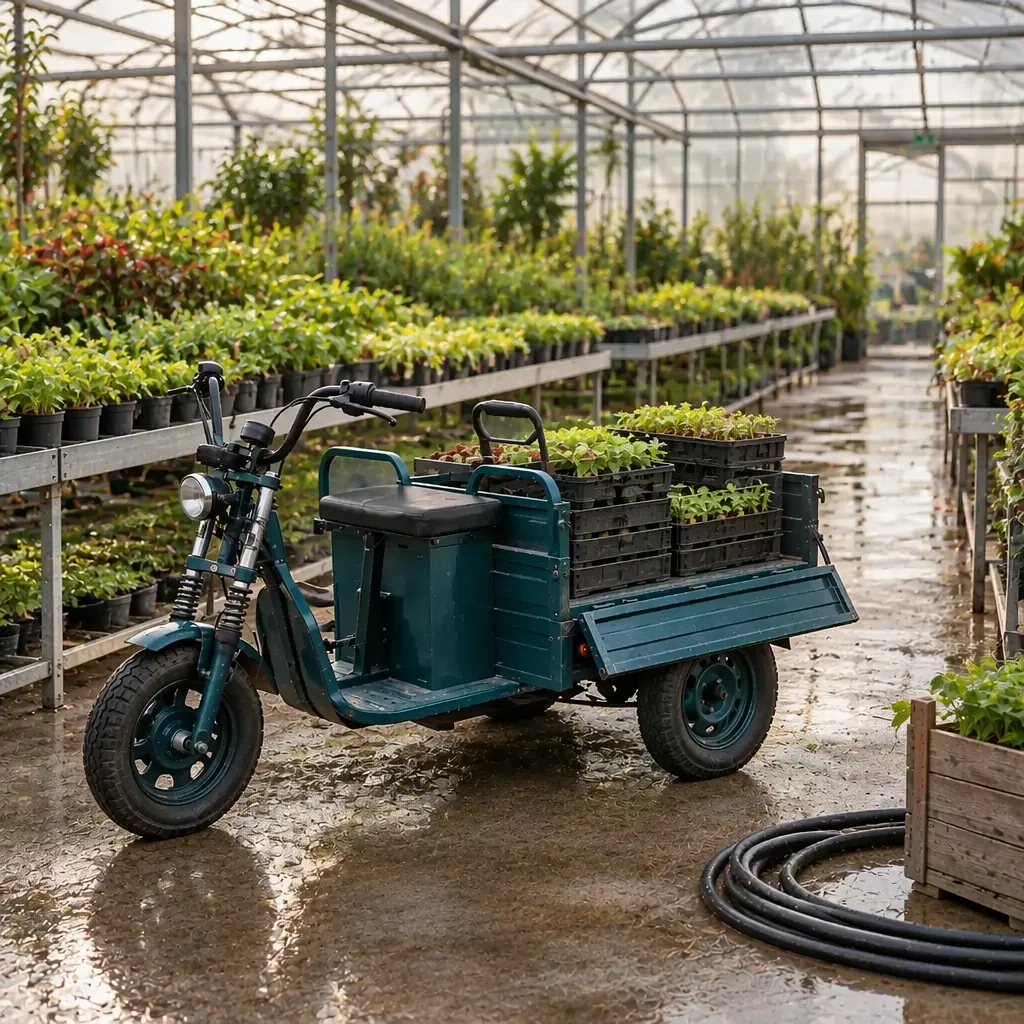
It pays back on repeated short moves under roughly 300 kg where a utility vehicle is oversized and a wheelbarrow is too slow: bench-to-bench shifting during pot spacing, tray movement across a house, propagation runs, despatch to the loading bay, trolley towing across a level yard, and general site cleanup between crops. The value is that the vehicle moves at walking pace with the worker rather than being parked at one end of the house.
It does not pay back on high-speed road work, anything needing a load bed longer than about two metres, or any job that spends most of its day on gradients rather than on the level. The same reasoning is worked through for outdoor crews in the landscaping route guide, and for mixed outdoor crops in the vineyard and orchard guide. It also does not replace a forklift for vertical lifting, and it does not replace a tractor for towed field cultivation. A tricycle competes with a wheelbarrow and a small flatbed utility vehicle. It does not compete with a telehandler, and no amount of specification will make it.
Be honest about which column your site falls into. The most common expensive mistake is buying for dispatch and discovering the week is dominated by shifting, or the reverse.
OEM line items to settle before you order
- Vehicle width on the order sheet. Confirm the delivered width against your narrowest path, not the standard width. Rectifying it after delivery is not economical.
- Body configuration and media-specific lining. A flatbed for trays, drop-side for loose media, and a galvanised or aluminium body if the site is damp or uses fertigation continuously. Cold-storage and chilled dispatch work needs a different body again — see the cold chain guide. Ask specifically about corrosion protection on the deck.
- Coupling and hitch compatibility. Bring the actual trolley dimensions and coupling eye height. The hitch geometry must match the fleet, not the other way round.
- Battery chemistry and charge window. State the climate, the season length, and the hours available for charging. LFP where the vehicle is left on charge in a warm structure, NMC where energy density and up-front cost matter more than pack life.
- Compliance documents for the destination market. Confirm the full compliance package for your market, and that each order carries the relevant cell, BMS and test-report documents in the export file.
- Spare parts for a long-season fleet. Tyres, brake shoes and the controller are the realistic replacement items. Body fabrication and assembly tolerances are described in the manufacturing process guide. Confirm that these exact specifications can be supplied on a continuing basis, not merely that spares exist in principle.
- Commercial terms. Standard OEM terms start at 50 units per model with a 15–30 day standard lead time, and 30–45 days for a first custom-branded run. Pre-production samples ship before mass production; use them to verify the width and the coupling against your actual house and your actual trolleys.
Running the first vehicle, not just buying it
Put the first unit on the duty it will actually serve most of the week, and run it for a full cycle before committing to a second. Track three numbers from day one: moves per shift, minutes lost to loading and unloading, and charging time consumed per shift. If loading dominates, the problem is the body or the coupling, not the motor. If charging intrudes into the working window, the problem is the duty-cycle estimate, and the answer is a second pack or a second vehicle rather than a bigger battery to carry through the same day.
Confirm the operating envelope is a specification fact rather than an assumption, and compare total cost of ownership against the alternative you are replacing using the cost breakdown guide. A platform with the specifications reviewed here is a non-road-registered or low-speed vehicle in many markets and is not intended for public road use, so the internal site loop is the whole duty — which is exactly what the three-duty analysis above describes.
Spec a Nursery Trike Against Your Own Benches
Send us your narrowest bench path, your heaviest trolley, and your media type. An export engineer will come back with a width-checked configuration, the body and coupling that match, and a compliance pack for your market — on one call, no obligation.
