
Every warehouse and terminal site with more than about 250 staff eventually runs into the same problem: the car park and the gatehouse are 800 to 1,400 metres apart, the night shift ends at 06:00, and there is no public bus that runs that loop at that hour. The usual answer is a spare van with a driver, and the usual result is a vehicle that is idle for 22 hours a day while still costing a full shift of labour, fuel, insurance and a bay in the workshop queue. This guide is about replacing that van with a governed three-wheeled passenger platform, and the arithmetic that decides whether it works.
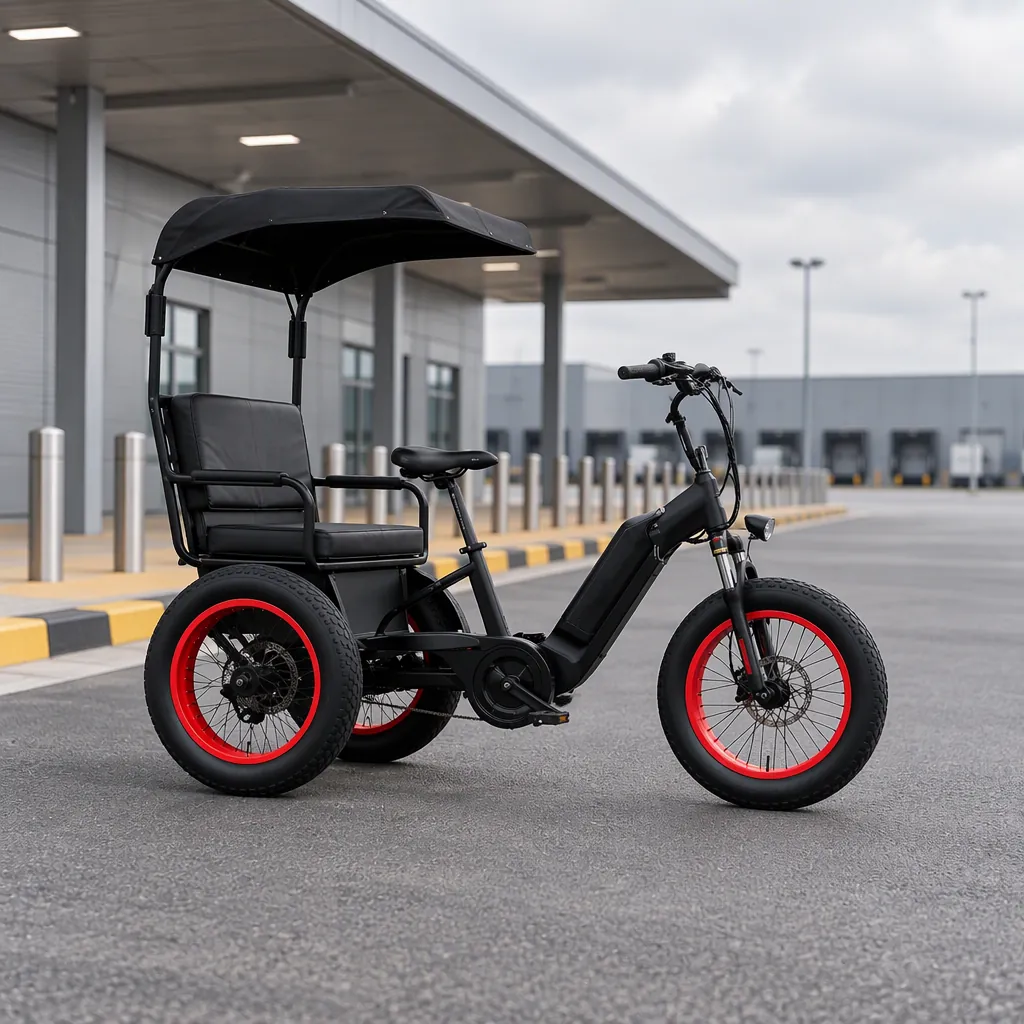
The platform in question already exists in our catalogue as a passenger tricycle: 500W or 800W brushless hub motor on a 60V system with a rear differential axle, a 60V 20Ah or 60V 32Ah pack mounted under the seat, a rear bench rated for two passengers with a backrest and armrests, and an optional fabric canopy on a steel tube frame. 300 kg total including driver, 40 to 60 km loaded range, 25 to 35 km/h top speed, 6 to 8 hours to charge. The point of this article is not to sell that vehicle - it is to show the four calculations that tell you whether it can carry your shift, because a staff shuttle is a timetable problem long before it is a vehicle problem.
Why a staff loop is not a delivery route
Fleet buyers tend to reason about staff transport using last-mile delivery instincts, and it fails in a specific way. A delivery route is optimised for stop density and load, and the vehicle spends its day moving. A staff loop is optimised for a timetable with two very sharp peaks, and the vehicle spends most of its day parked. Five differences matter:
| Dimension | Delivery duty | Shift-change staff duty |
|---|---|---|
| Demand shape | Spread across an 8 to 10 hour day | Two spikes of 20 to 40 minutes at shift boundaries |
| Payload | Parcels, boxes, 100 to 300 kg of dead weight | People, roughly 75 kg per seat plus hand luggage |
| Utilisation | Continuous, 80 to 120 km per day | Intermittent, often 25 to 45 km per day across 4 to 6 rounds |
| Loading surface | Drop-side box, flatbed or insulated box | Padded bench, backrest, armrests, step-in height, canopy |
| Failure cost | A late parcel, recovered next day | Two shifts delayed at once, and a safety conversation |
Two of those rows drive the whole spec. Utilisation is low enough that battery capacity is almost never the constraint - the constraint is how fast you can recharge between peaks. And payload is live, so the things that matter are step-in height, handholds, the governor setting and wet-weather protection, not box volume. If you are sizing a vehicle around goods rather than people, the payload and load-distribution guide is the right starting point instead.
The three-number loop model
Before looking at any vehicle, measure three things about the site. Everything else follows from them, and a supplier cannot quote sensibly without them.
- Loop length in metres, on the actual route. Not the straight-line distance. A car park to gatehouse run that looks like 900 m on a map is often 1,300 m once you follow the perimeter road, the security chicane and the pedestrian crossing.
- Peak headcount per shift boundary. The number of people who arrive or leave within the same 30 to 40 minute window, not the total site headcount. A 600-person site with a staggered 90-minute arrival has a much smaller peak than a 300-person site with a single bell.
- Acceptable wait at the boarding point. This is a policy number, not a technical one. Ten minutes is generous and doubles the fleet size; twenty minutes is common and halves it.
With those three numbers the sizing arithmetic is short. Divide the peak headcount by the vehicle's practical seat count, which for the two-person bench plus the driver saddle is three including the driver but two once you accept that the driver does not carry a passenger - so plan on two paying seats per round. Multiply by the round time, which is loop length divided by an average governed speed of roughly 18 to 22 km/h including stops, then add two to three minutes of boarding time per round. If the resulting interval between departures exceeds the acceptable wait, you need a second vehicle; if it comfortably fits twice inside the wait window, one vehicle is enough and you have spare capacity for maintenance days.
Charging between shift peaks, not overnight
This is where a staff shuttle differs most sharply from a delivery fleet, and where most specs get the decision backwards. The platform charges in 6 to 8 hours on its standard charger, which is fine for an overnight top-up but useless inside a shift change. What actually matters is the interval between the last round of one peak and the first round of the next.
Take a site on a three-shift pattern. The boarding peaks land at roughly 06:00, 14:00 and 22:00. Between the morning and afternoon peaks there are nearly eight hours of idle time - more than enough for a full recharge at the standard rate, and the vehicle can do it on a plain wall socket in the gatehouse. The interval that breaks is the one between the afternoon and night peaks, which in a staggered pattern can compress to four hours once you allow for the vehicle being cleaned and checked. Two options work: a second pack, or a charger with a higher output so the same pack refills inside the window. Adding capacity to the single pack is the option that does not work - a bigger pack takes longer to refill at a fixed charge rate, so it makes the tight interval worse rather than better.
The wider economics of fleet charging, including the difference between individual docks, central cabinets and a swap pool, are covered in the charging dock and station architecture guide. For a two-vehicle staff shuttle the answer is almost always two individual docks on the gatehouse wall, because the fleet is too small to justify anything more elaborate.
Boarding geometry decides the platform
Staff transport is the one duty where the boarding point is a fixed asset you cannot move, so the vehicle has to fit it rather than the other way round. There are four measurements worth taking with a tape before a supplier quotes.
- Step-in height at the bench. The passenger floor of this platform sits well below the seat, but the first step from kerb to floor is what most complaints are about. Measure the kerb at the actual boarding point: a raised loading dock edge and a dropped kerb differ by 100 to 150 mm, and that is the difference between a comfortable step and a complaint.
- Canopy headroom in the open position. A fabric canopy on a steel tube frame adds roughly 1.9 to 2.1 m to the vehicle's height. Any covered walkway, gate boom or dock canopy on the route needs to clear it.
- Turning circle at the turnaround. The rear differential lets a three-wheeled platform pivot much tighter than a van, which is why it can serve a gatehouse forecourt that a minibus cannot enter. Measure the forecourt, not the road.
- Doorway and barrier width on the route. Pedestrian gates, bollard pairs and security chicanes are usually built for a person, not a 1.2 m wide vehicle with mirrors.
If any of those four fails, the honest answer is that the loop should run outside the perimeter on public road with a registered vehicle, which is a different compliance conversation entirely. Our road classification guide covers where that line sits in the EU and US markets, and the airport and campus shuttle guide covers the closed-perimeter case in more depth.
Wet weather, darkness and the shift nobody wants to drive
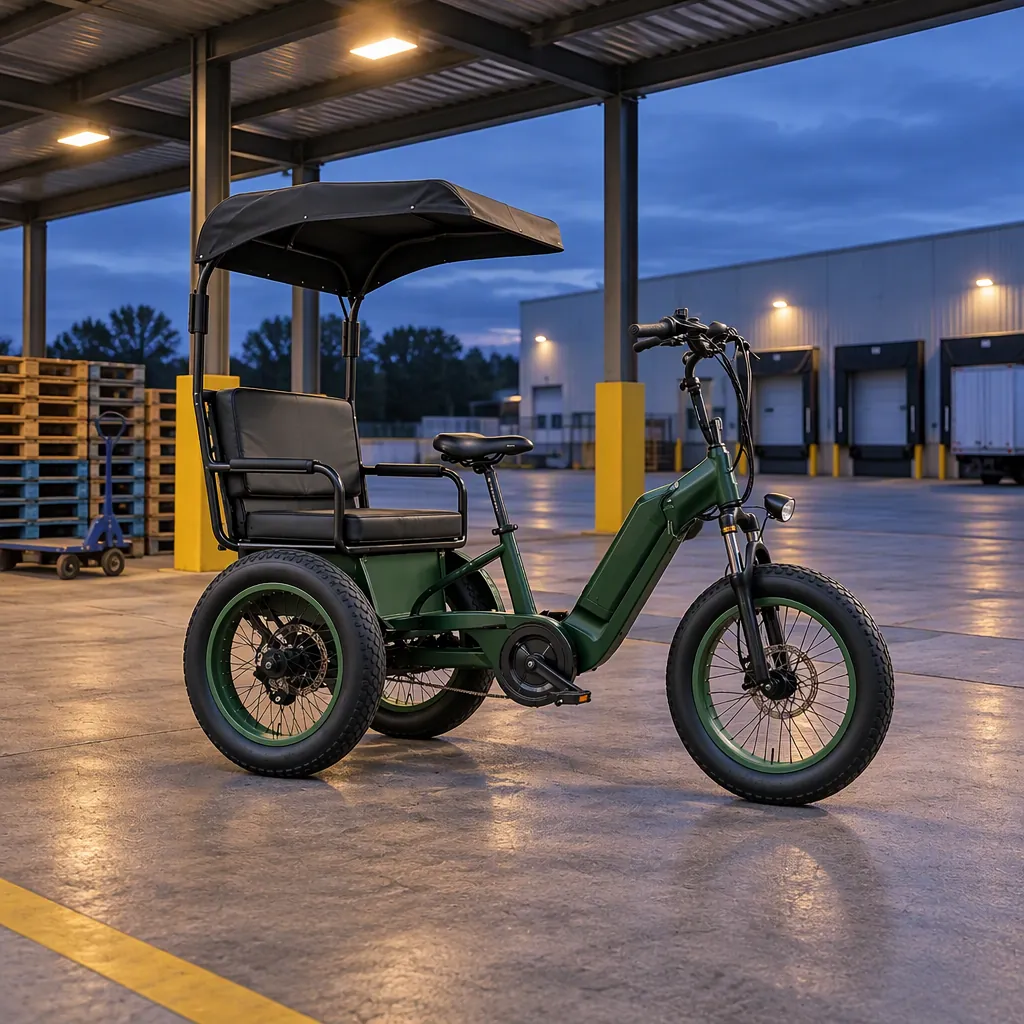
A staff shuttle runs at the two worst times of day, in the two worst conditions. The night shift change happens in darkness for most of the year in northern latitudes, and the winter shift change happens in rain, sleet or worse. Three specification items exist specifically for that, and they are the ones most often dropped to hit a price.
The first is lighting. The platform ships with an LED headlight, tail and brake lights, turn signals and a horn. That is adequate for a road-legal two-wheeler and marginal for a vehicle that will be boarded by tired people in the dark at a site with mixed forklift traffic. Specify the beacon and additional reflective marking on the canopy frame if the loop crosses a yard where powered industrial trucks operate.
The second is the canopy itself. The fabric canopy keeps rain off the bench, but roll-up side curtains are what stop a passenger arriving at the workstation soaked. Treat the curtains as a required item for any site above roughly 45 degrees latitude rather than as a comfort option.
The third, and least obvious, is the governor setting. The platform allows 25, 35 or 40 km/h, and the temptation is to set it at the top because the loop feels slow. On a site shared with pedestrians, cyclists and forklifts, a lower setting shortens stopping distance proportionally - and staff shuttles are the one fleet application where the passengers themselves are the hazard if the driver has to brake hard. Set the governor to the lowest value that still meets the timetable, and revisit it only when the timetable changes. Our safety specification checklist walks through the full set of items to raise with a supplier.
Platform data that matters for this duty
Here is the specification of the passenger tricycle as it is built today, with the rows that matter for staff transport marked in the notes rather than in a separate column.
| Parameter | Value | Why it matters on a staff loop |
|---|---|---|
| Motor | 500W / 800W brushless hub, 60V, rear differential axle | The differential is the difference between a tight gatehouse turn and scrubbing the inner wheel |
| Battery | 60V 20Ah / 60V 32Ah lithium, LFP option, under-seat mount | 32Ah covers any realistic shift pattern; the pack is sized for the charge window, not the range |
| Range | 40 to 60 km loaded, moderate speed | A 1.2 km loop at 6 rounds per shift is under 15 km per shift |
| Top speed | 25 to 35 km/h, governed | Set to the lowest value that meets the timetable |
| Charging | 6 to 8 hours | Fits the overnight and the long inter-peak window, not the tight one |
| Brakes | Hydraulic disc front (180 mm) + dual mechanical drum rear | Loaded braking with passengers aboard is the safety-critical row |
| Load capacity | 300 kg total (driver plus 2 to 3 passengers) | Two paying seats per round is the planning number |
| Tires | 3.00-12 front / 3.50-12 rear, road tread | Road tread suits sealed site roads; unsealed yards should be discussed with the supplier |
| Seating | Front driver saddle + rear two-person bench with backrest and armrests | Backrest and armrests matter more than they sound for tired passengers |
| Canopy | Optional fabric canopy, steel tube frame, roll-up sides available | Curtains are the wet-weather item, not the canopy alone |
| Weight | 120 to 160 kg with battery | Light enough for a standard vehicle lift if the site ever needs to move it |
One row deserves a warning. The 300 kg figure is total load including the driver, not payload. Two passengers at 80 kg plus a 75 kg driver and a few bags already lands at 240 to 250 kg, which leaves little margin for a third passenger. Sites that habitually carry three passengers should be looking at a different platform, or at a second vehicle, rather than at a bench that physically seats three.
Vehicles versus a minibus, in the numbers that a finance team will ask for
The case for a shuttle trike is not that it is cheaper than a car per kilometre. It is that the duty is small enough that a car is grossly oversized for it, and the fixed costs dominate. On a loop of about 1.2 km, running 6 rounds per peak and 3 peaks per day, the vehicle covers roughly 22 km a day. The van doing the same job still needs a driver for the whole shift, still burns fuel idling between peaks, still occupies a workshop slot, and still needs a licence category that not every site supervisor holds. The trike needs a wall socket, a canopy and a check sheet.
Two practical conditions decide whether the swap is viable. The first is whether the site can legally run an unregistered vehicle wholly inside its own boundary - most industrial estates can, mixed retail and public transport interchanges usually cannot. The second is whether the loop crosses a public road even once. A single crossing converts the whole programme into a registration exercise, and the arithmetic stops being favourable. Our registration and insurance guide covers that boundary, and the in-plant industrial transport guide covers the adjacent materials-movement case inside the same buildings.
What to put in the RFQ
Most first-round quotes for a staff shuttle come back either as a van quote or as a generic passenger-trike quote, because the enquiry did not specify the duty. Six items close that gap:
- Loop length, round time and peak headcount, so the supplier can sanity-check the seat count against your timetable rather than against a catalogue.
- Boarding point dimensions: kerb height, canopy clearance, forecourt turning space, and the narrowest barrier on the route.
- Climate: minimum winter temperature, whether the loop stays inside the boundary, and whether the site salts its roads. Cold-weather duty changes the battery advice, and our winter operation guide explains what to expect from range in the cold months.
- Canopy and curtain specification as a line item, not an assumption.
- Governor setting and whether it can be locked so a supervisor cannot raise it casually - and so it survives a fleet audit.
- Charging arrangement: what outlet is available at the boarding point, and whether the supplier will specify a higher-output charger for the tight interval.
Standard programme terms on this platform are a 50-unit minimum across the model range, 15 to 30 days production for a standard build, and 30 to 45 days for the first custom-branded run. Sites that need two or three units usually buy through a distributor who holds stock, and the dealer and distributor programme guide explains how that route works. If the fleet is larger, the fleet financing guide covers the lease structures that fit this vehicle class.
The questions buyers ask after the first site visit
Can the bench carry three passengers? The bench is built as a two-person seat with backrest and armrests, and the total load rating of 300 kg includes the driver. Three adult passengers plus a driver is over the rating. Plan the timetable around two.
What happens when it rains hard and the loop is exposed? The canopy with roll-up side curtains keeps the bench dry. If the loop crosses an open yard with no shelter at either end, budget for a small canopy at the boarding point - it is usually cheaper than a second vehicle, and it is the single change that most improves the experience for the night shift.
Is a second battery worth it? Only if the interval between your two tightest peaks is under about four hours. Otherwise a standard recharge between peaks is enough, and the second pack is money spent on capacity you will not use. Our battery pack selection guide covers the swap-ready configurations if you do need one.
How does this compare with the shared mobility platforms? Shared fleets are built for public use by unknown riders, with anti-theft and swapping hardware that a staff shuttle does not need. The shared mobility procurement guide explains the differences; for a single-site staff loop, the simpler platform is the better buy.
If you are sizing this programme now, send us the loop length, the peak headcount and the charge window you actually have. We will come back with a seat count, a governor setting and a two-vehicle versus one-vehicle recommendation - and tell you honestly if the answer is that a registered minibus is still the right vehicle for your site.
Size a Shift-Change Shuttle for Your Site
Send us the loop length on the actual route, the peak headcount per shift boundary and the charge window you have between peaks. We will come back with the seat count, the governor setting and a one-versus-two vehicle recommendation, with the production slot reserved ahead of your launch.
