
A closed-perimeter site is the one place an electric tricycle does a job a van cannot. Terminals, hospital blocks, university quads and corporate estates all share three constraints: the routes are fixed, the loads are light, and every vehicle on site has to be accounted for by badge. A 120 kg tricycle that turns inside a 1.6 m service corridor and moves at walking pace past a boarding gate is a better instrument than a light commercial vehicle for most of that work.
This guide is written for the fleet or facilities manager assembling a purchase specification, and it is built around the numbers that actually decide the platform. We publish the platform data below because we build both the passenger tricycle and the cargo tricycle platforms, and the useful conversation happens after you know what the ground operation actually requires.
What a closed-perimeter movement task actually looks like
Before any vehicle discussion, write down the four numbers that define the task. They are the same four regardless of whether the site is an airport, a hospital campus or a technology park, and they eliminate most platforms immediately.
- Loop length and turnaround. Most terminal and campus shuttles run 1.2–4 km loops. That is well inside the loaded range of either platform, so range is rarely the binding constraint — charge window is.
- Who boards, and how. Staff on a shift change walk on and off. Passengers with luggage need a lower step-in height and someone to load. Both change the seat layout, not the drivetrain.
- What has to move with the people. A passenger loop that also carries mail cages, instrument trays or a wheelchair does not need two vehicles — it needs one platform with the right body configuration.
- The narrowest point on the route. Service corridors, fire doors, maintenance gates and turnstile-adjacent gaps decide your vehicle width, and they are usually narrower than the planner's first guess.
Which platform fits which duty
The two platforms differ most in what they are engineered to carry, and that difference should drive the choice before anything else.
| Requirement | Passenger platform | Cargo platform |
|---|---|---|
| Motor | 500W / 800W / 1000W brushless hub, rear differential axle | 800W / 1000W / 1200W brushless hub with differential |
| Battery | 60V 20Ah / 60V 32Ah lithium (LFP option), under-seat mount | 60V 32Ah / 72V 40Ah lithium (LFP available), heavy-duty BMS |
| Range | 40–60 km loaded | 50–80 km at 200 kg on flat terrain |
| Load | 300 kg total (driver + 2–3 passengers) | 300 kg (EU) / 500 kg (non-EU), 150–500 L box |
| Top speed | 25–35 km/h | 25–35 km/h |
| Charging | 6–8 hours | 6–10 hours on a 5A charger |
| Brakes | Hydraulic disc front 180 mm + dual mechanical drum rear | Hydraulic disc front + dual drum rear, parking brake |
| Tyres | 3.00-12 front / 3.50-12 rear dual, road tread | 3.00-12 front / 3.75-12 rear dual, load-rated |
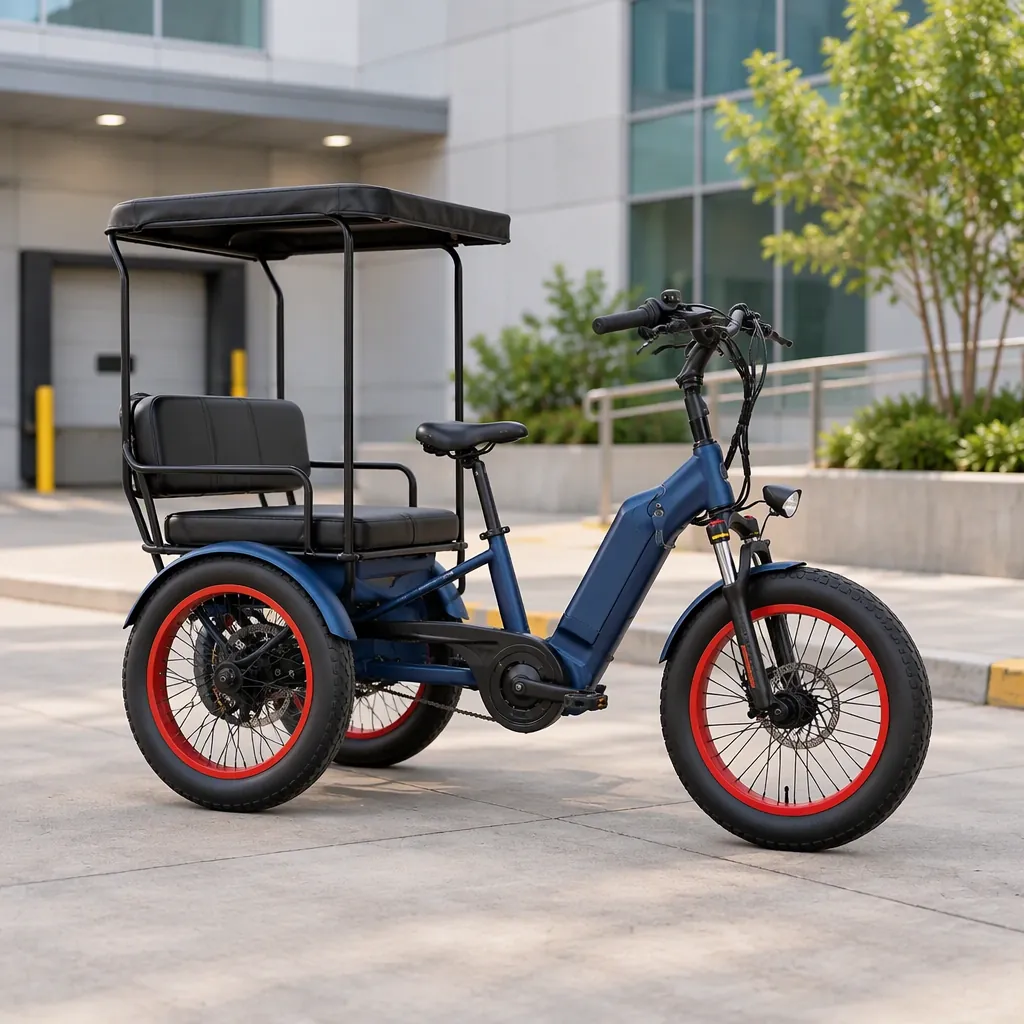
| Seating / body | Front driver seat + 2-person rear bench with backrest and armrest | Aluminium or steel box with drop-sides, flatbed or tipper |
The useful reading of that table: if the shift change is the primary task, the passenger platform's bench and armrests matter more than the cargo platform's payload ceiling. If the site moves equipment cages between buildings all day, the cargo platform's drop-side box and 72V option are the reason to buy it.
Duty cycle decides the battery, not the brochure
Two shifts a day is the single most common specification mistake on a closed-perimeter site, because it sounds like a range question and is actually a charging question. Consider a realistic case: a hospital campus loop of 2 km, 14 rounds per shift, two shifts a day, with a 90-minute window between them.
- A 60V 32Ah pack on a 5A charger needs 6–10 hours to refill from a deep discharge. It will not be ready for the second shift after a 90-minute break.
- A 60V 20Ah pack at the same charge rate still needs several hours. Reducing capacity does not solve a two-shift schedule.
- The options that do solve it are: a second pack per vehicle swapped at the break, a higher-output charger where the site's electrical supply supports it, or a second vehicle alternating shifts.
On a campus where the vehicles park in a designated bay, the second-pack route is usually the least disruptive, because it needs no new electrical infrastructure. Where the site already has a proper charging yard, the charging dock planning guide covers the circuit and bay arithmetic that applies to both routes.
Speed governance and the walking-pace requirement
Most closed-perimeter sites have one place where a passenger vehicle and a pedestrian share a surface without a barrier: a boarding gate, a hospital entrance, a crossing between two car parks. That is where a governor becomes a specification requirement rather than a nicety.
Both platforms accept a set speed governor, configurable in three steps: 25 km/h, 35 km/h or 40 km/h. On airside and campus loops, the practical configuration is a governed low setting for the shared-surface sections combined with a driver procedure that keeps the vehicle at walking pace in those zones. The governor sets a ceiling; the procedure sets the speed where pedestrians are.
Three further points belong in the same conversation:
- Reverse. Both platforms carry a forward / neutral / reverse selector with an LCD reverse indicator. On a loading dock or in a service corridor, reverse is used constantly and the audible reverse alarm is worth specifying for warehouse-side compliance.
- Noise. A hub-motor tricycle is effectively silent at low speed. That is an operational hazard on a pedestrian surface, not a benefit, and the mitigation is a visual one — high-visibility body colour, full LED headlight plus tail, brake and turn signals, and an optional beacon light for utility builds.
- Ramps. Where a route crosses a kerb ramp or a garage incline, order the drivetrain for the gradient rather than adding battery capacity. Motor power scales from 800W for flat urban routes to 1200W with hill-climb gearing for sites built on slopes.
Access control and site security
Every vehicle inside a badge-controlled perimeter has to satisfy a security officer, and that requirement is easier to meet when it is designed in rather than added later.
- Vehicle identity. Every unit is tracked by VIN from the factory floor, and the export documentation pack links each VIN to its cell batch, BMS and test records. That is the record a site security team needs when the fleet register is audited.
- Telemetry. GPS tracker integration with geofencing is available as a fleet option. On a site with defined zones, a geofence gives you a movement record against the badge system rather than a separate spreadsheet.
- Key management. Fleets that run shift changes lose time to key handling. A key-alike system, where one key opens every unit in the fleet, removes the matching problem at the point where it costs the most.
- Accessory lockers. For utility builds on government and institutional sites, a lockable tool box on the platform keeps service equipment on the vehicle between rounds rather than in a separate store.
Indoor and outdoor transitions
Closed-perimeter work is unusual in that vehicles move between surfaces with different characteristics in the same shift: polished terminal flooring, exterior asphalt, gravel service roads and painted concrete decks.
Tyre and brake selection follows the worst surface on the route, not the best. The passenger platform ships 3.00-12 front and 3.50-12 rear dual with road tread; the cargo platform ships 3.00-12 front and 3.75-12 rear dual, load-rated. Where a route includes a wet or greasy indoor surface, the tyre choice and the walking-pace procedure matter more than any brake upgrade, because a three-wheeled vehicle under braking puts its load on the front wheel and the two rear wheels together.
Corrosion is the second transition issue. Salt-laden air, road salt in winter and repeated wash-down all attack fasteners, spokes and connectors. The chassis is steel tube with e-coat and powder coat for rust resistance on both platforms; where a site runs coastal or heavy wash-down duty, that coating specification and a documented wash protocol should be written into the purchase order, and the winter operation guide covers the salt and wash cycle for year-round routes.
Building the purchase specification
A specification that gets answered properly has six parts. Send all six and the quotation comes back comparable across suppliers; send three and you will spend a week clarifying.
- Duty statement. Loop length, rounds per shift, shifts per day, and the break window available for charging.
- Occupancy or payload. Seats needed, or the box volume and weight the cargo variant must carry.
- Route constraints. Narrowest gap, steepest gradient, indoor and outdoor surfaces, any pedestrian-shared section.
- Speed governance. The governed setting required and where the walking-pace zones are.
- Compliance documents required by your tender. Named explicitly, because the document pack differs by market.
- Fleet programme terms. Quantity, delivery window, spares arrangement and branding requirements.
Compliance and documentation for institutional buyers
Public-sector and institutional procurement carries a documentation burden that commercial buying does not. The tender pack routinely asks for UN 38.3 battery transport test reports, EN 15194 or UL 2849 compliance letters depending on the market, RoHS and REACH substance declarations, and factory ISO 9001 and ISO 14001 certificates, sometimes with legalisation or apostille steps. A single missing document disqualifies the bid, which is why the document schedule should be agreed before the order rather than after it.
Both platforms ship with CE marking planning, RoHS documentation extending to components, and UN 38.3 battery test documentation, with each order carrying cell, BMS and test-report documents in the export file. Passenger tricycles in particular sit in a regulatory grey zone between bicycle and motor vehicle categories in many jurisdictions, which is why the compliance path for a specific site should be settled with your own authority before the specification is finalised. The EU versus US certification comparison sets out how the two paths differ, and the government and municipal fleet page covers the tender documentation framework in more detail.
Programme terms and what to expect
OEM orders on both platforms start at 50 units per model, with a standard lead time of 15–30 days and 30–45 days for a first custom-branded run. Pre-production samples ship before mass production, which matters on institutional programmes because the sample is usually what gets signed off internally before the volume order is released.
Customisation options that matter for campus fleets specifically: canopy fabric with branding across the panels and a powder-coated frame in any RAL colour for site identity; acrylic windshield for wind-driven rain on exposed loops; marine-grade vinyl upholstery with adjustable foam density for high-turnover seating; dual USB charging ports on the rear armrest for passenger builds; USB and audio options for campus tour narration; and LFP battery chemistry where ambient temperatures routinely exceed 40 °C and thermal stability extends pack life.
For comparisons against the incumbent vehicle on these sites, the tricycle versus golf cart analysis covers the specification differences, and the passenger shuttle guide covers duty-cycle and fleet economics for scheduled passenger service.
Frequently asked
Can an electric tricycle be used indoors on a campus?
Yes, and that is one of its main advantages on a closed site. A hub-motor tricycle has no exhaust and effectively no low-speed noise, which makes it suitable for covered walkways, service corridors and loading areas that a combustion vehicle cannot enter. The constraint is the reverse of the outdoor case: because the vehicle is quiet, high-visibility body colour, full LED lighting and a walking-pace procedure in pedestrian areas become safety requirements rather than options.
How many vehicles does a site shuttle loop need?
Work it from the loop time and the headway you want, then add one. A 2 km loop at an average 15 km/h takes roughly eight minutes; a four-vehicle rotation holds an eight-minute headway with one unit out for charging or service. The charge window is usually what forces the extra unit, not the passenger volume.
What is the step-in height and can passengers with limited mobility board?
The passenger platform uses a front driver seat with a rear bench carrying two to three passengers at 300 kg total including the driver, and a low floor with an optional acrylic windshield. Boarding height is a specification item to confirm against your own access requirements, not something to assume, and the accessibility fleet page covers the adapted platforms built for higher support needs.
Do both platforms accept the same accessories?
Mostly, but not identically. Both accept canopy or rain cover, branding in paint or vinyl, and GPS tracker integration. The passenger platform additionally takes passenger-side options like USB ports, audio and upholstery specification, while the cargo platform takes the box configuration choices: fixed, three-way drop-side, or hydraulic tipper. The OEM guide lists the full option set for the cargo side.
What does the first order cost and how long does it take?
Cargo platform builds run in three FOB bands from $1,250–1,550 up to $1,880–2,250 depending on motor, battery chemistry and box configuration. Passenger tricycle fleet builds are quoted per seating and canopy specification. Standard lead time is 15–30 days, with 30–45 days for a first custom-branded run, and MOQ is 50 units per model. Duty-cycle fine-tuning questions are settled with an export engineer on one call, with no obligation.
Spec a Ground Transport Fleet for Your Site
Tell us your loop length, rounds per shift, occupancy and the routed constraints. We will propose the platform configuration, speed governance setting and a fleet programme with the production slot reserved ahead of your launch.
