
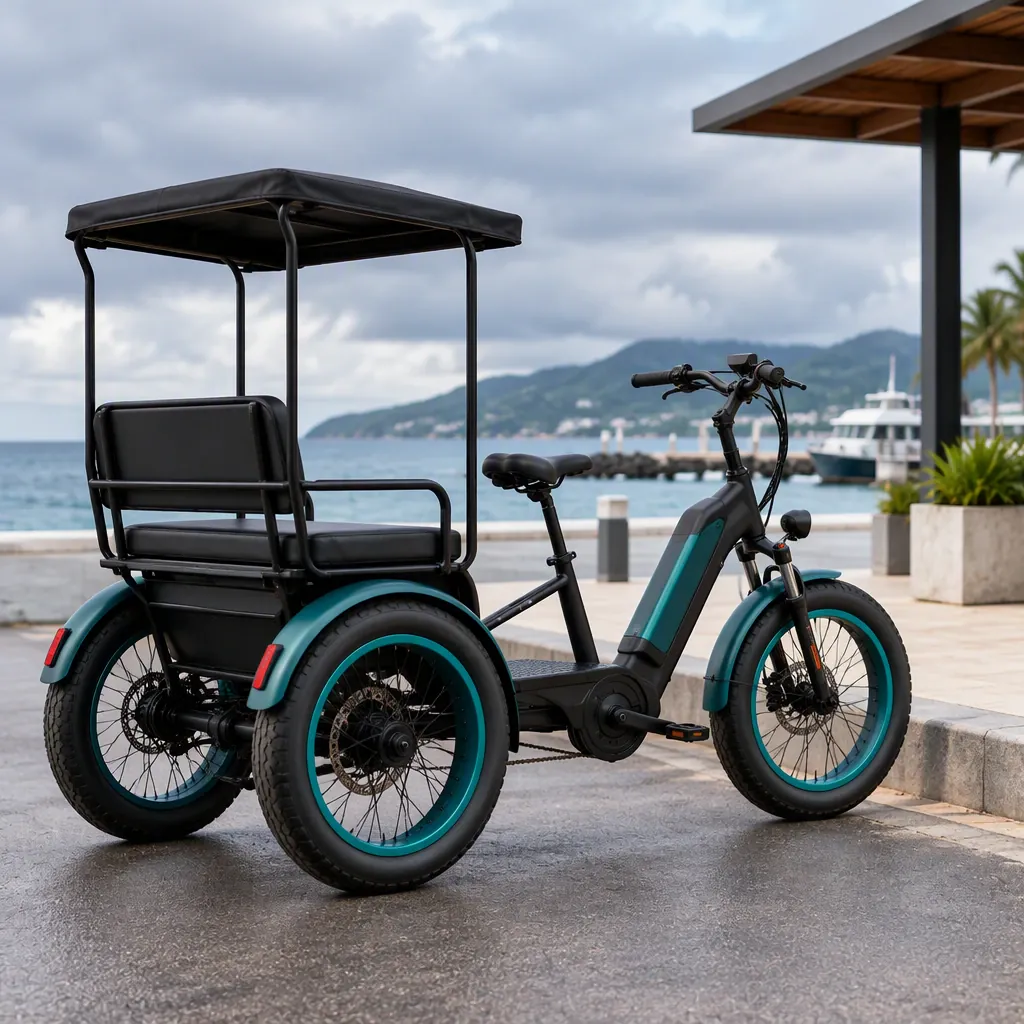
A guided tour operator buys a vehicle for one reason: it has to leave the depot at a published time, carry a paying group around a fixed circuit, and be back and recharged before the next departure. That is a fundamentally different duty cycle from a rental fleet, where the customer decides when and where to go. The passenger tricycle fits guided operation well because it carries two to three paying guests behind a single driver, boards them from both sides without a step-over, and runs at governed speeds that keep a mixed-skill group together on a city street.
What follows is the sourcing logic for that specific job. It assumes you already know your route and your timetable, and it treats the platform specification as a consequence of those two things rather than a starting point.
Why a Guided Route Is Not a Rental Round
Rental fleets optimise for turnover. Guided fleets optimise for schedule adherence. The two produce different purchase criteria, and confusing them is the most common sourcing mistake in this segment.
| Operating variable | Rental fleet duty | Guided tour duty |
|---|---|---|
| Who sets the route | The customer, each turn | You, a fixed circuit published in advance |
| Load profile | Highly variable, many single riders | Predictable, usually at or near capacity |
| Daily distance | Short hops, many returns to base | One or two long circuits per unit per day |
| Charge strategy | Swap or charge between casual rentals | Fixed window between scheduled departures |
| Rider skill | Wide spread, self-selected | Your employed driver, consistent |
| Failure cost | One lost rental | A cancelled departure and refunded seats |
The last row drives everything else. Because a breakdown does not cost you one fare, it costs you a departure, guided fleets should be specified with more redundancy in charge capacity and more conservative speed governing than a rental fleet of the same size.
The Four Numbers to Settle Before You Talk to a Supplier
Route length, seating demand, turnaround time and boarding access decide the platform. Work them out from your own operation before approaching any manufacturer, because a supplier who is given these four numbers can size a platform in one reply, while a supplier given a vague brief will quote you a generic vehicle.
1. Circuit length and the charge window
A passenger tricycle platform rated at 40 to 60 km loaded range on a 60V 20Ah or 32Ah pack will complete a typical urban heritage circuit of 12 to 20 km with a wide margin. The binding constraint is rarely the circuit itself; it is whether the vehicle can recover a full charge inside your turnaround window. Charging from a 5A charger takes six to eight hours on the 60V 20Ah configuration, which means a vehicle doing two circuits per day needs either a full overnight cycle plus a top-up, or a second battery.
The practical test: multiply your longest circuit by the number of departures you plan per vehicle per day, add 30 percent for terrain and gusts, and compare that distance to the claimed loaded range. If the result exceeds about 70 percent of the published range, plan for a battery pool rather than assuming one pack per vehicle is enough.
2. Seats you can actually sell
The standard passenger tricycle carries a driver plus a rear bench for two, with the 300 kg total load rating covering driver and passengers together. Some operators run a three-passenger bench on the longer-wheelbase configuration. Be conservative here: your advertised seat count is a promise, and a bench that is comfortable for two adults who know each other is often not comfortable for three strangers on a 90-minute circuit. For most guided operations the sellable number is two passengers per unit, with a third seat as an overflow or child position.
3. Turnaround and boarding
Boarding is the hidden schedule killer. A tricycle with a low step-in height and open sides boards two passengers in well under a minute. A vehicle with a high sill or a single-side entry will eat several minutes per departure, and those minutes compound across a day of scheduled departures. Look for a platform with a low, wide floor pan and unobstructed access from both sides. Where you have guests with reduced mobility, the same low-floor geometry that helps your turnaround also removes the awkward lift that ends rides early.
4. Who drives, and at what speed
Guided operations use employed drivers, which changes the speed calculus. You are not governing for a nervous first-time rider; you are governing so the whole group stays together and so your guide can narrate. Platforms with a programmable speed governor in the 15 to 25 km/h band let you set a tour pace and lock it, giving a consistent guest experience and a defensible safety position with your insurer. This is also where a fleet-wide setting matters: one governed speed for all units is far easier to defend than per-driver discretion.
Platform Specification for Guided Sightseeing
The table below reflects the passenger tricycle platform specification published for these duty cycles. It is the honest engineering picture, and where a number matters to your operation it is worth confirming against your own route data.
| Item | Standard guided-tour configuration |
|---|---|
| Motor | 500W / 800W brushless hub motor, 60V, rear differential axle |
| Battery | 60V 20Ah / 60V 32Ah lithium (LFP option), under-seat mount |
| Range | 40–60 km loaded at moderate speed |
| Top speed | 25–35 km/h, governor programmable in the 15–25 km/h band |
| Charging | 6–8 hours (60V 20Ah configuration) |
| Brakes | Hydraulic disc front (180 mm) plus dual mechanical drum rear |
| Weight | 120–160 kg with battery |
| Load capacity | 300 kg total, driver plus 2–3 passengers |
| Tyres | 3.00-12 front / 3.50-12 rear (dual), road tread |
| Frame | Steel tube body-on-frame, e-coated and powder coated |
| Seating | Front driver seat plus rear bench (2-person) with backrest and armrest |
| Canopy | Optional fabric canopy with roll-up sides, steel tube frame |
| Display | LCD speedometer, battery gauge, forward/reverse indicator |
| Lights | LED headlight, tail and brake lights, turn signals, horn |
Two of these rows deserve emphasis because they are the ones operators most often get wrong.
The differential axle is not a luxury. A three-wheeled vehicle with two driven rear wheels and no differential scrubs its tyres through every tight turn, because the inner and outer wheels travel different arcs at the same rotation. On a guided circuit with frequent turning points, that shows up as accelerated rear tyre wear and a subtle resistance that costs range. The standard guided configuration includes a rear differential axle, and it should be treated as a requirement rather than an upgrade.
Brake architecture follows from the load. A loaded passenger tricycle decelerates on one front contact patch and two rear ones, with the front doing most of the work. Hydraulic disc at the front and dual drum at the rear, as specified above, is the configuration that holds up to repeated loaded stops on a circuit run several times a day. Drum rear brakes are chosen here for their enclosed, low-maintenance behaviour in wet weather rather than for peak stopping force.
Compliance and Insurance Paperwork for Passenger Carrying
The moment you charge the public to sit in a vehicle, you move into a different compliance conversation than a rental fleet. Passenger tricycles operate in a regulatory space between bicycle and motor vehicle in many jurisdictions, and the practical requirement is not a single certificate but a documentation file you can hand to an insurer and a tourism regulator.
The export documentation package for this platform covers CE marking planning for the electrical system under the Low Voltage Directive, electromagnetic compatibility documentation for the motor controller, RoHS compliance across the wiring harness, lighting assembly and dashboard electronics, and UN 38.3 test reports for the battery pack covering the T.1 through T.8 sequences. For markets that require vehicle-type approval for three-wheeled passenger carriers, the technical construction file is adapted to local requirements. Every container ships with a certificate of origin, a packing list carrying HS codes, and a bill of materials.
What this means in practice for a tour operator: ask your supplier for the documentation file before you sign, confirm that the UN 38.3 reports are specific to the pack you are buying rather than a generic family certificate, and check whether the CE file covers the controller as installed. Insurers in this segment frequently ask for exactly these three items, and a supplier who cannot produce them promptly is a supplier who will slow down your season.
Related reading on the regulatory side: electric tricycle laws in the US and EU and EU versus US certification paths set out how the market-specific routes differ.
Branding, Comfort and the Guest Experience
A guided tour vehicle is a moving billboard that also has to be comfortable enough that guests recommend the tour. Both considerations push toward cosmetic customisation, and this is where a passenger platform offers more scope than a cargo one.
Canopy fabric can be printed across all four panels with your brand pattern and logo, and the steel tube frame accepts powder coating in any RAL colour. Seat upholstery comes in marine-grade vinyl with welt piping in an accent colour, and the foam density is adjustable for markets where riders prefer a firmer or softer seat. For a tour running in wet or tropical conditions, aluminium chequer plate flooring is a worthwhile addition, and for longer circuits the rear armrests can take dual USB charging ports and a Bluetooth speaker for narration.
Battery chemistry is the one comfort-adjacent choice with a real engineering consequence. The platform defaults to NMC lithium and switches to LFP for operators in the Middle East, South Asia or sub-Saharan Africa where ambient temperatures routinely exceed 40 degrees Celsius. In those climates LFP's thermal stability extends pack life, and a guided fleet running daily circuits in high heat will see the difference in replacement cost within a few seasons.
Where Guided Fleets Actually Lose Money
Three failure patterns account for most of the margin that operators in this segment give away, and all three are sourcing decisions rather than operational ones.
Undersizing the battery pool
Buying one battery per vehicle looks efficient until the first hot afternoon when a unit comes back with 20 percent charge and the next departure is in ninety minutes. A battery pool sized at roughly one spare pack per three vehicles absorbs back-to-back departures and lets you rotate packs to equalise cycle counts. It is a modest line item against the revenue of a cancelled departure.
Choosing on purchase price rather than duty-cycle fit
A consumer-grade three-wheeler is cheaper at the dock and more expensive over a season. The cost shows up in tyre scrub from a missing differential, in brake fade on repeated loaded stops, in corrosion on fasteners after a wet winter, and in batteries that lose capacity after a few hundred cycles instead of holding up over a thousand. Guided tours run more loaded stops and more turns per kilometre than almost any other use of this platform, which makes duty-cycle fit the dominant cost variable.
Treating spares as an afterthought
The parts that fail on a guided fleet are predictable: brake pads and shoes, tyres, and battery packs. A spares kit ordered with the fleet at a modest volume cost is worth far more than expedited shipping in the middle of your season, when a grounded vehicle costs a departure a day. Ask for the consumable list with your quote and price it into the initial order.
Programme Terms to Expect
For the passenger tricycle platform, OEM orders start at 50 units per model with a standard lead time of 15 to 30 days, extending to 30 to 45 days for a first custom-branded run. Pre-production samples ship before mass production begins.
Fleet programmes for rental and tour operations typically include bulk pricing, a spares kit with each container, reservation of a priority production slot ahead of peak season, and a dedicated after-sales contact for rapid parts dispatch. If your season is fixed by a tourism calendar, the production slot reservation is the clause that matters most, because it is the difference between your vehicles arriving before opening day and arriving during it.
For the wider commercial picture on fleet purchasing, fleet financing and leasing covers how tour operators typically structure the capital, and fleet charging infrastructure works through the depot-side arithmetic. If your programme also runs two-wheelers alongside trikes, the rental fleet platform guide and the motor power guide set out the two-wheel specifications. The taxi and shuttle guide covers point-to-point passenger operation, and the tourism rental guide covers the self-drive model. For maintenance planning across a season, the maintenance guide and the spare parts guide are the practical companions.
Questions to Ask Before You Place an Order
These are the questions that separate a supplier who understands passenger carrying from one who is reselling a generic platform.
- Does the platform include a rear differential axle as standard, and what is the tyre wear expectation on a circuit with frequent turning points?
- What is the charge time on the exact pack configuration quoted, and what range figure is it paired with?
- Is the speed governor programmable across the 15 to 25 km/h band, and can one setting be locked across the whole fleet?
- Which specific UN 38.3 test reports ship with this battery pack, and do they name the pack rather than a family?
- What are the consumable parts for a 12-month duty cycle, and at what volume discount can they ship with the fleet?
- Can the first custom-branded run be scheduled to land before your season opens?
- What is the warranty position on corrosion-related failure of fasteners, bearings and electrical connectors?
Reading the Answers
A supplier who answers all seven without hedging is a supplier who has built for this market before. A hesitating answer on the differential axle or the UN 38.3 reports is the signal worth acting on, because both are things a manufacturer either builds into the platform or does not. The platform specification above gives you the vocabulary to check the answers rather than simply accept them, and the four route numbers you settled at the start tell you whether the vehicle you are being offered actually fits the circuit you run.
Spec a Passenger Fleet for Your Route
Tell us your circuit length, daily departures, and seat requirement. We will propose the platform configuration, seat and canopy spec, and a fleet programme with the production slot reserved ahead of your season.
