
A hotel is not one operation moving on three wheels. It is four operations that happen to share a service yard: housekeeping moving linen and amenities to rooms, grounds keeping the estate presentable, engineering moving parts and tools, and front-of-house moving guest luggage between the porte-cochere, the rooms and the conference block. Each runs on a different circuit, at a different hour, at a different speed, and each has a different reason to reject a vehicle that the others accept. This guide is written for the property or estate manager who has to buy one fleet and make it work across all four.
The Four Property Circuits and What Each One Actually Demands
Property buyers who spec one vehicle for "everything on site" end up with a machine that is wrong for all four duties. Split the requirement first, then look for the platform that covers the widest overlap at the lowest cost per circuit.
| Circuit | When it runs | Load profile | Deciding constraint |
|---|---|---|---|
| Guest luggage and arrival transfers | Check-in and check-out peaks, conference breaks | Light per trip, 15–25 kg per trolley equivalent, high frequency | Step-in height, canopy, quiet drivetrain, seat comfort, reversing in tight forecourts |
| Housekeeping and amenities replenishment | Morning block, 08:00–14:00 | Mixed: linen carts, amenity totes, 60–150 kg per run | Flat floor access, lift and corridor width, door thresholds, parking inside the building |
| Grounds and estate maintenance | Early morning before guests | Heavy: green waste, tools, irrigation parts, 150–300 kg | Payload rating, drop-side or tipper body, grass and gravel traction, noise before 07:00 |
| Engineering and stores | All day, reactive | Dense and awkward: pumps, filters, spares, chemicals | Box volume, tie-down points, chemical segregation, charging siting |
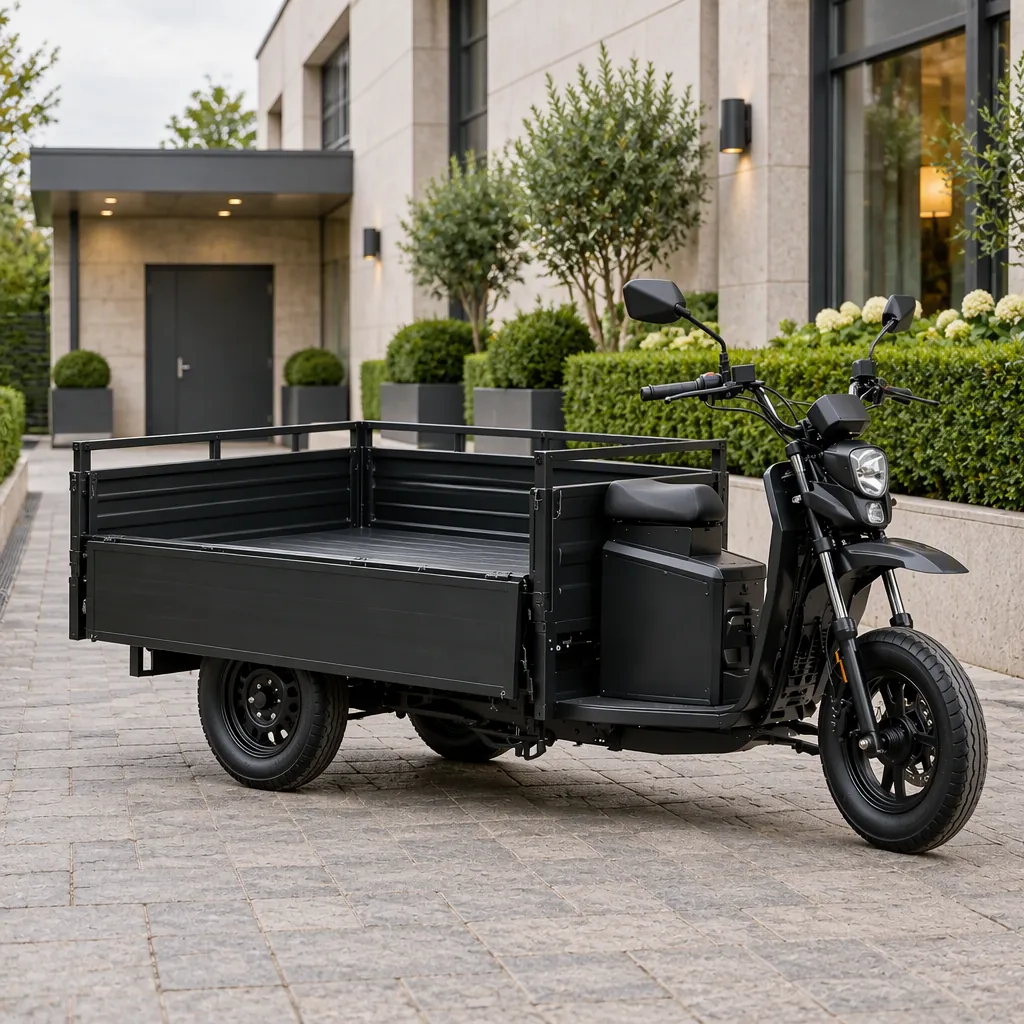
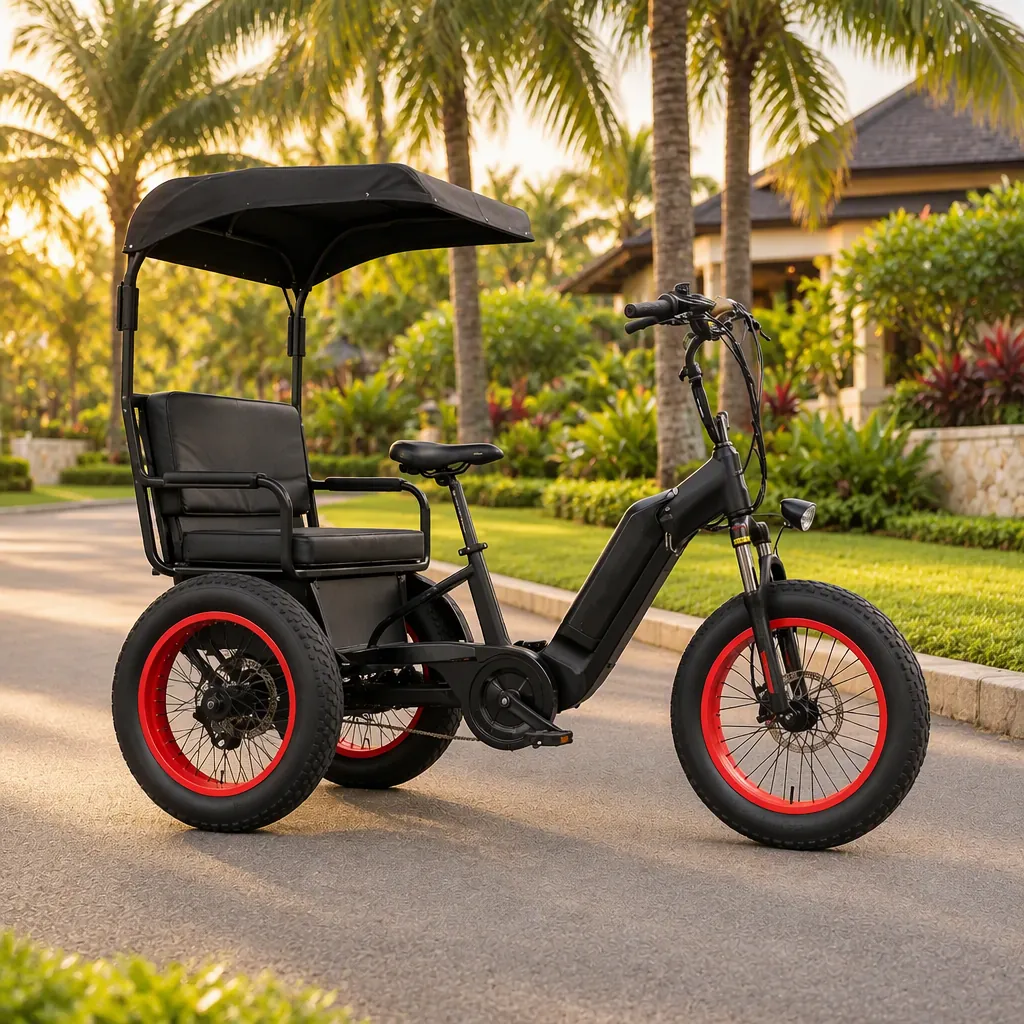
Two platforms cover this matrix on most properties: a passenger-configured trike with a bench and canopy for guest movement, and a cargo-configured trike with a drop-side box for linen and grounds. Both share the same three-wheel chassis, so one parts kit and one service procedure serve the whole fleet. That commonality is worth more than a marginal price difference between suppliers, because a property with two unrelated vehicle brands ends up stocking two spares inventories and training two service routines.
Why Three Wheels Suits a Property Better Than a Utility Cart
The obvious alternative on a large estate is a small four-wheel utility cart, and on flat paved resort grounds it is a reasonable one. It stops being reasonable in three specific property conditions.
- Public-road transfers between buildings. Many estates are split by a public lane, a footpath crossing or a municipal road. A golf-cart-style utility vehicle generally cannot be registered for that crossing, while a pedal-assisted or speed-governed electric tricycle can be specified to road-legal configuration for the market. See electric tricycle vs golf cart for the registration split in detail.
- Narrow service corridors and lifts. A three-wheel platform tracks in a narrower envelope than a four-wheel cart of the same payload, which decides whether it can use the service lift or has to loop around the outside of the building.
- Weather and canopy. Housekeeping and luggage circuits run in rain. A canopy and side curtains are a catalogue option on the passenger platform, not a custom fabrication. The canopy guide sets out what a fabric canopy does and does not keep dry.
The trade-off is direction: a three-wheel platform with a single front wheel is more stable under load than one with two front wheels, but it needs a wider turning circle at the end of a corridor. Measure the turning point before you commit the vehicle to an indoor route.
Step-In Height and the Luggage Circuit
Guest-facing movement is the circuit that most often disqualifies an otherwise sensible vehicle. The number that matters is not seat height, it is step-in height: the vertical distance from the ground to the lowest boarding surface. Anything above roughly 35 cm requires a step or a ramp for older guests, and a step on a moving property vehicle is a liability item as well as a service complaint.
The passenger platform on this site is specified with a low step-through frame, a padded rear bench with backrest and armrests, and a fabric canopy with roll-up sides as standard on the comfort tier. Load capacity is 300 kg total across driver plus two to three passengers, which covers a driver and a luggage-laden transfer with margin. Top speed is governed at 25–35 km/h, and for property use the governor should be set at the low end: an estate with guests walking between buildings does not need more than walking pace plus a margin, and a governed 15–25 km/h setting removes most of the objection from a health-and-safety review.
For the arrival circuit specifically, the useful specification additions are a rear bench that folds flat for luggage, a lockable small compartment for guest bags during a transfer, and full LED lighting including turn signals if the route touches a public road after dusk.
Housekeeping: The Envelope Constraint Comes First
Housekeeping is the circuit where the building decides the vehicle, not the buyer. Four measurements eliminate more candidate platforms than any specification sheet:
- Service lift internal dimensions. A cargo trike with a 150–500 L box is roughly 1.2–1.4 m wide at the rear axle. If the service lift is narrower, the trike is an outdoor vehicle and housekeeping reverts to carts pulled by hand inside the building.
- Corridor width and door thresholds. A 1.6–1.9 m clear corridor will pass a trike, but thresholds above 20 mm and door closers at 90 degrees will not. Walk the actual route with a tape measure, not on a plan.
- Floor loading and finish. A loaded cargo trike concentrates its mass on three contact patches rather than four. Check the point load with the facilities engineer before routing it over a raised floor or a decorative stone finish.
- Where it parks. A trike that has to return to an outdoor yard between floors is a different operational design from one that parks in a back-of-house corridor. Charging follows parking, so this decision sets the electrical scope too (see the charging section below).
Where the building does not accept the vehicle, the practical pattern is a two-tier housekeeping fleet: the trike runs the service yard, the linen room and the outdoor links between blocks, and floor attendants work from replenished floor stations. That is also how the laundry circuit is usually built, and the laundry and linen logistics guide covers the return-load maths, where the vehicle comes back heavier than it left.
Grounds: Payload, Body Type and the Hour Before Guests Wake
Grounds work is the only property circuit that genuinely loads the platform to its rating. Green waste, hedge cuttings and irrigation parts are bulky and heavy, and the estate usually wants them moved before 07:00. Three numbers decide the specification:
- Payload. The cargo platform here is rated 300 kg in the EU and 500 kg outside it, with a box volume of 150–500 L across the three tiers. That is the engineering limit of the chassis, axle set and brakes together, not a marketing figure. The payload capacity guide explains how the limit is actually composed.
- Body. A drop-side box is the default for grounds because cuttings can be tipped or forked out from three sides. A hydraulic tipper body is the upgrade when the estate generates dense loads such as soil, gravel or compost. Compare the two in the hydraulic tipper guide.
- Noise. A hub-motor platform is close to silent at walking pace, which is precisely why grounds crews can work a guest-facing lawn before breakfast. The noise that gets complaints is not the motor but loose tools in an unlined steel box. A rubber mat in the bed solves it for a few dollars per vehicle.
Traction on wet grass and gravel is the other grounds constraint. Tyre specification is covered in the cargo tricycle tires guide; the relevant point for an estate is that the rear dual wheels carry the load, so tyre pressure, not tread pattern, is what most often degrades performance on soft ground.
Charging: Site It Before You Order the Fleet
Charging is the item that turns a small vehicle purchase into a capital project, and it is the reason a fleet that looks cheap on paper stalls at the approval stage. The arithmetic for a property is simpler than for a delivery depot because the duty cycles are short and the vehicles return to the same place every day.
A 60V 32Ah pack on the cargo platform charges in 6–10 hours on a standard 5A charger, which fits an overnight cycle comfortably. The passenger platform's 60V 20Ah pack charges in 6–8 hours. Three property vehicles therefore draw roughly 1.5–2 kW of continuous charging load overnight, which almost every hotel already has available at the service yard without a supply upgrade. The correct approach is to place the chargers where the vehicles sleep, use one dedicated circuit per charger, and confirm the supply with the building's electrical contractor before the vehicles arrive.
Where the fleet cannot charge overnight because circuits run around the clock, the alternative is a second pack and a shift change, which is the pattern described in the fleet charging guide. For a property this is rarely necessary: a 40–60 km range on a passenger trike and 50–80 km loaded on a cargo trike covers an estate circuit many times over. If charging capacity is genuinely constrained, the charging station and dock infrastructure guide covers the architecture and the site survey that precedes it.
What a Property Fleet Costs and How to Phase It
Property buyers usually cannot commit the full fleet in one budget cycle. The staged pattern that works is to buy the vehicle that relieves the most expensive labour first, prove it for one season, and add circuits as the operating data justifies them.
| Phase | Vehicle | FOB band (this platform) | What it replaces |
|---|---|---|---|
| Phase 1 — grounds and service yard | Cargo trike, standard 1000W, drop-side box | $1,580–1,880 | Contractor collections and hand-barrow hauling of green waste |
| Phase 2 — guest and luggage movement | Passenger trike, comfort 800W with canopy | $1,080–1,300 | Bell-cart runs by foot across a large estate |
| Phase 3 — housekeeping and linen | Cargo trike, light 800W or standard 1000W | $1,250–1,880 | Second daily linen van movement or trolley relay |
| Phase 4 — engineering and stores | Second cargo trike, or share the Phase 1 unit | — | Parts runs to a central stores building |
Minimum order quantity on this platform is 50 units, so a single property rarely buys direct at the FOB band. The route for one property is a distributor or a dealer who holds stock, and the route for a group is a single consolidated order across the estate portfolio. The dealer and distributor guide covers the margin and stock structure of that channel, and the OEM buying guide covers MOQ, sample and lead-time mechanics if the group is large enough to order direct.
Access, Licensing and Insurance for a Property Fleet
Property buyers consistently under-estimate the regulatory question because the vehicles never leave private land. That is true until the estate is split by a public road, or until a guest takes a passenger trike onto the seafront promenade.
- Private grounds only. A speed-governed vehicle operating entirely on private land is generally outside vehicle registration, but the property's insurer will still want the fleet declared and drivers named. Confirm this in writing before the first vehicle arrives.
- Public road crossings. A route that crosses or runs along a public road pulls the vehicle into whatever category the market applies to it. The US and EU rules guide and the insurance and registration guide cover the categories and the registration paths.
- Driver competence. A trike with a rear bench and passengers is not a bicycle in the eyes of a risk assessor. A short in-house competency check, a governed speed setting and a defined route map are the three documents that satisfy most property insurers.
The Specification Checklist for a Property Buyer
- Walk and measure all four circuits before writing the specification: lift width, corridor width, door thresholds, turning point, parking position.
- Decide which circuits are indoor and which are outdoor. This single decision sets the platform count.
- Set the governor low for guest-facing routes and confirm the setting in writing on the order.
- Specify the canopy and side curtains on the passenger unit, and a rubber bed mat on the cargo unit.
- Confirm the charging position and have the electrical contractor approve the supply before the order.
- Declare the fleet to the insurer and define the driver competency check before delivery.
- Buy one parts kit and one service routine for the whole fleet, and keep to a single platform family.
A property fleet is a facilities decision more than a vehicle decision. The vehicle that wins is the one whose constraints fit the building, whose noise floor fits the hour, and whose charging position already has power. Get those three right and the platform almost chooses itself, and the specification stops being a guess. A property fleet that fits the building, respects the hour and has power where it parks will outlast three generations of guest expectations.
Send Us Your Property Circuits, We Will Spec the Fleet
Tell us the circuits you run, the building constraints you measured and the market you operate in, and we will come back with a platform recommendation for each circuit, the charging position and a quotation with the certification pack for your market.
