
A hotel laundry run is not a delivery route. It is a round trip in which the vehicle leaves the property full and comes back full, and the two loads are not the same product. Clean linen arrives in pressed stacks that must stay clean. Soiled linen leaves in the same vehicle, wet, contaminated, and heavier than it left. Almost every last-mile fleet guide on the market assumes a one-way loaded trip and an empty return. Laundry breaks that assumption, and that one difference reshapes the payload rating, the body configuration, the hygiene protocol, and the route math. This guide is written for OEM buyers and operators specifying a laundry and linen tricycle fleet for hotels, hospitals, care homes and commercial laundry plants.
Why Laundry Is a Return-Load Duty, Not a Delivery Duty
Start with the load ledger. A property that turns over 150 rooms a day moves roughly 2.5–4 kg of linen per room per day across bed linen, towels and terry. That is 375–600 kg of linen moving in each direction daily. The clean side is dry, folded and volume-heavy. The soiled side is damp, bagged and typically 10–25% heavier per piece because of retained moisture and the weight of containment bags. The vehicle carries both directions of that ledger, and it carries the soiled side with the same chassis the clean side rode in.
Three consequences follow directly:
- Return trips are loaded, so the payload rating is a both-ways rating. A platform rated 300 kg EU / 500 kg non-EU is carrying the clean drop and then the soiled pickup on the same shift. If the outbound load runs near the rating, the return leg has no headroom left for the soiled bag weight and the containment hardware.
- The compartment count is two, not one. Clean and soiled linen must not share an envelope. A single-box trike forces the operator to swap liners between legs, which adds a handling step at every stop and leaves contamination risk in the box seams.
- The duty is landaulet-shaped: many short stops, one long line-haul. The property-to-plant leg is the long one; the property-internal leg is a series of short stops at service doors, housekeeping rooms and loading docks. That is the opposite load profile of a food-delivery round, which is all short stops and no line-haul.
Duty Cycle Types: Which Laundry Run Are You Buying For?
Four operator types dominate this segment, and each one puts a different demand on the platform. Specify the duty type before the vehicle.
Type 1: Hotel and resort on-premises laundry shuttle
The property has its own plant or a contracted plant within a short radius. The trike runs multiple turns per day between the property and the plant. Load per turn is moderate, cycle count is high, and the vehicle lives on paved service roads and loading docks. Priority is turn frequency and fast swapping, not range. A 60V 32Ah pack charged on a standard 5A charger reaches full in 6–10 hours, so this operator charges overnight and runs the day.
Type 2: Hospital and clinic linen distribution
Load is smaller per stop but the stops are many, secure and time-critical. Hospital linen carries a higher hygiene burden and often requires documented segregation of categories. Priority is compartment hygiene, lid security and chain-of-custody discipline rather than raw payload. A locked, lined day-box and a separate lockable soiled compartment matter more here than the motor rating.
Type 3: Care home and assisted-living linen rounds
Many small properties, one shared plant. The trike runs a multi-stop route with moderate load at each stop and long inter-property legs. Priority shifts to range and to stability at low speed around residents and pedestrian areas. That is where the speed governor (25/35/40 km/h selectable) becomes a shared-space safety spec rather than a performance limit, and where a reverse gear earns its place on tight service courts.
Type 4: Commercial laundry plant collection fleet
The plant runs its own collection vehicles across a client base. Each vehicle hits many properties per shift, and load accumulates across the whole route before returning to base. This is the highest-gross-weight duty type: the vehicle finishes the shift at its heaviest, on the last leg, often on a public road. This is the type that most often exposes an undersized payload rating.
Payload Math: Sizing the Box Against the Linen Weight
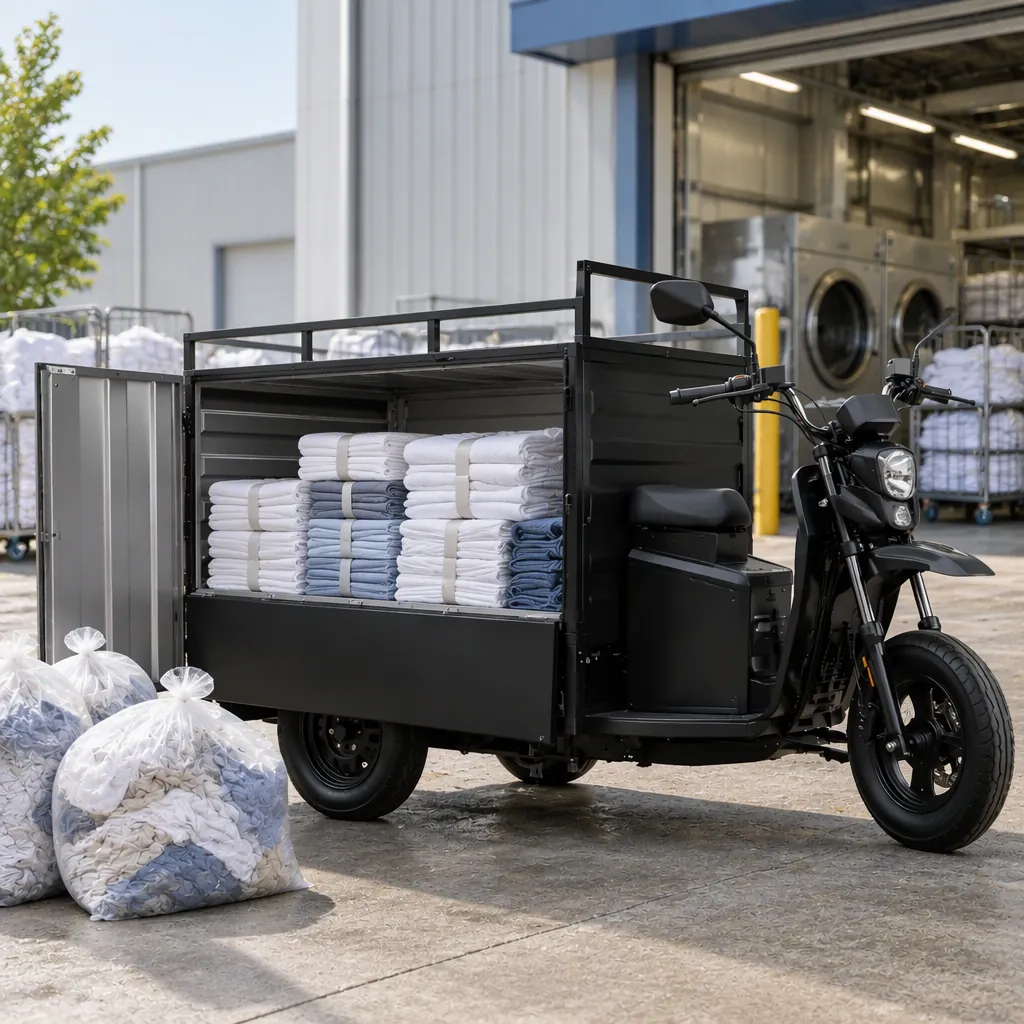
Linen is bulky and light. That combination is easy to underestimate, because volume fills before mass does. The working figures below come from the EMS-EBIKE cargo platform and from standard laundry-density assumptions. Use them as a sizing model, not as a warranty.
| Parameter | Specification | What it means on a laundry round |
|---|---|---|
| Motor | 800W / 1000W / 1200W brushless hub motor with differential, 60V/72V | Loaded start-stop at service doors needs the differential more than peak watts |
| Battery | 60V 32Ah / 72V 40Ah lithium (LFP available), heavy-duty BMS | LFP chemistry is the fleet choice for daily deep cycling |
| Range | 50–80 km (loaded 200 kg, flat terrain) | At 300–500 kg of linen the usable range drops below the published figure |
| Load Capacity | 300 kg (EU) / 500 kg (non-EU) | This is a both-ways rating when the return leg is loaded |
| Box Volume | 150–500 L, drop-sides, optional insulated lining | Linen fills 500 L long before it reaches 500 kg |
| Brakes | Hydraulic disc front + dual drum rear, parking brake | The parking brake matters on a sloped loading dock |
| Tires | 3.00-12 front / 3.75-12 rear (dual), reinforced load-rated | Rear pair carries the heavier share on a full return leg |
| Charging | 6–10 hours (5A charger) | One overnight charge covers a single-shift property round |
| Chassis weight | 150–220 kg without cargo box | Gross weight = chassis + box + linen both ways |
| Frame | Steel tube chassis, e-coat + powder coat, rust-resistant | Wet soiled linen makes corrosion protection a service-life spec |
The three linen load classes
Laundry loads fall into three classes, and each one pushes a different limit:
- Terry and towel-dominated load (dense). Towels are the heaviest linen category per unit volume. A box filled with terry can approach the platform payload rating while looking only two-thirds full. This is the class that tests the load rating.
- Bed-linen and flatwork load (bulky). Sheets and duvet covers are light but consume volume fast. A box filled with flatwork may weigh less than half the rating. This is the class that tests box volume.
- Mixed property load (the real world). Most hotel rounds are mixed, which is why drop-side box configurations and a two-compartment build are the working default rather than a custom option. The drop-sides let the operator add volume on a flatwork-heavy day and contain a dense terry day with the sides up.
Sanitation and Compartment Design: Clean and Soiled Must Not Mix
This is the specification that separates a laundry build from a general cargo build, and it is the one buyers most often omit from the RFQ.
- Two compartments, separated by a physical wall. The clean compartment should have a smooth, wipeable, non-porous liner and a close-fitting lid. The soiled compartment should be a lined or removable-bag compartment with drainage at the low point so retained moisture does not pool against the aluminium.
- Aluminium box with a cleanable liner. The standard box is aluminium sheet or steel with drop-sides and an optional insulated lining. For linen, specify the liner as a sealed, wipe-down surface. Bare steel sheet with exposed seams and fasteners traps fibre and moisture and turns into a corrosion site within a season of wet loads.
- Drainage and ventilation. Soiled linen is damp. A compartment that seals completely will hold that moisture against the metal and against the next clean load. Specify drain points and a vent path so the soiled side dries between turns.
- Restraint, not just containment. Linen bags shift. On a 500 L box the load can slide forward under braking and press against the front wall. Specify internal tie-down points or a load bar so the bagged load stays put through the stop-start of a service-door round.
- Document the protocol. For hospital and care work, write the compartment-use rule into the vehicle's operating procedure: clean side loads first, soiled side loads and closes at each stop, and a defined wash-down interval for the soiled liner. The vehicle supports the protocol; it does not replace it.
The vehicle specification that carries the linen load is the same cargo platform described in our cargo tricycle payload capacity guide, where the load ratings, axle limits and box volume classes are broken down by configuration.
Route and Range Math for a Return-Load Shift
Range figures published for cargo platforms are usually quoted at 200 kg on flat terrain. A laundry round runs heavier on the return leg, so the usable range is shorter than the headline number. Do the arithmetic on the real duty:
- Sum the daily distance. A single-property shuttle with a nearby plant may only run 8–15 km per day across several turns. A multi-property care home round can run 30–45 km. A plant collection fleet across a client base can exceed that.
- Apply the load penalty. A 300 kg-class trike carrying mixed linen near its rating will not reach the loaded-200 kg range figure. Treat the published range as an upper bound and plan the route with margin.
- Check the charging window. A 5A charger needs 6–10 hours for a full pack. That fits an overnight charge before a single-shift day. It does not fit a two-shift day on one vehicle, and it does not fit a mid-day top-up unless a higher-current charger is specified.
- Count the turns, not just the kilometres. A short shuttle round with four turns per day accumulates four loaded return legs. Load cycles age the drivetrain and the brakes, and multiple turns per day is a fleet-size driver.
Where a single property's volume exceeds what one trike can clear in a shift, the answer is generally a second vehicle rather than a bigger box. Splitting the round across two trikes keeps each one inside the payload rating and inside the charging window. Charging multiple units from one property supply is covered in our electric tricycle fleet charging guide.
Vehicle Class and Compliance for Laundry Fleets
Laundry trikes operate on a mix of private service roads and public roads, and the compliance position depends on where the vehicle runs and what it is classified as. The practical checks are:
- Speed limitation in shared space. The platform supports a selectable governor at 25 / 35 / 40 km/h. For care home and hotel service areas with pedestrians, specify the low setting at build time rather than leaving it to the rider.
- Certification package by destination market. Certification is destination-specific and must be quoted per market; the comparison across major schemes is set out in our EU vs US certification guide.
- Insurance and registration. Whether a laundry trike needs registration depends on classification and on the market. The general framework is covered in our insurance and registration guide; confirm the local position before committing to a fleet.
- Battery transport paperwork. Where the laundry provider moves battery packs between properties, the transport documentation requirements apply. Our battery pack guide covers the pack-level compliance set.
Specifying a Laundry Trike as an OEM Program
Bring the laundry-specific requirements into the RFQ rather than trying to retrofit them after delivery. The specification checklist that matters most:
- Compartment layout. State clean volume and soiled volume in litres, and confirm the wall between them is a physical partition with a sealed liner on both faces.
- Payload rating for both legs. Quote the maximum clean load and the maximum soiled load separately, and give the sum if both ride at once.
- Drain and vent points. Specify drainage at the low point of the soiled compartment and a vent path so the compartment dries between turns.
- Liner material. Wipeable, non-porous, sealed at seams. This is a line item, not an implication.
- Restraint hardware. Internal tie-down points or a load bar in the main box.
- Governor setting. Specify the factory speed setting for the operating environment.
- Locks. Lockable compartments for hospital and secure-property rounds, and where multi-user operation is expected, a key-alike lock system across the fleet.
- Commercial terms. The EMS-EBIKE cargo program runs MOQ 50 units with a 15–30 day lead time, and custom box configurations extend that. Programme structure and customisation options are set out in our cargo e-tricycle OEM guide.
A note on fleet financing
Laundry fleets are usually bought against a service contract, and the payback case is the cost of the vehicle-kilometres the trike replaces rather than the purchase price alone. Operators building that model should read our fleet financing guide for the depreciation and utilisation assumptions that drive it.
Frequently Asked Questions
How much linen can an electric cargo tricycle carry?
The EMS-EBIKE cargo platform is rated 300 kg payload for EU configurations and 500 kg for non-EU configurations, with box volume from 150 to 500 litres. Because linen is bulky rather than dense, box volume often runs out before the payload rating does. On a return-load laundry round, the practical limit is the sum of the clean drop and the soiled pickup, which is why the rating should be treated as a both-ways figure rather than a one-way one.
Can the same vehicle carry clean and soiled linen?
It can, and the standard configuration for laundry work uses two physically separated compartments so the two streams never share an envelope. Clean linen goes in a smooth, wipeable, lidded compartment; soiled linen goes in a lined compartment with drainage at the low point. Sharing a single box forces liner swaps at every stop and leaves contamination risk in the seams.
What range should a laundry trike be specified for?
Published range for the cargo platform is 50–80 km at 200 kg loaded on flat terrain. A laundry round runs heavier on the return leg, so plan the route against a shorter usable figure. Single-property shuttles typically run 8–15 km per day across several turns; multi-property care home rounds run 30–45 km; plant collection fleets run further still and should be sized with a battery and charging plan rather than a single pack assumption.
Does the trike need registration to run laundry routes?
That depends on the vehicle's classification in the destination market and on whether the route uses public roads. The general framework is covered in our insurance and registration guide. Confirm the local position for your operating market before committing fleet volume.
What charging setup does a laundry fleet need?
A single trike recharges on a standard 5A charger in 6–10 hours, which suits an overnight charge before a single-shift day. A two-shift operation or a multi-vehicle fleet needs a charging plan: either a second vehicle, a higher-current charger, or a dedicated supply at the yard. Our fleet charging guide covers the layout and load arithmetic.
The Specification Decision in One Page
Laundry logistics is a return-load duty, and every specification decision follows from that single fact. Rate the platform for both legs, not just the outbound one. Build two compartments with a physical wall, a sealed liner and drainage on the soiled side. Size the box against volume for flatwork and against payload for terry. Confirm the charging window against the number of turns per day, not just the daily distance. Set the governor for the operating environment. Then wrap the whole thing in an OEM programme that quotes the partition, the liner, the restraint hardware and the locks as specified items. Operators who buy the cargo platform first and try to fit laundry duty to it afterwards generally end up with a single-box vehicle doing two-compartment work, and that is the one configuration this duty will not tolerate.
Spec a Return-Load Laundry Tricycle
Send us your linen volume per shift, the soil-to-clean ratio, and the route distance between your property and the laundry plant. We will match a cargo platform, size the day-box and the soiled compartment, and quote an OEM program with MOQ 50 and 15–30 day lead time.
