
A food bank does not fail because it lacks volunteers. It fails on the one afternoon when a supermarket donates 700 kg of chilled product at 15:40, the receiving pallet is already full of ambient tins, the walk-in has 40 minutes of door-closing discipline left before its temperature log breaks, and the only vehicle free is out on a school pick-up run. Purchasing a van solves the wrong part of that problem: it solves carrying, not timing, and it commits a charitable budget to a diesel drivetrain with a fifteen-year service tail.
A cargo e-tricycle changes the arithmetic because it is cheap enough to buy two of, small enough to park at a loading dock ramp that a van cannot use, and slow enough that a volunteer who has never driven a commercial vehicle can be insured on it in an afternoon. But it only works if the specification is derived from the redistribution circuit the organisation actually runs, not from a catalogue. This guide sets out the four measurements that decide the vehicle, the cold-chain arithmetic that decides how many, and the tender language that decides whether a grant will fund it.
Why a Redistribution Circuit Is Not a Delivery Route
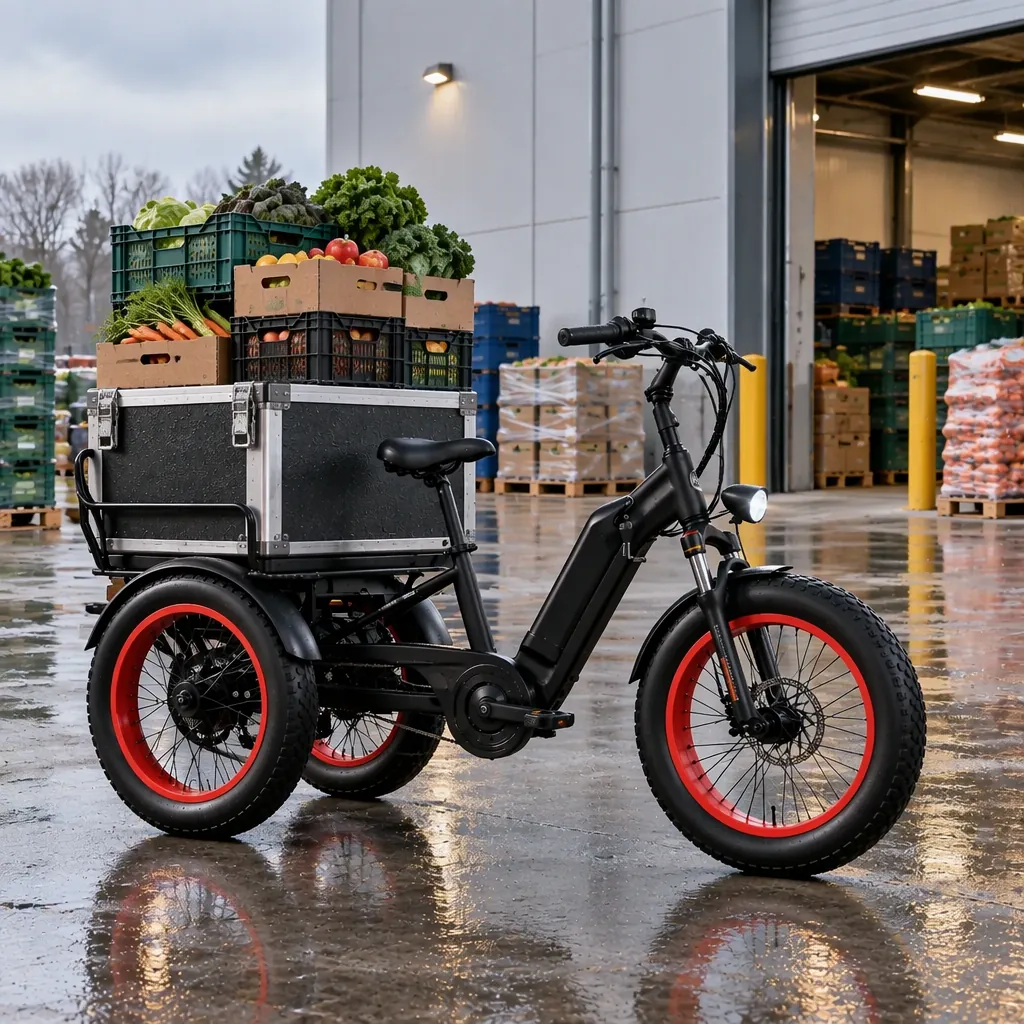
A commercial delivery route is designed backwards from a customer promise: the stops are fixed, the order is planned, and every vehicle on the road is doing roughly the same job all day. A food redistribution circuit is designed forwards from whatever donors happen to have. Three properties follow from that, and each one changes the vehicle specification.
- The load is discovered, not ordered. A donor call arrives with a weight, a temperature class and a collection window, and none of the three is negotiable. A van that was planned for 400 kg ambient and gets 600 kg chilled has to abandon part of the donation. A trike with a 300 kg EU-rated payload and a convertible box can take the chilled part, leave the ambient part to a second trip, and log both.
- The circuit is short and repeated, not long and linear. Most community redistribution runs are 8 to 25 km across six to twelve collection and hand-out points, returning to the same depot two or three times. That is the opposite duty cycle from last-mile parcel work, and it is the reason the platform's 50–80 km loaded range matters far less than its turnaround time at the depot.
- The fleet is driven by many people, few of them professionals. A charity may have two staff drivers and fifteen volunteers on a rota. Vehicle risk lives in the handover, not in the road: who checks the load, who closes the temperature log, who plugs it in.
That last point is the one most purchasing committees underweight. A charitable fleet buys insurance against a single volunteer error far more than against a collision rate, and the specification levers that reduce volunteer error are cheap: a step-through frame, a parking brake that holds on a ramp, a reverse gear for tight yards, and an LCD that reports load rather than only speed. If the buying group is comparing the trike to a compact van on payload alone, they are comparing the wrong numbers.
Measure Four Things Before You Choose a Platform
Four measurements eliminate more candidate vehicles than any specification table. Take them on the real circuit, with a tape measure, on a weekday, not from an office.
| Measurement | Where to take it | What it decides |
|---|---|---|
| Ramp and threshold geometry | Every collection point's loading dock, kerb and fire door | Whether a box body fits at all. A 150–500L box on a 3.00-12 front / 3.75-12 rear footprint is roughly 1.2–1.4 m wide; a 1.1 m fire door rules the vehicle out regardless of payload. |
| Peak single-donation weight | The largest donation received in the last 12 months | Payload class. The platform is rated 300 kg (EU) / 500 kg (non-EU). If the true peak is 480 kg, buying the EU-rated unit means splitting every large collection. |
| Cold and ambient split | Temperature class of every recurring donor | Box construction. Insulated sandwich panel for a chilled circuit, open drop-sides for ambient-only. Mixed circuits need both, which usually means two vehicles, not one compromise. |
| Depot dwell time | Minutes from arrival to next departure, observed | How many vehicles the organisation actually needs. Dwell time, not range, is the binding constraint. |
The ramp measurement catches the most expensive mistake. Charitable premises are frequently donated or leased space rather than purpose-built logistics buildings, which means narrow side doors, a step up from the yard, and a goods entrance shared with a kitchen. A vehicle chosen on payload and price without measuring those three surfaces will be unloaded by hand in the rain for its entire service life.
The Cold-Chain Arithmetic That Decides Fleet Size
Cold redistribution is where a trike either earns its place or quietly loses the food. The vehicle cannot hold a freezer temperature the way a refrigerated van can, so the design principle is to shorten the time the product spends in the box rather than to maximise the box's insulation. Two numbers do almost all of the work.
Plate the 6–10 hour charge window against the depot's opening hours. The standard pack is 60V 32Ah or 72V 40Ah, charged at 5A. Charging is not a mid-shift activity: a vehicle that returns at 12:30 will not be fully charged for a 16:00 second run. The realistic pattern for a charitable circuit is one long charge overnight plus one partial top-up across a lunch gap, and a fleet sized on that pattern needs one more vehicle than a naive "each route gets a vehicle" plan assumes.
Convert every hand-out into minutes of box time. A chilled donation is safe for a predictable window once it leaves the donor's cold room, and the trike's contribution is to make that window shorter than a multi-stop van run. On a twelve-point circuit, a trike that returns to the depot between clusters reduces the longest single box residency from a full loop to a single cluster. This is why small vehicles win charitable cold chains even though they lose on volume: the measured variable is minutes in the box, not kilograms per trip.
The question is never "how much can it carry". It is "how many minutes of cold chain does each donation spend in the box before it reaches a shelf".
Box Configuration: The Only Component Worth Customising First
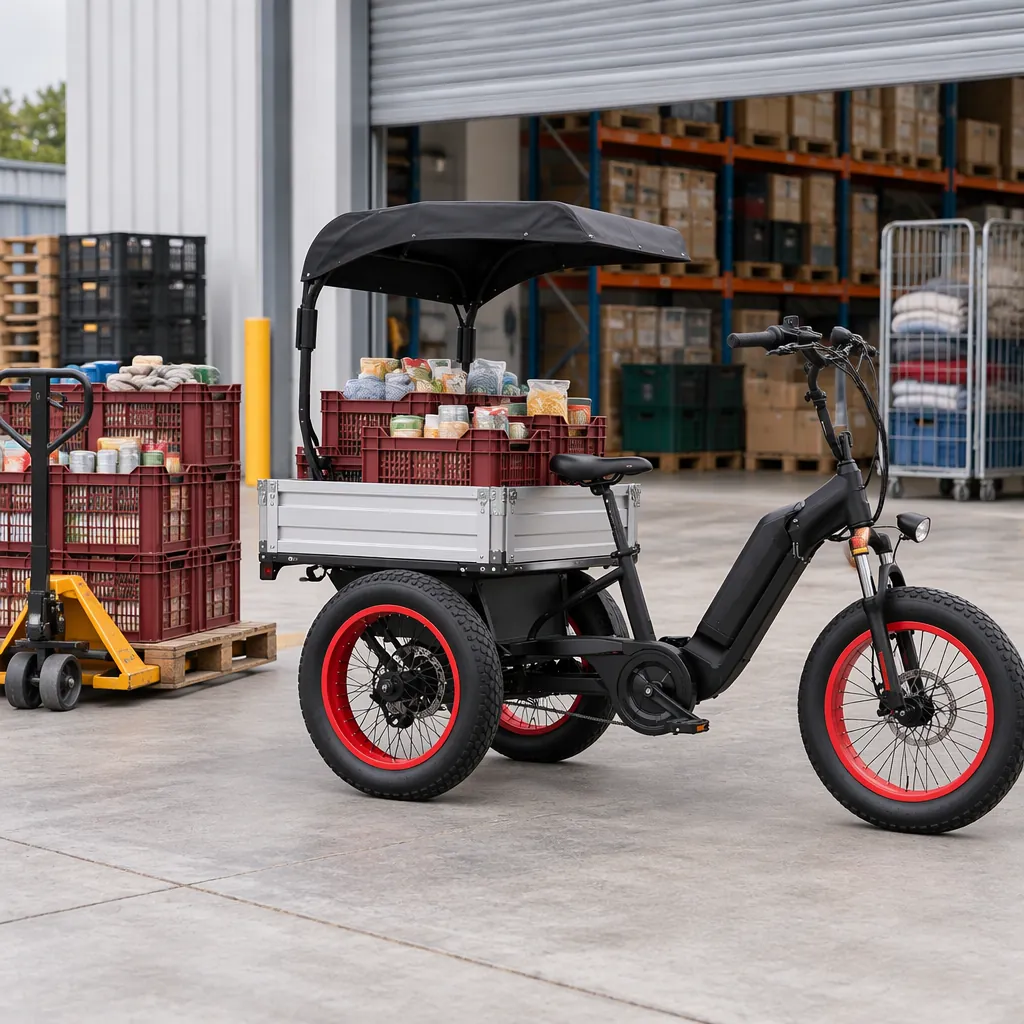
The cargo box, not the motor, is the component that decides whether a redistributing organisation can use the vehicle. The platform's box options are built as an engineering choice per order: welded aluminium sheet for corrosion resistance and weight saving, galvanised steel for impact-heavy duty, or insulated sandwich panel for cold-chain food. Configurations run from a fixed flatbed with stake sides through a three-way drop-side body that converts to a flatbed in seconds, to a hydraulic tipper.
For a food bank the three-way drop-side body is usually the right default, for a reason that has nothing to do with food. Roughly half of what a community redistribution operation moves is not product at all: it is crates, pallets, collection bins, folding tables for a pop-up pantry, and the occasional donated appliance. A body that converts to a flatbed in seconds handles all of it, while a fixed insulated box handles only the food and forces a second vehicle for everything else.
Where the circuit is genuinely chilled end to end, the insulated sandwich panel is worth its weight, but it should be specified with the hand-out points in mind: side access at working height matters more than total volume, because the last leg is usually a volunteer carrying crates through a community centre door.
Volunteer Operation, Insurance and the Handover Sheet
A vehicle shared by fifteen people needs a handover procedure, not a briefing. The three items that cause the most charitable fleet incidents are all load-related and all preventable with a printed sheet kept in the vehicle:
- Load distribution, not load weight. The rear axle pair is the load path, and the steel tube chassis with a load-rated 3.00-12 front and 3.75-12 dual rear is engineered for a centred load. Crates pushed to one corner turn a stable delta platform into an asymmetric one on the first tight turn.
- The parked state. Hydraulic disc front brakes with dual drums at the rear and a dedicated parking brake exist for a reason: volunteers park on slopes, at kerbs and on ramps. A vehicle without a parking brake should not be on a charitable shortlist.
- The reverse habit. A forward / neutral / reverse selector with a walking-pace reverse is what makes tight yards and narrow service entrances safe with a spotter. It also removes the single most common source of low-speed damage on shared vehicles.
Insurance and registration follow the same logic as any other commercial light vehicle, and the classification depends on the market rather than the charity. Speed-limited configurations at 25 km/h sit in a different regulatory class from units governed to 35 or 40 km/h, and the speed governor is a factory setting rather than a purchase-time option. For a volunteer-driven fleet the slower setting is almost always correct: it widens the driver pool, it reduces the insurance conversation to a formality, and a redistribution circuit is a stop-start duty cycle where top speed contributes nothing to throughput.
Grant Funding: Writing the Vehicle Into the Tender
Charitable vehicle purchases are usually funded by grant, and grant assessors read specifications differently from fleet managers. Three framing choices materially improve the odds of an award.
Cost per collected kilogram, not purchase price. A cargo platform at a $1,250–1,550 FOB entry tier for the standard build, rising through $1,580–1,880 and $1,880–2,250 for heavier and more specialised configurations, is compared by assessors against a van's not just on capital cost but on running cost per kilogram redistributed. A trike's advantage is that its charging cost and maintenance exposure are small and predictable, which is exactly the profile a grant wants: no large annual line item that has to be re-funded every year.
Volunteer hours unlocked, not vehicles purchased. A grant that funds a vehicle enabling twelve additional volunteers to drive is a stronger proposition than one that funds a vehicle replacing a paid driver. This is the single most persuasive argument for a speed-limited, step-through platform, and it belongs in the application, not only in the specification.
Replicability. Assessors fund programmes that can be copied by other organisations. A written circuit specification — the four measurements, the box configuration, the charge pattern — is a deliverable in its own right and costs nothing to produce.
For the procurement mechanics that a grant-funded purchase still has to satisfy, the fleet financing guide covers payment terms and staged purchases, and the public fleet guide covers the documentation set that public and grant-funded buyers are typically asked to produce.
What the First Container Should Contain
A 50-unit MOQ is meaningless to an organisation buying three vehicles, which is why most charitable purchases go through a distributor or a shared procurement consortium rather than direct. Where an organisation does buy direct, the first order is usually structured as a small pilot: two or three vehicles on the standard configuration, one spare parts kit, and a written agreement that the box configuration is proven on the pilot before any further units are ordered.
Standard lead time is 15–30 days, extending to 30–45 days for a first custom-branded or custom-boxed run, and pre-production samples ship before mass production. For a pilot, the sample stage is the deliverable that matters: it is the only point at which a 1.2 m box can be test-loaded against a 1.1 m fire door before the organisation has committed its grant.
Spare parts deserve a line in the pilot agreement for a reason specific to charitable fleets. A vehicle that is off the road for three weeks waiting for a tyre in a size nobody stocks locally has a worse availability record than the van it replaced, whatever its theoretical reliability. The tyre specification (3.00-12 front, 3.75-12 dual rear) should be written into the supply agreement with a commitment on continued availability, and the parts guide in the after-sales and spare parts guide sets out what a first-year kit should contain.
Frequently Asked Questions
Can a cargo e-tricycle replace a van for a food bank?
It can replace the vehicle, not the van's role. A trike rated 300 kg (EU) / 500 kg (non-EU) with a 150–500L box handles the majority of community redistribution circuits, which are short, repeated and split across many points. It cannot replace a van for long-haul collection runs or bulk ambient moves, and most organisations that switch successfully keep one larger vehicle for those and add two trikes for the circuit work.
How much cold chain can it actually hold?
The insulated sandwich-panel box option exists specifically for cold-chain food, but the design principle is time-based rather than temperature-holding. Shorter loops and depot returns between clusters reduce the minutes each donation spends in the box, which is the variable that matters for food safety. Organisations moving frozen product exclusively should treat the trike as a first-leg vehicle to a cold store, not as a mobile freezer.
What does a volunteer need in order to drive one?
A speed-limited configuration governed to 25 km/h widens the driver pool considerably, and the forward / neutral / reverse selector with a walking-pace reverse makes yard manoeuvring safe with a spotter. The practical requirement is a handover sheet covering load distribution, the parking brake and the charging plug, plus a rule that the vehicle goes back on charge at the end of every shift.
What should be in the first order?
Two or three vehicles on a standard configuration, a spare parts kit with the tyres and brake consumables that the circuit will actually wear, and a pre-production sample stage before mass production so the box can be tested against real doors and ramps. Standard lead time is 15–30 days, extending to 30–45 days for a first custom run.
Related Reading
The circuit-planning arithmetic in this guide builds on the cold storage and food distribution centre guide, which covers temperature-gate operation inside a purpose-built facility. For organisations whose redistribution work overlaps public health outreach, the community health outreach guide covers the documentation and cold-chain box requirements for publicly funded fleets. Payload decisions should be taken against the payload capacity guide, which separates the headline number from the axle and tyre limits underneath it. Where a circuit mixes chilled and ambient product across the same vehicle, the cold chain guide sets out the temperature-class split. And for the first purchase in any new market, the used tricycle buying guide explains why a second-hand platform is usually the wrong place for a grant-funded fleet to start.
Spec a Redistribution Circuit, Not a Vehicle
Tell us your circuit length, peak single donation weight and temperature mix. We will size the payload class, box configuration and charge pattern against your actual route, and quote the pilot quantity.
