
Public health does not fail at the clinic door, it fails in the last kilometer. In rural districts, peri-urban settlements and disaster zones, a four-wheeled clinical van is too expensive, too heavy for washed-out tracks, and too conspicuous for low-trust environments. An electric cargo tricycle closes that gap. It runs on a fraction of the fuel, climbs tracks a car cannot, and carries the three things outreach work depends on: an insulated cold box, a small diagnostic or vaccine kit, and a single operator who can reach villages a van never schedules. This guide covers what to specify in an outreach e-tricycle, the cold-chain build that protects the cargo, and how to buy a community-health fleet as an NGO or government program.
Why Outreach Routes Need a Tricycle, Not a Van
Community health work is a series of short, dispersed trips rather than one long haul. A vaccination drive visits fifteen villages in a week, each a 2–6 km hop off a dirt track; a nutrition or maternal-health team delivers supplements door to door; a disaster-response project forwards supplies from a distribution hub to a temporary camp. The economics that make this work are the same discipline behind any delivery fleet. The per-kilometer cost model is set out in our cargo e-bike and e-tricycle fleet guide.
The numbers that matter: an electric cargo tricycle runs on roughly $0.30–0.60 of electricity per 100 km against $10–14 of fuel for a small clinical van, and a 300–500 kg payload unit prices at $1,250–2,250 FOB depending on the motor tier, about one-tenth the cost of a basic mobile clinic vehicle. That gap lets an NGO buy five outreach trikes for the price of one van and reach five times as many villages on the same operating budget.
The Electric Spec That Carries a Cold Chain
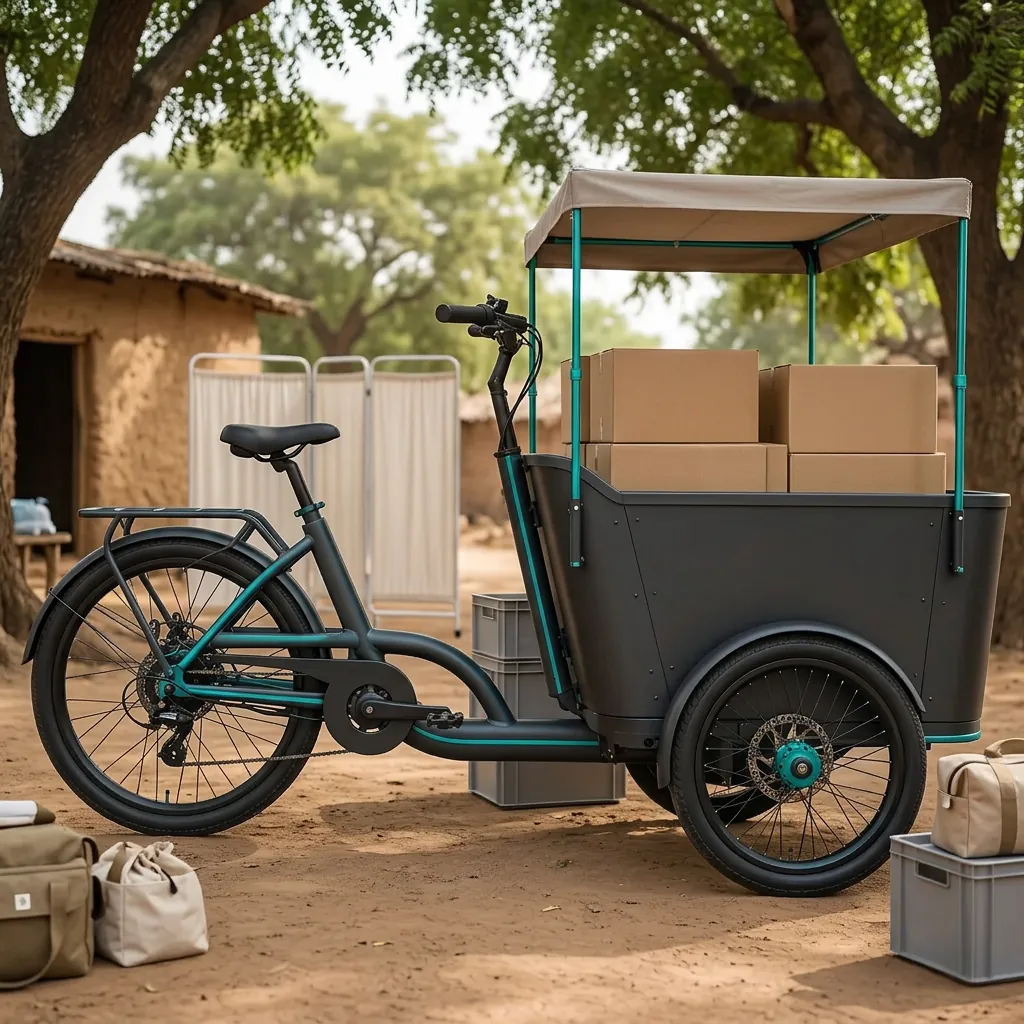
An outreach trike is a front-loader: one rear wheel and two front wheels with the cargo box carried low between them, so the payload sits ahead of the rider and keeps the loaded center of gravity stable on a crowned track. The real product specification that matters for health work is the motor, battery and charger package:
- Motor: 800W, 1000W or 1200W brushless hub with a differential drive, on a 60V or 72V system. The 1000W standard tier is the common outreach choice, enough to carry a loaded box up a long rural grade without draining the battery early.
- Battery: 60V 32Ah (NMC) or 72V 40Ah lithium, with LFP available. LFP is the pick for tropical field work. It runs cooler and survives more full cycles, which matters for a program charging off a generator or a weak grid.
- Range: 50–80 km loaded at 200 kg on flat terrain, tiered 50–60 / 60–70 / 70–80 km as the motor and battery move up. That is a full outreach morning before returning to a depot for the afternoon run. The charging and swap discipline for that cycle is in our fleet charging guide.
- Speed: 25–35 km/h, which keeps it under most Class 2 low-speed thresholds and classifies it as a low-speed appliance on many routes rather than a full motor vehicle.
- Charging: 6–10 hours on the 5A charger, an overnight top-up on depot power.
For a cold-chain payload, the battery chemistry and the range trade-off are covered in our battery technology guide.
The Cold-Chain Box and Insulated Cargo Bed
The medical payload is only as good as the box that carries it. A cargo tricycle bed comes in 150–500 L with a choice of aluminum or steel walls and drop-sides; for health work the specification to ask for is the optional insulated lining, which turns the bed into a passive cold chamber that holds a narrow 2–8°C band across a 2–4 hour rural run. Four non-negotiables for the cold-chain build:
- Insulated lining: sealed panels with a real R-value, not a plastic tub, sized to the vaccine cold-box or cooler you run.
- Vibration control: a grooved, padded floor and a load rating that keeps the box from shifting in a corner. This is where suspension and tire rating matter most.
- Temperature monitoring: a data logger or a min-max thermometer so a team can log the cold chain for audit.
- Active or passive box: a passive liner with ice packs needs no power, which is the default for rural work; an active thermoelectric box draws from the trike's main battery. The deeper cold-chain engineering order is set out in our cold-chain delivery guide.
Terrain, Stability and Load Rating
Rural routes are defined by what they lack: pavement, width, and drainage. The three-wheel footprint keeps a loaded trike upright on a crown and on a slope without the balance burden a two-wheeler carries with a heavy box. The load rating itself is tiered, 300 kg in the EU configuration and 500 kg in the non-EU build, which is the number to quote in a request for tender. The payload engineering behind that rating, tires, brakes and frame, is in our payload capacity guide, and the tire tread that handles mud and gravel rather than only tarmac is in the tire guide.
Two details quietly decide whether an outreach trike survives its route: the parking brake and the reverse gear. A loaded 500 kg trike must hold on the worst grade on the circuit. The hydraulic disc front with dual drum rear and a parking brake is the standard package. The forward / neutral / reverse selector with a 3-speed lets a single operator back the box into a village clearing or a camp gate without a spotter. The stability and brake engineering behind that is in our safety features guide.
Certification and Documentation for a Public-Health Fleet
Government and NGO procurement usually demands documentation that is harder to waive than a private buyer. The vehicle needs a recognized electrical-safety certification, UL 2849 in the US, EN 15194 plus EN 50604 in the EU, and UN 38.3 for the lithium battery in transport. The US and EU certification paths are compared in our EU vs US certification guide. Procurement teams should also demand the factory test data: brake stop distance from top speed, grade-hold with the parking brake, and the payload-rating certificate. What to request in that documentation is in our OEM buying guide.
Range and Charging for a Full Outreach Day
Plan the day around a charging window. A 60–80 km flat-terrain range matches a cluster of village visits before a return leg; a top speed of 25–35 km/h and a 6–10 hour charge mean an overnight depot charge covers a single daily circuit. Programs running two shifts should either carry a spare pack or specify the swap-ready battery tray. The fleet-charging and swap economics are in our fleet charging guide.
Buying an Outreach Fleet as a Program
A public-health fleet is bought like any vehicle program, but the acceptance test is stricter because lives depend on the cold chain. For a container order, plan a sample phase of one or two units and run a real, dated cold-chain route: load the box, run the actual village circuit, and check that the liner holds temperature for the full loop, that the parking brake holds the loaded trike on the worst grade on the route, and that the range survives an unplanned detour. MOQ for assembled units is typically 50, or 100 with full program-specific color and clinic livery. The container-planning math for a first order is in our importing electric tricycles from China guide, and how programs structure the capital is in our fleet financing guide.
Spec an Outreach Cargo Tricycle
Tell us your routes, cold-chain payload and procurement needs. We will quote the 800W–1200W cargo tricycle line with rated cold boxes, clinic livery, and container pricing, FOB China.
